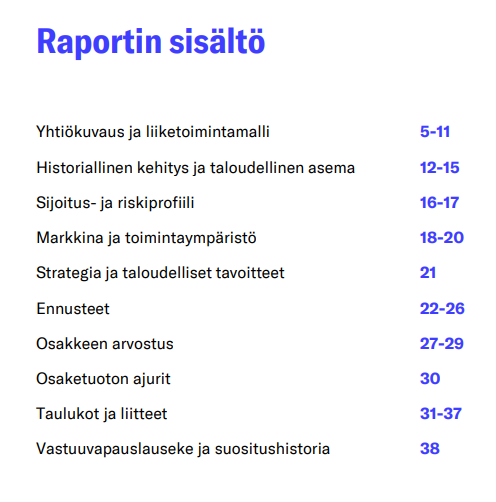
Here is a comprehensive report on HK Food by Pauli Lohi, like other extensive reports, it is available for everyone to read. If HK or other companies in the industry interest you, it’s worth reading - you can gain a lot of general information about the industry from it.
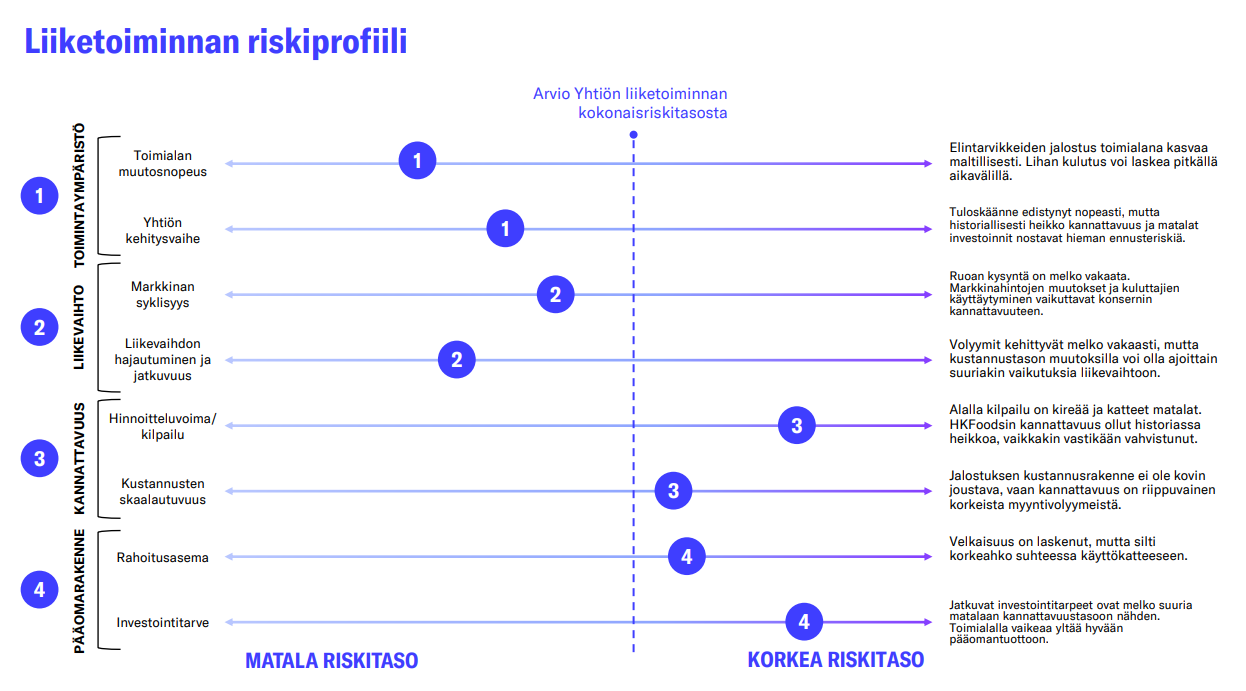
In recent years, HKFoods has achieved an impressive turnaround in results, supported by, among other things, the strengthening of its investment capacity through the divestment of operations outside Finland. Although, in our estimation, the largest increase in profitability is already behind us, we believe the company still has the potential for a moderate increase in profitability, which makes the valuation appear relatively inexpensive. If profitability were to rise to the level of its main competitors, the stock would have significant upside potential. On the other hand, relatively high indebtedness and historical challenges in profitability raise the stock’s risk level compared to the average for a defensive industry. We reiterate our ‘add’ recommendation and a target price of 1.70 euros.
In the long term, HKFoods’ businesses have the potential to be defensive and dividend-paying, albeit with a mediocre return on capital. The reduction in red meat consumption is slow, and the consumption of poultry and more processed foods is growing, so in the long term, we assume market growth will be close to general GDP growth. The meat industry and the food sector in general are competitive and capital-intensive industries where it is difficult to sustainably achieve a return on invested capital that exceeds the required rate of return. On the other hand, in the short term, we see HKFoods as a turnaround company whose realization of earnings potential could support the stock price development.
Here are Pauli’s comments on how the Baltic contingent additional purchase price does not seem to materialize now.
In our view, the weakening outlook for the contingent purchase price receivable has a small negative impact on the fair value of the share (written-down receivable 5% of the share price). We will calculate cash flow forecasts related to the receivable at the latest in connection with the Q3 report. However, the write-down does not cause an immediate need for a recommendation change, as its significance for the overall equity story is small. The sale of the Baltic businesses still seems to us a successful measure, as the fixed purchase price was already high in relation to the weak profitability of the sold business.
In recent days, Hkfoods has risen without a clear reason. Is this a sympathy move? Below is the AI’s answer.
A classic example of a sympathy move.
When Atria publishes better-than-expected results, investors conclude that the entire food or meat processing sector may be in the same situation: raw material prices, demand, or consumer behavior may also benefit HKFoods (HKScan).
Even if HK has not yet published its own results, the market prices in advance the possible positive development — which is why its share price rises “without its own news”.
HKFoods reported its Q3 interim report today, which was largely in line with our forecasts regarding operating profit. Revenue was lower than expected as lower-margin segments contracted. Net profit was surprisingly strong, influenced by lower-than-forecast net financial expenses and taxes. Overall, we consider the report to be quite neutral relative to expectations, unless other key points of note emerge at the company’s 10 AM press conference.
00:00 Start
00:14 “Good performance in Q3”
01:09 Retail and Foodservice market
02:19 Impact of nutritional recommendations on demand
02:47 Increased price of beef weighed on profitability
04:25 Tariffs imposed by China on pork
05:58 Impact of pork oversupply on the Finnish market
06:32 Focus areas of the new strategy
08:10 Increase in operating profit target
Pauli “Ora et labora” Lohi, as a diligent fellow, has already prepared a company report.
A largely unsurprising Q3 report led to moderate positive forecast changes, mainly due to a decrease in financing costs. We see the operational turnaround continuing, albeit at a more moderate pace than before, which, together with the gradual normalization of financing costs, rapidly lowers valuation multiples. We reiterate our Add recommendation and raise the target price to EUR 1.80 (previously EUR 1.70).
Quoted from the report:
Potential to become a defensive dividend company
In the long term, HKFoods’ businesses have the potential to become defensive and dividend-paying, albeit with mediocre capital returns. The reduction in red meat consumption is slow, and the consumption of poultry and more processed foods is growing, so in the long term, we assume market growth will be close to general GDP growth. The meat industry and the food sector in general are competitive and capital-intensive industries where it is difficult to sustainably achieve returns on invested capital that exceed the required rate of return. On the other hand, in the short term, we see HKFoods as a turnaround company, whose earnings potential realization could support share price development.
For the fourth quarter, there probably won’t be any write-downs related to international business operations anymore, so the full-year result might already be clearly positive, assuming the positive earnings momentum continues. In 2024, the fourth quarter’s operating profit was approximately 29% of the full year’s operating profit, and in 2023, about 21.7%. Q4 2023 is probably a somewhat poor comparison point, because at that time, more international units were still part of the group. If we now use that relative share of Q4/2024 operating profit as a base value, then 71% of the full year’s operating profit would have accumulated by 1-9/2025, and thus, with this calculation method, the operating profit for the last quarter would be approximately 8.9 million euros: (21.8 / 0.71) - 21.8 = 8.9.
I was wondering that since -2.7 million euros of the 1-9/2025 fiscal year result is attributable to the parent company’s owners (of which -0.4 million euros is from the third quarter), and +2.1 million euros to non-controlling interests, how might that affect the investment calculations of larger investor entities (institutions and whatever else there is)? If it does affect, it might still keep some investors away from HKFoods’ stock, because the parent company’s owners are still incurring losses from the operations. Of course, I don’t know the accounting principles of the investment world, so this was more of a random chatterer’s musings aloud.