Is there ultimately a use for nuclear heat when the greatest demand is concentrated in only part of the year? Heat can already be stored and cheaper electricity can be utilized, for instance?
Otherwise, heat produced by means other than electricity would be important, as it would shave off the worst consumption peaks during severe cold spells.
To me, it seems strange that small modular reactors would be riskier compared to large nuclear power plants. Hasn’t Olkiluoto been the only large nuclear power plant project built in Europe in the last 20 years, and the project’s schedule and costs ballooned many times over..
A huge amount of talk about these mini-reactors etc., but very few facts are known. Perhaps speculation about them should be left until the next decade.
In Scandinavia, the plant configuration should definitely be CHP (Combined Heat and Power) with an integrated condensing tail. This ensures the best efficiency and the option for maximum electricity production.
EDF just announced that the price tag for the nuclear power plant under construction in Britain is already nearly doubling from the original, now €40bn! What private company can take on things like that anymore?
It feels somewhat strange that people are worried about the drop in electricity prices. The price of electricity is still higher than it has been in years, and based on my own reasoning, we are slowly returning to “normal level” prices—specifically the levels at which electricity companies have previously made significant profits. As far as I understand, production costs haven’t gone up, and since domestic production has increased, I believe the share of exports should also grow, especially as domestic consumption also appears to have decreased slightly.
I don’t doubt for a second that electricity companies will continue to generate good results.
Fortum, likely like other power companies, hedges a portion of its electricity production in advance. Futures were at higher levels last year, and prices locked in accordingly could provide an advantage for the next two years if spot prices were otherwise lower. As far as I know, the hedged proportion is not publicly known.
Variable costs are not a risk in the same way they are for thermal power plants, as production relies on nuclear and hydropower. Production costs for these are quite well known. The switch to Western nuclear fuel and its ultimate impact on production costs remains a question mark?
p. 23 outlook
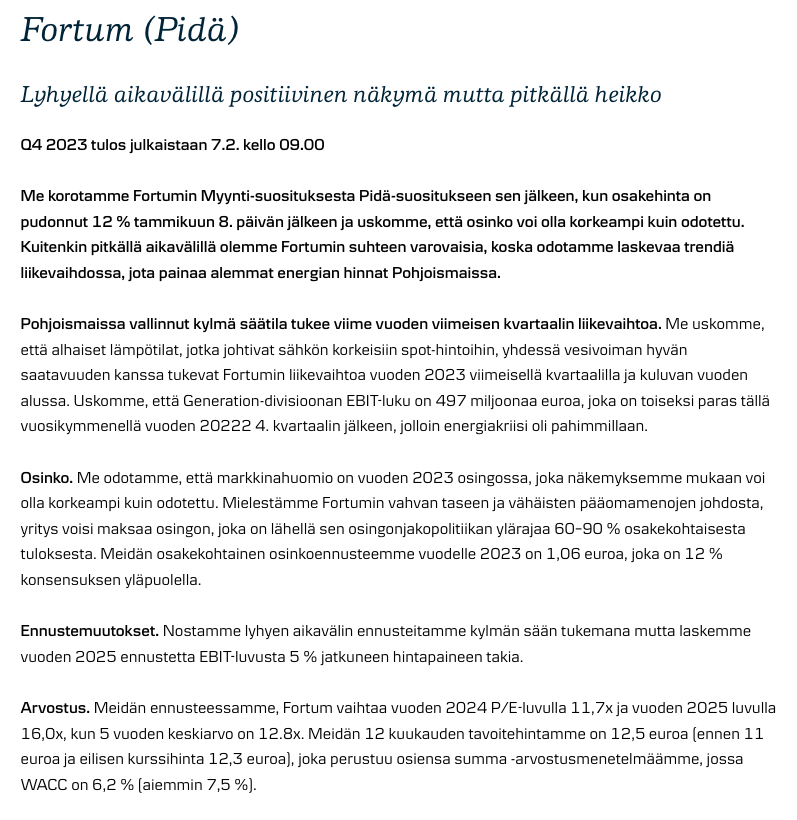
“At the end of September 2023, approximately 75% of the Generation segment’s estimated wholesale electricity sales in the Nordics were hedged at a price of EUR 50/MWh for the remainder of 2023, approximately 65% at EUR 47/MWh for 2024 (at the end of the second quarter of 2023: 50% at EUR 46/MWh) and approximately 30% at EUR 43/MWh for 2025. Reported hedge ratios are based on the Generation segment’s hedges and power generation forecasts.”
I’ll add to this that Fortum’s strategy includes entering into long-term contracts with industry, among others. It’s been less than a week since a 13-year fixed-price agreement with the Norwegian aluminum and renewable energy producer Hydro Energi AS was highlighted here. And those electricity price hedges haven’t really collapsed significantly from current levels for 2025: 50€/MWh → 43€/MWh. That hedging ratio will surely increase during the current year.
In many analyses, the investment case for Fortum is based on its assets being currently undervalued compared to peers, which is quite strange in itself given that the production is Nordic renewable energy. Nuclear power and hydropower. The former works perfectly for these long-term fixed-price contracts = reliable, steady returns, and as I understand it, hydropower is particularly beneficial during times of high electricity prices.
If you get nearly a 10% dividend yield from this and there’s some upside in terms of asset valuation, say ~20%?, then this is a very decent stock for my own portfolio at prices of 10-12€. Steady returns where the downside seems quite limited in my own reflections.
Still, it’s a drop of over ten percent. Even though production costs don’t change much for things like hydropower, interest expenses and other costs have been on an upward trend. This definitely shows up in the results through leverage, and that’s what the market is pricing in.
You can certainly get a reasonable return at the current price, but if you’re looking for thrills and alpha, I don’t know if this is the best company for that. It’s one of the largest and most followed companies on the exchange, and now that the company is a relatively pure-play energy producer in stable markets, predictability is at a good level. There’s no point in expecting occasional risk premiums or overreactions regarding things like Russian operations anymore.
In other words, I wouldn’t say this is the company to bet against the market with. It’s a bit like how Nokia has been “set to rise” for the last ten years, with the market supposedly being wrong the whole time
Does Posiva own the disposed nuclear waste? Could it have some value at some point?
Fortum’s credit rating is currently BBB; the next notch down is starting to be junk bond status. Could the rating improve, providing upside in the form of cheaper financing?
As I understand it, Posiva owns the waste destined for final disposal.
Posiva Oy, in turn, is a joint venture owned by Fortum and Teollisuuden Voima (of which Fortum is also one of the owners), which disposes of its owners’ nuclear waste. So, through this, Fortum retains ownership of the waste, even though it will eventually be transferred to the care of the “subsidiary” Posiva.
There is still a huge amount of energy left in the waste to be disposed of; as I understand it, fuel rods are not “run to empty,” but rather they are removed from the reactor when the efficiency derived from them drops low enough.
To my knowledge, there have been at least theoretical attempts globally to develop nuclear power plants similar to molten salt reactors, where the fuel and the radioactive isotopes produced from it could be utilized almost to completion, in which case very little waste would be generated and the energy would be recovered. At least I remember seeing some university-level theories in the news a few years ago.
With a quick Google search:
(Both articles are behind a paywall)
It is quite possible that during the next 100 years, while Posiva is disposing of these canisters into the bedrock, a commercially viable reactor type may already emerge that could utilize them. Although, there is much more easily accessible fuel available in the world than copper canisters buried in the bedrock of Eurajoki…
That is how it is for now at least, but as I understand it, the uranium market is surprisingly tight if demand were to increase suddenly. If the price of uranium rises, alternatives (e.g., recycled fuels) would become more competitive.
Edit: That HS article was really interesting. It’s a fascinating prospect that at some point, that nuclear waste might not be waste anymore, if we could still cost-effectively extract tens of times more energy from it.
This is just complete sandbox-level speculation, I don’t understand anything about this, so I’d love for smarter folks to shed some light on whether nuclear waste has any potential for hidden value
A short summary of the link: Recycling becomes economically viable with existing technologies when the price of uranium (inflation-adjusted to today) permanently exceeds about $200/lb. Considering known reserves, this will take about a thousand years.
Edit: Recycling could be done, and is done, for reasons other than economic ones, even though processing nuclear waste is much riskier than burying it in the ground. The value of nuclear waste is still negative.