I don’t believe in a giant power plant like OL3 or any other smaller prototype solution, but a relatively large one in the roughly 1300MW class could be possible and sensible. There would still be room in Finland, though…
In my view, the timeline for the widespread adoption of small power plants is uncertain.
Personally, I see small-scale nuclear power as a suitable product for the consumer and SME sectors for electricity and potentially heating/cooling. However, for example, Outokumpu is exploring new nuclear power together with Fortum. Outokumpu requires a massive amount of energy, and hopefully an even larger amount of even cleaner energy in the future. For this purpose, small modular reactors might not be the solution. Unless, of course, building several small nuclear plants is seen as a good solution.
Both Fortum and Outokumpu seem to have money burning a hole in their pockets, and such an investment would actually be sensible from all points of view. Especially if the political climate can be brought to support it.
I personally believe that financing for even a large project can be found. Fortum and Outokumpu have a clear interest. Additionally, Helen and numerous other small power companies would likely join in. Looking at UPM Energy’s key figures, I don’t believe they will remain as mere bystanders either, and they might raise double the funds from their partners through Pohjolan Voima. Pension insurance companies would likely be involved as well, either through PV (Pohjolan Voima) or other routes. Of course, PV may have the goal of proceeding with the OL4 project via TVO, which could detach them from the Fortum and Outokumpu consortium.
Let’s hope for the best. It would be in the interest of the entire country if electricity production did not depend on whether the sun shines or the wind blows.
Yep. And production isn’t, only the price is. We haven’t been anywhere near running out of electricity even once. But there has been significant concern about it, and that has reflected in prices based on incorrect forecasts.
It’s not just dependent on that, though. But it certainly is in the nation’s interest that we get emission-free and raw-material-free energy from wind and sun, where we aren’t on the leash of Russia or anyone else. Thanks to that, we didn’t face a total catastrophe when the war started. And within 2 years, we will get 800 MW more effective wind energy (2,500 MW maximum capacity).
But that alone is not enough; there is full consensus on that. The war scuttled one nuclear power plant project and another was scuttled by the endlessly expensive and poorly executed OL3 project. The permits had already been granted. Now we should consider how to balance supply and demand in the coming years. New nuclear power easily takes 10+ years, so it won’t be a solution for a long time yet. We probably need a broad palette of different solutions involving batteries, pumped storage, more flexible demand, and balancing power (e.g., co-generation), and likely many things I know nothing about. Hopefully, Fortum is on the ball and involved across the board.
The essential thing is to get producer-investors and consumer-investors to the same table and search for suitable market-based projects. Projects will not move forward if both sides are waiting for the other’s moves. One party is waiting for prices to rise, while the other waits for them to fall. For instance, a larger nuclear power plant will not happen without consumer-investors who commit to the project.
I see the role of the state as an enabler (permitting policy for both production and consumption), but in my opinion, massive financial subsidies are not the solution. As a major player in Finland, Fortum has a key role as a producer with the capacity to implement large-scale plants in the first place.
It is probably necessary to clarify what is meant by excess return. Perfectly efficient markets result in no excess return, i.e., no deviation from the theoretical optimum. In the long run, the spread between production costs and the spot price is always smaller than the spread between production costs and the hedged price. This is why Fortum wants to sell capacity at a price that includes a premium relative to the spot price. It probably also suits their production mix better technically.
Although Kemijoki Oy decided not to proceed with its dam project, speculation arose today as to whether the government could subsidize the project to make it more profitable. Fortum is an owner of Kemijoki Oy with a stake of just under 30% of the total shares. The largest owner is the state, with an approximately 50% stake.
THE GOVERNMENT is still considering supporting the Kemijoki Sierilä dam project with tens of millions of euros. Kemijoki Oy’s board announced a week ago that the controversial project, which has seen its costs balloon, would be abandoned.
Now it seems that within Petteri Orpo’s (NCP) government—which has profiled itself through the protection of flowing waters—there is at least consideration of bringing the Sierilä project back to life in one way or another.
I beg to differ. If so-called sufficient transmission capacity were built, Germany would take the electricity that would otherwise have been sold from Norway or Sweden to Finland.
I thought I’d post this news here, even though it’s only indirectly related to Fortum. Fortum is, after all, Outokumpu’s partner for the small nuclear power plant project.
Planning has, at least to a small extent, turned into action.
Here is more reassuring information regarding fuel adequacy and security of supply: Fortum’s report to the Ministry of Economic Affairs and Employment (TEM) regarding fuel sufficiency. A test batch produced by Westinghouse has already been loaded into the reactor since the summer of 2023. The process is likely already quite far along:
"Fortum has entered into agreements for the procurement and enrichment of uranium with Western suppliers for the fuel manufactured by Westinghouse. An ESG audit has been performed on the uranium producer to ensure that the producer properly takes environmental and human rights aspects into account in its production.
The agreements described above, as well as the fresh fuel storage in Loviisa, ensure Loviisa’s fuel supply for several years."
There is likely a significant amount of unused fuel in storage, clearly acquired well before Putin’s invasion of Ukraine.
It would be interesting to see profitability calculations for these various projects at some point.
Energy companies rarely seem to produce revolutionary technological inventions that would also lead to improved competitiveness (which, in turn, would be reflected in a higher return on capital than the industry average).
At least Fortum thinks these things through; it feels like many companies spray investments around more based on gut feeling. It’s hard to believe Fortum will come up with any truly great investment targets (now that those previous billions have been wasted in Russia and Uniper, Fortum could certainly start on something like Olkiluoto 4, given the desire for stable power generation. A 15-year timeline and a cost of 10 billion—surely that would meet the expected return )
These initiatives originate from the old Ekokem, which was an excellent company. On Fortum’s scale, such projects have little to no impact on the group’s figures; they are essentially rounding errors. On Ekokem’s scale, however, this is an interesting move. By the way, Ekokem is for sale, as it is no longer part of Fortum’s core operations.
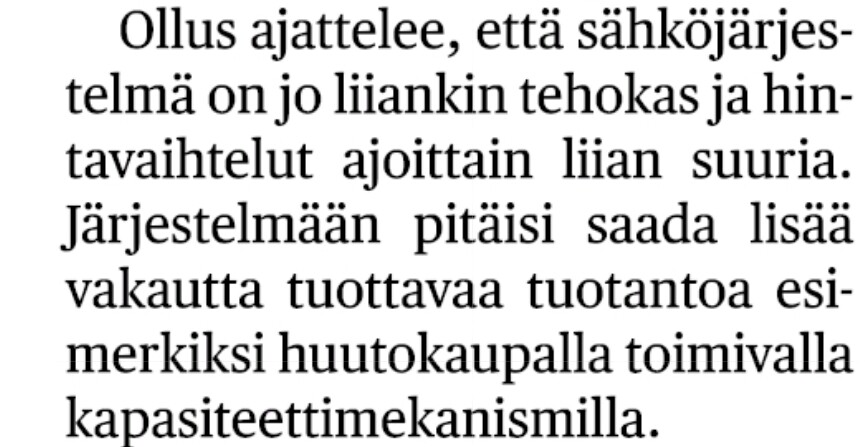

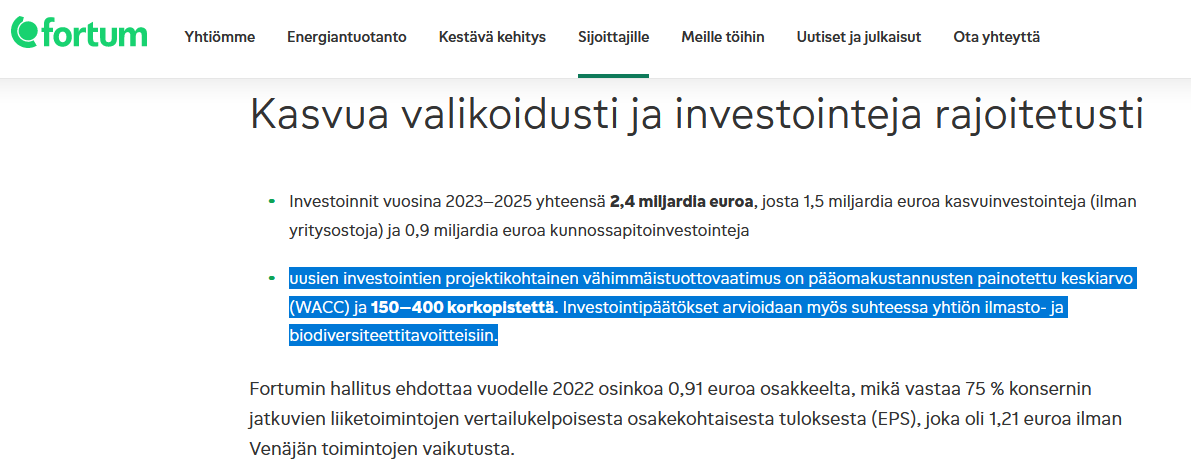
 )
)