Financial sector as an investment

Kauppalehti reported yesterday on a rather surprising transaction, as the OP-Metsänomistaja fund sold over 10,000 hectares of forest to Tornator (the article is at least currently free to read):

The sold forest corresponds to about an 8% share of the fund’s forest surface area, and estimated at average prices, the purchase price is somewhere in the region of 35 million euros. With these assumptions, the fund sold about 6% of its investment assets in this single transaction. An added twist to the deal is that the same fund owns 19.69% of the buyer’s, i.e., Tornator’s, shares.

One cannot avoid the thought that a wave of redemptions has already hit forest funds as well, and this transaction was made to prepare for the payment of future redemptions. According to the fund’s semi-annual report, the fund had nearly 22 million euros in cash at the end of June, and after this transaction, the amount could be in the range of 60 million euros, or 10% of the fund’s value:

https://www.op-mediapankki.fi/l/6dcWKxcKbmv7

Information on the OP-Metsänomistaja fund can be found starting from page 400 of the PDF. The fund also has Tornator shares available for sale if needed, with a balance sheet value of 112 million euros, but are there buyers at the balance sheet value?

19 Likes

Sale and Kassu have written some good comments regarding the asset managers’ year 2025 :slight_smile:

The stock market year is approaching its end, and after the Q3 season, we are starting to have a fairly good picture of how the year went for asset managers. In the big picture, the market environment has been very favorable for asset managers during 2025. Capital markets have been on a continuous upward trend, and the recovery from the tariff mess in the spring was ultimately very rapid. Investors’ risk appetite in Finland has increased throughout the year, even though the sentiment was very cautious at the beginning of the year.

7 Likes

Sale discussed real estate funds with Hannu Huuskonen. :slight_smile:

Topics:

00:00 Intro
00:28 Hannu Huuskonen
06:14 Real estate funds
09:34 Pros
12:52 Cons
18:29 For private investors
23:35 Why did these become so popular?
28:45 Are we in a crisis?
31:13 Current situation
44:00 Closing of funds
54:02 Volume of redemptions in the queue
58:55 Duration of the crisis
01:06:35 Reputation
01:09:08 Aftermath
01:30:00 Audience question

10 Likes

Happy New Year to the thread! :tada:

Next week will be shameful once again for domestic open-ended real estate funds :clown_face: One fund after another will announce the deferral of their redemptions this week, as the majority of funds have redemption windows at the end of June and December. Typically, redemptions are paid out at these times, and redemption notices usually have to be submitted at least 6 months in advance. So, the redemptions being paid out now are largely those made in H1’25. I’ve put together a quick summary of the situation for various companies and their funds. I’m also interested in following the funds’ Q4 returns, as for several years now, more significant valuation adjustments have been made in Q4 (even though valuation reports are, of course, done 4 times a year). :clipboard:

eQ: eQ will certainly announce the deferral of redemptions for its Commercial Properties (Liikekiinteistöt) and Care Properties (Yhteiskuntakiinteistöt) funds, as both funds already have a queue of unpaid prior redemptions. eQ sold some assets from its funds during Q4, and I find it possible they will mention paying off some older redemptions. eQ also publishes expanded reports on its funds (likely not released for another couple of weeks), and these are naturally of interest. eQ Commercial Properties’ quarterly return in Q4 was -3.5%, so the pressure there continues.

Titanium: The Titanium Care Fund (Hoivarahasto) will very likely defer redemptions again, as redemptions from the previous two windows are still in the queue unpaid. The fund finally sold assets in December (https://www.inderes.fi/analyst-comments/titaniumin-hoivarahasto-myy-kohteita-35-meurlla) and logically, the fund should also be paying off old redemptions at the same time. Furthermore, we are obviously interested in seeing the discount versus book value at which those assets were sold and how large a portion of the queued redemptions the fund is able to pay. Regarding the Residential Fund (Asuntorahasto), Titanium managed to pay off the outstanding redemptions during H2 (:clap:), and it remains to be seen if they can avoid deferring redemptions now.

OP: OP does not need to announce redemption deferrals, as it slammed the funds (Rental Yield/Vuokratuotto and Service Properties/Palvelukiinteistöt) shut a year ago (no redemptions/subscriptions allowed). All outstanding redemptions have been paid off during 2025, but the fund remains locked. Logically, OP is under enormous pressure to open the fund, as the “investor interest and/or exceptional market situation” argument is working less and less effectively. I find it hard to understand how OP can justify keeping the funds closed at this point, especially since both funds have been ticking off positive quarterly returns during 2025 (if the return is positive, one would think the underlying assets could be sold at their book values?).

Ålandsbanken: Å had the questionable honor of being the first party to defer fund redemptions for its Residential Fund in autumn 2023. The fund has deferred redemptions ever since, and we will 100% certainly read about a redemption deferral this coming week as well. By the way, the value of Å’s Residential Fund has fallen by about 20% since the situation in autumn ‘23, when it was closed to “protect the interests of customers.” After a 20% drop in value and money being stuck for 2 years, many customers are surely wondering whether this solution was about protecting customer interests or taking a speculative view with the customers’ money.

As a side note, I’ll mention that Ålandsbanken also has its Wind Power Fund (Tuulirahasto) currently closed (it closed in the summer), and redemptions here will also certainly be deferred. In the Wind Power Fund, I’m following the value development with interest, as the situation for the underlying assets is difficult (as it is for all Finnish wind farms) due to low electricity prices.

S-Pankki: S-Pankki’s residential fund operates on a different cycle, so we won’t get a bulletin from them until February. S-Pankki hasn’t technically deferred redemptions, as the fund has come up with an “ingenious” way to avoid this. The fund accepts only a fraction of the redemptions in terms of euros, and the remaining redemptions are cancelled. This means those whose orders don’t go through have to submit a new redemption order. Additionally, these new redemptions always slip into the next redemption window, which kicks the can down the road. It is also questionable how well the average retail investor (the proverbial “Grandma from Pihtipudas”) understands this kind of redemption cancellation.

Evli will also likely have to defer the payment of redemptions for its Rental Yield 2 (Vuokratuotto 2) fund, as my understanding is that there are also several redemptions in the queue there.

One has to hope that the forest funds stay open; the Finnish special investment fund field doesn’t exactly need a situation right now where a forest fund has to defer redemptions. This will also be a point of suspense in Q4, as all three open-ended forest funds have a redemption window open in December. :grimacing: :evergreen_tree:

69 Likes

It’s quite surprising that no one has taken these suspensions to court.

If there is a right to temporarily suspend redemptions, at what point does it become an indefinite state?

People have money tied up in these, after all, and there should be some kind of protection for assets. Right now, there’s no sign of that.

The money, if it were available now, would probably have yielded better in a checking account than in a closed fund during this suspension period.

17 Likes

What about UB’s products? As far as I understand, their funds haven’t been closed even once yet.

3 Likes

Yes! UB, Alexandria and, as I understand it, also Aktia have been able to keep their real estate funds open throughout this entire crisis. This is a good performance, considering the difficult market situation.

Btw, a release from eQ regarding deferrals just came out. YKK is paying 40% of old redemptions, but the newest ones will go to the back of the queue. https://www.eq.fi/fi/funds/news/2026-01-05

eQ also provided rather lengthy fund-specific justifications for why this is being done: https://www.eq.fi/~/media/files/funds/eq-yhteiskuntakiinteistot/eq-yhteiskuntakiinteistöt_lunastusten-maksutilanne-ja-käsittely.pdf?la=fi

16 Likes

This would be a good thesis topic for an economist: would bankruptcy and an external receiver have been a better option for the client when involuntary insolvency struck?

Evli released an announcement today stating that redemptions for Vuokratuotto 2 are being added to the queue: https://assets.evli.com/production/Evli.com/Documents/Mutual_funds/Other_information/FI/Asiakastiedote_Evli-Vuokratuotto-II_2026_01_07_fi.pdf?dm=1767783215

I have to say, there have been surprisingly few announcements so far, considering how far into the month we are. A year ago, they came much faster. Of course, there have been holidays in between, but it does smell a bit like postponement is now “business as usual,” and they aren’t too concerned about whether it’s announced immediately or with a slight delay. In my opinion, because this is an exceptional and very significant matter, owners should be informed immediately, not with a delay. For clarity, the decision is officially made by the fund management company’s board, and only then can the postponements be announced. Most likely, the long holidays have delayed the board meetings of the fund management companies.

28 Likes

Thanks for those links, Sauli. I read eQ’s justifications for postponing redemptions. In my view, the argument for responsible selling in a situation where there are few buyers is not without merit. Delaying redemptions is obviously not ideal. However, selling properties quickly at a heavy discount wouldn’t be ideal (or risk-free) either. Either way, there will be problems.

3 Likes

If the market value of a property drops, then that is its value. It is not “at a discount” then. Nor is it overpriced when values rise.

The markets won’t normalize until this bubble bursts.

If something like Kojamo once cost 20 euros per share, how realistic is it to say that it is still a twenty-euro company when the share price is around ten?

10 Likes

I think there has been the same issue with recording assets at “market value” for both funds and real estate investment companies: in both cases, book values were marked up while the market was overheated.

Once the hype subsided, both the funds and the likes of Kojamo started claiming that the current market situation does not reflect the real value of the properties. These values had been inflated based on appraisal reports produced during the period of low interest rates.

It’s worth noting, in my view, that the rise in interest rates doesn’t seem to have had much of an impact on the values stated in the appraisal reports.

13 Likes

We can all surely agree that panic selling during a crisis, for example, is not smart (e.g., COVID or the financial crisis). In crises, liquidity typically dries up completely and prices reflect this. In the current situation, I believe the question is primarily about how long you can claim that this current situation is an exceptional state? This is not a crisis situation, but a bear market following a long bull market. There is much less trading than, for example, 3 years ago, but trading is still happening. In my opinion, current prices reflect market realities rather than some exceptional circumstance. Yes, there are fewer buyers than during the wild years, but these cycles are part of the game. For example, in Ålandsbanken’s residential fund, values have fallen by over 20% since the initial deferrals, meaning that the delay has been costly for customers (yes, I know that properties could not have been offloaded at book value back then, but surely it would have been possible to move the assets with a discount of less than 20%?).

32 Likes

I suspect it works like this: if a fund is marketing a property for 100 and the highest bid is 70, it remains at 100 on the balance sheet. They don’t write it down, and the “external” appraiser isn’t made aware of these market prices, or if they are, they don’t take them into account.

Edit:

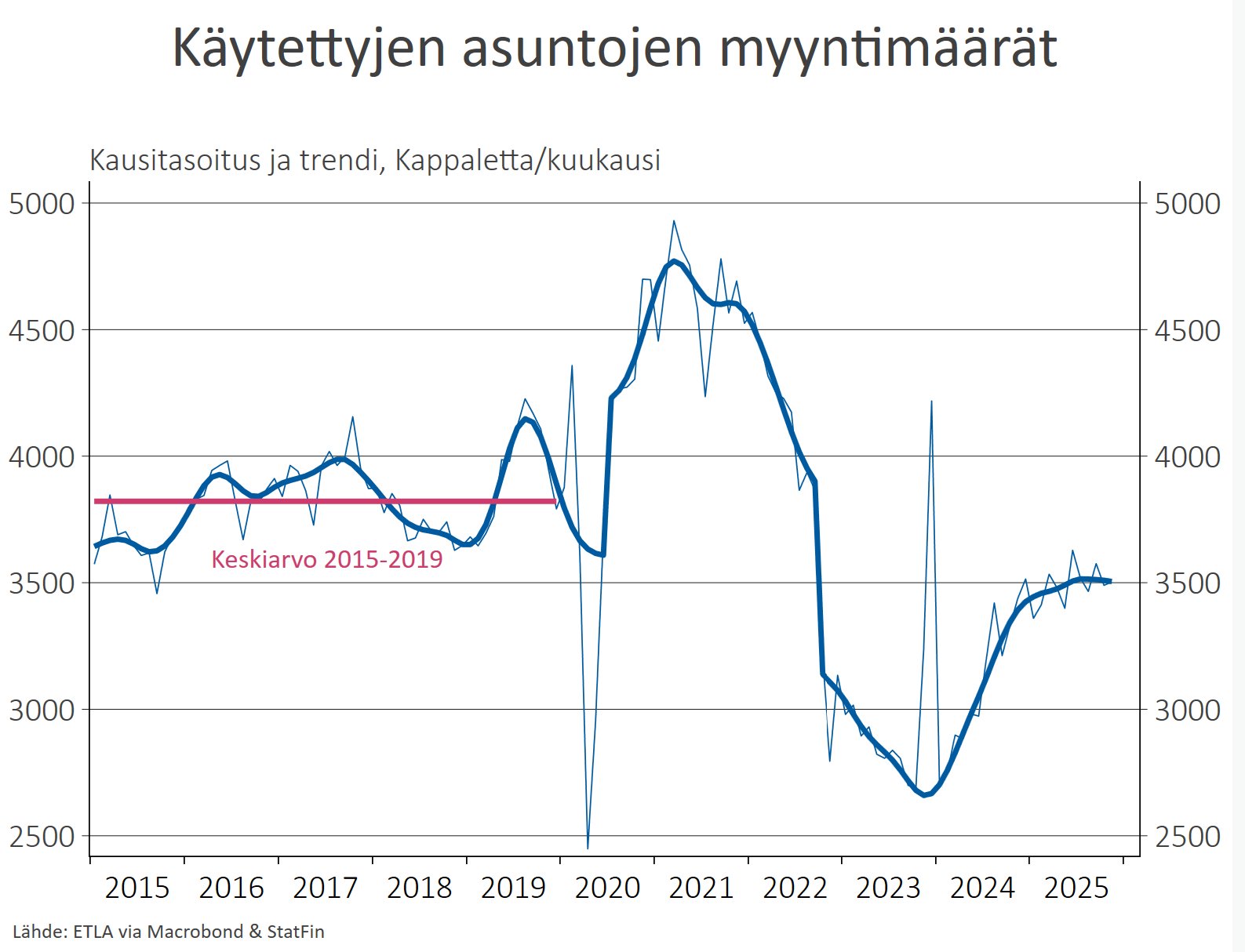
Adding a chart from Etla regarding the housing market. The situation might be worse in a year than it is now.

And currently, we aren’t far from the average.

8 Likes

Titanium has not yet issued a release regarding the deferral of redemptions. The company has always announced these in the past, and I don’t believe the company would have changed this practice. For example, at Å, an outsider has usually had to read about these in the fund’s quarterly reports, which always come with a delay of several weeks.

One must now assign some probability to the option that Titanium Hoiva would no longer have to postpone redemptions, but would instead be able to use the December transaction to pay the arrears + the current redemptions in full. This would naturally be an incredibly good thing for shareholders (and of course fund unit holders). I still consider a delay due to the holidays likely, but the probability of a positive scenario increases as the days pass :thinking:

10 Likes

Real estate funds often use leverage, i.e., debt.

If a property’s valuation is 100 and the price obtainable for it is 70, then for example with typical 20%…30% leverage, the value of the investment itself would be clearly below 70.

I can’t be bothered to calculate on my phone, but the lender certainly won’t be participating in any discount party…

1 Like

This comment might belong more in the coffee room section, but generally speaking, investors seem to have somewhat limitless trust in “external appraiser” reports. In the old days, those valuation reports could be obtained locally for a bottle of Koskenkorva from a “qualified” real estate agent; nowadays, larger players have to pay real money for them.

An external appraiser is generally aware of the current market situation and the price at which a specific asset could be liquidated at a given moment. However, they have an immense amount of leeway when preparing valuations, and they are never held responsible for a potentially incorrect estimate.

In this situation, the most natural thing is to produce a valuation report that satisfies the client/payer. Otherwise, the next valuation report will be done by another party, who will also collect the fee for the report.

9 Likes

I was a couple of hours too early; the releases from Titanium have now come out:

Regarding Hoiva, as expected, it is postponing redemptions for the turn-of-the-year window (i.e., redemptions submitted in H1’25). Hoiva is also paying out half of the oldest redemptions (those made in H1’24 and due for payment on January 1, 2025). This is an important data point. The fund sold properties for EUR 35 million in December, and assuming they do not want to increase leverage, ~EUR 25 million of that sum could be paid to investors. This would mean that H1’24 redemptions were EUR 50 million, which is the same amount we had expected all redemptions to be in total. Of course, there is some possibility that the company is leaving some room for the payout of distributions, but it is hard to spin this announcement as a positive for Titanium, and there is a clear risk that net redemptions are higher than our expectations :grimacing: I will look into this in more detail as soon as I return to work on Monday.

Regarding Asunto, the old redemptions were cleared during the autumn, but now new ones are being postponed again.

32 Likes

To wrap up the week, here’s a Q4 report from Ålandsbanken’s Residential Fund, where, unsurprisingly, they announce the continuation of deferrals. The portfolio managers’ comments are very gloomy. In previous reports, the comments were more positive. Now it says straight out that prices are not expected to rise properly until 2026. :derelict_house:

The fund is in quite a difficult situation indeed. Huge queue for redemptions, cash flow is running negative (own estimate), leverage is high (ltv 44%), and there are no clear drivers for positive returns. That leverage is awkwardly high, because a drop of just over 10% in the portfolio value would push the ltv above the allowed 50% limit. :chart_decreasing:

I did a quick back-of-the-envelope calculation that the fund paid out ~€30M in redemptions during 2025. In the 2024 annual report, they mentioned there was €68M in redemptions queued up. On top of this, of course, are the redemptions made in H2’24 and H1’25 (the worst media frenzy was in early 2025, so there have surely been more redemptions). These will be paid off until at least 2027. :people_wrestling:

The fund’s value has now dropped by nearly ~25% since redemptions were deferred just over 2 years ago. :neutral_face:

Otherwise, a rather miserable week for Finnish special investment funds, but on a positive note, forest funds haven’t reported any problems, meaning they seem to be able to handle redemptions. :+1:

35 Likes

Leverage is 44% of the self-defined balance sheet value, meaning real debt is actually over 50%

And the sluggishness of the housing market means that transaction volumes are about 300 apartments per month behind the normal level.

9 Likes