Financial sector as an investment

As I recall, that fund had redemptions frozen when the fate of the hotel investment came to light. Talouselämä or some other publication probably even wrote an article about it when a customer couldn’t get their money out.

Many of Samla’s investors are sect members, which might also affect how things proceed. Someone might also have thought that after that drop in value, it’s a good time to jump in, and that has helped manage redemptions.

1 Like

Today, many people on Aleksanterinkatu choked on their coffee when eQ boosted the transparency of its real estate funds to the next level. I believe this will have a significant impact on the entire industry, because after this eQ’s move, not increasing transparency is a conscious decision from a fund. I’ll link a comment from the eQ thread here, but let’s continue the industry-related discussion more in this thread :slight_smile:

43 Likes

A great decision from eQ and a really good reporting model! This could genuinely have a significant domino effect on the entire real estate industry if others strive for the same level. I also strongly believe that this kind of transparency is a winning choice in the long run. Of course, the performance level must also be in order, which is naturally a prerequisite in the long run, regardless of how one reports.

13 Likes

We also went through yesterday’s change in the video. In my opinion, it’s a bigger deal for the industry than for eQ itself. It will be interesting to see who takes the initiative next :spoon:

13 Likes

eQ has thus brought retail fund reporting to a similar level as where institutional fund reports have been until now, as far as I understand. They are not usually public, of course, but I don’t think that’s such a big deal otherwise in the end.

Still, other managers may now have to consider what the additional benefit of broader reporting would be (i.e., whether it affects sales) vs. cost, or if there could be other downsides. At least allegedly, it could affect, for example, the fund’s negotiating position in a sales situation, if the buyer sees precise details from public sources about what the fund has in its books and under what assumptions (i.e., at what price one could still make a profit, etc.). Or at least you hear these things sometimes. Who knows if it really matters then.

You are absolutely right that institutions, of course, do not make decisions based on a couple of pages of a brochure; they are inevitably presented with a more detailed overview of the fund. And, of course, fund owners have continuously been offered more information than publicly available, for example, in the form of financial statements and various events. As I said in the video, I see the direct impacts on eQ as quite limited.

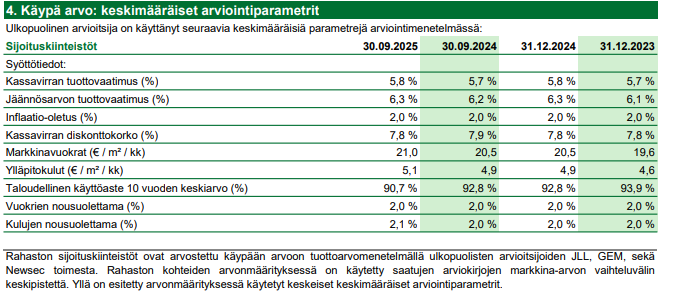
However, in the industry context, this is a bigger issue. I would be very surprised if the media did not raise this issue at some point and start asking “why doesn’t entity X report similarly.” Pressure on others to adopt a similar approach will grow, and this, in turn, will highlight fund-specific differences. I argue that there are quite significant differences in the fair value parameters of funds, and I am not sure how well these will withstand scrutiny for all funds. Once these are published, investors/media/analysts, etc., will be able to examine and evaluate them.

Below is an example of eQ Liikekiinteistö’s (eQ Commercial Real Estate) parameters:

In my opinion, all of this relates to the larger trend below regarding what the market for open-ended real estate funds will be like in the future. It is clear that we will not return to the gold rush of the previous decade, and in the future, investors will be significantly more selective regarding targets. This will cause large differences between good and bad funds. Good funds will certainly continue to raise reasonable amounts of capital, but for poorer ones, the outlook is bleak. This increased transparency will widen this gap as investors notice which funds operate cash-flow positively, etc.

8 Likes

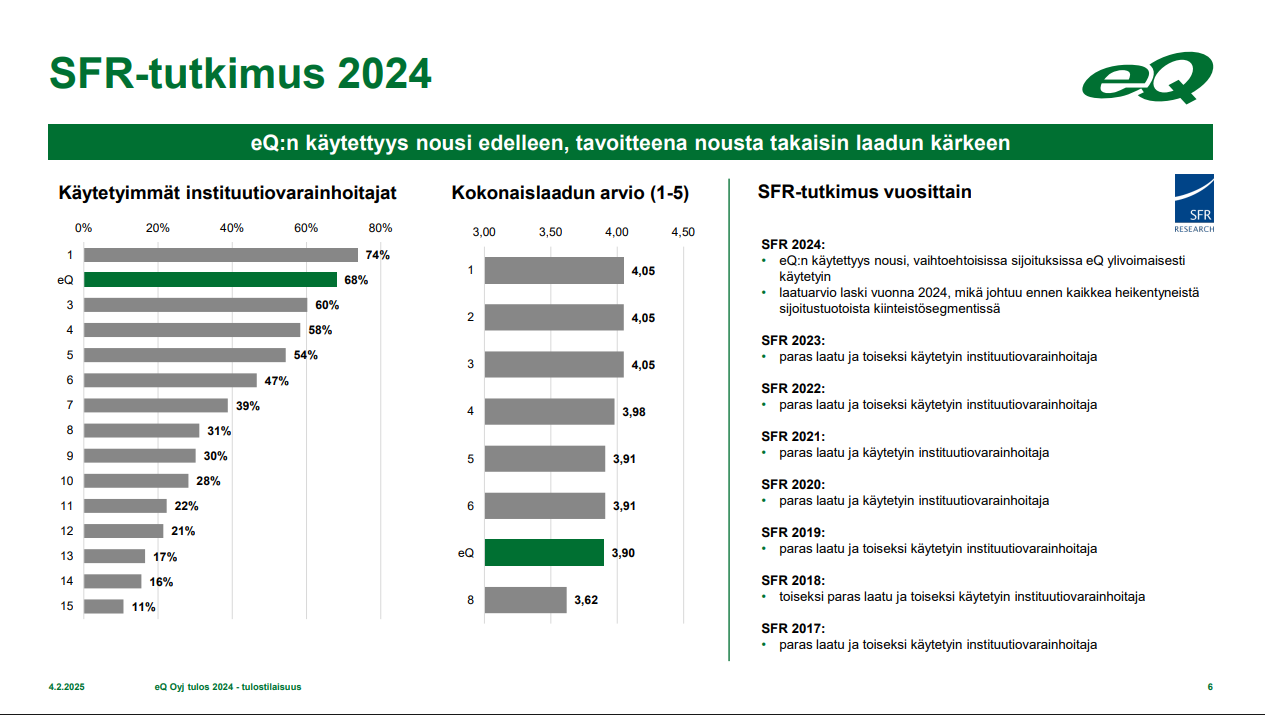
Today, by the way, the results of SFR’s annual institutional survey will be published. In my opinion, SFR’s survey is the highest quality survey in the industry, and it provides the best overview of how different parties have succeeded in the eyes of institutions. Just like last year, I consider it very likely that Evli and Mandatum will be at the top of the survey in terms of quality. It will be interesting to see if eQ succeeds in improving its weak position from last year (the company dropped to 7th place due to problems with real estate funds).

SFR does not publish the entire survey, but the award winners from different categories can be found on the following page: SFR Research - Palkitut

Additionally, the attached eQ slide gives some idea of the scoring:

5 Likes

So, I meant that in closed-end funds, reporting, as I understand it, has always been at a similar level. Or perhaps not in all, but often.

However, reports for open-end funds are public or at least distributed to a very wide investor base, meaning they are practically public, so that’s the difference. Not so much the production of the reports, although of course that also has a cost.

On a general level, I completely agree that it should withstand daylight, allowing potential investors to better evaluate for themselves. However, for individual assets, it might not be in the investor’s best interest if that information becomes public, as it could weaken the fund’s negotiating position when selling the asset. Generally, this is probably not a problem, but in some small funds, it might sometimes be (when there aren’t many assets in the portfolio, meaning that the key figures of the entire portfolio can practically reveal information about an individual asset). And is it really a problem in the end if the number of vacant square meters in some downtown office or the required rate of return in a valuation calculation were public?

1 Like

SFR announced yesterday the winners of its 2025 institutional research (found here). :trophy: SFR’s research annually interviews over 100 domestic institutions. Since, according to our calculations, there are fewer than 200 entities classified as institutions in Finland, the research sample is very comprehensive. The research evaluates all relevant domestic asset managers based on nine different quality criteria. The most important categories are large asset managers and challengers. In addition, SFR also gives awards in certain special categories. :military_medal:

The key measurable aspects of the research are quality and usability. Historically, these categories have had a strong link to each other, and the top-ranked players in quality have later also become the most used players. We note that the differences in the research scoring are often very small, and for example, last year, there was only a 0.15 point difference (on a scale of 1-5) between positions 1 and 7 in quality scores. Overall, we consider SFR’s research to be the best asset management research in Finland, and it provides a good indication of the development of various players. We note that SFR’s research is not public, and I myself have not seen the entire research for this year. Therefore, I will only highlight observations from the companies I follow here. :bank:

Among the companies we follow, Evli performed well again and ranked second in the large companies category. Evli has been among the top ranks of the research for well over a decade. In the challengers’ category, UB improved its ranking by one spot and won the entire category. :sports_medal:

Mandatum, which has made a magnificent rise to the top ranks of the research in recent years, was not among the top three, to our great surprise. For eQ, the result was a clear disappointment for the second year in a row, as it ranked 7th in quality scores. Between 2017-2023, eQ won the quality category every year except one.

Most likely, during the day today, the companies themselves will provide more detailed information about the results and, for example, discuss usability. :rolled_up_newspaper:

10 Likes

Alexandria recently published a review of the real estate market :film_projector: The review is really good and provides a lot of insight into the real estate market outlook. In my opinion, this is one of the best real estate market reviews I’ve seen in a while: :department_store: :school: :office_building:

https://www.alexandria.fi/sisallot/kiinteistomarkkinakatsaus-11-2025/

At the same time, a viewing recommendation for our real estate evening yesterday. Catella’s representative had a very clear view of the market, and the panel was probably one of the best Inderes has ever organized. :thought_balloon: Kiinteistöilta 3.12.2025 - Inderes

All in all, the market seems to be quite close to the bottom, but there is a lot of uncertainty regarding the slope of recovery. Differences between real estate categories will certainly be emphasized. Recovery in offices and the housing market will certainly take longer than, for example, in social infrastructure properties. :chart_increasing: :chart_decreasing:

21 Likes

Sentiment improves and sales are strong in the domestic investment services market! Kotimaiset rahastopääomat lähellä haamurajaa marraskuussa - Inderes

Fund subscriptions are again almost a billion in the black, and we are now 50 MEUR away from the 200 billion mark! :ghost:

Evli had another strong month, and UB continues to improve its performance. Aktia, on the other hand, had an unacceptably weak month :neutral_face:

26 Likes

We put together a more extensive piece with @Kasper_Mellas about financial sector dividends! Unsurprisingly, the dividend stream will be very strong, and the majority of companies will distribute dividends on an “empty the pot” principle. :money_bag: :slot_machine:

14 Likes

I spent some time digging through the numbers of our open-ended residential property funds :shovel: There are five open-ended residential property funds in Finland (OP, Ålandsbanken, Titanium, S-Pankki, and Aktia). I couldn’t find annual reports for Aktia’s fund, so I’ll focus on the others in this post. Unfortunately, materials are generally poorly available for these funds, and thus I have to make many assumptions in my calculations. Because of this, I don’t want to go into individual names here, but rather focus on the average of these funds. Data collected from the fund management companies’ annual reports and the funds’ own materials. :house:

Let’s start with rental cash flows, which is the backbone of all real estate investing! :money_bag:

All funds imply in their marketing that the fund’s return relies especially on rental cash flows. The boldest fund even dares to say this:

Long-term return target is about 5–6 % per year, based mainly on rental cash flow.

I calculated the funds’ returns and expenses, and when looking at the fund’s cash flow after expenses (rental income – maintenance costs – fund fees – interest – other expenses), it’s noticeable that two funds are running quite ugly negatives in terms of cash flow, and two are barely in the black. Maybe 2024 was just the wrong year? For 2023, 3 were in the red and one in the black. Additionally, at least to my eye, it seems that for 2024, at least for two funds, the cost of debt is still too low (they made smart financing agreements back in the day), and when the interest rates eventually reset, that cash flow will turn even worse. :face_with_raised_eyebrow:

Let’s open up the math a bit: :man_mage:

On average, these funds get a rental yield of just over 5% (3.9-6.0%) on their property portfolio. For some funds, the interest on housing company loans apparently runs in maintenance costs, and therefore a comparison of exact expense lines is not possible. When netting out maintenance costs, other expenses, and interest, we reach a situation where the return based on rental cash flow for the entire property portfolio is on average 0.6%/year (-0.3 - 1.5 %) before management fees. So one fund is already cash flow negative before management fees. In this figure, it’s clearly visible that leverage is currently working poorly, and there are also problems with occupancy rates or rental levels. Naturally, property valuation levels also weaken this return. When management fees are then taken out of this cash flow, the average net rental yield for the property portfolio drops to -0.6 % (-1.7 – 0.2%). So in practice, the funds are on average cash flow negative after all expenses. None of these four generate a proper cash flow for investors through rental income. For comparison, I looked at the same figures for eQ Care (Social Infrastructure) (which btw now reports its information with first-class transparency: https://www.eq.fi/~/media/files/funds/eq-yhteiskuntakiinteistot/eq-yhteiskuntakiinteistot-talouskatsaus-q3_2025.pdf?la=fi), and there the return based on net rental yield is between 3-4 %. Of course, it’s good to remember here that the net yields of apartments are supposed to be lower than social infrastructure properties, but for the investor and the cash flow return they receive, this doesn’t offer much comfort. :grimacing:

What does this mean for investors? For investors, this means that these funds are currently leveraged derivatives of the housing market, and the return relies entirely on the value appreciation of the apartments. :slot_machine: Unfortunately, this part is not found in the sales prospectuses. How would these funds then start producing better for investors? Rental cash flow must be pushed up, with occupancy rates and rent increases at the center. In addition to this, financing costs should be brought down, but this is decided by central banks, not fund managers. Of course, managers’ fees also eat up an unreasonably large part of that rental cash flow (at worst, half of the net rental income), but touching these to improve the return is, of course, out of the question.

It looks quite bleak for open-ended residential property funds at the moment if the interest rate level doesn’t change from here. It’s hard to see these instruments collectively being able to make a proper return based on rental cash flow without significant changes in the underlying market. Based on all this, those sales pitches about steady returns based on rental cash flow for investors are quite puzzling, when in reality the whole thing relies entirely on property value appreciation. :neutral_face:

66 Likes

I stopped by to have a chat with @Alex_af_Heurlin1 on the HS Vision podcast just before the holidays, and what else would it be about but real estate funds.

20 Likes

One more comment related to real estate funds before Christmas. In yesterday’s HS (Helsingin Sanomat) article, there was a rather sharp comment from the FIN-FSA (Finanssivalvonta) directed at the funds: Suomalaisten rahat jumissa kiinteistörahastoissa jo kolmatta vuotta | HS.fi

According to the law, funds can suspend redemptions “temporarily.” On the other hand, the law mandates that redemptions be handled “without delay.”

But what do “temporarily” and “without delay” actually mean? Many funds have been stalling redemptions for over two years now.

“The law does not directly set any time limit for how long redemptions can be suspended,” says Marko Hovi, Head of Division at the Financial Supervisory Authority.

The FIN-FSA cannot force funds to sell properties or open up redemptions. Therefore, the authorities are forced to watch the situation from the sidelines.

However, the FIN-FSA is monitoring the situation closely.

“The Financial Supervisory Authority assesses the companies’ operations through continuous supervision to see whether they are striving to take all possible measures to handle redemptions without delay.”

In Hovi’s opinion, there is reason to reconsider the industry’s regulation in the future.

“When the suspension of redemptions has already lasted for a longer period, one may well ask whether the duration of the suspension has drifted further and further from the spirit of the law and its original purpose,” Hovi says.

In my opinion, that bolded section says quite directly that funds are currently not respecting the spirit of the law by dragging their feet on redemptions. It is easy to agree with this, and I raised the issue as recently as yesterday in the HS podcast. In the absence of incentives, stalling and playing for time can often be the best strategy.

Also, the reference above to “reconsidering regulation” confirms what I have heard from various sources: changes to regulation are coming. The FIN-FSA already introduced some small changes to the regulation: (https://www.finanssivalvonta.fi/globalassets/fi/tiedotteet-ja-julkaisut/valvottavatiedotteet/2025/final-8.12.2025-finanssivalvonnan-nakemyksia-maksuvalmiuden-hoidon-keinojen-valinnasta_korjattu.pdf), but these are mainly cosmetic and do not address the root causes of the problems. In that document, I believe the biggest change is that, in the future, a fund must close both redemptions and subscriptions, and closing only one “door” is prohibited. This, too, is ultimately a rather marginal change.

25 Likes

The Finnish regulator is certainly quite lethargic. Anyone who knows the Finnish language understands that “temporarily” and “without delay” do not mean that redemptions are stuck for over 2 years in a market situation where the housing market is, however, in a relatively stable state and market interest rates are searching for a new bottom after a decline. Perhaps someone dreamed that peace in Ukraine would bring the markets to a new bloom, but that too has been pushed further into the future.

One could say unkindly that at the moment, fund managers are more concerned about their management fees than their clients’ capital. It is now evident that many retail investors want their money out as soon as possible, and new retail investor subscriptions are likely not forthcoming.

7 Likes

They can’t force them to sell or open redemptions, but it’s not true that they have to watch from the sidelines… I think things would start happening if they brought up the revocation of the fund management company’s operating license and thus the liquidation of the funds. It would probably be enough to make a cautionary example out of one market participant.

Personally, I’ve started to find the FIN-FSA’s spinelessness in various shenanigans a bit laughable…

14 Likes

The FIN-FSA can ponder regulation as much as they want, but at the end of the day, laws in Finland are enacted by Parliament, not by the authority. Despite the fact that the authority certainly has a certain amount of influence and can issue their own regulations on minor matters—these primarily relate to interpretation; they do not have the power to impose entirely new requirements.

The FIN-FSA may sometimes stretch its interpretive authority, but it is perfectly clear that they do not have the competence to revoke any operating licenses or similar, unless the letter of the law provides direct backing for it. Revoking an operating license is a very drastic measure and requires strong grounds—it is surely not enough to disagree on how long a period is “temporary,” if it hasn’t been defined in the law.

2 Likes

And even that within the leeway provided by EU legislation. Regulation concerning financial institutions and investing, as well as their supervision, has already been harmonized to some extent.

1 Like

And don’t many also hope for lighter regulation, since it gives companies better opportunities to operate? Increasing regulation and expanding the powers of authorities is therefore not purely a good thing.

Isn’t the real problem with these real estate funds that the customers themselves have tied up their money in something whose risks they didn’t fully understand? I don’t mean that there haven’t been issues with how they were marketed.

Competition could fix these problems instead of regulation. Of course, this would require customers to know how to ask the right questions… And perhaps if customers used outside help in their decision-making, mechanisms could potentially emerge resulting in higher quality products being sold?

Actually, when you think about it, is the root problem here in the structures of the domestic financial sector? Meaning that banks sell their own products to their customers instead of trying to find the truly best products from the market for each asset class and assembling the right overall package for the customer’s needs?