For example, because there can be (small) bounces in the downward trend of the share price. For instance, right now at €0.41, if you buy 100,000 shares for 41,000 and sell them off at, say, €0.45 for 45,000. That gives a profit of 4,000 — quite a nice return %. And Faron won’t go bankrupt before the money runs out… meaning a year’s time to wait for a bounce. You never know..
3 Likes
Always those. Sure, the bounces come so regularly irregularly… a mean reversion strategy can still work under some circumstances. Faron’s share price broke away from the moving averages this week and looks “oversold”. However, I don’t buy the dip myself except when increasing a long position. When trading, I focus solely on momentum.
Secondly, Faron’s board of directors should propose a 1:10 reverse stock split. At the 4€ price level, there was a better vibe.
17 Likes
It wasn’t HCM, it was Pentwater:
FARON PHARMACEUTICALS LTD: HOLDING(S) IN COMPANY - Faron
One of the underwriters of the share issue, however.
11 Likes
Pentwater was the second largest anchor investor after HCM, and Pentwater must have had approx. 7.86M shares based on the percentage in the flag notification (3.785746%). By the way, why wasn’t it visible on the list of largest owners? The notification only shows the current ownership as (Less than 3%), but I suppose they are selling everything. I wonder if they will run out today. In itself, it’s a bit of a relief that the seller’s identity is known, because perhaps the reason for the sale is nothing more than them following their strategy.
8 Likes
Admittedly, the situation gets a bit complicated, but Pentwater does not/did not own any Faron shares. They have/had a SWAP agreement with BofA. HCM had lent Faron shares to BofA so that their holding would fall below the 9.99% limit required in the financing agreement (if exceeded, repaying Faron’s loan with shares is not possible).
What may have happened now is that Pentwater has closed the SWAP, at least in part, allowing the shares to return to HCM’s control. HCM’s holding in the company has thus risen above 9.99%, and they are forced to sell shares in order to be able to receive the next Faron loan repayment installment in shares.
In short: the seller is therefore likely HCM, and they are selling out of necessity because they do not want repayments in cash (and Faron does not want to pay them in cash).
If I am wrong about anything in this reasoning, I gladly welcome corrections.
15 Likes
Shouldn’t this go more along the lines of Pentwater having converted its equity-linked securities (anti-osakkeensa) into a swap, and now that it has decided to “close” the swap, the counterparty of the swap, which held the shares, is selling the shares off? In my opinion, there is no certainty that HCM is involved in this setup at all, and in BofA’s flag notification (liputusilmoituksessa), the amount of the swap seemed to be around 200k, while the rest were “rights of use”, the amount of which in my opinion matched HCM’s convertible bond (VVK) amounts better. Could HCM have pledged the convertible bonds (VVK:t) to BofA?
2 Likes
[quote="Tuul1puku, post:4886, topic:66933"]\nPentwater has converted its share issue shares into a swap\n\n[/quote]\n\nThis would practically mean selling. They received 6 million shares from the share issue, but in the June flaggings (notification of major shareholdings) they did not own a single share. It is likely that they sold those 6 million shares to the market immediately after the issue. I checked, and the trading volume would have been sufficient for that. In June, they then executed a SWAP with BofA.\n\nHow HCM is connected to this (if at all) is based entirely on those share quantities and the chronological connection of the events. HCM lent 8 million shares to BofA practically at the same time when Pentwater executed an 8 million share SWAP with BofA, in which they get the economic exposure of the shares without owning the stock.
6 Likes
Could voting rights still be retained by Pentwater based on the swap, and that’s why only they are flagging? In June, they indeed flagged that the swap amount had dropped from just over 4% to that just over 3%, meaning that even then, the reduction would have been around 2 million shares. I couldn’t find the previous flagging notification where they would have flagged that 4% voting stake.
I still believe this is ultimately about Pentwater’s issue shares. This definitely goes beyond my area of expertise, so I could very well be wrong.
edit. Also, where does it show that HCM has lent shares to BofA?
edit. 2 And that arrangement doesn’t really work from BofA’s perspective if they lend shares to hedge the swap. Because if the share price multiplies, BofA has to return the shares to HCM and at the same time pay Pentwater the return according to the swap, but BofA itself doesn’t get any return from the appreciation of the share price through any channel. Isn’t the whole point of a swap precisely that the counterparty to the swap buys the underlying instrument and takes its own (guaranteed) fee as the financing interest rate?
2 Likes
It’s hard to make heads or tails of that, but isn’t the core issue that Pentwater, for one reason or another, is forced to unload shares at a loss? September, so many companies’ fiscal year ends and there’s a rush to patch up the balance sheet.
2 Likes
The acquisition price for the guarantors is probably just under 40 cents, when taking the guarantee fee into account.
5 Likes
Pentwater has never owned such a large share of Faron that it would have been required to flag it under the First North Finland rules. They received 6 million shares, which is below First North Finland’s 5% flagging threshold. They could have sold those 6 million shares in March-April immediately after the new shares were detached. In June, according to their flagging (which was not statutory), they no longer had any shares in direct ownership. What I don’t understand is why they flag sometimes and sometimes not. Perhaps they sold the issue shares so quickly that they didn’t see the need to flag.
There probably isn’t any hard fact about that. That is based on speculation. BofA flagged 21,333,422 right-of-use-flags. A few days before this, HCM flagged and at that time they had 21,324,320 shares in direct ownership (and they are easily the largest owner). The difference between those numbers is only 9,102 shares (more for BofA), so the alternatives are that HCM has lent its shares to BofA (they didn’t intend to sell their issue shares) or several other large owners have lent their shares to BofA and by coincidence the amount matches almost exactly.
But as I said, it’s speculation. However, HCM had a motive to lend the shares, because they needed to get their ownership ratio down for the amortization (they cannot own more than 9.99% or the amortization comes in cash).
I believe BofA has borrowed the shares from HCM for free and gets its return from selling the Cash SWAP to Pentwater. That is, Pentwater pays a fee to get the economic benefit (or loss) of the shares without owning the share. So BofA gets money anyway.
Pentwater possibly started thinking about the matter more closely. They figured the stock price would just keep falling because good news seemed far away and HCM was pushing shares to the ask side every two months. As a result, it was decided to terminate the SWAP, and thus the risk of the share price development returned to BofA. Now BofA gets no compensation for holding shares losing value on their balance sheet, so they inform the original lender (HCM or someone else), “You better take your shares back.” And this is actually the thing that proves to me that those shares were lent by HCM. Because in the financing agreement between HCM and Faron, there is that 9.99% rule, so HCM is forced to sell the shares to the market so that the upcoming amortization in a month can be received in shares. If anyone else had lent the shares to BofA, they wouldn’t have been forced to sell the shares immediately to the market, because they don’t have financing conditions forcing them to.
I think it went to zero in one go, so there’s nothing left to report. They didn’t have anything to sell, so 8,000,000 SWAP → 0 SWAP is just a matter of notification. No need to wait to find a buyer.
Man, that turned into a long message. Apologies!
11 Likes
They apparently have to comply with AIM regulations due to Faron’s dual listing. According to AIM, a disclosure is required at over 3% and then at every 1-percentage-point interval when moving up or down.
I was also wondering why HCM kept making threshold disclosures, but it apparently stems from those AIM regulations, which have different thresholds than in Finland.
2 Likes
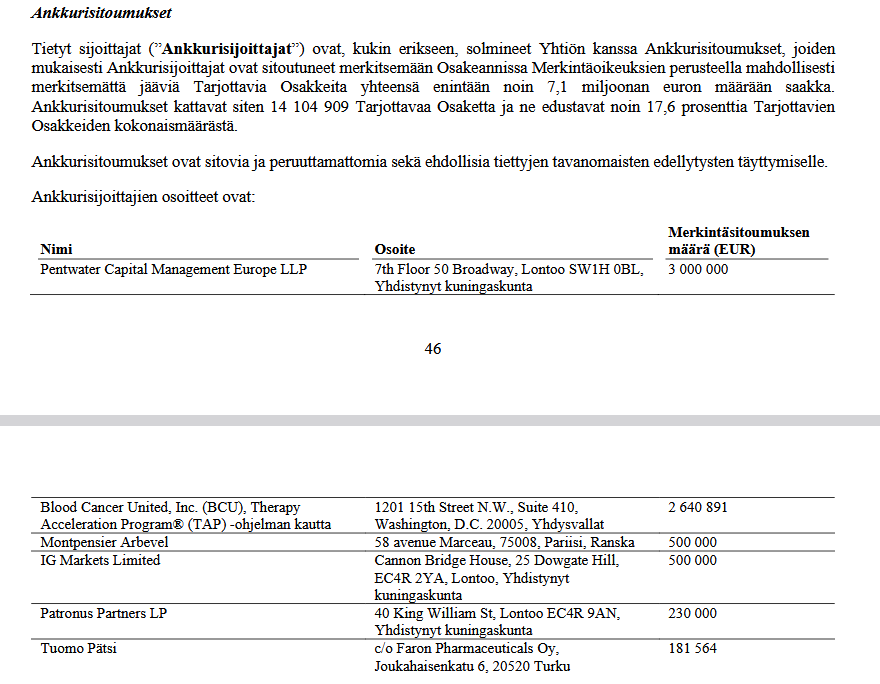
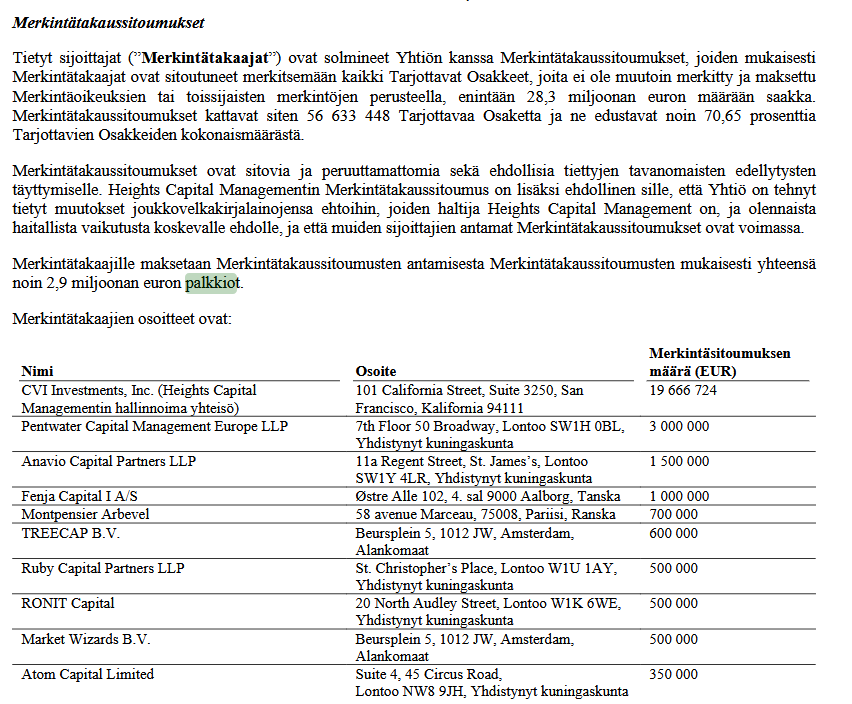
Do you mean by that that they received 6 million shares in the share issue? Pentwater was both an anchor investor in the share issue with a 3 million euro pot and an underwriting guarantor (merkintätakaaja) with a 3 million euro pot. Based on the anchor investment, they received 6 million shares from the issue, and based on the underwriting guarantee, roughly another 1.2 million shares. In addition to this, the guarantee fee was likely also paid in shares, from which the number of shares obtained by Pentwater would have been approx. 600 thousand shares.
It is unlikely that Pentwater sold the issue shares in the meantime, but a SWAP was made with them immediately after the share issue was completed, and for some reason, that was left undisclosed. Now, however, the shares are clearly being dumped, and there are still a few million left to sell for next week.
3 Likes
I had no idea about this. Where can such information be found? I have been under the impression that Pentwater was an anchor investor, but they did not participate in subscribing for the unsubscribed shares. So, according to my understanding, they were not involved in guaranteeing the share issue. But I might be wrong.
This is interesting—what do you mean by a SWAP being made of the shares? A Cash SWAP, which they had, is specifically one where they do not need to own the shares, but they get the financial benefits or drawbacks from them. In other words, for the shares in their possession to become a Cash SWAP for them, they have to sell the shares to whoever they want to make the SWAP with. Or have I misunderstood something?
2 Likes
The information can be found in the offering prospectus. I would actually encourage everyone considering participating in an offering to read through that booklet for every company before making a decision, even though it is often hundreds of pages long. 
Here are the relevant excerpts from the prospectus:
By googling you can find a lot of information about this, at this time on a Friday evening I won’t even try to top that.
8 Likes
ValkoisenPeura makes a very good point. It would seem somewhat like Pentwater received about 8.59 million shares from the share issue, assuming the shares left for the underwriters were distributed pro rata. Perhaps some clarity on this will emerge at some point. I’m still a bit lost on how those Pentwater shares would have become a SWAP agreement and why they are now being aggressively sold.
4 Likes
If Juho would just talk to partner or buyer candidates now, and no longer to investors… well, I still don’t interpret that in any way. I mean that event posted above on September 14th-16th.
6 Likes