Very high-quality scientific marketing (and perhaps a bit of ribbing the competitors). I wonder if San Diego was what the gentlemen had in their sights. 
3 Likes
In the Faron case, Syrjälä really hasn’t known what he’s doing.
Syrjälä has taken such a massive loss (turska) with this one that I’m not overly worried about this.
Faith has run out, and it’s no wonder.
Personally, I still have a glimmer of hope.
Edit. typo
4 Likes
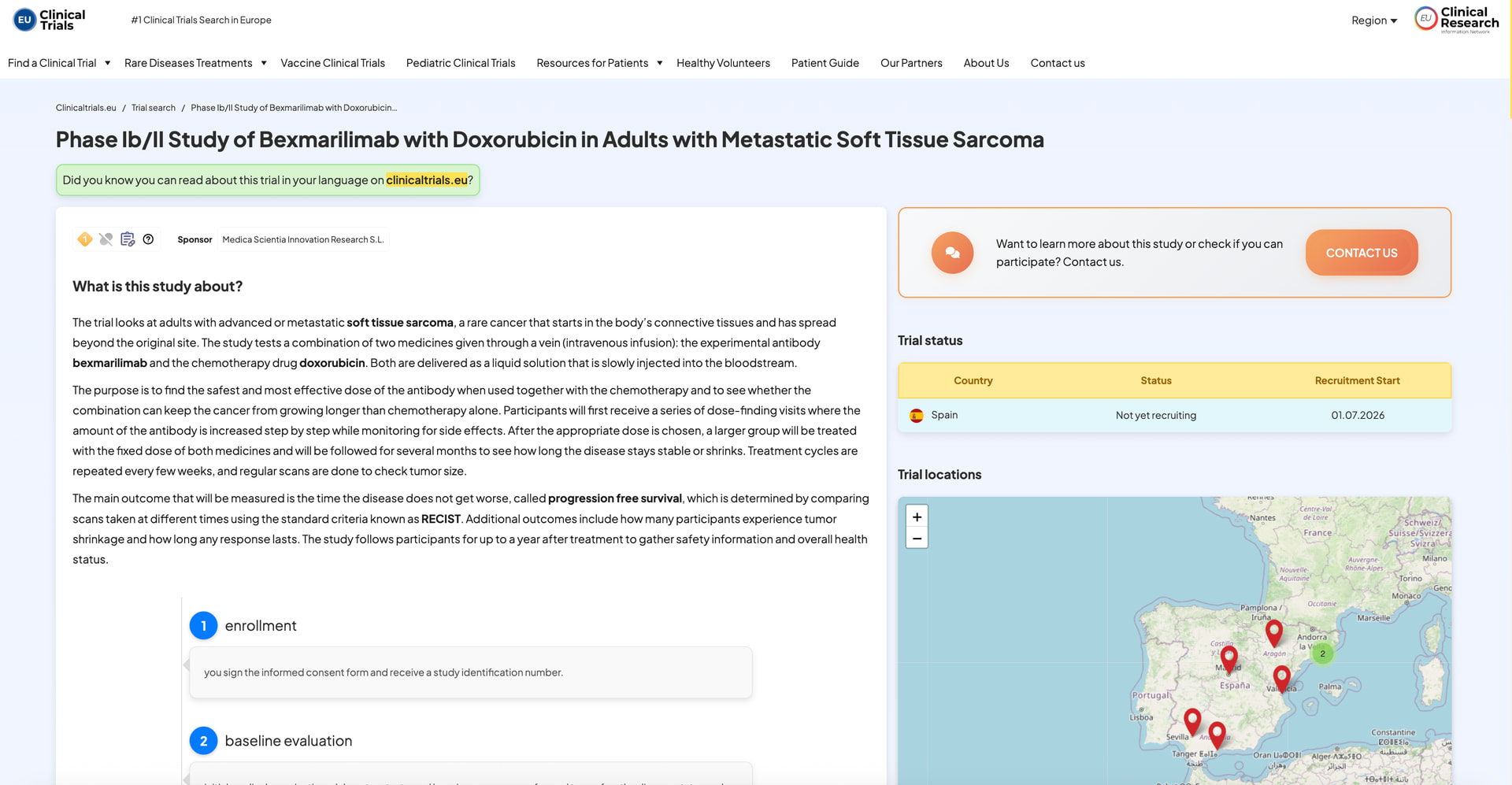
BEXAR (soft tissue sarcoma) recruitment is apparently starting in just a couple of weeks on July 1, 2026
bexmarilimab + doxorubicin, phase Ib/II
Several centers in Spain.
16 Likes
That criterion is in the upcoming Bexera trial, not in Bexmab, the results of which we have now…
1 Like
It’s not worth shouting for or against anything without better information. He is still on the nomination committee and involved with a very significant and truly large contribution. Thanks to Timo for that.
7 Likes
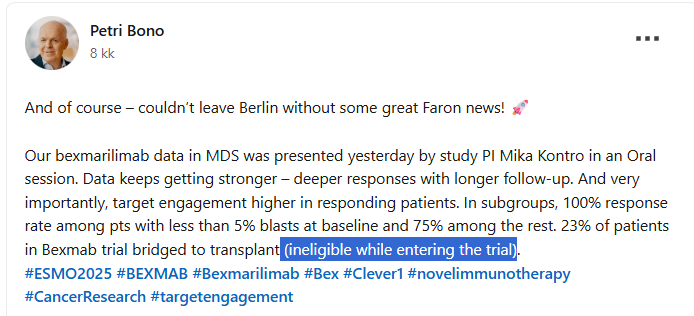
Do you mean that “transplant-ineligible” was not an officially defined inclusion criterion in the BEXMAB study protocol (I couldn’t find immediate information on this myself), or that it wasn’t an actual protocol criterion, but the study in practice targeted transplant-ineligible patients? However, Juho said in the interview that transplant-ineligible patients are being used in BEXMAB and in future studies. Additionally, Petri Bono wrote in connection with the ESMO update (8 months ago) that 23% of BEXMAB patients proceeded to a transplant, even though they were ineligible when entering the study.
Juho: “In BEXMAB, and also in our future studies, we are taking transplant-ineligible patients.”
So, are we talking about the official protocol criterion or the practical nature of the study population?
7 Likes
Officially, being “unfit for transplant” was not an inclusion criterion ClinicalTrials.gov (scroll down to find it). It was also not an exclusion criterion, meaning the study should have included both.
According to that LinkedIn post:
23% of patients were those who were successfully bridged to transplant despite being ineligible at the time of study entry.
According to the Feb 2024 corporate deck, the SCT rate was 35% in first-line and 18% in r/r patients.
So, BEXMAB includes both fit and unfit patients, exactly as defined in the study protocol.
But it was interesting in itself that this information was dropped in a passing remark during the webcast (I missed it) / in a LinkedIn post.
2 Likes
Can one conclude that there SHOULD be both, i.e., it is mandatory to include both eligible and ineligible?
In other words, could it also be said that:
- Bono’s comment is true. (only ineligible)
- Juho’s comment is true from the perspective of the study population. (only ineligible)
- ClinicalTrials.gov is true from the perspective of the protocol. (either both / or only one)
1 Like
Well yeah, it shouldn’t explicitly, but neither has been excluded, so I assume both will end up in the study.
The real question here is, of course, what “transplant ineligible” means in Bono’s language. It doesn’t mean that the patients were particularly multimorbid, as the ECOG scores were mainly 0-1. It could mean there was too much tumor burden or the patient had some temporary issue, like an infection. It could also just mean “logistical” issues, i.e., a suitable graft is not available or the center otherwise doesn’t have the capacity to carry out the treatment at that specific time.
Once again, I would like more clarification from Faron. What were the patients’ backgrounds???
If we believe/assume that Juho’s webcast comment and Bono’s phrase “ineligible while entering the trial” mean that these were patients who were genuinely ineligible for transplant upon entering the study, what do you think this says about the BEXMAB results?
If a patient is ineligible at baseline but achieves remission after treatment, their blood counts recover, and their condition improves so much that they become transplant-eligible and eventually undergo a transplant.
Would you consider this a strong signal of BEX’s efficacy, or do you see such an outcome as something that could be fully expected with azacitidine alone? In your opinion, is an ineligible patient becoming transplant-eligible a clinically significant finding or not?