The way I see it, we are in a so-called “Green” zone until next summer, meaning there is still cash left and time to get some kind of deal done. Once we reach the point where there is only 3-4 months of cash remaining, we move into the “Orange” zone. At that stage, the pieces will likely start falling into place for a new share issue and further dilution. Hopefully, something can be achieved before then.
6 Likes
What happens then, for example, if the aforementioned Oryzon signs a deal? How many can fit into this space? In fact, one could already credit Oryzon for the fact that the value of Faron and a potential deal has decreased significantly, as there are now two alternative partners available..
I would expect an expert’s view from the Medicine (Medisiina) section as soon as possible…
2 Likes
Isn’t it a slightly different disease, even though Bex has supposedly been studied for AML as well? Saying that the Spaniards are coming is misleading in the sense that the FDA already granted Iadademstat orphan drug designation for AML back in 2021. Bex received a similar designation for MDS in 2024. There is an IIT ongoing for MDS as well, of course, but these cancer drugs aren’t exactly “cure-alls.”
2 Likes
Were there 15 patients in that Spanish study? Faron has also been evaluated quite a bit in terms of the number of patients treated. Why would BP (Big Pharma) be particularly interested in this specific AML lead?
3 Likes
Those results are Phase Ib.
Faron is slightly further along in the clinical research phases.
Furthermore, the mechanisms of action for Oryzon’s and Faron’s drug candidates differ.
21 Likes
18 Likes
Great find,
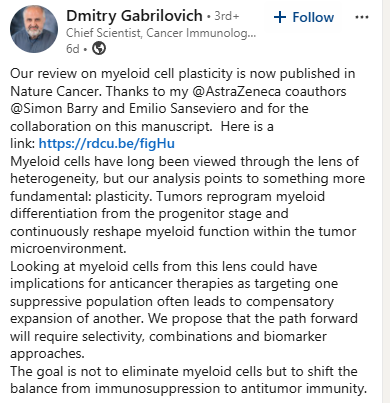
Here is also a LinkedIn post from a friend on the subject; the old way of thinking is no longer sufficient, new methods are needed:
“targeting one suppressive population often leads to compensatory expansion of another”
“The goal is not to eliminate myeloid cells but to shift the balance from immunosuppression to antitumor immunity.”
17 Likes
Great!
From the link in the image, you can open the full article for free:
https://www.nature.com/articles/s43018-026-01159-6.epdf?sharing_token=iHkjMRYXVnWxQvsO8XSNS9RgN0jAjWel9jnR3ZoTv0PYAE8en-KIAFDR-pso6tjEiEy_45jyYu3gdXSX555ResOWeArKL5aRcYcec_0Mk8Komg_TSI2gTTdMH4Uec-Kj9qRJccOaeF4XMjUL3KL6yHDp26osIK5Ll-3p-hsrvm0%3D
19 Likes
Even though no names are mentioned, it is clear that this article plays right into Bex’s hands.
It is worth noting and appreciating the quality of that publication (Nature Cancer).
When scientists from a “small shop” (AstraZeneca) like that submitted their article for publication on Oct 30, 2025, it was accepted on March 11, 2026.
That time was spent on rigorous peer review regarding the quality of the piece.
You’d get away much easier in a tabloid.
28 Likes
Over on the Nordnet side, there was a listing of current open positions at Astra (including Head of Early Assets, etc.).
Below, I have listed some recently hired individuals. This is unlikely to be related to Faron, but it offers a different perspective here.
- Anas Younes (SVP Global Head of Haematology R&D 8/2025)
- Developing innovative treatments for blood cancers.
- David Auerbach (Head of Business Projects – Oncology R&D Business Planning & Operations 7/25)
- Appointed as head of business projects for AZ’s oncology unit.
- Acerta Pharma (AZ’s haematology unit) announced new leaders in 2025, such as Niko Andre (Head of Oncology, Germany) and Martijn Bax (Country President, Netherlands).
4 Likes
CLEVER-1 and bex have been referenced in publications by Hollmén et al. and Virtakoivu et al., stating that it is a promising early-stage PoC (Proof of Concept). One probably couldn’t say much more or better than that.
19 Likes
https://thebrilliantbiotechboss.substack.com/p/when-translation-overruns-great-science?r=nftvj
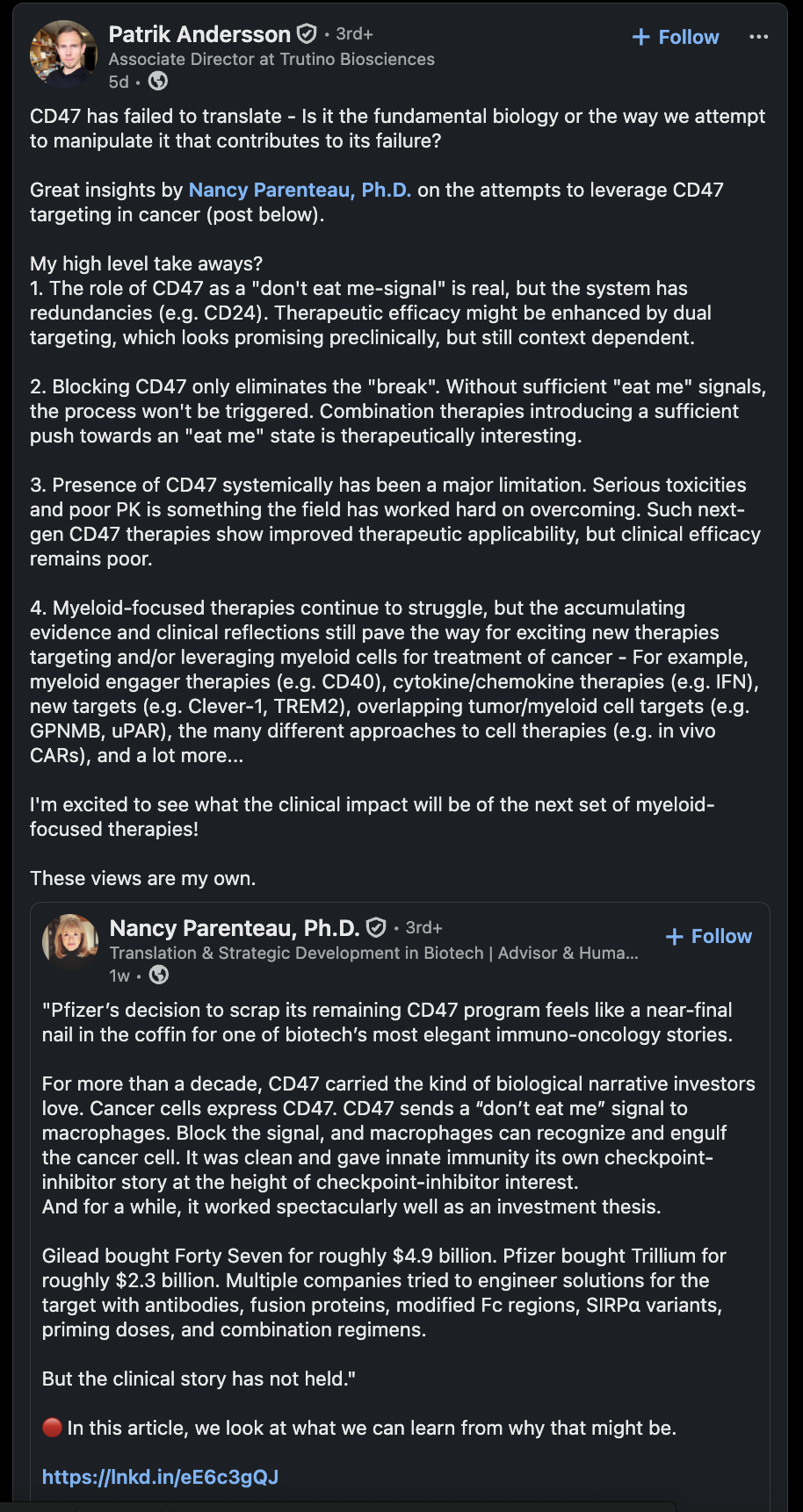
The story of CD47 is increasingly looking like the biology was right, but the approach was too simple. Gilead paid 4.9 billion for Forty Seven and Pfizer paid 2.3 billion for Trillium, but the clinical benefit ultimately remained weak.
A good write-up by Nancy. From Faron’s perspective, however, the most interesting part is the comment on the post by Patrik Andersson, Head of Immunology at Trutino Biosciences (later acquired by Boehringer Ingelheim):
“4. Myeloid-focused therapies continue to struggle, but the accumulating evidence and clinical reflections still pave the way for exciting new therapies targeting and/or leveraging myeloid cells for treatment of cancer - For example, myeloid engager therapies (e.g. CD40), cytokine/chemokine therapies (e.g. IFN), new targets (e.g. Clever-1, TREM2), overlapping tumor/myeloid cell targets (e.g. GPNMB, uPAR), the many different approaches to cell therapies (e.g. in vivo CARs), and a lot more…”
With CD47, one “don’t eat me” signal was removed, but the macrophage itself remained in a suppressive state. This is why Patrik highlights Clever-1 among the next-gen myeloid-IO targets.
Big Pharma certainly knows which direction the field is heading.
34 Likes