CD8 and Treg changes should not be interpreted too linearly as individual markers. Bex is not a direct T-cell activator, but an upstream myeloid checkpoint therapy that affects the entire tumor immune microenvironment through macrophages. It can reduce immunosuppression, help the immune system recognize cancer cells better, and improve the function of T and NK cells.
It is therefore more about reprogramming the entire immune network than boosting a single cell type.
That point about the differences between cancer types is important. Different tumors emphasize different suppression mechanisms.
https://www.nature.com/articles/s41586-026-10452-4
Non-invasive profiling of the tumour microenvironment with spatial ecotypes
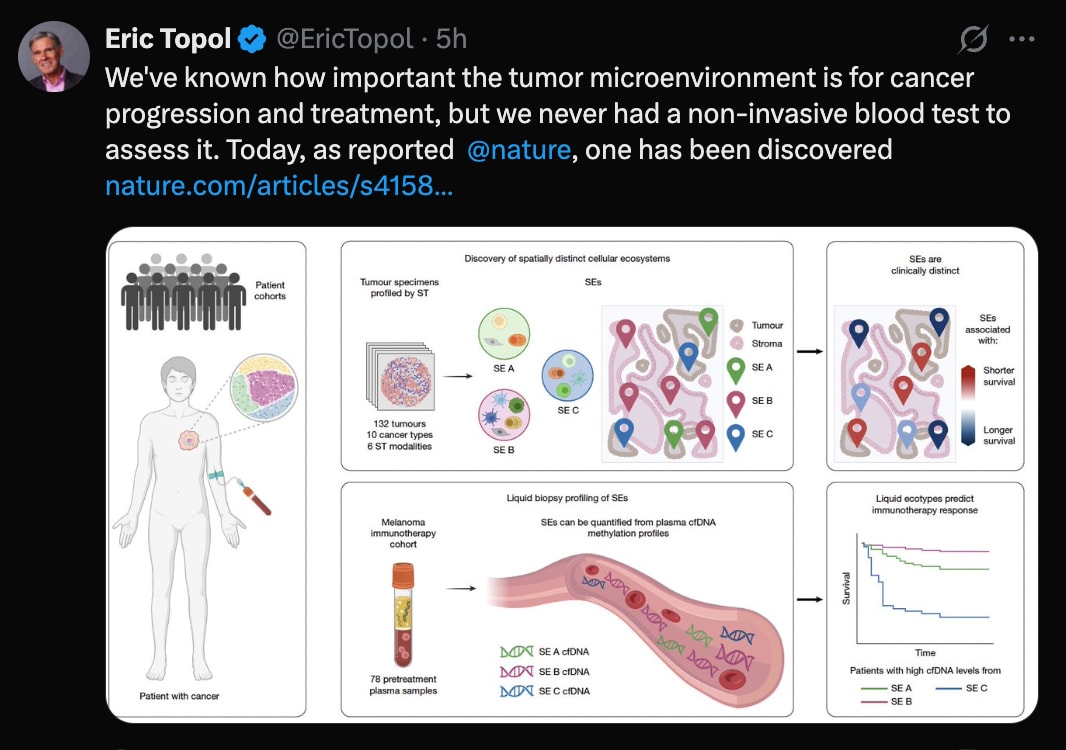
A new study published in Nature is very interesting. It describes the tumor microenvironment (TME) as âspatial ecotypes.â They identified myeloid/SPP1/fibrotic suppressive niches as well as interferon/CXCL9-active regions associated with immunotherapy response.
This strongly supports the idea that cancer immunoresistance is not just a lack of T cells, but a structural state of the entire TME. This aligns very closely with the TAM (tumor-associated macrophage) reprogramming logic of Bex.
The biggest surprise in the paper was that these ecotypes can even be detected from cfDNA via a blood test.
Cancer medicine used to ask: âWhich mutation?â
Now the question is: âWhat kind of ecosystem?â
So Eli Rannikkoâs âTME dissertationâ ties into that as a âcommon threadâ very well! ![]()
Yeah, that describes the new âvendor management process for good general practices concerning vendors involved in clinical trialsâ implemented at Faron in 2022.
A process existed before this as well, but it was more superficialâthe new process was drafted from a regulatory guidance perspective to align as closely as possible with ICH, FDA, and EMA guidelines.
A survey was then conducted within Faron, involving 12 employees, regarding how well they felt this new process complies with regulations. Depending on the question, respondents agreed with the statements either 100% of the time or at a minimum of 83% (10 / 12 respondents in agreement). The questions where these individual disagreements occurred were:
Vendor management:
- Recent changes to the vendor management process have been effective improvements
- The vendors that Faron oversee are fully qualified for the service they are performing
- Faronâs processes ensure good vendor oversight
- Faronâs processes ensure the best vendor is selected
Vendor evaluation processes:
- To the best of your knowledge, Faron complies with all regulations in its vendor performance management
In practice, for 11 out of the 12 survey questions, more than half of the respondents âstrongly agreedâ. So, I would conclude that, at least in the opinion of Faronâs own staff, their new process adheres excellently to various regulatory guidelines.
The final conclusions refer to an article by Hennig et al (2017), which states that one in five âresearch-based pharmaceutical companiesâ lacks any kind of documented vendor management process. In light of that, they state that this paper offers insight into what kind of framework a âsmall pharmaceutical companyâ could implement for vendor management that is in line with regulatory guidelines.
Quite interesting, it just shows how challenging last year was in the M&A environment
The value of acquisitions and mergers in Q1-Q3 /2026 was: 84 Billion
In 2025, the total amount was 44.4 Billion
A few examples of patent expires:
Keytruda - 2028 / generates over half of Merckâs revenue / sales 30 billion
Opdivo / BMS / 2028 / 9 billion
With Anniâs help, we gained time for the data to mature, while the M&A market appears to be strengthening. Based on those figures, risk appetite in the pharma/biotech sector also seems to be on the rise. Once new data starts trickling in (hopefully staying at the same level), we could see a good competitive setupâwill BP have the patience to wait for final results?
- New direction: combination therapies
https://www.the-scientist.com/next-generation-precision-medicine-platforms-come-for-cancer-74414
Reprogramming T cell-myeloid crosstalk overcomes immune resistance in colorectal cancer
A very strong Mount Sinai / Cell Reports Medicine -CRC paper says it again:
According to the study the combination therapy achieved up to 100 percent tumor clearance in models of mismatch repair-deficient colorectal cancer, and more than 70 percent clearance in mismatch repair-proficient tumors, which are typically resistant to immunotherapy.
âThis approach effectively reprograms the tumor microenvironment,â said first author Guillaume Mestrallet, PhD, a postdoctoral fellow in the Bhardwaj Lab at Mount Sinai. âBy simultaneously reinvigorating T cells and targeting suppressive macrophages, we were able to restore immune coordination and generate powerful anti-tumor responses.â
Importantly, the study also demonstrated the development of immune memory, suggesting the potential for long-lasting protection against cancer recurrence. The findings have significant implications for the future of cancer treatment, supporting the development of rational combination immunotherapies that go beyond single-agent approaches
Very close to the biological logic that Bex is also based on.
Out of interest, I Googled the connection between hantavirus and stab1 (Bex).
HTNV (Hantaan virus subspecies) causes a strong inflammatory response in humans, but in rodents, the immune response later shuts down into a protective M2 state. STAB1 is a marker for this anti-inflammatory M2 phase (if I understood that table correctly).
I donât expect it to be the answer to Hantaan, but perhaps in the distant future for suppressing inflammatory reactionsâcould it be possible as a combination therapy?
Andes can cause respiratory depression due to pulmonary hemorrhaging, so Traumakine comes to mind again. I donât know and I canât be bothered to Google it, but I suppose the standard treatment is cortisone in addition to respiratory support.
Understanding the Molecular Mechanisms Underlying Anemia in Myelodysplastic Syndromes: From Erythropoiesis to New Therapeutic Approaches
A fresh review in Blood Cancer Discovery provides a good overview of why anemia occurs in MDS. The big takeaway is that itâs not just about mutations, but a disruption of the entire bone marrow microenvironment. Particularly interesting regarding Bex is the âerythroblastic islandâ model, where the macrophage acts as the central hub for red blood cell production: providing iron, regulating maturation, and maintaining the environment.
The image illustrates the significance of the macrophage well. It is literally the âhubâ of the entire erythropoiesis process.
The MDS field is clearly moving toward targeting the inflammatory microenvironment.
https://www.nature.com/articles/s41698-026-01474-2
Multi-omics profiling reveals tumor microenvironment characteristics linked to immunotherapy response and prognosis in non-small cell lung cancer
A new NSCLC paper from Nature that extensively studied the biological layers of the entire treatment. Immunotherapy response depends not only on the number of CD8 cells but on the entire TME ecosystem. In treatment-resistant tumors, SPP1+ macrophages were prominent, inhibiting the function of CD8 and NK cells.
Once again, direct support for myeloid-thinking and TME reprogramming â> Bex
It would be good to update Faronâs strategy on the website; hopefully, one exists. The key points seem to be a bit outdated now, especially if the main focus is on Bexâs Phase 2.
Yes. Faron still treats its shareholders with indifference; it seems like nothing is ever learned. Paavo has also completely disappeared from the mapâis he even on the payroll anymore, since thereâs no time for the owners? Which stakeholder group is more important than the owners? Well, a buyer, but that doesnât seem to be coming either. Currently, Faronâs message is that of a homegrown, wannabe breakthrough acquisition target, when with a different kind of communication, they could take control of the field and be in the driverâs seat. A new CEO and a fresher horse to cross the finish line.
EHA2026:
The ânormalâ abstracts were released today. Based on my own skills, I canât find Faronâs abstract there.
Edit: this can be deleted
Posteriesitys siis tulossa 11.6., sisÀltÀen uutta dataa.
Summary/Conclusion:
Translational results show both immune activation and targeting of malignant blasts in the BM upon BEX+AZA treatment in MDS patients. Addition of BEX to AZA results in encouraging clinical efficacy in both treatment-naĂŻve HR-MDS as well as r/r MDS. Translational results for the full study population, including both frontline and r/r MDS, will be reported for the first time.
So this information is from November '25, so:
âFull results from ongoing confirmatory flow cytometry analyses characterizing the BM immune, blast and progenitor cell changes induced by BEX+AZA will be reported.â
At EHA? Did I understand correctly?
Last year, Faron released updated efficacy figures via a stock exchange release three days before the EHA presentation. Weâll see if the data will be released in advance this time as well.
ASH showed good responses, the Mickos/Hollmén paper presented a model, and now concrete signals from human data are being presented at EHA:
- Immunosuppressive monocytes are decreasing
- HLA-DR increases up to 10-fold
- NK/CD8 activation increases
So the story is no longer just âgood responses,â but the mechanism is beginning to show in the immune biology of patientsâ bone marrow exactly as the theory predicted. Proving the mechanism is crucial for both the FDA and Big Pharma.
This is moving forward like a train. Well done, Faron!
The FDA commissioner just got fired. Thereâs an opening for someone who can read tea leaves.
I wonder what will happen with Faronâs applications!
NBC NEWS:
âDr. Marty Makary is out as commissioner of the Food and Drug Administrationâ


