Every pharmaceutical company hopes that patients stay alive for as long as possible, but don’t get better. Faron has indeed faced so many pitfalls that a more paranoid person might suspect some kind of foul play. But didn’t Juho promise some results this spring, so then we’ll be a little wiser.
1 Like
You probably know yourself why there were patients with less than 6 HMA cycles. Life expectancy in the r/r category is 5-6 months. The length of one cycle is 28 days, so patients are highly likely to die while waiting for those at least 6 cycles.
6 Likes
They are not yet in the r/r category. The life expectancy in HR MDS (high-risk Myelodysplastic Syndromes) is something like 18 months.
I thought you meant something completely different by that: “When they did that, there were patients in the r/r category who had fewer than 6 HMA treatment cycles.”
1 Like
The original was in English, so the Finnish translation might sound strange. This was about baseline data, i.e., the patients’ condition at the start of the study. A patient should not be put into the r/r category if they haven’t had at least 6 cycles. In some recommendations, it’s 4-6, but the point is that especially those with less than 6 cycles might very well still respond to HMA treatment. So, one can reasonably suspect that the observed response is due to HMA treatment, not Bex.
2 Likes
My understanding is that life expectancy is a median. If the range is 4-6 months, then perhaps the patients in poor condition were included earlier than after six cycles, in order to offer something? And if that is allowed in drug research, then everyone probably uses it. More importantly, if Bex works for these patients, then that is absolutely amazing. The story just doesn’t reveal the individual patients’ conditions behind the numbers and the decisions made based on them. Humanity.
6 Likes
I disagree, you are missing the whole premise here, ie you are not accounting for the refractory population that may not respond to HMA’s as a monotherapy and then respond following an immune intervention…
4 Likes
Bono on MTV’s morning show. This is a brief overview of where cancer treatment is heading, immunological drugs, their downsides and benefits.
According to Bono, 60% of patients in Faron’s trials have been from the USA. (Comment: With the planned investigator-initiated trials, this will likely change significantly in the opposite direction.) When discussing side effects in blood cancers, Bono mentions that Bex aims for fewer blood cell transfusions and infections leading to hospitalizations, i.e., an improved quality of life. (Comment: There is some preliminary evidence of this, but it will only be confirmed in phase 2b/3 if this is the case.)
New weapons against cancer – what will a patient’s daily life be like in the future?, 12 min 22 s
Guests on Huomenta Suomi (Good Morning Finland) are Faron’s Medical Director Petri Bono and HUS (Hospital District of Helsinki and Uusimaa) investigator physician Mikko Myllymäki.
23 Likes
Today we should get the preliminary results of the offering, and tomorrow the final ones. According to Nordnet’s ownership data, quite a few small investors did not participate in the offering:
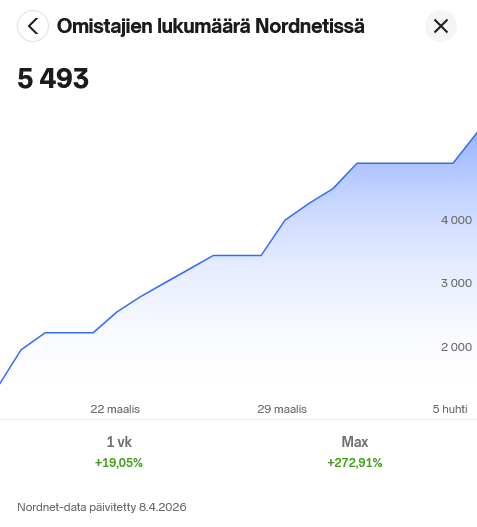
According to this, 5493 investors own new Faron shares, while there are ~14300 owners of old shares:
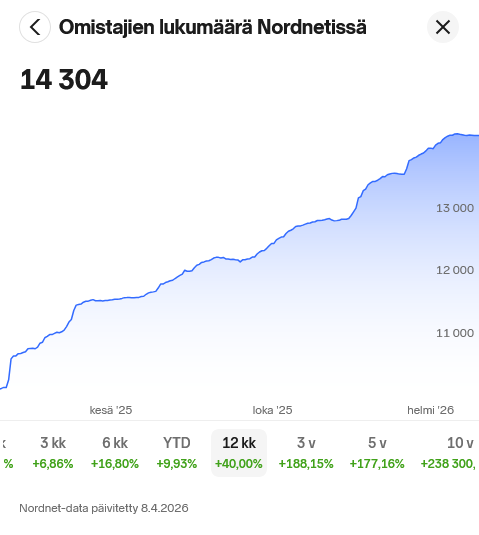
I don’t know how reliable the above figures are, but based on them, many small investors seem to have thrown in the towel.
5 Likes
Based on the Nordnet-Shareville discussion forum, participating in the offering seemed to be challenging for many due to a lack of information and skills (if one can genuinely deduce anything from the chatter on said forum).
5 Likes
Is there any information on whether retail investors have traded subscription rights? If not, could the offering fall short?
The trading volume for Faron has remained high, so someone is still willing to buy the shares. One would think the offering went through because of this.
3 Likes
Small investors have certainly sold their subscription rights, but some were probably left unused. Towards the end, the price of the right was so low that the value of many holdings did not even cover the selling costs.
However, it is quite typical for primary subscriptions not to be fully subscribed. In Faron’s case, what I find essential is whether any shares were left for the underwriters after the secondary subscriptions.
1 Like
The offering was/is practically fully guaranteed. So, there’s no need to speculate whether the offering succeeded or not. It did succeed, and that has been known for several weeks now. Of course, this certainty came at a considerable cost, as instead of 40 million, only 32-34 million (I don’t remember the exact amount) will be received in cash.
2 Likes
At least I wasn’t able to sell subscription rights from my Nordea Buy account, even though I tried. It brought to mind the famous words from Monopoly: “ignorance in official matters, fine 28.40 €.” So, I didn’t sell, even though I was eager to. Of course, I topped up a little directly from the stock exchange. No great harm was done there. Now we just wait for Timo Soini to announce on TV that JYTKY has arrived.
2 Likes
8 Likes
A few were left, 52% of the shares were subscribed. A successful offering, as Faron announced.
7 Likes
Well, the offering really went south, and the guarantors ended up with a huge number of shares.
15 Likes
Wonderful, a negative take on every piece of news concerning the company. However, the offering still generated the money sought. Now, we can only hope for the worst possible research results so we can rant even more.
57 Likes
I really hope Faron and Juho come to their senses now and understand that we’re almost at the last resort:
- Could we save money somewhere?
- Do we need all this staff? All the time? Layoffs (YT)?
- Communication should be direct and honest
They could start by acknowledging that the company will go bankrupt within a year if things don’t change – and results don’t improve.
This second-to-last offering barely scraped by. The last remaining options are in this current share issue…
7 Likes