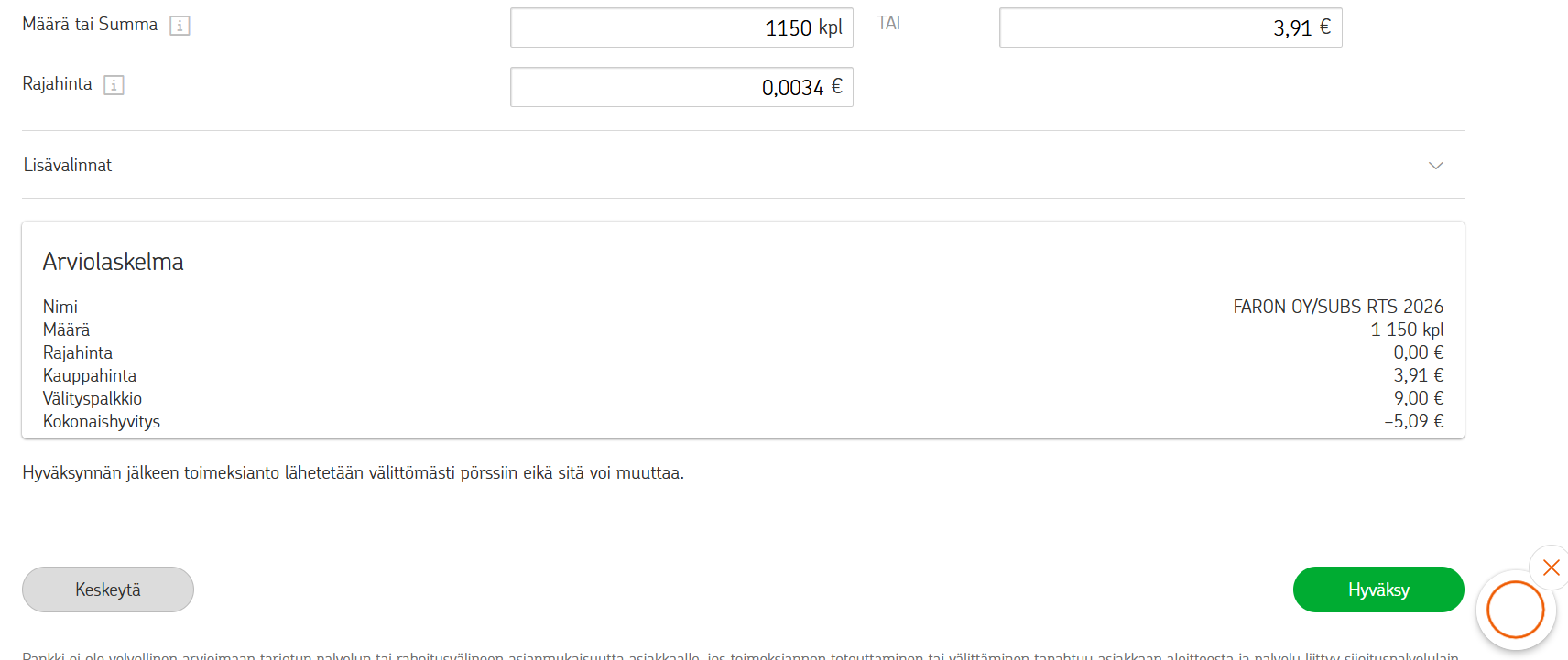
Right now, by selling, you would get €0.0038/share for those subscription rights, which is roughly a bit over €4 for 1150 subscription rights. I’m not familiar with Osuuspankki’s (Co-operative Bank’s) fees, but it’s unlikely you’d gain much after expenses from that sale. The subscription rights will eventually disappear from your portfolio, and in your case, they hold almost no value.
3 Likes
Of course, you can also exercise your subscription rights by subscribing to new shares (1150/13x9) 796 shares x €0.5/share = €398 (no trading fees). In this case, your ownership in Faron will remain at the pre-issue level. But this is not investment advice! Everyone makes their own investment decisions.
4 Likes
The share price dropped by €0.5 because the offering allows subscribing at exactly €0.5/share! I’m operating on the assumption that the company’s value will recover to close to €200M, which would mean about €1/share!
3 Likes
I couldn’t get rid of them from my Equity Savings Account, at least not me. First, it reported a technical error for a week, and now it suggests opening a book-entry account. I’d say they can keep their junk. And finally, a couple of swear words. Nrd. damn it!
Thanks for the advice. Somehow, I was confused by the €3.45 and the €0.60 my other family member had. I pressed the sell button and looked at what it offered. And indeed, it offered a net of about €4 (of course, OP’s fees would be deducted from that - should be €8 in fees). So, it seems these rights shouldn’t be sold even if you end up with a net loss either way. This kind of stock doesn’t seem suitable for an amateur when you have to think so much and still don’t understand anything. Better to stick to what you somehow manage. And that’s not stocks 
On OP’s equity savings account, subscriptions or the sale of subscription rights can be done under Events - Corporate Actions.
1 Like
I no longer know whether to be pleased or concerned about this race by the Chinese researcher army. They repeatedly support these results.
This ovarian cancer article also strengthens mechanistic understanding, and as others assemble the puzzle, Faron will likely be the first to see the emerging picture and be able to utilize it, provided the funding lasts that long.
China would also be able to copy anti-PD-1 drugs, but they still sell the same blockbuster drugs as in the West. However, price competition, supported by domestic products, is distressing.
This article used RNA STAB1 gene silencing, which cannot be fully compared to Bex. Maija’s lab work probably better proves that Clever-1 blockade has an effect on immunity. These have been discussed in the thread many times.
But strangest of all, this study investigated STAB1 silencing in cancer cells! Not in macrophages/TME. Where’s Maija!
Almost all ovarian cancers were found to be lymphocyte-poor in the TME in Maija’s review Faron Pharmaceuticals - Innovatiivisia lääketieteen ratkaisuja (Osa 2) - #2887 käyttäjältä jerej. That is, cold, meaning Bex candidates.
Ovarian cancer was studied per Maija, but macrophages were studied as “Here we characterized bexmarilimab response in ovarian cancer ascites macrophages ex vivo using single-cell RNA sequencing and demonstrated increased IFN signaling and CXCL10 secretion following bexmarilimab treatment. We further showed that bexmarilimab was most efficacious in macrophages with low baseline IFN signaling, as chronic IFNγ priming abolished bexmarilimab-induced TNFα release. These results highlight an approach to target immunologically cold tumors and to increase the likelihood of their subsequent response to ICIs.” Bexmarilimab Activates Human Tumor-Associated Macrophages to Support Adaptive Immune Responses in Interferon-Poor Immune Microenvironments - PubMed
The Chinese conclude:
“These findings suggest that STAB1 is a promising dual-compartment therapeutic target capable of disrupting the symbiotic pro-tumorigenic interaction between cancer cells and tumor-associated macrophages (TAMs).”
11 Likes
That’s how it seems to go with Osuuspankki (Co-operative Bank). You have to pay if you sell the subscription rights, so don’t do anything, you’ll save 5 euros.
3 Likes
The setup is indeed different from Bex. Here, STAB1 of cancer cells was examined, not macrophages/TME.
Perhaps its value lies in the fact that the same STAB1 axis appears to be functional on the tumor side as well, not just in macrophages. It somehow complements Maija’s/TME picture; it doesn’t replace it.
8 Likes
or you put in that less than 400 euros and subscribe for the additional 796 shares you are entitled to with your rights. You can, of course, try to get more from the secondary subscription, but there’s no guarantee you’ll get all of them, time will tell.
But if you don’t want to invest more money, it’s best to do nothing; fortunately, we’re not talking about a big loss of money here. At the start of the subscription, you would have made a few euros profit by selling them.
1 Like
It is certainly not an alternative to the Clever-1 studies conducted so far. It only makes Clever-1 an even more significant target. Directly, RNA silencing within a cancer cell cannot be compared to paralyzing the Clever receptor on the cell surface with Bex, even if it were internalized into the cell; the effect of reduced signaling through Clever can ultimately be similar. And would that also reduce the movement and division of cancer cells? Will the Chinese or Maija conduct the experiments first?
When considering how various signaling pathways operate in cancer, what comes first and what follows, this study ponders whether it could be that Clever-positive macrophages communicate via the SPP1-CD44 axis. SPP1 and its connection to Clever were already discussed in the thread by @jerej. The question arises whether s-Clever is in some cases a possible component of the secretome. Does the cancer cell secrete osteopontin SPP1, which turns the macrophage Clever-positive? At least TGF-beta and IL-10.
Essential for cancer’s success is its secretome, i.e., all the mediators it secretes into its environment and the structures it forms on its surface to suppress immunity. This study found that Clever-1 would be one such factor. How significant it is generally is unknown. Every cancer is individual. Cancer has all the cell’s means at its disposal, and it would be a wonder if Clever-1 were not one of them.
15 Likes
Macrophages are of great interest in China.
From the major Bex review:
“Beyond myeloid-specific interventions, Clever-1 blockade may augment innate immune agonists such as STING or TLR ligands. These agents activate type I interferon signaling and dendritic cell maturation, processes that bexmarilimab potentiates by increasing antigen availability and presentation.”
https://www.tandfonline.com/doi/full/10.1080/1750743X.2026.2617035
So there is evidence that blockade with Bex enhances the same processes as STING, but whether it goes in the order that Bex regulates through STING, making Clever the Master of Regulation, is only stated as “may.”
“cytokine-driven signatures, such as IL-10–rich environments, may serve as functional biomarkers for Clever-1 dependence and therapeutic susceptibility.”
“Functionally, bexmarilimab inhibits scavenging of modified LDL, reducing the activation of nuclear lipid receptors while promoting NF-κB activation.”
The same mediators are being discussed.
The MIIP in the Chinese article is an intracellular protein. Clever-1 is expressed on the cell surface and freely, so it is in constant interaction with the environment. It describes signaling that prevents M2-type development of macrophages. Bex, on the other hand, blocks the activity of already formed M2s. It is possible that STING suppresses STAB1 (STAB1) transcription through a decrease in IL-10. So it would be its regulator.
But in biology, things don’t always go in one direction. Clever-1 activity (M2) consumes and destroys cellular debris, precisely those that would trigger STING defense, so in this way, Clever is actually a STING regulator.
Whether Clever is at any point in the chain, the most important thing is that a safe antibody has been developed to block it. STING drugs are being developed, but there have been problems with efficacy and safety. Regarding efficacy, we are eagerly awaiting the start of solid tumor patient studies for Bex.
13 Likes
Based on that paper, it is still impossible to say what mechanism mediates the Clever-1+ cancer cell phenotype. One possibility is that Clever-1 stimulates T-cells to secrete TGF-beta, which is a very well-known factor promoting EMT (i.e., epithelial to mesenchymal transition, a cellular mechanism that mediates metastasis), and TGF-beta increases the metastatic properties of cancer cells.
However, Figure 9 in the paper shows Clever-1 knocked out in cultured cancer cells, and it was shown to affect cell migration. This result would rather suggest that Clever-1 directly affects cancer cells. In this earlier work from Sirpa’s lab, Clever-1 was shown to mediate leukocyte binding. It is possible that it mediates the same mechanism in metastasis when cancer cells move from the tumor to the bloodstream.
“Anti-Clever-1 mAb inhibited monocyte binding to tumor vessels by 70%, whereas no inhibition was seen in lymphocyte binding (Fig. 6B). Thus, anti-Clever-1 therapy may prevent leukocyte entrance into the tumors by targeting Clever-1 both on the vascular endothelium and monocytes and is well in line with the results obtained with MACROclever−/− and ENDOclever−/− mice.”
Wasn’t a macrophage-like gene expression signal identified in some of those earlier Clever-1+ cancer cell papers precisely from metastatic cancer cells? Perhaps that is also related in some way to Clever-1-mediated cell adhesion.
11 Likes
The Chinese researchers’ observation regarding cancer cells themselves needs to be replicated and refined. I haven’t found any other observations of Clever-1 expression in solid tumor cancer cells being studied/discovered. Are there any?
When a cancer tumor is studied, it contains macrophages and Clever-1s on the endothelium of the tumor’s blood vessels and lymphatic vessels, which indeed seem to have some significance if they are regulated up or down. Tadayo refers in his dissertation “Role of Clever-1 in Leukocyte Trafficking and Inflammation”
to the work of Professor Marko Salmi (fun fact: Salmi is Faron’s 6th largest owner right now and Sirpa’s successor at inFllames) from 2004: “Upon inflammation, Clever-1 is upregulated on the blood endothelium of inflamed tissues, such as tissues undergoing wound healing, skin psoriasis and endothelium of melanoma metastasis. (Salmi et al., 2004)”
12 Likes
Hello,
I thought I’d once again explain my reasoning in simple terms, this time regarding that article. I should mention that I have read the entire article, not just the snippets visible “on this side” of the paywall.
Link to the article:
https://www.sciencedirect.com/science/article/abs/pii/S1368764626000300
What is the essential finding of the article?
The article demonstrated that clever-1/stab1 (a beloved child has many names) affects the SIRP-alpha (SIRPα) expression of macrophages, which in turn affects how well macrophages recognize CD47 proteins on the surface of cancer cells.
So what are CD47 and SIRP-alpha?
CD47 is a protein found on the surface of numerous cells in the body, intended to signal the immune system (macrophages) that “do not eat us, because we are not foreign.” Otherwise, the immune system would start destroying the body’s own cells, which would have dire consequences. Macrophages recognize these CD47 proteins with the help of a receptor called SIRP-alpha, which is located on those macrophages.
The problem in cancer is that if cancer cells express this CD47 structure, then macrophages do not recognize them as cancer cells but mistake them for the body’s own cells, and thus do not engulf them, nor can they present their antigens to other immune cells. This is how cancer “hides.”
CD47 inhibitors have been studied as cancer drugs for a longer time, and they are very effective, but unfortunately, they block CD47 on all cells, so the harms are truly abundant and dangerous, making the drugs clinically unusable. For example, magrolimab.
What is the role of clever-1?
Clever-1 is on the surface of the macrophage (not in the cancer cell) in the same way as SIRP-alpha. The article showed that in a mouse model of lung adenocarcinoma, resistance to osimertinib was mediated by higher clever-1 expression in tumor-associated macrophages, and more specifically that higher clever-1 expression was associated with higher SIRP-alpha expression and more abundant CD47 expression in cancer cells. It was also shown that blocking SIRP-alpha removed this clever-1 mediated effect.
That is, higher clever-1 appears to regulate how much SIRP-alpha a macrophage has, which it uses to identify CD47-positive cells (either its own or cancer cells), so that it knows not to engulf them. Conversely, less clever-1 leads to a lower amount of SIRP-alpha and thus causes the macrophage to also engulf cells that have CD47 expression. That is, it effectively creates local CD47 inhibition.
What does this mean for BEX?
Clever-1 is thus an enhancer of SIRP-alpha and thereby participates in regulating how macrophages recognize CD47-positive cells (and leave them uneaten). So, in summary:
- Lots of clever-1 in the macrophage
- More SIRP-alpha in the macrophage
- Macrophage recognizes CD47-positive cancer cells more effectively
- Macrophage leaves cancer cells uneaten, which is a bad thing
The biological effect of bexmarilimab (which binds to clever-1) is based on the fact that it somehow affects the function of clever-1. It is known that bex transforms macrophages from an immunosuppressive (M2) type to an inflammatory (M1) type, improves antigen presentation, alters lysosomal processing, affects the cytokine profile, and increases T-cell-mediated immunity… but how and why? It’s a bit unclear.
Given the previous background, at least this mechanism seems obvious:
- Bexmarilimab binds to Clever-1 on the macrophage surface, which interferes with clever-1’s function and does not activate it (antagonist)
- The amount of SIRP-alpha in the macrophage decreases as a result of reduced clever-1 function (as the article strongly appears to show)
- The macrophage no longer recognizes CD47-positive cancer cells as it did before
- The macrophage begins to engulf cancer cells again and thus can also present antigens
So how about all those different effects of BEX? My guess is that they are all downstream effects of the main mechanism. If the macrophage begins to effectively engulf cancer cells again, it naturally follows:
- more tumor material inside the macrophage
- more antigens to process
- more antigen presentation
- more T-cell priming
- more inflammatory signals (cytokines)
- less immunosuppressive macrophage state
If a single molecule has abundant effects, in biology it is fundamentally more often a case of several downstream effects of one main mechanism. And this would fit here too. And the clever-1-SIRP-alpha-CD47 pathway shown in the article would indeed beautifully fit as that mechanism.
Why does this matter?
CD47 inhibitors appear effective in cancer treatment, but are primarily unusable due to systemic side effects. But if clever-1 inhibition with BEX effectively creates local CD47 inhibition where there are many TAMs (tumor-associated macrophages in an immunosuppressive environment = macrophages with lots of clever-1), then that would explain how good efficacy can be achieved combined with minimal side effects. It also explains why BEX works specifically in combination therapies: BEX frees macrophages to engulf cancer cells and present antigens (“targeting the target for T-cells”), but in addition to targeting, those T-cells are also needed to “fire.”
PD-1 inhibitors, on the other hand, are effectively brakes on those T-cells. They are effective in metastatic cancers, but the problem is developing resistance as tumors become immunologically cold when macrophages no longer present antigens…
That is, BEX gets macrophages to target and PD-1 gets T-cells to fire.
Makes sense. I emphasize that this is my assessment of what the mechanism could be, not proof. But if it were true, then BEX would practically be a way to utilize CD47 inhibition without its key side effects.
36 Likes
Juho’s interview with Redeye:
https://www.redeye.se/research/1158137/faron-pharmaceuticals-interview-funded-beyond-inflection-points?utm_source=interview
14 Likes
How is bex’s effect targeted to this desired location, without causing side effects elsewhere?
2 Likes
4 Likes
Reason for Syrjälä’s notification: Dividend payments in kind. As a result: An acquisition or disposal of voting rights.
A similar operation as 2 weeks ago. Dividend payment to someone other than oneself. So, an ownership arrangement where shares are transferred out of a holding company. Technically something other than a sale, but the outcome is the same: Syrjälä’s official voting power and ownership stake in the company decrease.
There is no information about other Acme owners who could receive dividends. As capital-envious speculation, it’s good to make wealth arrangements when the target is undervalued, if taxes concern anyone in Monaco.
7 Likes
Bex is a Clever-1 antibody. It works where there are many Clever-1 expressing cells, i.e., in tumor-associated macrophages (TAMs), which are specifically found in immunologically cold tumors.
In other words, the Clever-1 antibody specifically targets macrophages in an immunosuppressive state. These macrophages are not evenly distributed in the body but are concentrated in the cancerous tumors that are the problem. This allows Bex to be administered systemically, but its effect is (due to the distribution of Clever-1 expressing macrophages) somewhat localized to where the cancer is.
If, on the other hand, CD47 on cancer cells is targeted directly, then all CD47 on the body’s own tissues will also be targeted, resulting in a large part of the effect occurring in places where it is not wanted or needed.
13 Likes