If I read and interpreted that correctly, the funds will last roughly until the end of May. I couldn’t find any savings from last year - others?
There is still almost 3 months left to secure that €40M. There’s already a real rush for the share issue and its terms as the stock price continues to languish.
There didn’t seem to be any rush to the general meeting - this results in a really cheap offering price, the market price won’t really rise from here because the offering is being awaited, it will drop though.
Kauppalehti’s interview with Juho, Economic Morning 4.3.26 today Pörssissä rysähtänyt suomalaisyhtiö lupaa suuria: ”Nyt on baana auki” – Katso keskiviikon Talousaamu | Kauppalehti Regarding partner negotiations, ongoing, mid-sized pharma, partly BP interested in MDS, big pharma in solids. Faron’s iPhone moment. Transcription by TurboScribe, typos corrected and checked.
Summary
Kauppalehti Economic Morning 4.3.26
2025 was an excellent year for us regarding drug development, as you said, losses were made quite famously and in steady amounts, but the medical results were exceptionally good and right now I would like to express my thanks to all our shareholders and supporters in Finland, of whom there is a large number, that together we have achieved something, I would say, exceptional—that is, we are developing a drug against blood cancer, for which there has been no new treatment in 20 years; we’ve even gone to the moon, but a drug for this has not been found, and now we have so far achieved some of the world’s best results in this.
So, your lead product is this cancer drug called Bexmarilimab. Briefly, what does it actually do?
Yes, it’s a receptor on the surface of a cell called a macrophage. Now, the blood cancer we are treating is a macrophage; those cells have, those cancer cells have gone crazy, so now they all have that receptor, which we then target with Bex—meaning we attach to it—so we essentially turn off the cancer’s defense mechanism and then get the immune system to attack the cancer. So we’re not talking about a traditional toxic cancer drug here, but rather getting the body to kill the cancer.
So, it’s a bit like training the body.
Yes, exactly so.
And removing the defense mechanism from the cancer.
Well, Faron’s big news for the beginning of the year is that you need 40 million euros in additional funding through a rights issue, and now on Monday, the general meeting authorized the board to seek this additional funding through a rights issue.
What is this money actually needed for?
Yes, that’s right.
The board has made a plan for this.
We intend to conduct the next phase clinical trial as planned next.
What also happened in 2025 was that when we published these excellent results, our biggest competitor, a pharmaceutical giant named AbbVie, actually failed in its own attempt in this blood cancer.
And now the way is clear, and that’s when you have to put the pedal to the metal.
That’s what we’re raising money for: to push forward at full speed, to maintain the lead, because new competitors will be coming up behind us.
That’s why the raise is happening.
I understood that, yes, the money is needed for drug development and it’s expensive, but wasn’t this money supposed to be funded through a partnership agreement with a pharmaceutical company?
That’s also still possible, and partner discussions are continuing closely around this.
Now, this failed clinical attempt by AbbVie has brought some after-effects; some caution has entered this sector, but regarding a very difficult blood cancer.
However, we have excellent results for it.
Partner discussions have had to be recalibrated.
We’ve had to learn from what went wrong in AbbVie’s attempt.
We have adjusted our development plan accordingly.
And now partner discussions have had to be recalibrated.
They are still ongoing.
It’s one option, but we can’t, so to speak, stay lying in the line of fire. We must continue forward.
We must remain strong and in that leading position.
So that’s why this is a very important funding round for us.
Yet, regarding a partner, this agreement was promised in 2024 and 2025.
So what has it been stuck on, that they haven’t materialized?
Proposals and offers have come in.
In 2024, it was said openly that the offers weren’t quite enough.
We know what our value is or what kind of significant scientific contribution we are making here.
So in 2024, it wasn’t enough.
Let’s say, we’ll finish these clinical trials as we did.
And now we’ve reached the level where we need to be.
Now we’re talking about the right things.
The world is cruel.
Our financial situation is also looked at because we are a public company.
That is used ruthlessly against us.
That’s why we must remain strong, stay in control, and keep our own fate in our own hands.
What kind of offer would be enough?
I cannot specify that.
What kind of companies have you been negotiating with?
Probably individual partners can’t be named, but is it Big Pharma—these large partners—or smaller companies?
There’s a mix of both; there are quite a few parties involved.
At the moment, the most significant ones are mid-sized companies that specialize in blood cancer.
Big Pharma is also involved, but Big Pharma looks at this from a slightly different angle.
I really can’t say names.
Big Pharma is interested in what the future drug sales will be.
MDS, the blood cancer we treat, is a moderately sized market.
That interests mid-sized pharma.
Big Pharma is interested in large indications, truly massive sales.
MDS is right on the edge for them.
In addition to what we are doing now with this funding round, we intend to produce data in several different cancers.
Then, if we can show that, wait a minute, this isn’t just for this blood cancer, but it also works in this cancer, then that is what Big Pharma ultimately wants to see.
Are you in negotiations right now?
Yes.
How many?
Enough.
Well, what would you say to investors who once again have to fund Faron, even though they might have been expecting a partner deal and a return on their investment?
Well, now if ever, we are at the right tables, with the right sums.
I know it has taken time.
These things often take time.
Partly also, conditions change around us, as in this AbbVie case.
We’ve had to adapt our operations.
In my opinion, companies that can’t adapt to circumstances usually don’t succeed.
Companies that can adapt, listen, learn, understand, and adjust become successful companies.
This is how I see our situation.
Fortunately, we are small, agile, and I would say smart.
We have adapted.
We have taken the lessons learned.
We’re pushing forward.
One example.
I could say in layman’s terms:
Now we are putting a touchscreen into the handset.
Putting a touchscreen into a handset requires more investment.
What makes this moment different from, say, 2025 or 2024?
Now we are starting several clinical trials in different cancers.
Now the data battery we intend to produce is significantly larger and broader.
Back in 2024–2025, we had to concentrate our operations and resources entirely on this one thing to get on our feet.
2024 was a crisis year for us.
aiming to get on our feet.
We delivered excellent results.
Now we’re thinking of opening up that front and pushing a bit broader front again.
How far will this 40 million euros last, if it is raised?
Until the end of 2027.
Will that allow for this third phase to be completed?
Phase 2/3 has its two parts.
Now this Phase 1–2 has been what’s called an open label study.
People see what’s happening in it.
The FDA has wanted the “gold standard” from us next; they want a blinded, randomized study.
Meaning nobody knows who gets what.
And that will be BEX plus standard chemotherapy versus standard chemotherapy alone.
Nobody knows who gets what.
And then the cards are turned over.
That is the ultimate test that is needed, what the FDA wants, so that the drug can receive approval.
The FDA is the federal drug administration of the United States.
Yes.
The United States is the main market you’re targeting.
It is by far the largest market.
And the fastest to process these marketing authorization applications.
Finally, Faron CEO Juho Jalkanen.
What will happen at Faron this year? What are the milestones for this year?
[/details]The steps forward.
The board will then decide on the financing round.
And then it will be announced at a time the board decides.
From here on, the emphasis will be on clinical development.
Commercial negotiations will also continue.
They may materialize, but we will not wait for them, as the most important thing is specifically to keep the development ongoing.
To produce the next data points for these commercial discussions as well.
The next data points, whether they are from blood cancer or solid tumors, will be significantly valuable for us in these negotiations.
Is there a plan for when these data points, information, and results will be coming to investors?
They will be presented over the course of this spring.
All right. Thank you very much for the interview, Faron CEO Juho Jalkanen.
Bye bye Business case. Who still remembers? Personally, I am looking forward to the results of the combo trials. From the sidelines, of course. 2026 is a gap year. Research case, we meet again (actually he never left).
In this situation, the company’s board simply had to ensure the company’s financing. This is what we’re going with now. The company’s value will then rise with new pharmacological evidence. The share has indeed been beaten down. I have so much tied up in the company now that I won’t be doubling or tripling my holding anymore, but I have strong confidence in the results so far and that the company will be able to deliver more of the same in the future.
I wonder if we are also waiting for EU funding decisions here? If Faron Pharmaceuticals were to receive, for example, €40M in debt financing and a share issue didn’t need to be organized, shouldn’t the market value settle higher than before the share issue news, as financial security would improve, dilution risk would disappear, and at the same time, better conditions would be created to advance bexmarilimab + new research projects? After all, the EU is now quite a significant owner in Faron. Is this perhaps too much wishful thinking?
Usually, the EU seems to want private money involved. So, I personally see this as an opportunity after the share issue. Could EU money be used to get rid of the HCM loans?
From the interview, it can be interpreted that evidence in solid tumors is needed to interest Big Pharma; otherwise, they remain in the negotiation league of mid-sized pharmaceutical companies.
The potential €40M funding from the share issue will be sufficient for the period from Q2 2026 to H1 2027. This means that strategic partnerships should be established by H1 next year at the latest, for which further research results can start to arrive in 2026/2027. Otherwise, an additional share issue will be required.
Good interview and it makes sense that these mid-size companies are the most interested right now. I believe, however, that Novartis is strongly on the lookout, and if the solid [tumors] break through, then the mid-size players won’t have a chance anymore. Strategically, these smaller ones should join forces with Faron early. Whether it’s financially worth it for us shareholders is another matter.
Well, “small” is relative; I’d certainly be fine with Jazz as a partner.
| Company | Revenue (USD) | Focus in blood cancers |
|---|---|---|
| Incyte | ~5.1 bn. (2025 forecast) | Market leader in myelofibrosis (Jakafi). |
| Jazz Pharmaceuticals | ~4.1 bn. (2024) | Significant AML and leukemia portfolio (Rylaze, Vyxeos). |
| BeiGene | ~3.8 bn. (2024) | World’s best-selling BTK inhibitor for lymphoma (Brukinsa). |
| Genmab | ~3.7 bn. (2025 forecast) | Antibody technology giant (Darzalex, Epkinly). |
| Exelixis | ~2.3 bn. (2025 forecast) | Expanding strongly from solid tumors into hematology. |
| Argenx | ~2.2 bn. (2024) | Focuses on blood-related autoimmune diseases (ITP). |
Incyte and Jazz Pharmaceuticals are strategically closest to Faron’s Bexmarilimab, as they already operate heavily in myeloid diseases (such as MDS and AML).
BeiGene is currently the most aggressively growing “mid-size” player, investing heavily in new mechanisms of action.
The potentially obtainable €40M in financing from the offering will suffice for the Q2 2026–H1 2027 period.
In the interview, Juho said the funds would last until the latter part of 2027.
These are estimates, and it is currently unclear how much of the €40M will immediately be absorbed by short-term loan repayments and arrears. For 2025, I understood the operational cash burn to be €1.6M/month, with expenses potentially rising to the €2.5–3.5M/month level as Phase III approaches. I estimate that in 2026, around €30M will be burned, leaving the cash balance at €22M at the end of the year. And in 2027, the spending level will surely be around €45M/year.
I don’t believe the cash will last until 2027, but there are certainly different views on this.
What was Juho saying there, as it seems people are trusting the story again?
A big share issue is coming up soon, though.
Learning from late-stage trial failures in higher-risk myelodysplastic syndromes:towards adaptive and biomarker-enriched designs:
Amer M. Zeidan, Sofia Aakko, Maximilian Stahl, Jan P. Bewersdorf, Petri Bono, Teppo Huttunen, Juho Jalkanen, Elina Louramo, Aneel Nimba and Joab Williamson
https://www.tandfonline.com/doi/full/10.1080/14737140.2026.2640238
HR-MDS trials have often failed because the patient population is very heterogeneous. A review featuring familiar names emphasizes the importance of adaptive trial designs and biomarker-based patient selection.
→ in line with the BEXMAB program.
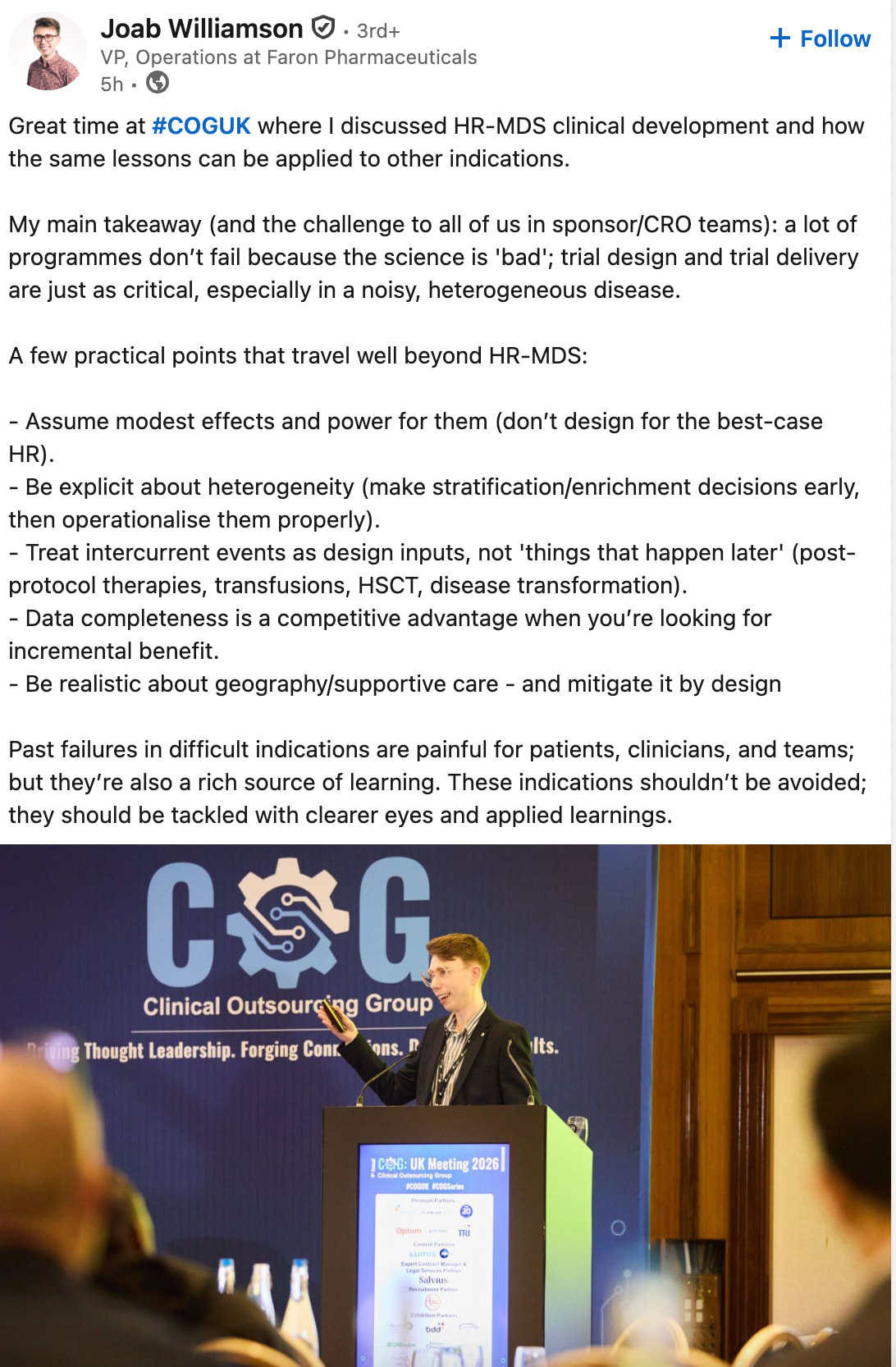
Joab spoke about this same topic and paper:
Webcast Q&A
Interesting reflections on whether Phase 3 could be in subgroups like TP53 or low blast counts, where Bex has looked particularly good. Lower costs and lower risk. Once a foot is in the door, it could be expanded. Transcribed, translated, and checked. Cash runway is indeed a “kassakiitotie”.
Additionally, regarding the study design for r/r MDS and why there might not be a control group.
Is Bex really protective against a dangerous lack of white blood cells, i.e., neutropenia? We will see in the follow-up study.
Summary
Q&A
The first question goes to Jurriaan.
What is the timeline for the planned offering?
I can say that we are progressing well and will provide more information in due course.
The next question is for Juho.
Why does City of Hope want to conduct the R/R MDS study? Have you considered conducting it yourselves, despite what the FDA has said?
There are several reasons to continue the study in the last-line setting. Ultimately, the most important thing is that there isn’t really anything else available. The study gives last-line patients a chance to receive BEX + AZA treatment and hopefully benefit from it at that stage.
After talking with doctors, especially at the ASH congress, they see very clearly that the benefit in the last line comes from BEX. We discussed with the investigators preparing the study whether they would consider a control arm of investigator’s choice treatment, which would increase the regulatory significance of the data. They felt that would even be unethical because BEX + AZA is available. They did not consider it ethical to provide investigator’s choice (what the doctor decides) or best supportive care as a comparison.
Ultimately, it’s not about AZA. They are planning the study with oral HMAs. According to doctors in the US, oral HMAs are becoming more common and are likely the future standard of care instead of AZA. For us, if we are aiming for a new standard of care as an HMA combination, it is also important to generate data with these new oral HMAs.
⸻
Question: As you see responses deepening over time in the Phase I/II data, can we expect the CR rates for the randomized Phase II part to be sufficiently mature by the end of 2027, or will more come during follow-up?
We are looking at this closely. We believe that by the time results are released, the vast majority of patients will have achieved CR, if it is achievable. This is a very important data release, so we won’t do it too early.
⸻
Question: Do your updated BEXMAB data show strong signals in first-line high-risk MDS, including TP53-mutated patients? What is your biomarker strategy regarding enrichment or companion diagnostics?
In MDS, practically all patients are CLEVER-1 positive, so there doesn’t seem to be a need for patient selection. Therefore, we are not developing a companion diagnostic.
However, there are very interesting subgroups. As mentioned in the question, in TP53-mutated patients, the CR was an astounding 70%. It is a very interesting population where nothing really works.
Another interesting subgroup is the so-called low blast count patients, i.e., patients with few cancer cells. It seems we are performing well in this population, which is considered difficult and where cell-killing drugs usually don’t work. As a disease-modifying drug, we seem to be working.
That’s why the Phase II part of the Phase II/III plan is important: we can then consider whether the final Phase III study should be done in a specific subgroup, for example, in the low blast count or TP53 population. This way, the Phase III study could be smaller and more cost-effective while still allowing for approval. The most important thing is the first approval. We have shown that this is an all-comer drug, but it seems to work particularly well in these subgroups.
⸻
Question: You report that the combination of bexmarilimab and azacitidine is well tolerated in a fragile patient population. What are the most common adverse events, their severities, and have any new risk signals emerged in longer follow-up?
Excellent question.
In longer follow-up, we don’t see new safety signals. The safety profile has remained the same. Nothing new in long-term treatment.
The most common adverse event is neutropenia and severe neutropenia. It is part of the disease, and AZA usually worsens it. With the BEX + AZA combination, severe grade 3–4 neutropenia is about 34%, whereas with AZA alone, it has been around 60%.
Surprisingly, it seems that the BEX + AZA combination improves AZA’s safety profile. This can potentially be shown in the randomized data next. If it proves true, it would be truly significant. There is a biological rationale because we induce hematopoiesis and improve neutropenia and anemia.
⸻
Question for Jurriaan: Besides the rights issue, what backup plans are in place (e.g., bridge financing, cost shifts, business development, milestone payments) to ensure a 12-month cash runway?
Based on the current state of the process, we are confident that we can extend the cash runway beyond 12 months, until the Phase II data release. The company constantly evaluates all financing options to act if necessary. More information will be provided in due course.
⸻
Question for Juho: You have decided to conduct the Phase II part separately before finalizing Phase III in first-line high-risk MDS. What are the exact decision points and success criteria that trigger Phase III?
Good question.
Historically, AZA alone yields a CR of about 17%. A 10 percentage point increase (about 27–28%) has been seen as positive and sufficient for others to move to Phase III, but that was based on open-label data and historical comparisons.
We have randomized real-time data. This gives the confidence to move to Phase III.
However, we aim to double the CR. For example, AZA at 17% and us at 35%. In that case, the Phase II data would have sufficient power for significant regulatory discussions.
⸻
Final question: What are the key drivers for 2026 that investors should follow?
In 2026: first patients in solid tumor studies, planned offering, first patient in the Phase II high-risk MDS study. Towards the end of the year, IIT studies will be open. Data will be reported gradually while we await the results of the randomized first-line MDS study.
⸻
That was the Q&A from 2025.
Thank you everyone. Have a nice day.
From a Kauppalehti snippet:
“Faron rejected a partnership offer in 2024.”
This is from a time before I followed Faron’s activities more closely.
Was there more detailed information about this, as in which company and under what terms it was rejected?
Apparently the negotiating parties have signed an NDA, as no information regarding who they are negotiating with, when, or what is being discussed has leaked to the public. It didn’t leak today either, and likely won’t until the deadline agreed upon in the NDA.