Faron Pharmaceuticals - Innovative medical solutions (Part 2)

How did the timeline go for the public offering 2 years ago?

A directed “bridge offering” to institutions (incl. EIC Fund) at €1.50 each + a loan totaling €8 million was announced on April 4, 2024, and it stated that a total of €27 million is needed to complete Phase 2. Mr. Syrjälä, Markku, Sirpa, and Pätsi participated in the crisis financing Announcement of Placing - Faron.

The Annual General Meeting (AGM) decided on April 8, 2024, to authorize the Board to organize a public offering of 30 million new shares and, if necessary, 30 million shares held by the company.

The Board’s decision on a €1 offering was announced on June 4, 2024 Faron commences a share offering - Faron; at that time, it was mentioned that only? Christine Roth had committed to the offering.

On June 20, 2024, the offering was announced as fully subscribed and even slightly over; €30.7 million was raised, and small additional subscriptions by Markku, Sirpa, Wichmann, and Pätsi were announced in accordance with PDMR Fully subscribed EUR 30.7 million share offering - Faron, because the price had dropped from €1.50 → €1 and that drop was compensated in shares.

At that time, shareholders did not have a pre-emptive right to subscribe, and there was no similar record date of ownership as there is now, if that means anything for the timeline. If things proceeded at the same pace now, the Board’s announcement of the offering would come in about 2 months from today. A historical timeline is, however, no guarantee of the future.

17 Likes

It was nice to travel from a bit further away to the Extraordinary General Meeting, and the takeaways from the hallway conversations with the CEO certainly increased my faith and trust in Faron’s management and board, but at the same time, it further shattered my faith and even naive trust in the FDA. Such errors in Phase III trial designs are absolutely unforgivable. How many lives have been lost because of this? Apparently, these have been seen before, so throw all of Kent’s endless writings praising the FDA into the scrap heap. I have lost trust in the entire institution, but this will still turn out very well, especially now that an absolutely incomprehensible built-in mine from the FDA’s side has been avoided.

58 Likes

I’ve been on winter break for a few days, so have I missed anything essential, as the FDA is being put through the wringer here? So, is the FDA to blame for Faron’s drug study drifting—if not quite completely off course, then at least for its progress slowing down? After all, Europe has its own medicines agency, the EMA, and a registration application can be sent there as well if things go sideways with the FDA.

Yes, it is. If we had followed the original plan, then for the primary endpoint regarding OS, Bex + Aza versus Vene + Aza would have been compared at 20-30 percent. It just doesn’t add up.

5 Likes

Here are Antti’s preview comments, as Faron reports its H2 results tomorrow, Wednesday. :slight_smile:

Faron will publish its H2 report on Wednesday, March 4, 2026, and the company’s results presentation can be followed here starting at 4:00 p.m. Faron is preparing for a registrational study, for which the company plans a EUR 40 million share issue. In the report, our interest is particularly focused on any potential further details and schedules regarding the financing round.

And here are further comments from Antti regarding how Faron and City of Hope are planning a new study. :slight_smile:

Faron announced on Monday that it is planning a new investigator-initiated Phase II study for bexmarilimab in relapsed or refractory MDS blood cancer (r/r MDS). The company intends to conduct the study as an investigator-initiated trial in collaboration with the prestigious U.S. cancer research organization City of Hope. The initiative helps expand the clinical evidence for bexmarilimab in a cost-effective way for the company. The announcement does not cause changes to our forecasts.

17 Likes

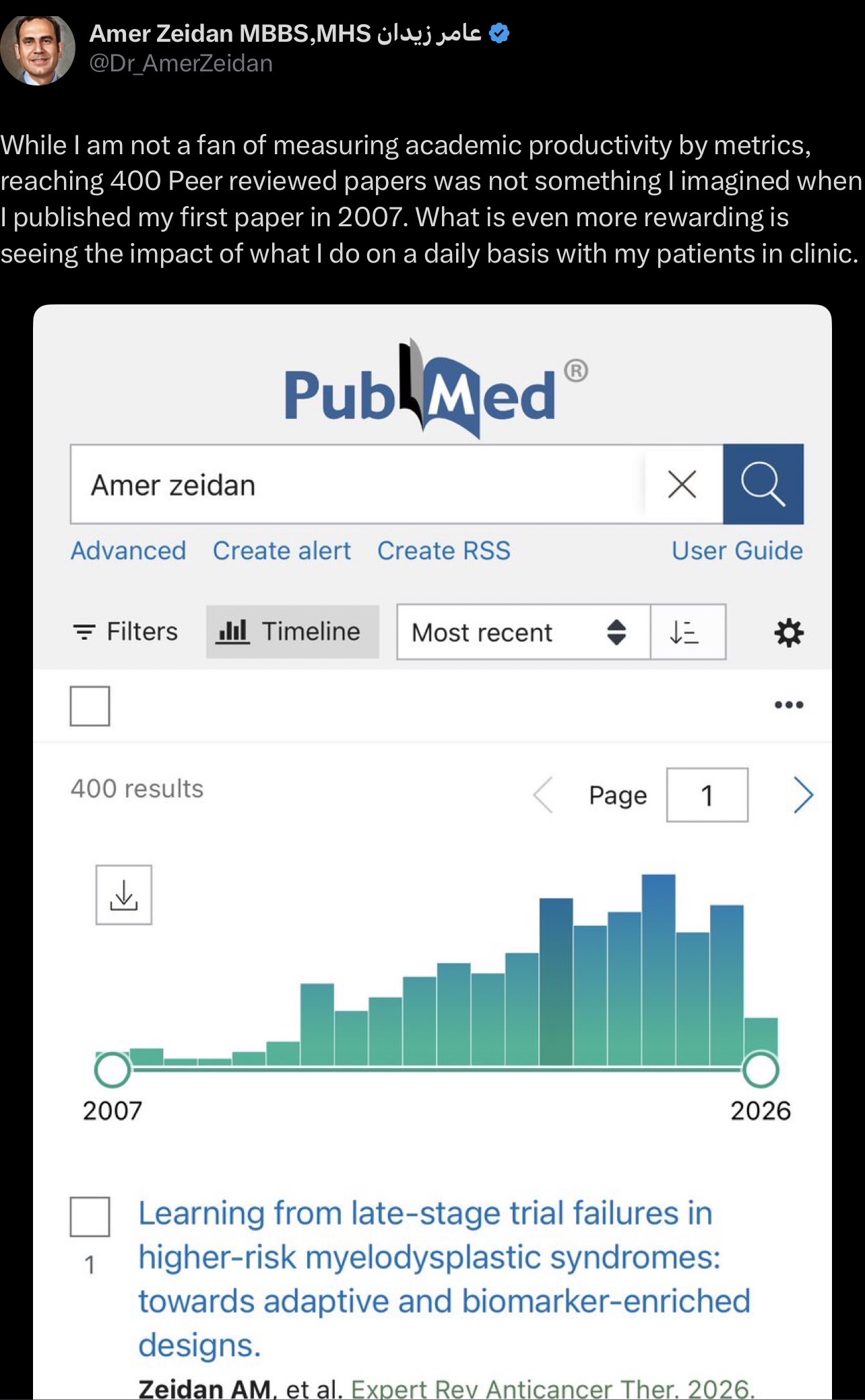
Help is on the way. The challenges of MDS trials are now featured in the Expert Review of Anticancer Therapy publication:

Zeidan himself says this is his 400th peer-reviewed article. Not bad for a scientist who isn’t exactly at retirement age yet. Other authors include oncologist Stahl from Yale, Huttunen as a statistical health economist, and staff from Faron.

The thread already featured a Blood publication on the topic “The Conundrum…”
In this one, Zeidan writes that researchers shouldn’t wait for a “miracle drug” that doubles survival time all at once, but rather focus on smaller, yet significant, steps forward.

Because: With current treatments, patients’ life expectancy tends to plateau at around the two-year mark; crossing this threshold is difficult.

Selecting patients for the study based on specific genetic mutations so that the treatment hits the right target and results are clearer—i.e., molecular enrichment. Or then stratification (as the phase 2/3 was intended to do regarding TP53).

Research must be adaptable on the fly based on results so that resources are not wasted on ineffective drugs. (As the phase 2/3 was intended—meaning the sample size can be adjusted according to results, a “seamless design 2/3” (which is apparently being abandoned), and Z. says that it must be possible to stop useless ones).

Additionally, it must be managed and predefined how those proceeding to stem cell transplantation are handled, as well as those receiving other drugs after the study (that Vene [Venetoclax]!).

I’m sure BEXMAB-2 will still turn out to be valid. That is, in a way that demonstrates the efficacy of Bex+aza without the pitfalls of study designs undermining the potential.

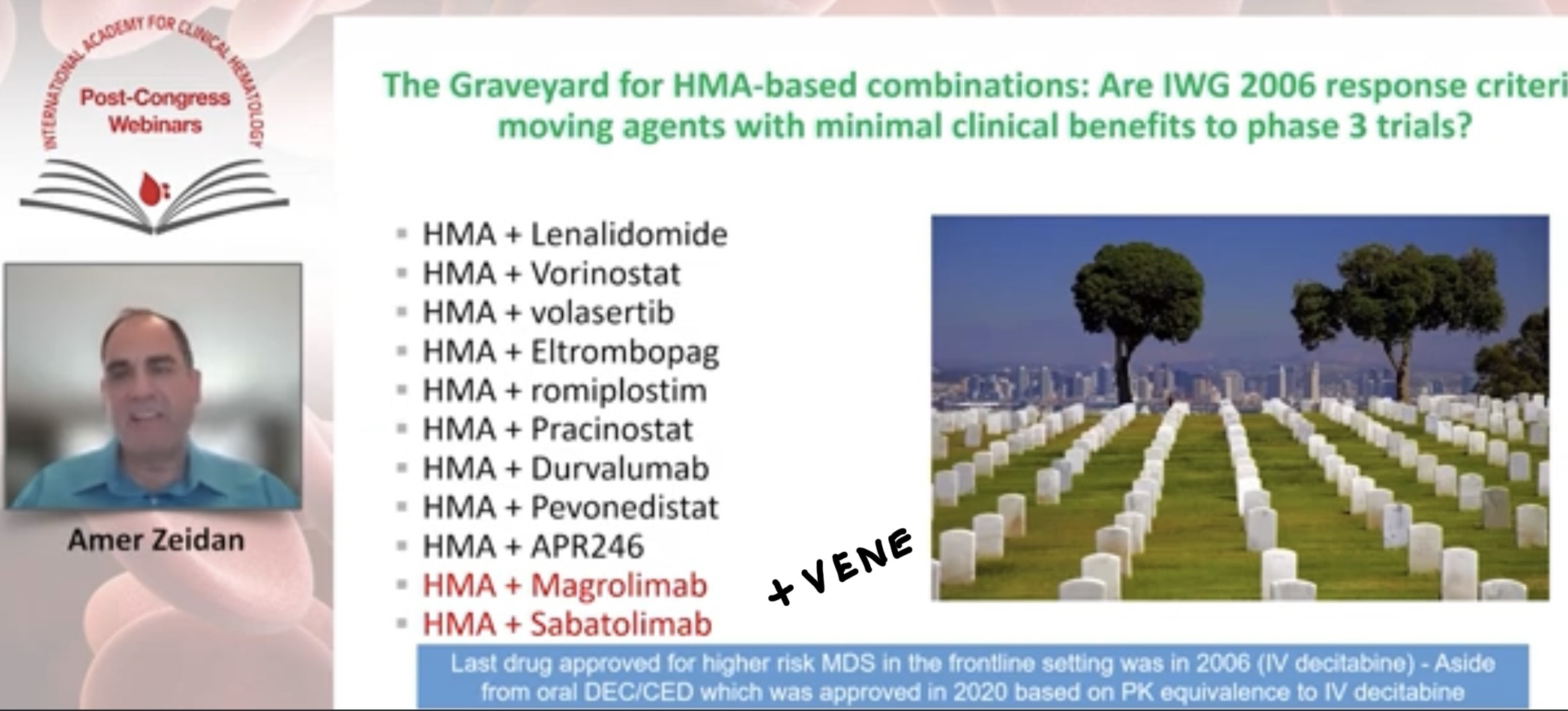
Zeidan has communicated in Faron’s webcasts that he has buried numerous MDS drug hopes, and now his eyes have apparently opened properly after the Verona trial; the ambition now is to actually get something through, but in a different way.

Some might remember this image from over a year ago. I added the latest one to the image.

IWG2006 was blamed there. Then Zeidan and his group developed IWG2023 and, from those criteria, for example, cCR, which was already accepted at the FDA’s EOP2 meeting as a secondary endpoint for Phase 3. The FDA does listen to scientists, but there is still some work to do—though it’s better to do it now than after the fact.

39 Likes

The question arises: is there a lot of wasted potential in those “graves”?
Would there be reason to dig some of them up and apply the IWG2023 criteria?

5 Likes

I wonder the same thing, and how it’s perceived in these companies—whether their product was really that bad after all. How many have gone under completely for nothing? How has it affected the development of cancer treatments, etc., etc. Then, when research plans are made under the guidance of the FDA that cost millions and have practically led straight into a wall. And there’s no accountability.

6 Likes

Regarding Magrolimab, it will likely no longer be tested in blood cancers due to toxicity; a tamed version is in trials, let’s see if it even has any efficacy.

Regarding Sabatolimab, it was explained afterwards that it might work in women. Novartis is not moving forward with it in MDS, however.

For Venetoclax, it was observed that it seemed to work in subgroups with high blast counts, who weren’t extremely old, etc. Phase III VERONA trial results show potential benefit for some groups with myelodysplastic syndrome (MDS) | Dana-Farber Cancer Institute

Presumably, some subgroup could be viable for some shelved drugs if you look at earlier phase results; that’s what Zeidan also advocated for by targeting subgroups more precisely, but you cannot conduct a registration study on subgroups with new criteria from already collected data after the fact. It can, however, serve as the basis for a new trial design, but only by starting over.

21 Likes

Just a heads up that Juho Jalkanen will be a guest on Kauppalehti’s Talousaamu tomorrow, Wednesday at 9:30 AM.

16 Likes

I wonder if Z is frustrated since he hasn’t been involved in bringing a single drug to market.

Response criteria can be adjusted and stratifications made, etc., but a randomized trial—where patients are randomly assigned to a group—is unbiased. You see, those adjustments affect all groups.

As I said, abandoning OS (Overall Survival) is bad for two reasons: A) no survival benefit can be demonstrated (what’s the use of a cancer drug if it doesn’t extend life?)
B) If bex truly worked as a bridge to transplant, it would significantly increase the OS of the bex group.

The FDA’s job isn’t to be some godfather helping biotechs get drugs to market and making investors rich. The FDA is a regulatory authority, and their primary interest is ensuring that drugs are definitely A) effective and B) safe. I have personal experience with this as an investor; I’ve repeatedly taken hits from FDA decisions.

11 Likes

I am not a doctor, but doesn’t CR (complete remission) and its duration at least indirectly indicate an extension in survival? Secondly, couldn’t the survival time and the impact of the transplant be followed off-topic—especially if CR as an endpoint happened to lead to FDA drug approval… Otherwise, OS probably doesn’t even matter, as BEX would be a NO GO regardless.

6 Likes

That is the question. Not even Z or Kontro can give you an exhaustive answer. The FDA mentions it as an endpoint in the draft, but that doesn’t mean yet that achieving it leads to marketing authorization. The problem with CR is that if those who received a transplant are controlled for, the significance is diluted. In other words, it is a confounding factor.

If Faron tries Phase 3 with CR as the primary endpoint, an SPA (Special Protocol Assessment) would likely be appropriate. Otherwise, the regulatory risk is too high—meaning that in the end, they might be told it was a great trial, but it isn’t sufficient evidence for marketing authorization.

But this whole discussion is premature, as the start of Phase 3 will likely be in 2028 at the earliest. First, Phase 2b must be completed.

If it is not an endpoint, it cannot be used for labeling—that is, what the drug is claimed to do. And that matters for how much can be charged for the drug $ (or what people are willing to pay).

6 Likes

https://aacrjournals.org/cancerdiscovery/article-abstract/doi/10.1158/2159-8290.CD-25-1774/774912/A-tumor-promoting-inflammatory-SPP1-macrophage-IL?redirectedFrom=fulltext

A tumor-promoting inflammatory SPP1+ macrophage—IL-6—CRP axis drives immune dysfunction in bladder cancer

Cancer Discovery (2026)
In bladder cancer as well, poor immunotherapy response is associated with macrophages (SPP1+) that maintain inflammation (IL-6/CRP) and suppress T-cells.

The overrepresentation of SPP1+ indicates an immunosuppressive TAM environment, and such an environment belongs to the same immunosuppressive macrophage field that Clever-1 is also associated with.

So, it’s not directly a Clever-1 paper, but this also reinforces the idea that the problem is not just in the T-cells but in the macrophage environment.

17 Likes
7 Likes
1 Like

If I read and interpreted that correctly, the funds will last roughly until the end of May. I couldn’t find any savings from last year - others?
There is still almost 3 months left to secure that €40M. There’s already a real rush for the share issue and its terms as the stock price continues to languish.

9 Likes

There didn’t seem to be any rush to the general meeting - this results in a really cheap offering price, the market price won’t really rise from here because the offering is being awaited, it will drop though.

1 Like

Kauppalehti’s interview with Juho, Economic Morning 4.3.26 today Pörssissä rysähtänyt suomalaisyhtiö lupaa suuria: ”Nyt on baana auki” – Katso keskiviikon Talousaamu | Kauppalehti Regarding partner negotiations, ongoing, mid-sized pharma, partly BP interested in MDS, big pharma in solids. Faron’s iPhone moment. Transcription by TurboScribe, typos corrected and checked.

Summary

Kauppalehti Economic Morning 4.3.26

2025 was an excellent year for us regarding drug development, as you said, losses were made quite famously and in steady amounts, but the medical results were exceptionally good and right now I would like to express my thanks to all our shareholders and supporters in Finland, of whom there is a large number, that together we have achieved something, I would say, exceptional—that is, we are developing a drug against blood cancer, for which there has been no new treatment in 20 years; we’ve even gone to the moon, but a drug for this has not been found, and now we have so far achieved some of the world’s best results in this.

So, your lead product is this cancer drug called Bexmarilimab. Briefly, what does it actually do?

Yes, it’s a receptor on the surface of a cell called a macrophage. Now, the blood cancer we are treating is a macrophage; those cells have, those cancer cells have gone crazy, so now they all have that receptor, which we then target with Bex—meaning we attach to it—so we essentially turn off the cancer’s defense mechanism and then get the immune system to attack the cancer. So we’re not talking about a traditional toxic cancer drug here, but rather getting the body to kill the cancer.

So, it’s a bit like training the body.

Yes, exactly so.
And removing the defense mechanism from the cancer.

Well, Faron’s big news for the beginning of the year is that you need 40 million euros in additional funding through a rights issue, and now on Monday, the general meeting authorized the board to seek this additional funding through a rights issue.

What is this money actually needed for?

Yes, that’s right.
The board has made a plan for this.
We intend to conduct the next phase clinical trial as planned next.
What also happened in 2025 was that when we published these excellent results, our biggest competitor, a pharmaceutical giant named AbbVie, actually failed in its own attempt in this blood cancer.
And now the way is clear, and that’s when you have to put the pedal to the metal.
That’s what we’re raising money for: to push forward at full speed, to maintain the lead, because new competitors will be coming up behind us.
That’s why the raise is happening.

I understood that, yes, the money is needed for drug development and it’s expensive, but wasn’t this money supposed to be funded through a partnership agreement with a pharmaceutical company?

That’s also still possible, and partner discussions are continuing closely around this.
Now, this failed clinical attempt by AbbVie has brought some after-effects; some caution has entered this sector, but regarding a very difficult blood cancer.
However, we have excellent results for it.
Partner discussions have had to be recalibrated.
We’ve had to learn from what went wrong in AbbVie’s attempt.
We have adjusted our development plan accordingly.
And now partner discussions have had to be recalibrated.
They are still ongoing.
It’s one option, but we can’t, so to speak, stay lying in the line of fire. We must continue forward.
We must remain strong and in that leading position.
So that’s why this is a very important funding round for us.

Yet, regarding a partner, this agreement was promised in 2024 and 2025.
So what has it been stuck on, that they haven’t materialized?

Proposals and offers have come in.
In 2024, it was said openly that the offers weren’t quite enough.
We know what our value is or what kind of significant scientific contribution we are making here.
So in 2024, it wasn’t enough.
Let’s say, we’ll finish these clinical trials as we did.

And now we’ve reached the level where we need to be.
Now we’re talking about the right things.
The world is cruel.
Our financial situation is also looked at because we are a public company.
That is used ruthlessly against us.
That’s why we must remain strong, stay in control, and keep our own fate in our own hands.

What kind of offer would be enough?

I cannot specify that.

What kind of companies have you been negotiating with?
Probably individual partners can’t be named, but is it Big Pharma—these large partners—or smaller companies?

There’s a mix of both; there are quite a few parties involved.
At the moment, the most significant ones are mid-sized companies that specialize in blood cancer.
Big Pharma is also involved, but Big Pharma looks at this from a slightly different angle.
I really can’t say names.
Big Pharma is interested in what the future drug sales will be.
MDS, the blood cancer we treat, is a moderately sized market.
That interests mid-sized pharma.
Big Pharma is interested in large indications, truly massive sales.
MDS is right on the edge for them.

In addition to what we are doing now with this funding round, we intend to produce data in several different cancers.
Then, if we can show that, wait a minute, this isn’t just for this blood cancer, but it also works in this cancer, then that is what Big Pharma ultimately wants to see.

Are you in negotiations right now?

Yes.

How many?

Enough.

Well, what would you say to investors who once again have to fund Faron, even though they might have been expecting a partner deal and a return on their investment?

Well, now if ever, we are at the right tables, with the right sums.
I know it has taken time.
These things often take time.
Partly also, conditions change around us, as in this AbbVie case.
We’ve had to adapt our operations.
In my opinion, companies that can’t adapt to circumstances usually don’t succeed.
Companies that can adapt, listen, learn, understand, and adjust become successful companies.
This is how I see our situation.
Fortunately, we are small, agile, and I would say smart.
We have adapted.
We have taken the lessons learned.
We’re pushing forward.

One example.
I could say in layman’s terms:
Now we are putting a touchscreen into the handset.
Putting a touchscreen into a handset requires more investment.

What makes this moment different from, say, 2025 or 2024?

Now we are starting several clinical trials in different cancers.
Now the data battery we intend to produce is significantly larger and broader.
Back in 2024–2025, we had to concentrate our operations and resources entirely on this one thing to get on our feet.
2024 was a crisis year for us.
aiming to get on our feet.
We delivered excellent results.
Now we’re thinking of opening up that front and pushing a bit broader front again.

How far will this 40 million euros last, if it is raised?

Until the end of 2027.

Will that allow for this third phase to be completed?

Phase 2/3 has its two parts.
Now this Phase 1–2 has been what’s called an open label study.
People see what’s happening in it.
The FDA has wanted the “gold standard” from us next; they want a blinded, randomized study.
Meaning nobody knows who gets what.
And that will be BEX plus standard chemotherapy versus standard chemotherapy alone.
Nobody knows who gets what.
And then the cards are turned over.
That is the ultimate test that is needed, what the FDA wants, so that the drug can receive approval.

The FDA is the federal drug administration of the United States.

Yes.

The United States is the main market you’re targeting.

It is by far the largest market.
And the fastest to process these marketing authorization applications.

Finally, Faron CEO Juho Jalkanen.

What will happen at Faron this year? What are the milestones for this year?

[/details]The steps forward.
The board will then decide on the financing round.
And then it will be announced at a time the board decides.
From here on, the emphasis will be on clinical development.
Commercial negotiations will also continue.
They may materialize, but we will not wait for them, as the most important thing is specifically to keep the development ongoing.
To produce the next data points for these commercial discussions as well.
The next data points, whether they are from blood cancer or solid tumors, will be significantly valuable for us in these negotiations.

Is there a plan for when these data points, information, and results will be coming to investors?

They will be presented over the course of this spring.

All right. Thank you very much for the interview, Faron CEO Juho Jalkanen.

59 Likes

Bye bye Business case. Who still remembers? Personally, I am looking forward to the results of the combo trials. From the sidelines, of course. 2026 is a gap year. Research case, we meet again (actually he never left).

16 Likes