Another takeaway from the IACH webinar: Post-Congress Webinars – International Academy for Clinical Hematology (IACH) . Information/perspective/speculation on the significance of the marrow CR (mCR) treatment response, i.e., when the bone marrow has been cleared of all or nearly all blasts, but blood cell counts have not risen according to the criteria.
At the 30:00 mark, Zeidan reflects that it has been difficult to say whether it is significant for an MDS patient to achieve blast clearance or mCR, while discussing another trial. He now says (3 weeks ago) that “could be”—specifically before a bone marrow transplant—that it might be significant. “To achieve best disease control before going to transplant.”
This has been debated on the forum for years; I have personally been of the opinion that it should at least matter that the bone marrow, which receives the transplant, is not pre-occupied by blasts Faron Pharmaceuticals - Innovatiivisia lääketieteen ratkaisuja (Osa 1) - #7534 käyttäjältä Vino_Pino . In the IWG2023 criteria, there was an attempt to discard mCR regarding clinical benefit, even though some in the working group disagreed, specifically because it enables the success of a transplant. Now it seems that Zeidan, the head of the IWG2023 working group, is also questioning what the benefit might be in terms of transplantation. It is unlikely that mCR benefits a patient who does not get to a transplant.
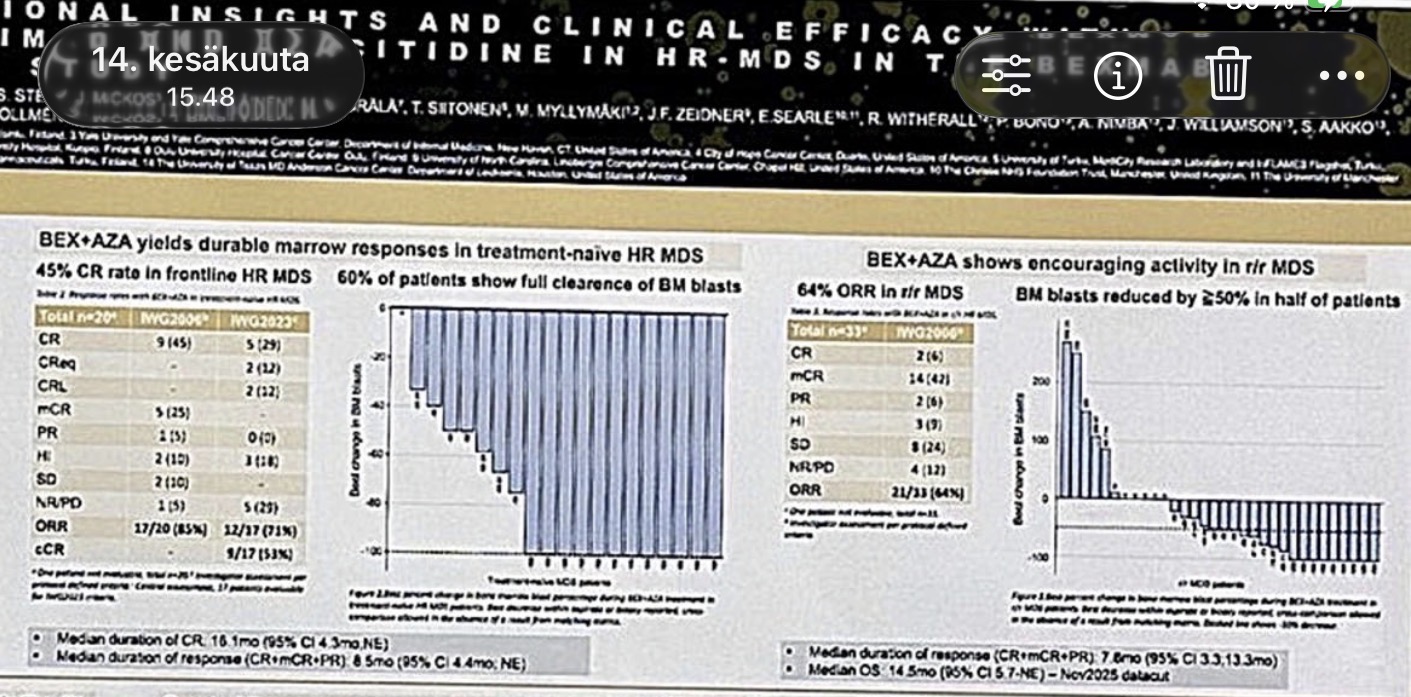
With Bex+aza, CR + mCR has been achieved by 70%. In R/r, by 48%. At EHA, total blast clearance was 60% in the first-line setting, and in R/r MDS, a 50% or greater reduction in blast counts was achieved in every other patient. Historical mCR figures for Aza are under 20%, and CR + mCR are approx. 25-35%.
https://ascopubs.org/doi/10.1200/JCO.2022.40.16_suppl.e19062 .
When comparing to other newer molecules that are marrow-suppressive, it must be remembered that mCR can indeed be achieved, for example, by giving intensive chemotherapy that kills the blasts but also all other blood cell precursors, and ultimately the patient as well.
In BEXERA, only patients who are not transplant-eligible upon entering the study are accepted. One of the measurable endpoints of BEXERA is how many become fit for transplant. And transplant patients are not censored.
One can attempt a transplant on almost anyone, but its success is a different matter. We will soon be able to examine this in a randomized setting. If Bex facilitates bone marrow blast clearance without suppressing the marrow (there has even been speculation about recovery, although if it remains an mCR, it does not meet all the criteria for recovery) and thus without worsening blood counts, as chemotherapy and many newer drugs like venetoclax do, and the patient could better withstand the conditioning regimen prior to transplantation, it would be a competitive advantage. After all, this is the only potentially curative treatment.
We are (continuing to) live in interesting times; it remains to be seen if and how Bex differentiates from placebo and competitors regarding pure bone marrow CR + mCR and the side effects associated with achieving mCR. Zeidan’s statements or phenomena observed with other drugs in other trials do not yet directly play into Bex’s hands, but they once again increase expectations and things to watch. And they may gradually change treatment recommendations regarding transplants.
A piece of the EHA poster from that Nimba post: