That 3.73 billion by 2031 figure implies that it excludes, for example, anti-PD-1 drugs; pembro (pembrolizumab) alone has sold about 30 billion. It has apparently only calculated macrophage modulators, such as Bex (bexmarilimab) and others, cytokines, vascular growth factors (which have been in use for a long time, but are also being studied as TME modulators, i.e., possible new revenue), agents affecting connective tissue cells, etc. By paying 4,000 USD for that report, one could see the assumptions in more detail. I suppose it was ordered for Ralph Hughes, and let’s hope he summarizes it for us sometime as well.
If we consider how slow it is to generate revenue after all the phases for drugs currently still in development, the year 2031 is not that far away. Therefore, I’m not surprised by the modest billion-dollar figure. You can also think of it in terms of which cancer treatment is so permanently solved that a treatment enhancer or an agent to break down developed resistance isn’t needed during treatment (not many). Thus, we arrive at the conclusion that 3.73 billion is a good start, but only a start.
There is no precise information yet on which cancers require a macrophage modulator or their combination with each other or with other types of tumor microenvironment (TME) modulators. BEXERA will provide preliminary answers next year, but we will only get a better idea of the better billion-dollar estimates in that market research once we get results from BLAZE and BEXAR for solid tumors. And there are other players besides Faron.
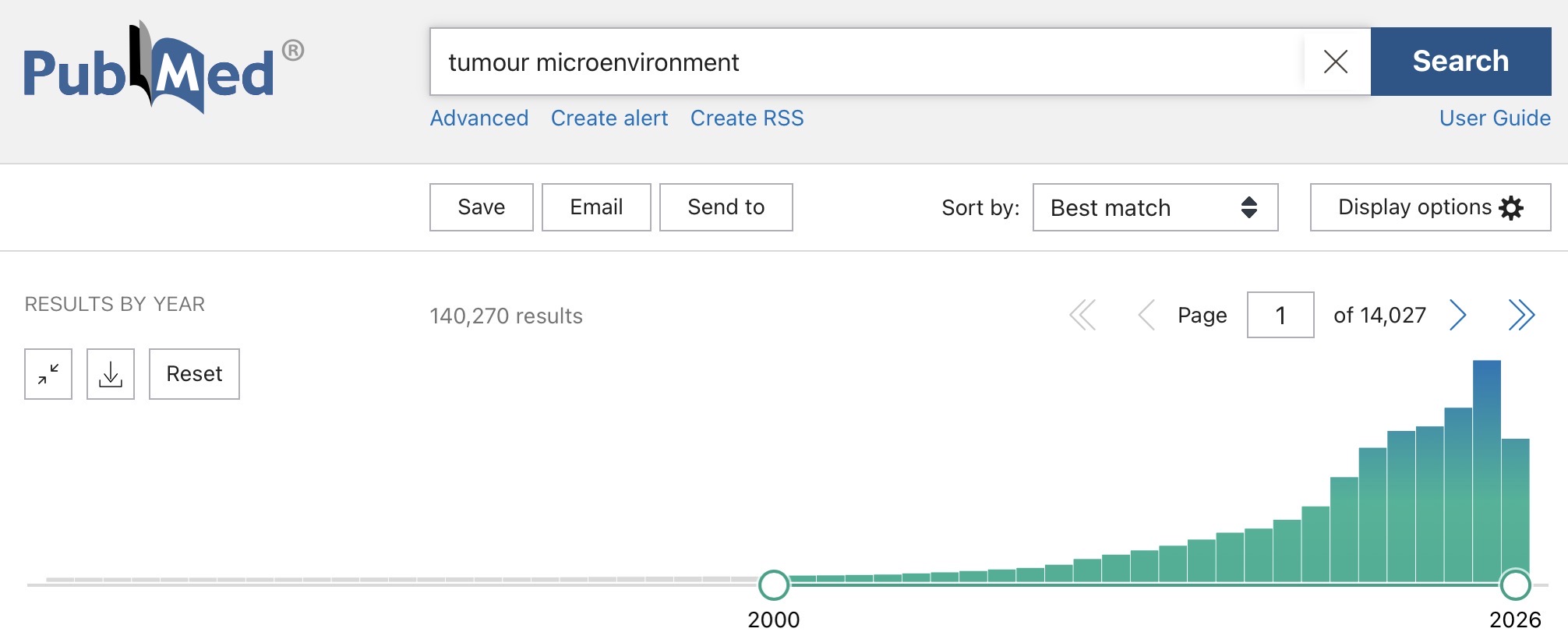
The TME is increasingly of interest to the scientific community. And, of course, the results of the studies are of interest to pharmaceutical companies. The image shows PubMed TME articles; this year we are heading for a new record again.