2026 will be a gap year in terms of research results, and 2027 will likely be well underway before the first BEXMAB-2 results are obtained. Therefore, I don’t have much to comment on; those changes in ownership, etc., do not interest me.
If you are looking for some “bearishness” or just general reflection, I could write out some of what I’ve been pondering in my silence. Now is a good time to go back to Faron’s roots, re-examine the scientific background, review the significance of Clever-1, and especially the significance of blocking it with an antibody. This bolded part interests me in particular.
First, let’s remind ourselves that Clever-1 is a protein on the surface of macrophages—the scavenger cells of the immune system—which primarily binds LDL fats. There are other similar proteins. However, we also know somewhat indisputably that the presence of Clever-1 in macrophages is associated with a poor cancer prognosis (with some exceptions), an unfavorable tumor microenvironment, etc. From this, one could easily conclude that we block Clever-1 with an antibody and voilà, the negative effects are reversed. But we forget that the presence of Clever-1 in macrophages is not an independent factor, as Clever-1 positive macrophages are a genetically different population. This was already shown in Sirpa’s “landmark” paper in 2016.
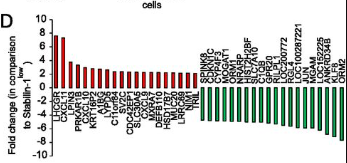
In the image, we see how there are major differences in the expression of several genes between Clever-1 positive vs. Clever-1 negative macrophages. So, it is not Clever-1 positivity itself, but the genetic code and its expression that is the driving factor behind the unfavorable characteristics of these macrophages.
Still, many papers have been presented, for example by the writer “poiju,” where the inhibition of Clever-1 produces favorable effects, and I won’t link those papers here now. In these cases, it is always necessary to ask what exactly inhibition means. It is a completely different thing to 1) block Clever-1 with an antibody, 2) create a knockout mouse, which lacks the entire gene, 3) conduct a knockdown/silencing experiment where the translation of the gene into a protein product is prevented. Actually, we are only interested in point 1) and what has been achieved in this experimental setup. In points 2) and 3), other “downstream” effects likely occur after blocking the gene, which are not generalizable to what happens when the protein itself is blocked with an antibody (i.e., what bexmarilimab does).
In my opinion, the three most important articles for understanding Clever-1 antibody inhibition are 1) the 2016 “landmark” publication linked above, 2) this 2019 paper on the T-cell effects of Clever-1 blockade, and of course 3) MATINS. All of these have likely already been linked in Faron’s main thread.
But let’s go through these again from the perspective of what exactly can be said mechanistically about blocking Clever-1 with an antibody—specifically, what is known about the mechanism of action of bexmarilimab.
In Paper 1), a single experiment was conducted where white blood cells isolated from blood (a mix of macrophages, T-cells, etc.) were given a Clever-1 antibody and control antibodies. In this, the administration of the Clever-1 antibody resulted in approximately 5x the number of interferon-gamma secreting T-cells compared to the control. Interferon-gamma is a well-known mediator of immune activation.
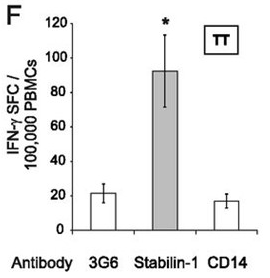
This is, in my opinion, the most significant single finding and the promising foundation upon which Faron/Bex is built. However, we know that an increase in IFN-gamma alone is not enough; for example, administering it as is to a cancer patient is harmful—it causes flu-like symptoms and negative feedback effects that negate the achieved activation of immunity. So, we need more evidence.
In Paper 2), many experiments were conducted, mainly with knockout mice. In an experiment using antibodies on mice that had experimentally developed lung cancer, they were given a Clever-1 antibody or a control substance. The clearest results are below:
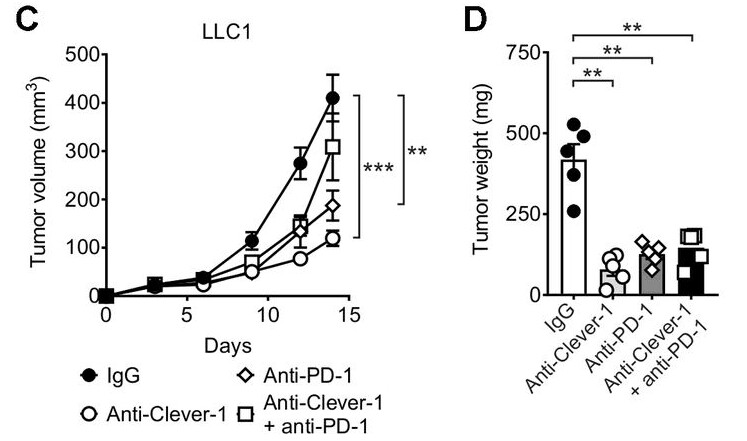
Lung cancer tumor growth slowed with anti-Clever-1 treatment, but surprisingly, when combined with PD-1 treatment, growth slowed significantly less. The result is the same when looking at tumor weight.
This result is clearly a disappointment and makes one wonder if the prerequisites for PD-1+Clever-1 synergy exist. In biology, 1+1 is not 2. On the positive side, tumor growth did slow down regardless.
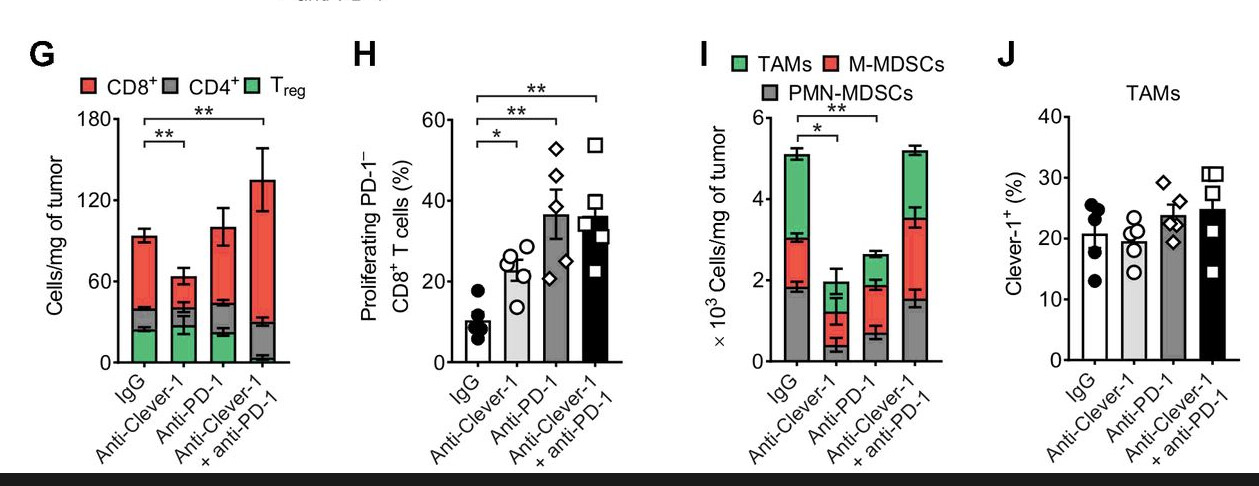
In this image, I think the most important thing is G—Clever-1 treatment did not increase the number of CD8+ positive cells. Nor did the combination manage to increase the number of “immune-released” PD-1- CD8+ T-cells (F).
- MATINS, the first human trial. We already know that Bex alone provided no benefit; the ORR was less than 1%. Let’s look closer at the lab tests done with patient samples. Although the study was titled after MATINS, it also included experiments with healthy donors and, again, mouse experiments.
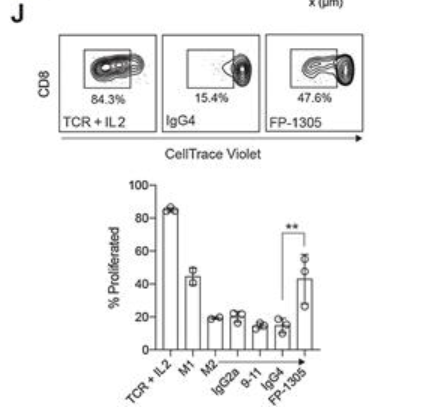
This image is, in my opinion, the most important observation of the above article. In it, healthy donor macrophages have been marinated with dexamethasone and interleukin-4 to create an immunosuppressive situation. Healthy donor lymphocytes, including T-cells, were added to the cocktail. Then FP-1305 (Bex) was administered, with a maximal activator cocktail TCR+ IL-2 and an ineffective IgG4 as controls. We see that Bex succeeds in releasing the immune inhibition such that 47.6% of the cells turn CD8+ positive, but the response remains partial. It must be remembered that this is an MLR test using cells from healthy donors, whose reactivity can vary. It looks like cells from three donors were used in each test (the same ones in every test?).
So, mechanistically we know: 1) Bex increases interferon-gamma, 2) Bex together with a PD-1 inhibitor is worse than alone, 3) Bex partially affects T-cell differentiation.
If there are other noteworthy points in the articles above, or if someone finds more mechanistic evidence specifically regarding Clever-1 antibody blockade, we can go through them. This wasn’t really a “bearish” post, but rather an opening for discussion to attempt to gather the best mechanistic evidence for and against Clever-1 antibody blockade.