Okay! Searching for Hollmen + SPP1 was quiet. Sirpa and Marko Salmi’s work from 10 years ago therefore gave some indication that high Clever-1 and high SPP1 do not necessarily correlate. The SPP1 gene codes for the osteopontin protein. STAB1 codes for Clever-1, which is a secreted protein s-Clever, but also a cell surface receptor. SPP1 has been linked to immunosuppression, but it does not fit into the M1<—>M2 continuum.
One article discussing SPP1-macrophages is a Chinese Clever-1 article on gastric cancer, in which they concluded: “CLEVER-1 +TAMs may become a novel biomarker for predicting patients with GC who could benefit from anti-PD-1 therapy and highlights them as a promising target for overcoming immunotherapy resistance in GC.”
It states that SPP1 activity is higher in Clever-1 positive macrophages: "reinforcing the limitations of the conventional M1/
M2 macrophage model. Notably, STAB1+TAMs exhibited
increased expression of both CXCL9 and SPP1 (figure 5D).
Recent studies have proposed that the CXCL9/SPP1 ratio,
referred to as the “polarity” of TAMs, offers a more refined
and clinically relevant metric than conventional M1/M2
markers.30 To evaluate this, we assessed CXCL9 and osteo-
pontin (OPN/SPP1) levels via FCM. OPN expression was
significantly higher in CLEVER-1+TAMs (p<0.01; online
supplemental figure 4A), while CXCL9 levels were similar
between the two groups (online supplemental figure 4B).
A paired comparison of the CXCL9/OPN ratio between
CLEVER-1 and CLEVER-1− TAMs revealed a statisti-
cally significant difference (p<0.05; online supplemental
figure 4B), further supporting the notion that CLEVER-1+
TAMs exhibit a polarity indicative of an immunosup-
pressive phenotype.”
Rannikko’s dissertation mentioned that Bex would further raise the levels of CXCL9/10, which are essential for T-cell activation.
These Chinese observations contradict the side note in Sirpa’s paper’s heatmap? Here, logically, high Clever-1 simultaneously with high SSP1 means immunosuppression. The question of whether Bex could in any way affect SPP1-related immunosuppression is not addressed.
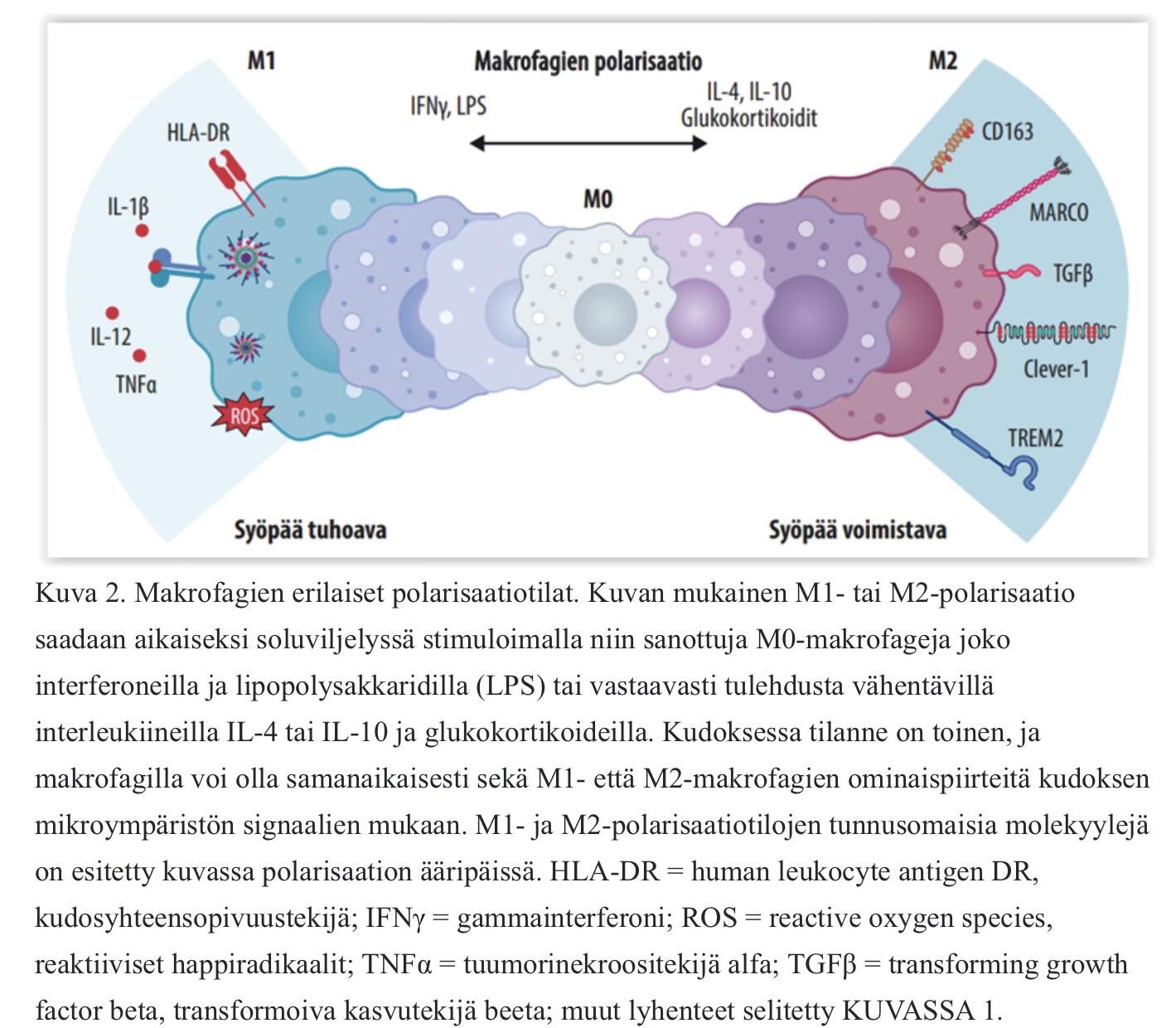
Below is Maija’s outline from Duodecim a couple of years ago, which also states that this is not about either M1 or M2, but something in between, and what influences which direction. The situation in the TME changes constantly, just like Faron here in the macroenvironment.