The article contains the wrong year; the company invested in Faron in 2015, not in 2025 as the article stated.
5 Likes
How do you think about that study design for Vene+Aza? In a randomized study, it’s obviously a clear case if Vene+Aza is more effective than Aza monotherapy. But why isn’t Bex+Aza acceptable if it proves to be better than Aza monotherapy?
One argument has been that marketing authorizations have not been granted for combination drugs before, so why are such Vene+Aza studies even conducted?
2 Likes
You are at the heart of the matter. When one delves into previous approvals in oncology and hemato-oncology, it becomes clear that it is very rare for an approval to come for a combination where one component has not been previously approved for anything. Venetoclax, however, has already been approved for AML.
But that is, of course, just a statistic. Situations must be looked at one at a time, but in my thoughts, that statistic reduces beks’ LoA%.
4 Likes
There’s no point dwelling on history.
The main thing is probably that Faron’s direction is now northeast.
This story still seems to be as eventful as the rule of a
superpower.
What is the next obstacle / stumbling block?
Will the wiser ones tell us?
3 Likes
Expectation management, on the other hand, has been the kryptonite of Faron investors. When the CEO visited Inderes to praise the company shortly before the directed share issue, talking about this issue was a direct insult to all parties. When the issue was then made exactly as expected, there was strong reassurance that this was just interim financing, as the partnership deal worth hundreds of millions or even billions was just around the corner, and big pharmaceutical companies were practically rolling out the red carpet for Jalkanen to create a new revolutionary cancer drug for them.
Well, now a longer-term financing solution has been made for Faron, which strongly signals that no partnership deal is coming anytime soon, but still the prevailing idea seems to be that a Finnish small investor will trick the stupid procurement teams of pharmaceutical giants by buying Faron’s miracle drug from the stock market at a bargain price. Those professionals must be utterly stupid if they refuse to make a deal.
There’s a tremendous amount of detailed technical expertise and intricate skill in the thread, but that famous common sense doesn’t always seem to keep up. The atmosphere is like listening to Poland’s Markku’s stories on the Voxtur forum back in the day. The financing is only for a year, so next we’ll be waiting for a new share issue or convertible bond, which will probably come sometime in Q4 2025. If things go well, some weak deal might be concluded in the autumn, but before that, there will be tremendously stormy price movements both up and down.
41 Likes
That is indeed a clear difference: Bex has not been approved for anything, but Vene has. However, it doesn’t make sense to me that it couldn’t get marketing authorization if it’s scientifically proven that as a combination therapy, it is better than Aza alone.
Science is evolving, and in my opinion, we should expand beyond oncology and hemato-oncology and simply see if any drug has ever received marketing authorization for any treatment solely by demonstrating combination efficacy. Similarly, the IGW criteria also update as science develops.
In any case, Bex is not intended to destroy cancer cells, but rather to make them ‘hot’ so that the human immune system can attack them. For this reason, patients who have failed previous treatments are also a difficult target group, because - as you have noted - their internal organs are already damaged. And this is precisely why Bex should target first-line treatment, because there it has the potential to work more effectively, as Aza + the body’s own immune system attacks these ‘hot’ cancer cells.
In my opinion, no definitive facts have been presented for or against Bex certainly working this way. There have been indications, and the work (+patent application) around Clever-1 sounds reasonable, and there already seems to be at least good evidence for it.
Once the first fact completely ruling out Bex’s possibilities is presented, I will jump off this train (of course, the money will have been lost by then, but so what, it’s a conscious risk). However, I haven’t encountered such a thing yet, and I will continue to be bullish.
17 Likes
Even if venetoclax were to receive marketing authorization for MDS as a combination therapy with azacitidine (it does not have marketing authorization for AML as monotherapy), it would not affect Bex’s chances of obtaining r/r MDS AA marketing authorization in any way, as the venetoclax trials were discontinued in that indication.
It would likely not affect first-line either, unless Bex’s efficacy was poor.
For the reasons that
- Venetoclax’s efficacy will eventually run out anyway. Something must be available after that. The same, of course, applies to Bex.
- The mechanism of action is completely different
- Bex has a better safety profile
- It may turn out that venetoclax does not work for a certain patient group or cannot be used, and there should be some option for them too

Why would the FDA have directed Faron to seek AA marketing authorization in a specific way (start Phase 3 in first-line and look at responses and mOS in r/r), if everything were so depressing and hopelessly impossible? Perhaps they don’t read this forum 
39 Likes
Well, one should not overinterpret that message, not even as a preliminary promise of anything. The FDA merely states that this is the route.
Good that you brought up AAs. I used the Accelerated Approvals found on the FDA’s website in oncology and hema-oncology as a basis. I Googled, researched, and asked AI, and we concluded that combination-AA approval for a combination, where one part has not been previously approved for anything, has occurred 7 times in human history. The trade names of these drugs are Polivy, Xpovio, Padcev, Ibrance, Perjeta, Tykerb, and Erbitux.
The AA program was started in 1992! So, every three years, one approval for such a setup in the entire world…
And Becksi is trying to join this group, and some think the probabilities are close to 50%? Allow me to laugh.
9 Likes
The FDA has traditionally been trusted, and its processes have worked. Now there is concern about how the administration’s streamlining will affect things. The agency has other responsibilities besides just medicines, but it’s quite possible that Faron will also get its share if things start to falter: meeting times are hard to get, matters are delayed, and - as in the example below - there is no longer sufficient substance to make proper decisions.
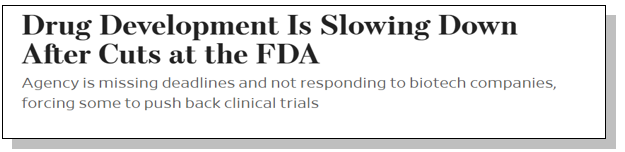
Large companies generate billions in annual sales from approved drugs, while smaller biotechs might develop as little as one drug. Their success and investors’ support hinges on regulatory milestones, making every interaction with the FDA key.
At one biotech preparing to test an experimental cancer antibody, the company’s request to have study subjects provide a second biopsy was denied by the FDA, according to a person familiar with the matter.
The company has conducted trials for other drugs in which subjects get two biopsies, and European regulators approved it for this trial. A second biopsy in the U.S. trial would have allowed the company to measure how tumors change over time and regulators increasingly allow them in trials, the person said.
In denying the company, the FDA first cited agency guidance that was drafted but not yet adopted, which said the biopsy could only be a secondary goal of the trial, the person said. When the company responded by agreeing to make it a secondary goal, the FDA then said no because there wouldn’t be a benefit to the patient, the person said.
The denials, the agency’s reasoning and the speed at which the subsequent denial was issued—a few hours—makes the company suspect a less-experienced staffer was overseeing the process, the person said. The company could have appealed but that would have meant delaying its early-stage study, the person said.
Source: WSJ.com
5 Likes
So when reading these messages, it went wrong, it’s not working. What are the chances, are there any left, why did Hong Kong sell everything, strange.
Can someone explain in non-medical language, is there any hope at all to get the product successfully approved and onto the market?
6 Likes
I said that one should not speculate on the factors guiding patient enrollment in trials, but I’ll throw in a counter-argument here as well…
I think that r/r patients are directed to BEXMAB very early (even immediately after 4 cycles), because according to the protocol, AZA continues anyway and Bex has minimal side effects. I.e., nothing is lost by switching to BEXMAB. This is how I would reason if I were an oncologist  This explains the good ORR%, because it includes the delayed effect of AZA…
Instead, for monotherapy trials, r/r patients are likely directed to those for whom it can certainly be said that HMA is no longer effective, meaning they have had more cycles.
Now, close the forum and enjoy Easter…
7 Likes
As previously stated, medicines eventually lose their effectiveness in cancer diseases, and it would be good if there were effective alternatives. If Bex maintains its efficacy and safety, why shouldn’t it become a medicine? The need is great. Now, that large sale occurred in a peculiar situation, which undeniably raises suspicions. As does the rather vague announcement of preliminary results, which did not mention what criteria were used. On the other hand, the results were in line with expectations. If the outcomes for the remaining patients remain in the same proportion, then the results are tremendous, and there have been no safety issues. Everyone certainly wants a medicine on the market whose side effects are as minimal as possible and which improves patients’ quality of life. Partnership news would be great at this stage. Now, just follow Juho’s whereabouts; that will tell quite a lot. I’m not encouraging anyone to stalk, though; a little social media ‘stalking’ should suffice. 
12 Likes
To add a bit more to the mix. The Aza+Vene combination is already prescribed, at least to some extent, for first-line treatment of HR MDS. Someone from my close circle is on this combination outside of a clinical trial. The treatment location is Slovakia.
8 Likes
Juho confirmed that it does not affect in any way, nor does it mean that things would be easier to get through. This is a significant matter for all parties that when the criteria are met, nothing will stand in the way.
6 Likes
This was a good write-up; there’s a lot of detailed information here, but less is said about the investment aspect itself. I also remember when Juho blurted out last autumn, in some context, into the mic at the end of the last event, that partnership news was expected next or something similar.
But I also understand the perspective that when financing is difficult in this sector right now, you also need to have self-confidence. According to someone lacking confidence, it’s harder to approach financiers, because returns are sold through perceptions. And in my opinion, those financing arrangements have been handled well recently. In that sense, Juho has indeed handled this well.
But these require patience and the ability to wait, and I don’t have either. That’s why I’ve been trading this in and out. But I’ve always kept a small position, even after lightening up, just in case of that deal. And things are in better shape than a year ago. And I wouldn’t be surprised at all if some deal were reached this year.
18 Likes
Let’s just say that you shouldn’t base your investment in any company solely on forum messages, even if you sometimes read good things there. If you also read, for example, Inderes’ or Carnegie’s analyses, you don’t get a very depressing picture of the company’s situation. Of course, there are risks, but there always are. Now, just calmly wait for the more detailed data from phase 2 and the scientific community’s comments on it; that’s where the most authoritative expert opinions will come from. After that, we can start waiting for the drug agencies’ statements… Investing is often endless waiting, unfortunately. Perhaps at some point, while waiting for future events, we will notice that the company’s affairs have gone well and our own assets have grown at the same time 
24 Likes
When reading these messages, it went well and seems to have succeeded - of course, the details are under embargo for a short time.
An owner who invested due to trauma sold their shares, and no conclusions can be drawn from this regarding Bex.
Let’s wait a moment for the details. In the meantime, let’s remember that a mediocre drug is sufficient for marketing authorization when the alternatives are terrible. I have strong faith in mediocrity.
20 Likes
And I would add that investing in anything should not be based solely on any forum, analysts, a company’s CEO, or a bank’s advisor. Or even neighbor Esko, who seems to know everything about everything. They are just people too.
It’s worth doing some background research, and perhaps Googling the probabilities of similar companies succeeding after Phase 2 as a basis. AI would gladly create tables of these.
And even those don’t tell the absolute truth about things; there’s always a risk for you. But the higher the probability of things succeeding according to the investor’s wishes, the better the hit rate will be in the long run. One might fail, but after 5 or 10, you’ll be profitable, provided the parameters are estimated relatively correctly.
Or you can play one company or card if you are absolutely sure about it. That also suits some people. It’s worth finding your own niche where you can make a profit.
For me, in these cases, it’s technical analysis; I buy when there’s fear or an offering has been realized, and I sell at different price levels when FOMO takes over. With this, you’ll never get those amazing 10x or 20x returns (unless you get incredibly lucky and a deal comes through just when the allocation is 200% and there’s a huge overweight). But this has also worked quite well; I consider over 100% annual returns to be a pretty great thing, and last year I achieved that due to a public offering.
And if we take one comparison, albeit from a slightly different indication, I have MindMed [MNMD] among others from the American continent. There, a “Breakthrough therapy designation” came last spring, and the stock jumped to $12. The cash on hand is currently around $270M, and the market cap is about $430M. And currently, the stock value is under $6. The cash runway should be sufficient until the end of Phase 3, i.e., until 2026, and additional funding may not be needed.
Its market cap hovered around $2 billion sometime in 2020 when Biden was elected, and there wasn’t a single Phase under its belt then. And the cash burn hadn’t even started. This probably tells a lot about how undervalued all biotech stocks are currently. The NBI, or Nasdaq Biotech Index, tells the same story, having just hit its post-2023 lows a moment ago.
The purpose of this story was mainly to illustrate how wildly the valuation of these papers fluctuates depending on the phase of the stock market cycle. In a good cycle, Faron would be a 5-euro stock now, perhaps.
18 Likes

“In this project, we will integrate concurrent efficacy data, obtained from the BEXMAB trial, and detailed molecular level information about bexmarilimab’s mechanism-of-action by single-cell RNA sequencing of patient bone marrow samples before and after treatment. We will also implement mouse models of chemotherapy-induced leukopenia to study Clever-1–regulated hematopoietic recovery, a phenomenon observed in BEXMAB patients after bexmarilimab administration”
14 Likes
What if these patients are pumped full of aza and it just doesn’t take effect until they get bex?  Surely such results wouldn’t have come about if bex were useless.
11 Likes