New target price €11.50 (previously €9.20) 
Oh, that’s sweet, the average price in the portfolio is €4.39/share. 
New target price €11.50 (previously €9.20)
Oh, that’s sweet, the average price in the portfolio is €4.39/share.
OP: also a very positive earnings comment, with a target price of €12.00 (previously €9.50).
It is considered particularly significant that Exel saw broad-based growth in both new and old customer accounts.
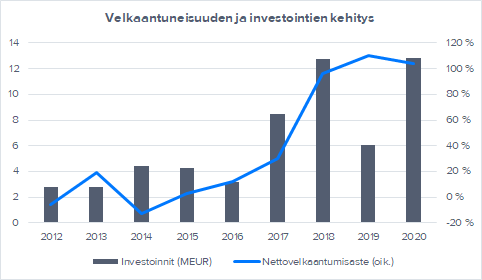
Hey! This seems like an interesting company! What sticks out to me is the rather high debt-to-equity ratio. Is there a clear reason for the debt figures in recent years? The forecasts suggest that debt will drop significantly in the coming years. To what extent will the company’s room for maneuver in the coming years be spent on curbing indebtedness? @Joonas_Korkiakoski
Hello Janne12!
The significant increase in indebtedness over the last four years is largely explained by the company’s corporate acquisitions and other investments. In 2017, Exel acquired a 70% stake in the Chinese JHFRP (Enterprise Value (EV) approximately EUR 6 million), and the remaining part was redeemed (EV approximately EUR 3 million) last year. In 2018, Exel, in turn, bought the entire share capital of the American DSC (EV approximately EUR 10 million). Both of these arrangements were financed entirely with debt. Last year, investments were boosted by efforts directed at the new production facility in Austria. Of course, the IFRS 16 standard, which came into effect at the beginning of 2019, has also had some impact on the debt ratios.
Currently, Exel should have the production capacity for higher manufacturing volumes than at present without significant new investments. In other words, I do not see that the current indebtedness would radically restrict operational activities. The company’s self-imposed net gearing target is around 80% or below. If our full-year forecasts for earnings development and cash flow are accurate, this target would be achieved by the end of the current year. I believe this target level can be used as a kind of metric/benchmark for implementing strategic corporate acquisitions. In practice, from 2022 (net gearing 51%) onwards, the company should have reasonable room for maneuver in a strategic sense as well. Of course, this requires that business develops at least in line with our current expectations.
Thanks for the comprehensive answer! I’ll have to keep a closer eye on Exel. Have a great summer! 
Has anyone discussed Exel’s situation regarding price inflation, given that the prices of raw materials and other factors affecting the company have risen/are rising?
Additionally, do the availability problems of raw materials/components that Exel needs for its products and manufacturing affect it?
The share price has already fallen below the last earnings report, which was excellent, and the order books were full accordingly, so I’m tempted to buy a bit more… In addition, I think it’s a worthwhile addition that the company will be bought out of the stock exchange with a good premium 
I can’t say how strong Exel’s pricing power is, but raw material availability issues definitely have an impact. There are problems with the availability of polyester, vinyl ester, and epoxy. The price of polyester has doubled, but companies are more concerned about availability.
Wind turbine blade manufacturers are also suffering from resin availability problems. Several blades will not be made this year because there aren’t enough raw materials. Whether Exel wins the lottery for allocated blades, I don’t know. On the other hand, Vestas said there was also a shortage of pultruded products.
Today at 10:00, Exel’s half-year review will be released. Exel has become the largest holding in my portfolio, and I find it very interesting. It’s strange that there’s no discussion about it on any forum, nor are there any news updates.
Yesterday, Kauppalehti reported that Exel’s profit is expected to have decreased from the comparison period. Only Inderes expected it to grow. This consensus forecast completely surprised me; I was and remain optimistic due to the presented order book and economic growth.
Exciting times ahead 
EXEL COMPOSITES OYJ HALF-YEAR REPORT 20.7.2021 at 10:00
Exel Composites estimates that its 2021 revenue and adjusted operating profit will increase from 2020.
In the second quarter of 2021, order intake continued to be strong as market demand picked up in several customer industries. Due to the strong order intake, revenue also increased in the quarter compared to the previous year. However, adjusted operating profit was lower than in the previous year.
So, revenue is growing nicely, but profit isn’t… scalability issue?
Surprisingly light reaction in the stock price; if revenue grows but operating profit decreases, isn’t that unprofitable business? Here, we are now entirely dependent on the company management’s promises of operating profit growth. Inderes’s (Finnish equity research firm) forecast for operating profit was wrong this time, and the consensus was right…
Well, if raw material prices rise and you’re selling a lower-margin product, that’s what tends to happen.
I wonder if wind turbine buyers have been waiting for EU guidelines
Right, so it’s a bulk product that many others can easily make, for example, cheaper in China. The company doesn’t have pricing power, which has been discussed a lot, and now we have the answer.
Could you, for example, link to one company from China that produces this “bulk product” easily and cheaper?
Still “€11.5 and more”
https://www.inderes.fi/fi/muut-analyysit/exel-composites-extended-heady-growth-evli-research
Evli update: “€11.5 and buy” was previously “€11.0 and add”
I was updating my outdated notes and at the same time re-watched Exel’s ROAST from a year ago. It’s still a truly interesting discussion.
One thing that became much clearer in the roast, at least for me, than by reading interim reports, was the changes made in the company during Kytömäki’s tenure as CEO. If I worked in Exel’s IR, I’d think about what kind of timeline of changes could be made for the annual report.
On the other hand, as noted earlier in this thread, six years is a long time to turn around a company the size of Exel. Even with the Austrian factory, it took about five years to get things right.
In the discussion, I was bothered by the attitude towards the amount of debt. In my opinion, CEO Kytömäki dismisses questions about the large amount of debt a little too lightly, both in the roast and in the latest quarterly interview. Even if the company manages its debt burden during a period of low interest rates, a net gearing ratio of well over 100% significantly narrows the financial buffer if a surprise occurs and the composite gets rolled into the fan instead of the reel.
With less debt, it would also be easier to push forward growth projects, which seem to be plentiful. If I understood Exel’s strategy correctly, the company plans to:
Not many growth options are left out here. Would it be wise to prune growth projects and choose only a few most important development directions for the strategy period? This gives a bit of an “everyone’s happy” feeling, which was also questioned in the roast.
Regarding growth, the revenue of the smallest customer sector, Defense, has grown almost unnoticed last year and this year. Last year its revenue more than doubled (+133%), and this year it has grown (+100%) to the same scale as Telecommunications and theコロナ-affected (COVID-affected) Transport sector. In 2019, the full-year revenue for Defense was 2.29m, while in the first half of this year it was already 4.03m. Of course, Defense is still the smallest customer sector, but the difference to others has narrowed considerably.
I wonder why the demand for camouflage net support arms has taken off so rapidly. Did Exel develop a new solution for them? Or perhaps more essentially, is this a temporary jump caused by a large order/orders, or is Defense revenue rising to a higher level in the longer term? The company doesn’t say much about defense-related matters, but would @Joonas_Korkiakoski still have a view on the matter?
In any case, it’s great that Exel has taken steps in a better direction, so clearly that it’s visible even to a passively following small shareholder like me.
Hello Karkea!
It’s great to see some life in the Exel thread through your quality reflection.
As I understand it, the support arms for camouflage nets are not about new/revolutionary solutions, but rather about accelerated investments from customers. However, the good momentum in defense has continued for a long enough time that I wouldn’t dare attribute this solely to a single large order. Based on this and the stable nature of defense budgets, I consider continued growth in the longer term to be very possible.
Hey @Joonas_Korkiakoski!
You are only forecasting about 4% growth for '22 and '23. You don’t model acquisitions, but based on Riku’s comments and order backlog, it could be inferred that current production lines are capable of higher volumes. Do you think this won’t translate into higher growth? Is sales not picking up, or what’s the problem?
Hello Mika!
It is absolutely true that current capacity should not create bottlenecks for pursuing growth. It’s worth noting that Exel’s order book has a rather short structure, roughly a quarter long. Due to this, drawing overly bold conclusions for next year or the year after based on, for example, a single quarter’s order book might not be wise, even though it certainly gives good indications of short-term demand. Forecasts are, of course, always influenced by the caution of their creator.
Exel’s production network is genuinely global, and the long-term growth drivers for the company’s key customer industries are strong. Furthermore, in my opinion, as a leading player in pultrusion, the company also has genuine relative scale advantages that increase overall competitiveness. When these structural factors are considered, the company certainly has the prerequisites for even better performance than forecast.
Thanks for your answer, and a rainy Sunday morning to you too!  Inderes, your service is amazing.
It was especially good to get clarification on the short structure of the order book. Then the question arises about this year’s forecasts. If the order book is a quarter long, Q2 order book was +90% YoY, and H1 revenue already grew 17% YoY, then what on earth needs to happen in H2 for full-year revenue to grow by only 13.9% according to the forecast?
I would also like to hear your thoughts on the advantages of pultrusion over other manufacturing methods. Can the growth of Exel’s current customer segments be seen as a direct driver for Exel’s growth, or do customers genuinely have the option to switch to other manufacturing methods or materials?