eQ - The most boring money machine

Those were some excellent questions! :clipboard:

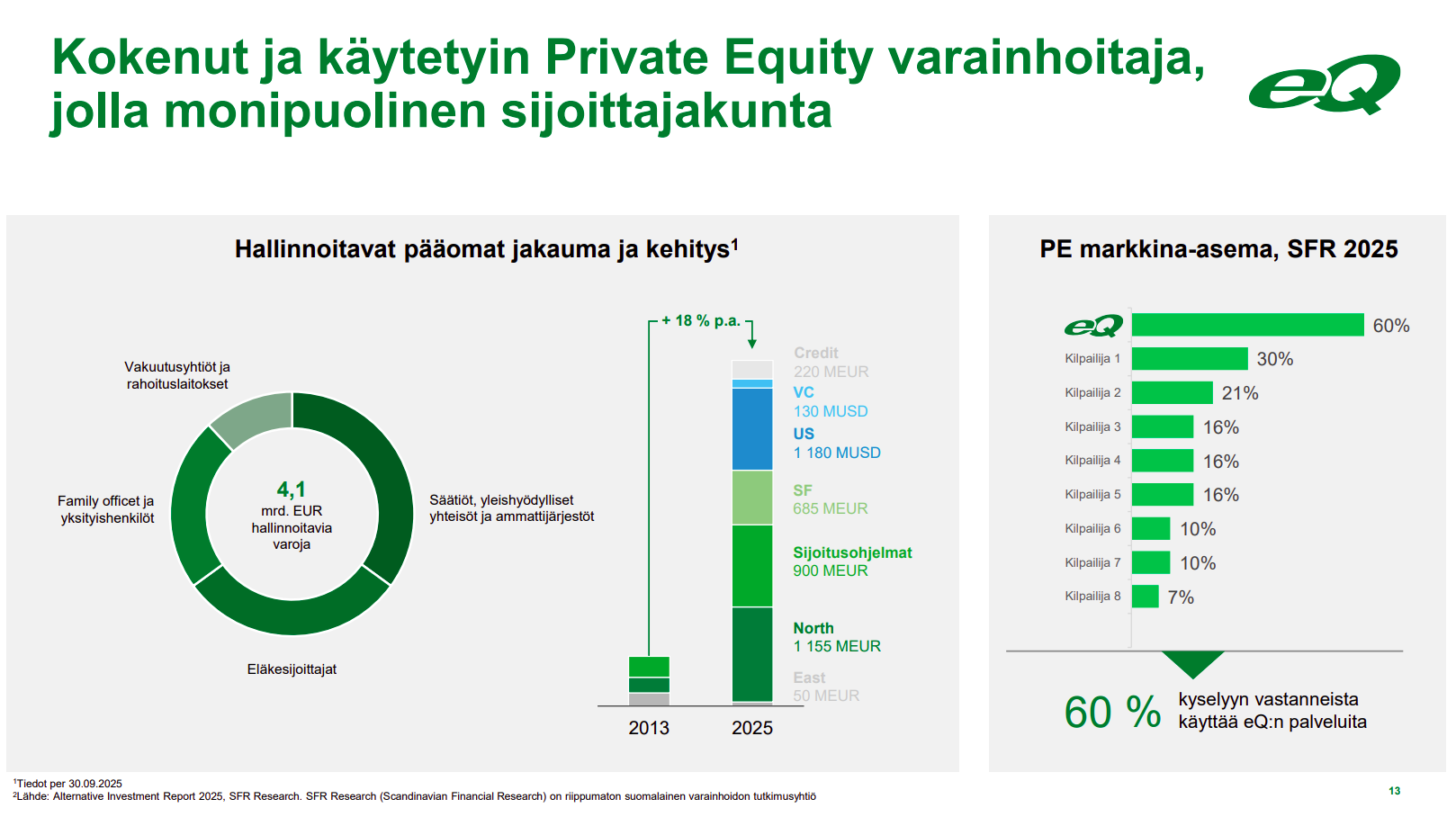
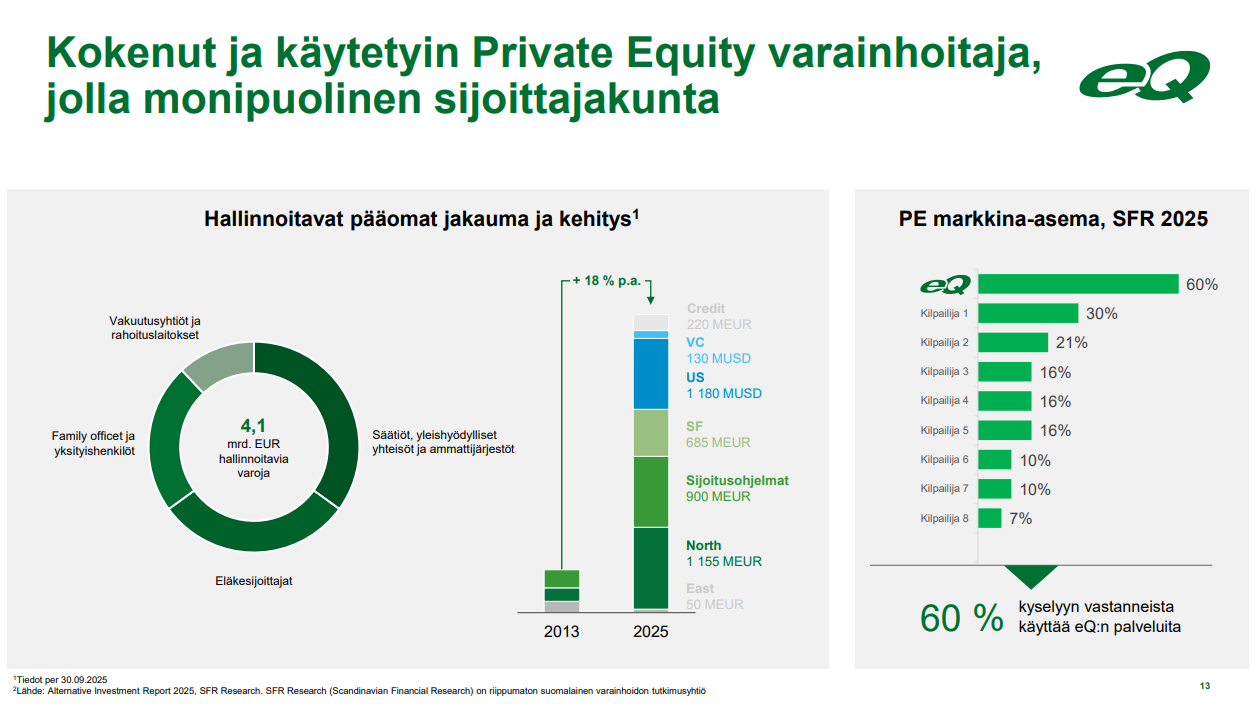
eQ’s real estate funds (as well as all of eQ’s assets under management) come mostly from institutions (instikot). In my understanding, the share of private clients is less than 10%, and in PE (Private Equity) or asset management, there are practically no private clients at all (the few that exist are comparable to institutions). There are, of course, a reasonable number of owners in terms of headcount in the real estate funds (2k and 4k), but I believe these are largely “small fragments,” and they mostly date back to the time when SPL and Investium were selling these funds widely in Finland. So, when for example 20% of a fund’s assets leave, many institutions are also involved. Attached is a screenshot from the comprehensive report regarding eQ’s client base:
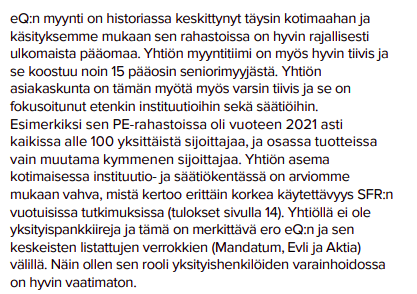
Why is Titanium Hoiva (Care) a retail investor-driven fund and eQ YKK institution-driven? There are certainly several reasons for this, but one of the key ones is, of course, the focus of the organizations. eQ has always been an institutional house, while Titanium has always sold Hoiva to private investors (previously through SPL and Investium, and later directly). Another reason is the fee structure. Hoiva’s fee structure is clearly higher, and especially that cumulative performance-based calculation and the 2% transaction fee are components that are hard for institutions to swallow.

To whom are the properties sold? Herein lies the core of our market’s problem. During the previous red-hot bull market, we had two major buyer groups: international (KV) investors and domestic special investment funds (erkkarit). Now, for the coming years, special investment funds will be strictly on the sell side, and domestic pension companies are reducing their real estate weightings, so the buyer practically has to come from international investors. Until there is greater interest from international investors, there aren’t really enough buyers in the market. Furthermore, from this perspective, one cannot expect a return to the “wild years,” as special investment funds will not be the same kind of net buyers in the coming years. Larma also mentioned this in his farewell interview: eQ Q2'25: Kiinteistömarkkinan vaisu kehitys painaa - Inderes

You are absolutely right that untangling this web will take time. This will also inevitably leave its mark on the entire sector, as the reputation of special investment funds has taken a serious hit. eQ has arguably been one of the most active players in the market, and the company has genuinely tried to sell assets to get redemptions paid. This has meant that the values of eQ’s funds have come down significantly in a front-loaded manner, which in turn has been reflected in customer dissatisfaction (SFR 24 and 25). Could eQ gain a competitive advantage from this? Well, at least in the sense that from April onwards, you can no longer accept subscriptions if redemptions have been postponed. This could lead to a situation where the one who has handled their redemptions is one of the few funds that people can even invest in. But ultimately, the final verdict from investors depends on how the fund’s value has developed and how the manager was finally able to pay out redemptions once the whole situation is resolved. :office_building:

Regarding the sensibility of the FoF (Fund of Funds) structure. @Kermit already explained this logic well, and I largely agree with it. A smaller institution that doesn’t have its own large organization doesn’t have the resources (or even the capital) to access the necessary funds, let alone build a diversified portfolio from them. eQ’s core client base consists precisely of these various foundations/institutions for whom these products are very relevant. Regarding costs, you are right; a FoF is basically one extra layer, but of course, a good manager knows how to negotiate a deal so that the total cost for the end investor doesn’t rise completely out of proportion. In open PE funds, this is a very big risk because there are at worst three layers, and full fees are paid on all of them (performance fees might even be in two layers). :face_with_peeking_eye:

Advium has been part of eQ since its inception. In 2011, eQ was assembled from Advium, eQ Asset Management, and Amanda Capital. Advium is a company founded by Larma, and he was, of course, the lead architect in the whole arrangement. It’s worth remembering that the majority of asset managers have an investment bank included. It is generally seen as part of a full-service financial house. I think it’s important that the share of the investment bank is small enough so that it doesn’t swing the entire group’s results. In that case, the investment bank “inherits” the asset management multiples, and not the other way around. :balance_scale:

Tomorrow is going to be a very interesting day! :eyes:

22 Likes
2 Likes

eQ Renewed its Management Team and Strategy - Aiming to Double Operating Profit by 2030

The size of eQ’s management team has grown since just over a year ago.

Aiming to Double Operating Profit

According to eQ’s press release, the company aims to double its operating profit by the end of 2030. eQ’s operating profit fell by 21 percent last year and was 27.4 million euros.

There are also other goals, such as expanding business operations internationally and to private clients.

The strategy to achieve this goal includes the following components, according to the release:

Asset management and corporate finance activities are at the heart of the strategy and are set to be strengthened. Strong growth is sought from the market investing in small and medium-sized unlisted companies (private equity).

Competitor Capman has traditionally been better known for its unlisted funds.

eQ is also seeking growth by strengthening real estate asset management services, the release states.

The release mentions international institutional clients as new customer groups, particularly in the areas of unlisted investments and real estate investments. The company also wants to offer domestic corporate clients solutions that institutional clients use.

9 Likes

Here is Sauli’s quick comment

Although revenue fell short of expectations, the company’s operating profit was exactly in line with our forecast at 8.2 MEUR.

8.0 MEUR and 8.2 MEUR are not exactly the same number, but I guess sufficient accuracy has been achieved there.

6 Likes

I have to ask a quick question here: what is “Erkkari” in this context? :smiley:

4 Likes

:smiley: erkkari = special investment fund. Sorry for the industry slang. I will use a clearer term from now on :man_raising_hand:

16 Likes

At first glance, it seems that forecasts for 2026 are trending lower than expected. Real estate asset management is declining, and PE asset management is compensating for this. On the other hand, asset management expenses are rising due to heavy recruitment. Growth is mainly coming from the Corporate Finance side, which is qualitatively the weakest part of EQ’s business.

I believe EQ’s operating profit will be around 30-32 million in 2026. Risks remain tilted to the downside, as the last 4-5 years have taught us. A weak dollar certainly doesn’t help EQ.

3 Likes

As some of you surely noticed from the cancellation of the earnings live stream, I’m home sick today, but fortunately @Kasper_Mellas stepped in to do the interview! I think the interview gives a really good idea of the direction eQ is heading from here. :microphone: :television: eQ Q4’25: Strategiapäivitys - Inderes

9 Likes

In case anyone missed it, here are eQ’s strategy slides from today:

Unfortunately, no recording of the results briefing is available, so this slide deck will have to suffice.

Here are also a few key highlights :chart_increasing:

PE customer breakdown published for the first time, and that usability is certainly at a staggering level.

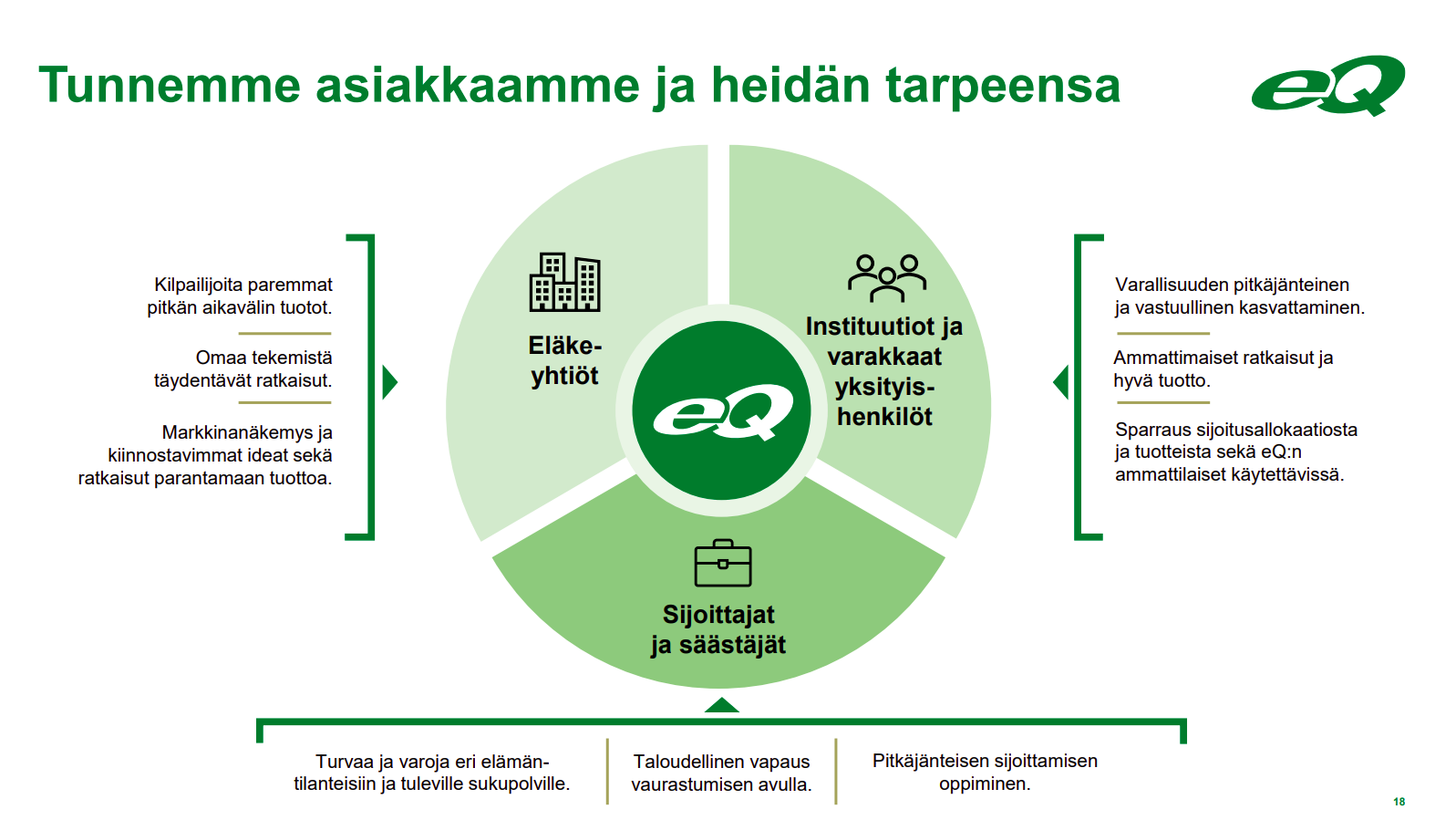
Different customer groups and their needs (also applies to other asset managers)

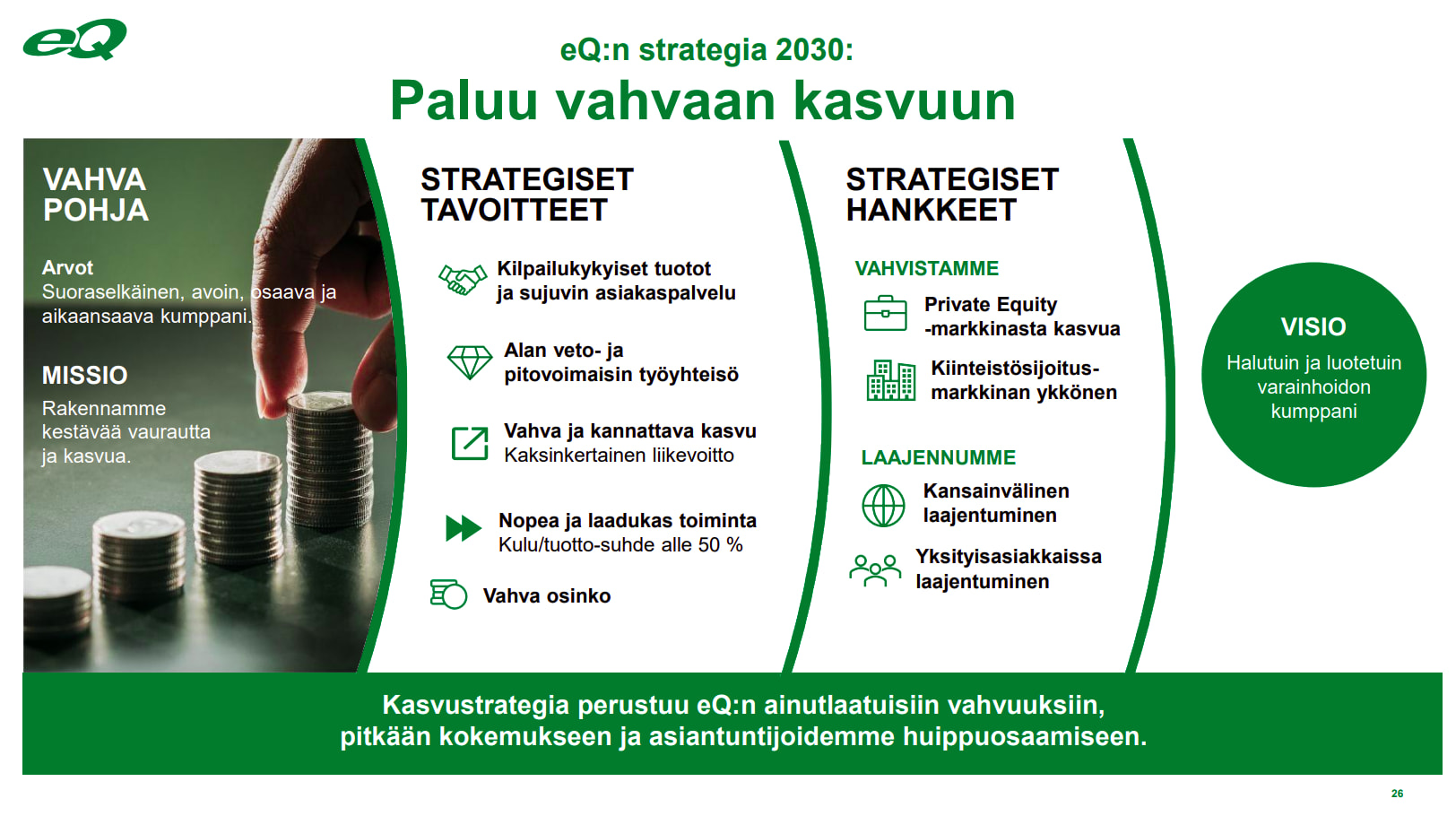
The whole strategy in a nutshell.

14 Likes

That “strategy update” turned out to be quite a flop. Growth expectations seem to be just numbers in an Excel sheet lacking any real substance, and the company has more downside than upside risks on the horizon. For example, the weakening dollar, PE market pricing and liquidity, real estate fund redemptions, and weakened customer satisfaction results.

How much longer can that “pricing at a significant premium” compared to the industry be justified in the case of eQ?

7 Likes

Here is the company report from Sauli after Q4. :slight_smile:

There were no surprises in the Q4 figures, and the main focus of the day was on the new strategy. The main lines and targets of the strategy were quite well in line with our forecasts, and the company is seeking a strong earnings turnaround in the coming years. Forecast changes have remained moderate, and we expect earnings to return to growth starting from 2026. In our view, the share is fairly priced, and due to the uncertainty related to earnings growth, we do not see the risk/reward ratio as sufficiently attractive. We reiterate our reduce recommendation with a target price of 11 euros.

Quoted from the report:

The share is cheap if financial targets are met

eQ is targeting an operating profit of approximately EUR 55 million for 2030, and with the share count considering current option programs, this would mean earnings per share of slightly over EUR 1.0. At this stage, eQ would be firmly back on a growth path and its risk level would be lower than at present, so the acceptable valuation level would be higher than current levels. With an acceptable P/E ratio at the 15-20x level, the corresponding share price would be EUR 16-21. The company would also pay ~3-4 euros in dividends in the meantime, meaning the total return on the share would be roughly 100-150% during the strategy period. The corresponding annual return would be an excellent 20-25%. This illustrative calculation underlines the company’s potential, provided it succeeds in implementing its strategy.

15 Likes

eQ: Info on fund distribution units: eQ - Tietoa eQ Rahastojen tuotto-osuuksien omistajille jaettavasta tuotosta 2026

Regarding the Commercial Real Estate Fund, the “good” news is that distribution units do not need to be paid out as sales have fallen below acquisition prices. This is a good thing because it doesn’t further strain the fund’s difficult liquidity situation.

YKK pays its ~26 MEUR, which does not materially change the fund’s liquidity position.

11 Likes

eQ continues to make high-profile appointments. Now a new head for international operations. Pertti Vanhanen on nimitetty eQ:n kansainvälisestä liiketoiminnasta vastaavaksi johtajaksi - Inderes

I have never met the gentleman in question, but based on his CV, it is indeed a strong hire. eQ is clearly serious about its international expansion, and the current team should already have the prerequisites to achieve results. At the same time, I would remind you that sales cycles as an unknown firm in new markets are long. :globe_showing_americas:

20 Likes

I wonder if commercial real estate funds are starting to be able to pay out redemptions yet? Of course, it will be clear next week, but any thoughts at this stage?

Are you referring to the release of next Tuesday’s quarterly report? It only covers the Q4’25 situation, so it doesn’t really relate to the payment of redemptions.

At least from what I’ve seen, there has been no indication in the market that eQ has sold properties from the Commercial Properties (Liikekiinteistöt) fund (though of course, a lot happens in the market that I don’t know about :sweat_smile:). Properties must be sold in order to clear the redemption backlog. A key challenge here is that eQ also has massive vacancy rates in its offices, and selling them in this market is difficult. However, offices must be sold as well, otherwise their weight in the portfolio will increase too much.

5 Likes

I’ve been thinking a lot about the company’s other “pillar,” namely PE funds. Quite grim news is coming from across the pond regarding the PE field, especially about private credit players and those with high software exposure.

It might be difficult to sell PE funds to the average institutional investor given the market conditions, but for a more opportunistic investor, a crisis could present very attractive opportunities, for example, in buyout-type funds targeting more traditional industries. These solutions should be marketed to clients who are able to think cross-cyclically in their investment process, and there aren’t exactly a lot of those players around here.

I really hope that now, as the future strategy is specifically based on growing in PE, the company would start communicating even more transparently about the PE landscape and the outlook for the funds. Currently, the visibility is quite poor, and one can’t help but wonder if the guys actually know what they are doing after all.

@Sauli_Vilen, what are your thoughts on the difficult PE situation and its impact on eQ’s outlook?

7 Likes

Regarding eQ, I think PE can be divided into two parts: 1) new sales volume of funds in the future :chart_increasing: and 2) performance fees :money_bag:. Let’s start with those new sales! I think there are two dimensions here: 1) the general attractiveness of PE funds, 2) eQ’s position in the domestic market (which in practice correlates largely with the quality of the company’s products). Almost all institutional surveys still indicate that institutions (and investors in general) want to increase their allocations to PE in their portfolios (both in Finland and globally). I don’t believe there will be any sudden change in this trend, even though I think it is completely clear that when looking at the PE market as a whole, returns cannot be what they have historically been. I justify this purely by the fact that PE has become too popular and many drivers generating outperformance have disappeared from the market (such as the ability to buy cheap, because there are simply too many buyers). Here is my podcast on the topic :radio: : Pääomasijoittaminen, vieraana Saku Sairanen | inderesPodi 239 - Inderes

If we look at eQ’s position in the domestic PE field, eQ is indeed still a completely dominant market leader:

Source: eQ’s strategy presentation Q4’25.

However, there has been a lot more competition in Finland, which further highlights the importance of returns as a differentiator. And this leads us nicely to point 2, performance fees!

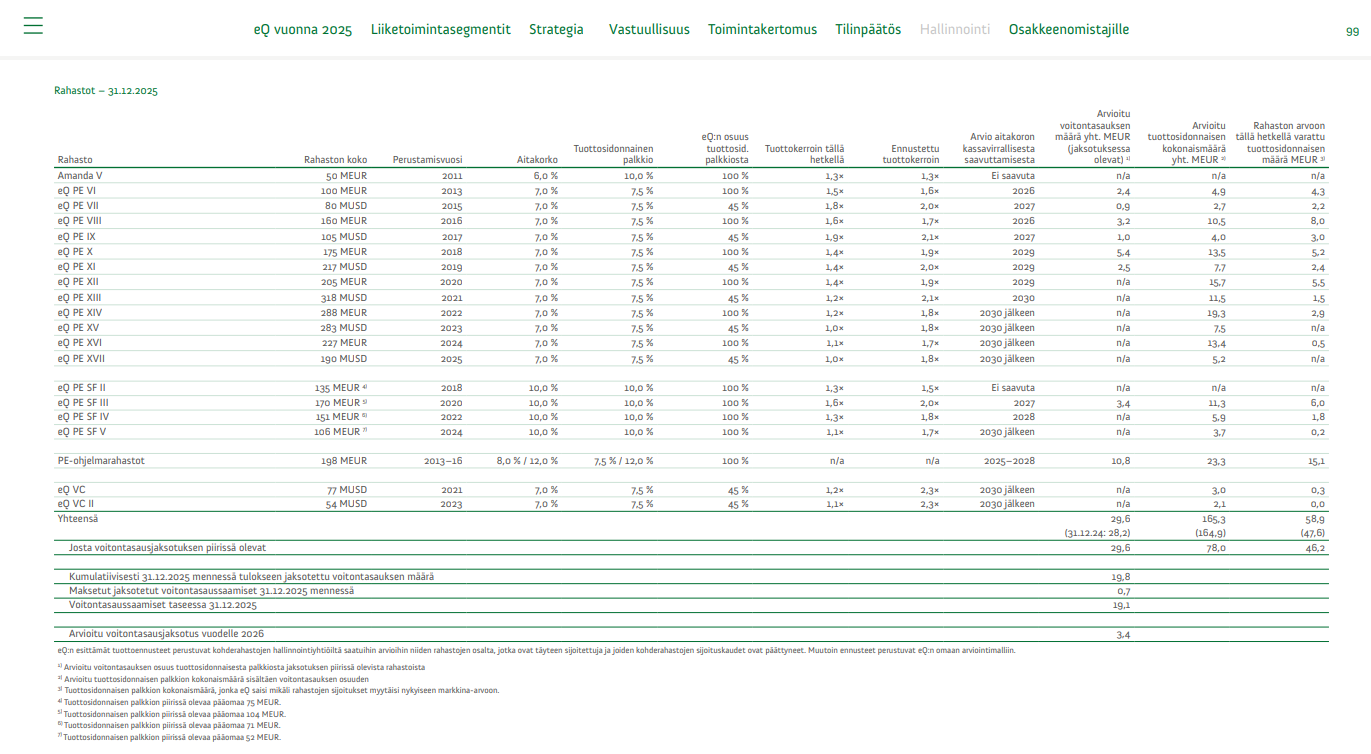
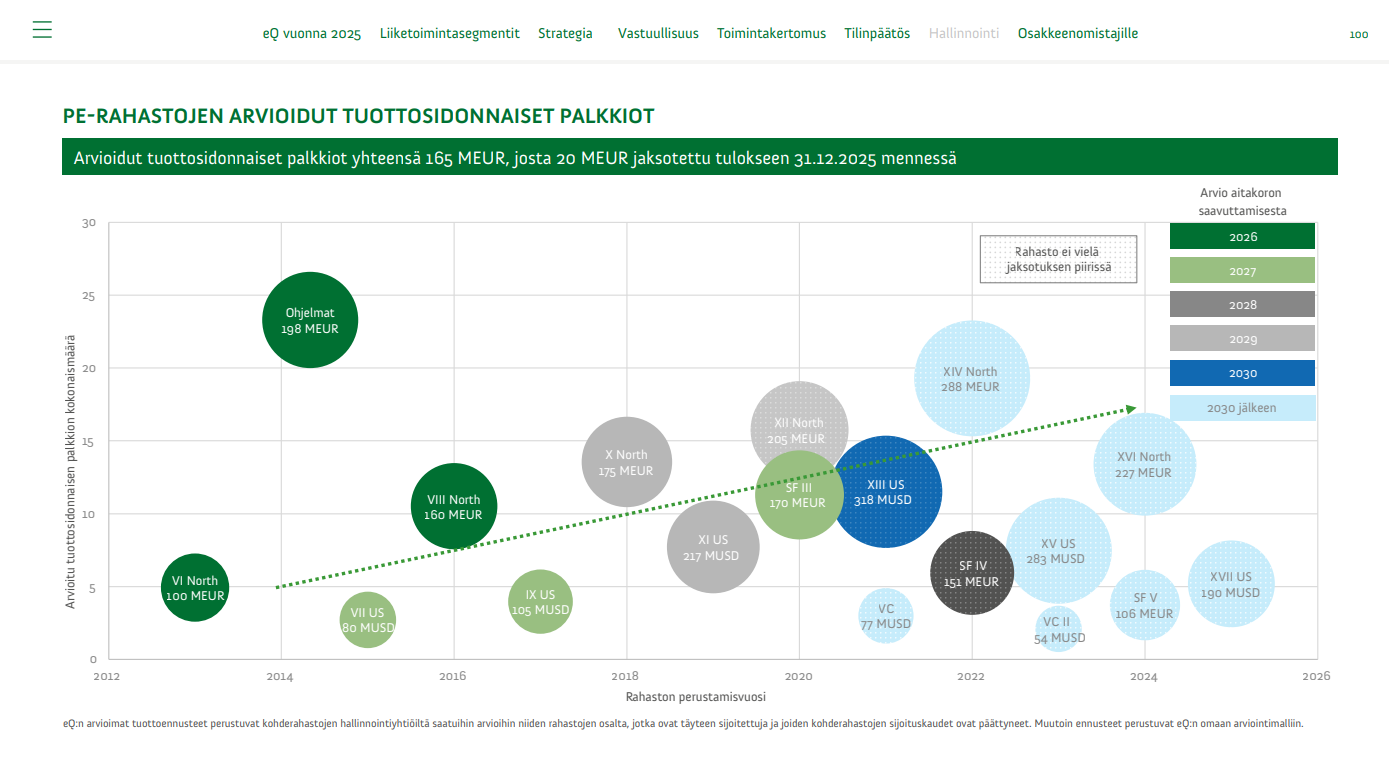
This has been the hot potato regarding eQ for the last couple of years. Huge amounts of performance fees are expected to come in (eQ’s own estimates for performance fees are in the images):

Source: eQ annual report 25: https://www.eq.fi/~/media/files/konserni/vuosikertomukset/eq_vuosikertomus_2025.pdf?la=fi

It is clear that the market currently does not believe in the realization of these performance fees (market cap 400m vs. 165m perf fees) on this scale. This uncertainty and skepticism has grown in recent years as performance fees have been constantly kicked down the road due to the slow exit market. In my opinion, these performance fees in the coming years play a very central role for eQ. If they come through on the promised scale, the fund returns will have been good, and this helps maintain the company’s leading position in the growing domestic market. Conversely, if the performance fees do not materialize, it means returns have remained at a lackluster level, and in this industry, that has generally always meant weaker new sales. This naturally reflects on the company’s chances of success abroad, as it’s useless to go to the international arena offering mediocre products. :globe_showing_americas:

Then to your question about Private Credit and PE software. I wouldn’t draw a very large parallel to eQ there. eQ only has a couple of older funds in PC, and in PE, as far as I understand, the company’s strategies are not software-focused in any way. I would focus more on the company’s own game, of which we will see a lot of evidence this year, as significant capital should be raised for several PE products and performance fees should start to materialize more briskly :slight_smile:

15 Likes

Thanks for the comprehensive response. Let’s wait and see if PE funds emerge unscathed. The problems are in the private credit market, but I’m considering that the same companies that have financed their operations with capital from private credit funds may have also raised the equity component from private equity investors. And when the music stops, the equity capital is wiped out first, and only then the credit side.

Another thing I’ve been thinking about, which could be bullish: the portfolios of Finnish pension insurance companies are being restructured, and a larger allocation is being given to equity risk. I wonder to what extent this capital could be channeled into the PE market, for example through eQ’s funds. If anyone, the new CEO might have a clear vision on this… This could be a good structural driver for the coming years and is in line with the company’s strategy. Any thoughts on this from others?

1 Like

eQ once again published the quarterly reports for its open-ended real estate funds yesterday. The reports are very extensive, and they provide essentially all relevant information related to the funds. I have personally criticized open-ended real estate funds specifically for the lack of transparency, and these reports answer that call well. One can hope that these become the standard for the entire industry. :teacher:

Naturally, there haven’t been any massive changes in the reports since Q3. In the big picture, the situation in YKK (eQ Community Properties) is still quite good in my opinion, and the fund is currently generating a ~3% cash flow yield. On top of this, there are value increases, which are a realistic assumption in the long term given the portfolio. There is also only a limited queue of unpaid redemptions.

As for Commercial Properties (Liikekiinteistöt), the situation is very grim. Vacancy is high, cash flow yield is weak, and there is a massive queue of redemptions. The office situation is particularly concerning. The net rental yield for the portfolio’s offices is 3.8%, which speaks to a severe vacancy problem. It is clear that an assumption of rising occupancy rates has been baked into those appraisals, as that 3.8% is far too low for offices. The problem with the Commercial Properties fund is that offices make up 40% of the portfolio, but selling them in this market with high vacancies is difficult. On the other hand, if a lot of other properties are sold, the share of offices will increase even further and the portfolio structure will suffer. The portfolio’s return has also remained weak, and 2025 was the third significantly negative year. As a side note, I take my hat off to eQ for genuinely writing down the values of their funds substantially.

26 Likes