Buying Your First Investment Property

It seems that both existing real estate investors and those considering their first property are writing in this area. I’m also eager to acquire my first property, and I thought it would be good to create a separate topic for this specific subject, as it can be discussed from many perspectives. The danger in a large thread would be that the points get lost among other discussions.

There are several different tactics. It might sound strange, because it’s always said that one should buy a studio apartment in the center of a growing city, because the appreciation and rentability are excellent. Why isn’t this always done then? Clearly, the reason is that such apartments cost a fortune, precisely because there is high demand for them. It’s difficult for an average person to get involved because the down payment amount is really high. Few people have collateral yet to be able to utilize it. Inheritances and other such things help only a few.

The easiest way to get involved is to buy an apartment in a slightly worse location. This sparks more discussion. Is it worth buying in a suburb of a large city, in a nearby city along transport routes, or in a small city cheaply in the center with a high rental yield? Then it would be easier to proceed when collateral is freed up, and one can buy elsewhere with that security. Or would it be best to start, for example, with a cheaper storage unit?

There will probably also be contemplation on whether it’s more sensible to buy the first property as quickly as possible and learn the industry through it. An alternative could be to consider dry practice, i.e., studying things thoroughly and then carefully buying a well-chosen apartment.

There are numerous perspectives on the matter. I would gladly hear how you approach the issue, and preferably from those who have already invested, how your journey to acquiring your first property has gone.

10 Likes

I’m in pretty much the same situation as described in the opening post.

I have my own home loan, but I’ve only been paying it down for a couple of years. So, there’s no free collateral from my own apartment, and I probably wouldn’t even want to use it if other options exist. I called my contact person at a small OP branch, and the following example deal sounded possible to the bank official:

  • Apartment price 100,000 euros
  • Own money min. 10 percent, i.e., 10,000 euros
  • Personal guarantee (in my case, from my parent) 20,000 euros
  • Apartment collateral value 70 %

The loan period for investment apartments is generally a maximum of 15 years, but based on the discussions, there might be flexibility. My goal is to achieve a cash flow that is neutral or slightly positive, so a loan period of 20-25 years is almost a prerequisite for success in growth centers in Southern Finland. I need to inquire about the situation with a few other banks.

My chosen target city and strategy are still finding themselves. I believe my strengths lie in regional comparison due to my educational background, so I aim to find the most sensible target cities through various city and neighborhood analyses. I use different market overviews, zoning information, construction industry publications, and, for example, Statistics Finland data. Additionally, I could add renovation skills to my strengths, so a cheaply priced apartment in need of a surface renovation could also be a wise investment for me.

My initial thought is that the target would be a studio apartment, but a small two-room apartment could also be an option if I find an easily rentable, affordable, and reasonable rental yield property. Helsinki’s price level is such that it might not be possible for me with my resources, but Espoo and Vantaa might be possible. Tampere and Turku are similarly borderline and possible if a good property comes into view. Commuter towns probably offer better opportunities due to price levels.

I’ve been wondering if it’s wiser to start with a more affordable property and stay away from the largest cities. This would allow me to get started a bit faster, potentially get a better rental yield, and enable me to buy the next property more quickly. On the other hand, large cities seem to have the best appreciation potential, good rentability, and stable rent growth – usually at the expense of rental yields, though.

I will continue with market surveys, requesting loan offers, and refining my strategy, and I’ll update here from time to time.

4 Likes

Any experience with larger apartments? Small studios are the easiest, and then probably large studios/small one-bedroom apartments are the second easiest. But because of this, they are naturally more popular, and thus competition eats into returns.

So, as I understand it, better returns can be achieved with larger apartments, but this is certainly not the whole truth. Returns per square meter are smaller, but housing company renovations are not. I don’t know how surface renovations scale, but likely in this regard too, I believe two or three-bedroom apartments are worse than studios. There are also fewer target tenants, meaning more work may be needed to find a tenant, but then again, people typically live in these longer than in studios, meaning more effort, but spread out less frequently.

Is there anything else? Has anyone already done calculations or has experience comparing these apartment categories from an investor’s perspective? Assuming we’re not talking about some AirBnB party pad, but long-term renting.

I highly recommend joining Veromaksajat (Taxpayers’ Association) if you are interested in investing. For example, articles on this topic are regularly published in the association’s Taloustaito (Financial Skills) magazine, from which I picked the text below from the “Karo’s Stock Market” column.

Karo interviewed Petri Roininen, who is a real estate investor and has also written a book on the subject, “Apartment – The Most Important Investment of Your Life,” which I also recommend. Karo asked Petri to name the three most important things when acquiring a rental apartment:

1. Ensuring Rentability

“You must acquire an apartment of a suitable size in an area where rental demand will remain strong. This is crucial for both rental income and potential future sale. In such cases, you must either know the market yourself or have a trusting relationship with an expert who manages real estate assets.”

2. Condition of the Housing Company

“The condition of the housing company significantly affects future repair needs and thus the value of the investment. It must be priced correctly at the acquisition stage.”

3. Avoiding Personal Preferences

“When making an acquisition, the criteria for rentability should be clear in mind. An investor should not be enchanted by stylings, color choices, interior design, or space solutions that might appeal to their own preferences. This is about real estate investment, not the investor’s own home.”

I would also add that it is easier to buy cheap than to sell expensive, so liquidity must be good. This applies to many other things as well.

5 Likes

You’ve clearly spent time pondering and planning the topic, but I must comment that it’s quite challenging to achieve even slightly cash-flow positive/neutral returns in those cities, from better areas, with those specs. With 70% leverage and a 20-year loan, the rental yield needs to be around 6% at this interest rate level. However, in the fringe areas of the city center, by paying the self-financing for a new build, this is achievable with 70% leverage and a 25-year loan, thanks to the tax advantage.

That’s how it seems to be. I’ve calculated with a 25-year loan term myself, although getting one for an investment property seems difficult. I occasionally collect potential properties in Excel and look at their rental yields, considering renovation costs. Very rarely do I see rental yields above five in, for example, studio apartments in Tampere, even with renovations factored in. If I do, I might still be making mistakes in determining renovation costs and rental levels, or the location might leave a lot to be desired. So, it’s not easy.

I’ve started to feel that I really need to think about what kind of strategy to use when going shopping. For example, is it:

  • To buy a newer studio apartment near the city center or at least with excellent connections, which is not particularly attractive in terms of rental yields (let alone cash flow positive), but which would have good rentability, carefree ownership, a bright renovation future, good housing association specs, and perhaps appreciation potential.

  • To look for overpriced and poor-condition properties stuck on Etuovi (or actively monitor various channels in real-time for new listings) and offer a boldly low price for them. Implement a sensible surface renovation (I have the expertise and some connections for this) and rent it out at a reasonable price. You might become cash flow neutral, but at the same time, you might have to compromise on the housing association, location, appreciation potential, etc.

And of course, there are a hundred other strategies, but I need to start outlining a few potential ones for myself.

Many more experienced people seem to recommend that you just start, and it will take off from there. But then when they say in a side note that properties should be acquired 10-30 percent below market price, it’s a hell of a difficult equation for a beginner. :smiley:

By the way, what is the order in which one should proceed regarding starting:

  1. Familiarization with the topic (investment books, blogs, podcasts, courses, coaching)
  2. Market research and market selection (overviews, zoning, browsing properties)
  3. Loan offers

What then?

It’s probably worth calling real estate agents about potential properties. What about calling the property manager and the chairman of the housing association board? What kind of reception do you usually get from them, and what significance do you think these types of information sources have? What documents should be obtained for a potential property, how, and why?

1 Like

The order of familiarization with the topic also seems quite functional. I started pretty much the same way myself.

Regarding buying apartments: The chairman of the board and the property manager usually have a very professional attitude and provide information about the housing company’s situation. It is also in their interest that sales in the company go smoothly. I haven’t always called, but I recommend it if you have even the slightest doubt. Of course, people always differ.

Regarding documents, the budgets and financial statements are, of course, the basics, but it’s also worth asking for the shareholder list if it seems to attract investors according to the apartment distribution. Properties may have very concentrated ownership or assisted living, etc.

Networking is difficult for the Finnish nature, but I have personally noticed that by attending viewings and discussing one’s goals, some off-market properties may open up from real estate agents. Some agents maintain their own investor circle, while others “don’t have time” for such things. There are occasionally gems in the public market as well, but these usually move within hours, so closing them requires confidence in the price level and the property so that a decision can be made quickly.

1 Like

Here are some thoughts on buying a first investment apartment. Although I don’t currently own any investment properties, I research the field a lot and always calculate the yield percentages of studios for sale in my locality into Excel. I also work in the real estate sector.

  • The location of the apartment is certainly important, but in the Helsinki metropolitan area especially, prices are too high for a first-time investment apartment buyer, unless they have sufficient equity. So, I would favor other university towns where you can get better returns with a lower purchase price. Although studies show that apartment prices fall annually, rents remain the same or even improve. Here, I would emphasize familiarity with the chosen locality. I would also be cautious about towns with a few larger companies whose closure could have a significant negative impact on apartment prices.

  • Apartment sales documents. You will probably get the first information from, for example, etuovi.com, which, in addition to pictures and a description, summarizes the information from the housing manager’s certificate. You can calculate preliminary yield figures, but it’s worth asking the broker to email you the housing manager’s certificate, budget, maintenance needs report, financial statements, auditor’s/operations report, articles of association, and energy certificate. These provide a comprehensive package of the housing company’s status. Below is more information on what I pay attention to:
    o From the housing manager’s certificate, you can see, for example, the apartment’s loan shares and the entire housing company’s loan information. The loan share can be paid off if desired, but this usually incurs costs for either the seller or the buyer. Of course, an investor should note that they can deduct financial charges in taxation. In this regard, you should either read from the income statement or ask the broker whether the financial charges have been recognized as income or capitalized. From the investor’s perspective, it is better for them to be recognized as income, because if capitalized, they are not deductible in taxation. You can also ask the housing manager directly about this.
    o In the budget, you can see the amount of maintenance charge required to cover expenses. On the income side, it is worth checking whether the housing company collects an additional “renovation charge” for future renovations. This is common in older housing companies. Regarding the budget, I would warn against the term “cheap maintenance charge” that appears in many sales brochures. Unless it is, for example, a ground source heat property, this term can be misleading. The maintenance charge can be made very small, but there is usually a reason for it. If almost nothing is budgeted for repairs, the maintenance charge can be kept small. But if liquidity is not good and there are, for example, water damages, the housing company will have to collect additional charges from shareholders, which in turn reduces the investor’s return. Therefore, it is better to pay an average maintenance charge, where the budget also sufficiently allocates for annual repairs.
    o The maintenance needs report is a really important document. It lists completed and future renovations. In old housing companies, a long list of completed repairs is not necessarily a deterrent, but a sign of active housing company management where repair debt is handled on time. I also give extra points if the housing company has had a condition assessment or study within 10 years. These provide an outside perspective on the housing company’s condition with cost estimates. Future repairs usually involve major basic renovations. If, for example, a 1970s apartment building has not had any major renovations so far, a large pipe renovation may be due within the next 10 years, the costs of which could be as high as the current market value of the apartment. This is usually taken into account in the sales price, but it is worth calculating the costs yourself.
    o The financial statements should be read through, and unclear matters noted down and clarified with either the broker or the housing manager. The financial statements include the activity report, subsequent calculation, budget comparison, income statement, balance sheet, and notes. All of these are important, but I emphasize the importance of the subsequent calculation. It shows the housing company’s liquidity, which is a more reliable measure than the bank account balance shown in the balance sheet. If necessary, you can ask the housing manager directly how the housing company’s liquidity has developed over the past few years. Most housing managers, to my understanding, answer these questions. Also check whether the housing company has an official auditor, which is always a plus.
    o From the articles of association, you can see, among other things, the number and sizes of the housing company’s premises.
    o The current energy certificate model is, in my opinion, almost useless, but from it, you can see the estimated energy class of the building. I even wrote a thesis on this, criticizing the certificate and its calculation principles.

  • At apartment viewings, you should be vigilant and not pay attention to the colors of the wallpapers. If the numbers are in order, the apartment surfaces can be renovated at low cost.

  • If you don’t have much equity, you will naturally have to apply for a loan. It’s worth asking several banks to see how you are perceived as a loan applicant by the banks. You should negotiate for the best offers.

  • It is worth calling the chairman of the board. They can provide practical information about the housing company. Is the housing company’s spirit so poor that resident turnover is high?

  • It’s worth finding out the square meter prices of similar apartments so that you don’t pay too much for the apartment. You can easily get help with this by simply googling.

  • Renting out the apartment. Do you use a rental agent, or do your personality and expertise allow you to handle the renting yourself? This saves costs. Rental agreement templates are available, and if necessary, you can even draft them yourself in an hour.

  • In my opinion, the first apartment should preferably be a studio rather than a two-room apartment. In recent years, demand for studios has been higher than supply, but they are safer in terms of yield.

  • If you know the local market, networking can allow you to hear about potential apartments for sale before they come onto the general market. In these cases, there is an opportunity to buy at a discount.

These are some thoughts. I probably didn’t remember everything essential now, but I would be great to hear others’ thoughts.

15 Likes

New apartments in pre-marketing in Pitäjänmäki, Helsinki - SRV.fi

What do forum members think of this property? I myself have lived on the other side of Pitäjänmäki and know the area fairly well. The future location of the company is, in my opinion, excellent: close to a beautiful park (visible from the windows of some apartments), the outdoor recreational areas of Tali, and a Raide-Jokeri stop coming a few hundred meters away. Train stations (Valimo and Pitäjänmäki) are also within walking distance. Own plot, which is quite rare in the Helsinki metropolitan area nowadays.

A quick calculation. A 37 m2 two-room apartment, debt-free price €235,870. Maintenance costs €159/month and rent… €900/month? The initial yield is just under four – 3.8%. With a monthly rent of 800 euros, the initial yield is approximately 3.3%; it falls somewhere in between. I didn’t research the rent level in the area closely, but it seems to be in the range of €800-900/month for a 37 m2 two-room apartment in that area?

It doesn’t seem particularly expensive to my eye. And I agree about the area: a magnificent park, good transport connections. Services are a bit so-so; there’s an S-market right next door, but that’s about it. There aren’t many other services within walking distance.

The rent level based on the comparables found is surprisingly high. Sato, for example, rents studios on the other side of Pitäjänmäentie for up to 950e/month, although they are spacious for studios:

https://asunnot.oikotie.fi/vuokrattavat-asunnot/helsinki/15957731

I made my own calculations for a studio and used 850e/month as the estimated rent. A rental yield of just under 4% or even 4% in Helsinki is sufficient for me, so I have tentatively reserved a studio in this company :+1:t2:

Many recent estimates I’ve read suggest that this area may also have good appreciation potential, as mentioned, for example, in this article:

However, I can’t say how accurate these forecasts have been in the past.

1 Like

The appreciation potential is definitely there. If I had to find a flaw in that area, I think it would be commuting to the center of Helsinki. The train station is a bit of a distance, but there is a bus stop nearby, although it is a bit slow. This is certainly compensated by the natural values of the area.

If we consider appreciation potential, will it come from… 1. (net) rent increase or 2. decrease in yield requirement. In this area, a bit of both. In my opinion, calculations for this property could be made with an average yield of 3.75%?

As a comparison, a property completed next to the station in 2019: https://asunnot.oikotie.fi/myytavat-asunnot/helsinki/15944967. The asking price does seem very high, especially considering that it’s on a city-leased plot :D.

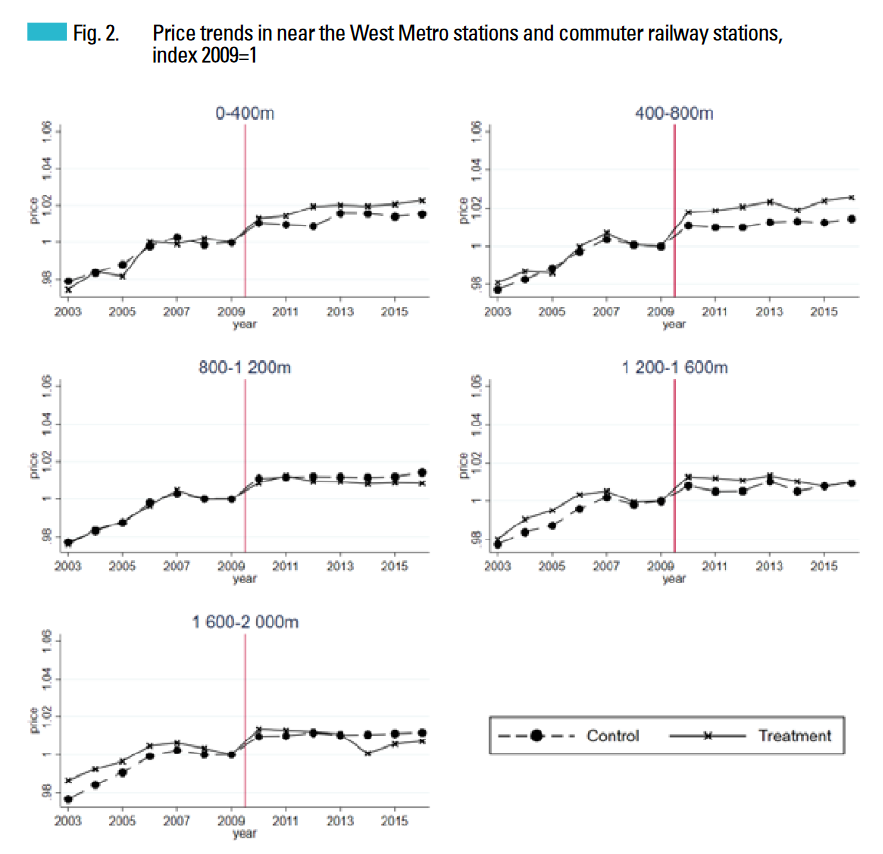
One comparison area is certainly Keilaniemi. There, appreciation was tremendous during the 2010s. I can’t give figures now, but offhand, I recall it being as high as 50% at its best. Also, residential properties along the Länsimetro (West Metro) line — a doctoral dissertation has actually been written about the Länsimetro and the appreciation of apartments. I recall the result being that the biggest appreciation happened right when the route alignment was finalized, and that’s how it should be. Of course, appreciation has continued since then.

1 Like

This is an interesting question. Antti Palkèn, a guest on the Ostan asuntoja (I Buy Apartments) podcast, mentioned that in Lauttasaari, people talked about the West Metro already being priced into apartment values decades before it was finally completed :smiley: On the other hand, many areas along the Helsinki metro have lagged behind in price development for a long time, even though transport connections are excellent with the metro.
In recent years, as far as I understand, prices in Helsinki have risen more than rents, but of course, there will be limits to the decline in yield requirements at some point. In an area like this and on one’s own plot, a decrease in the yield requirement to, for example, 3 percent does not yet sound like a bubble to me, if interest rates remain low for a long time as predicted.

Here’s a link and a couple of interesting graphs!

1 Like

I’ve been thinking about real estate investing vs. stocks, and it always seems to be said that stocks offer the best return. Let’s assume an initial investment of 150k. For stocks, a holding period of 20 years and a 7% annual return. Then for real estate, the same amount, but by putting 15k per apartment as equity × 10 apartments, with the rest financed by a loan, and an expected return of 7% per year for 20 years. After 20 years, would you rather have 10 debt-free apartments generating continuous cash flow, or a stock portfolio? How could that 7% return be the same if the tenant is essentially paying for your apartment? Beginner asking, so please be kind in your answers :slight_smile:

In that case, the bank would require additional collateral. Unless you buy 50k apartments in the countryside, in which case the bank will provide a mortgage for perhaps 40-50% of the value of the properties, requiring even more collateral or your own money.

10 apartments require some work vs. just sitting on the couch with a portfolio? What if you get bad tenants? The list goes on. But I think a good combo would be a bit of everything :blush:

I tried to make the scenario as simple as possible. I know that renting out an apartment causes trouble and machines break down, etc. I’m mainly wondering what the claim I’ve heard many times is based on, that a 7% expected return on apartments and stocks would lead to the same outcome. If you have 10 apartments with an initial investment of 150k, and each apartment’s value at the time of purchase was 100k and after 20 years it’s still 100k. So, a total of one million, and the tenants would have paid for the fun vs. a portfolio with 7% and 20 years. Of course, it wouldn’t go exactly as planned, but I’m just wondering about that claim. Is it just that if you always acquire a new apartment using the previous one as collateral, you will eventually surpass the stock market’s return?

I’m not sure I understand the question, but in that scenario, you have 850k in leverage, which significantly impacts returns.

Let’s assume you buy an apartment for €150,000 and take out a loan of €120,000 for it. Furthermore, let’s assume that the rental income covers loan payments + maintenance fees + other expenses, with a rental yield of 4.5% or 4.5% x €150,000 = €6,750. In that case, the return on equity would be €6,750/€30,000 x 100 = 22.5%, which is higher than the average 8-10% (or whatever it is) return from the stock market. So, it would probably be a really good idea to buy that apartment, especially if you believe you cannot achieve the same return from the stock market yourself.

The example is completely made up, and taxes, interest rates, appreciation, etc., are not considered. This is somehow how I compare these things myself. Please correct me, wiser ones, if I am wrong. Currently, it seems that, especially in the Helsinki metropolitan area, the equity portion needs to be quite large for rental income to reach a break-even situation, and that significantly weakens the return on equity.

4 Likes