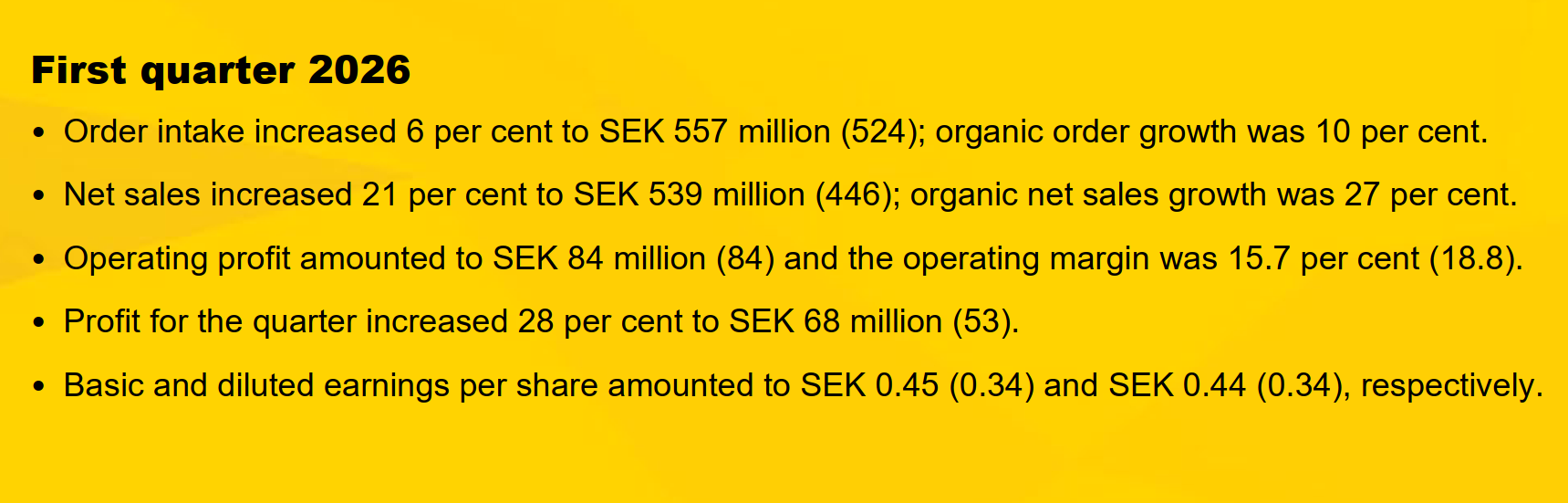
Engcon: What's so special about tiltrotators, and why is the company so profitable?

I’ve been contemplating the market potential a bit more myself.

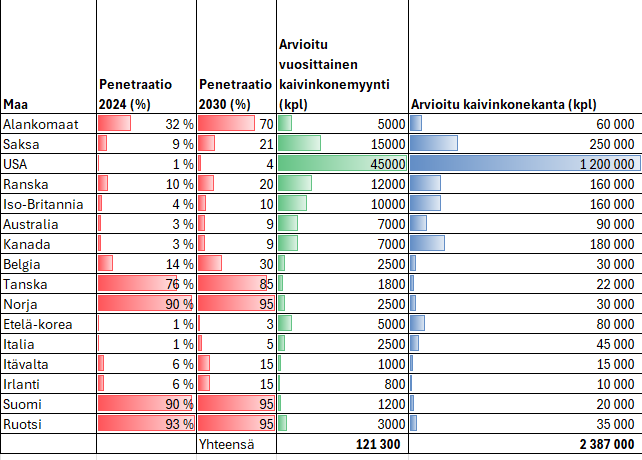
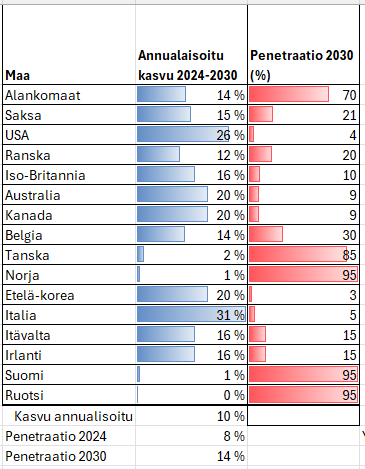
ChatGPT has estimated those excavator populations. It’s worth noting that not nearly all countries are even included here. The 2030 penetration rate estimate is taken from the Q3 2025 presentation.

The largest market is, of course, the USA. China is completely missing from this, as is Japan.

Even if, for example, the USA were to grow only to 4% with annual growth at 26%, there would still be an endless market remaining. I would also estimate that pricing is higher in the US, so in addition to volume, unit sales are also more valuable.

For example, Germany, as the second largest market on the list, is interesting. Germany alone has significantly more equipment than the high-penetration Nordic countries.

Here’s also a “blurry” graph of management’s estimates since the IPO. For example, the US estimate at the IPO stage was on the high side.

On the other hand, good development has been seen in the Netherlands, Germany, and Austria.

kuva

So, there is a market, but how will it develop and what is Engcon’s share?

5 Likes

Rakennuslehti had an article about this Finnish company. The article highly praised its own device, claiming its features are better than other tiltrotators. Its smaller size was mentioned, which is due to the heart-shaped hydraulic torque device.

The device therefore fits into tighter spaces. Also, hydraulic hoses are not an obstacle.

Additionally, the device’s tilt angle is larger, 2x50, compared to 2x45 for other manufacturers. I myself cannot say how much significance that really has in practice. Perhaps @Kuokkavieras would have information about these?

Rotyx is still very small compared to Engcon

3 Likes

This domestic Rotyx device is indeed interesting. I’d immediately want to put on my Finland-tinted glasses, play Den glider in, and declare Finland’s victory in the excavator international match in the town square. However, the matter is not quite so straightforward.

An old-new invention. Germans launched such a tiltrotator already about ten years ago. The manufacturer was Kinshoffer and the product name NOX. The exact same idea as Rotyx, implemented with different technical solutions. The same tilt angles compared to the domestic competitor. The idea is very good, and some units have been sold in Finland over the years. However, greater success did not come, as the product did not withstand Nordic conditions, and repairing the device proved to be very expensive. A simplified example: If the tilt hydraulic cylinder of an Engcon tiltrotator breaks, it can be replaced quickly as a single part, and replacement is easy. If something broke in a NOX, the fault was usually inside the device, requiring the device to be disassembled, and repairs were more expensive, both in terms of parts and labor. Added to this was the machine’s downtime.

In the long run, this leads to a used machine with a NOX being difficult to sell, and the tiltrotator no longer adds value. Often quite the opposite. The same suspicion applies to Rotyx, although I have no personal experience with its durability. This also applies to tilts from other smaller manufacturers when changing machines. In contrast, a used machine equipped with a major brand tiltrotator sells well, the price is better, and it’s a safer option for the buyer.

As major brands, Engcon, Rototilt, and Steelwrist set the guidelines. In Finland, also Marttiini, whose product is proven good. However, on a large scale, a really small competitor.

My own analysis: The market will likely be divided among the three biggest players. Tiltrotators have also come to other parts of the world to stay, as the Nordics have shown. The question is only how quickly this happens, as the industry is quite conservative. Good successes have already been seen, for example, in France and the United States. The French deal mentioned in previous messages was rare in that it went directly to the end-user. Usually, tiltrotators are sold through machine dealers with a new machine. I could imagine the margin also being different when going directly to the end-user.

I truly hope that domestic Rotyx or Marttiini can reach the podium in this race. While waiting, ABBA plays on the radio.

8 Likes

Engcon and Komatsu are deepening their cooperation. New machines are available from the factory with an Engcon tiltrotator or tiltrotator readiness.

A comparison to the automotive world: A brand selling cars to much of the rest of the world would start offering the possibility to buy Nokian Tyres Hakkapeliitta 10s as factory-installed winter tires. Not bad.

7 Likes

A Finnish company is challenging Engcon and other established players with its new technology, which is reported to be more compact and require less maintenance than traditional tiltrotators. The breakout force is touted as superior, and torque is better maintained at the bucket’s extreme positions. Rotyx’s technology is not the only one operating without external cylinders, but it nonetheless features patented solutions.

10 Likes

Kuokkavieras analyzed those very points just a few messages ago.

I was also referring to that same article. To me, it felt more like an advertisement than a magazine article.

But it’s difficult to evaluate the devices when you have no practical experience.

There are surely pros and cons to each of the different technologies.

1 Like

Off the top of my head, if you’re scooping something a bit coarser/stonier, a rock slipping against the cylinder will break it. Oil spills out or the piston bends, etc. Even a small hit when digging in a tight spot damages the mechanism. It also occurs to me that a cylinderless design is generally stronger. These thoughts came to mind while digging—my nose, that is.

1 Like

Kuokkavieras analyzed those very things just a few messages ago.

Indeed they did, already back in November, and they were apparently very much on top of industry developments. Regardless, I linked this fresh article about the same company.

1 Like

As someone working in the landscaping industry, mini-excavators and the larger machines used by partners are close to my heart. Previous commenters have already voiced my thoughts on the product itself. It is a high-quality product that improves productivity and has a solid dealership and aftermarket network.

In today’s digital world, I would imagine that the sale of heavy machinery and related accessories and attachments is still a fairly personalized business, meaning that a close connection to a familiar person or firm is important; I would expect customer retention to be high, with the possible exception of the largest companies.

Then I wonder why tiltrotators don’t catch on as easily in developing markets or, for instance, in the USA/Canada sector—pure guesswork, but perhaps the work there is more focused on mining, heavy earthmoving, etc., and manual labor for finishing work is readily available at lower wages than here in the Nordics. I am happy to be proven wrong and to see tiltrotators become more common worldwide; my own experience with the necessity of the aforementioned invention comes from, for example, cramped yards where you should be able to finish the job from one spot, but the bucket’s lack of rotation forces you to find new positions for the machine itself, whereas with a tiltrotator, you could optimize the machine in one location and finish the job from there. I am not, however, an earthmoving professional, and my experience is limited to mini-excavators rented during peak seasons.

4 Likes

Results today

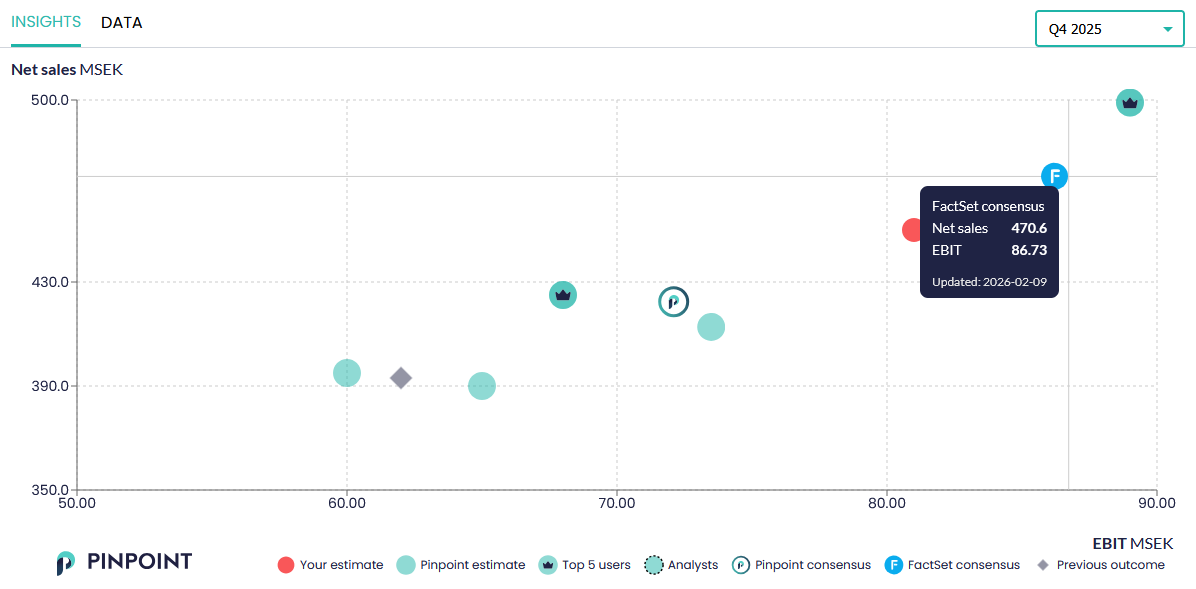
Q4 expectations FactSet

Revenue 470.6

EBIT 86.7

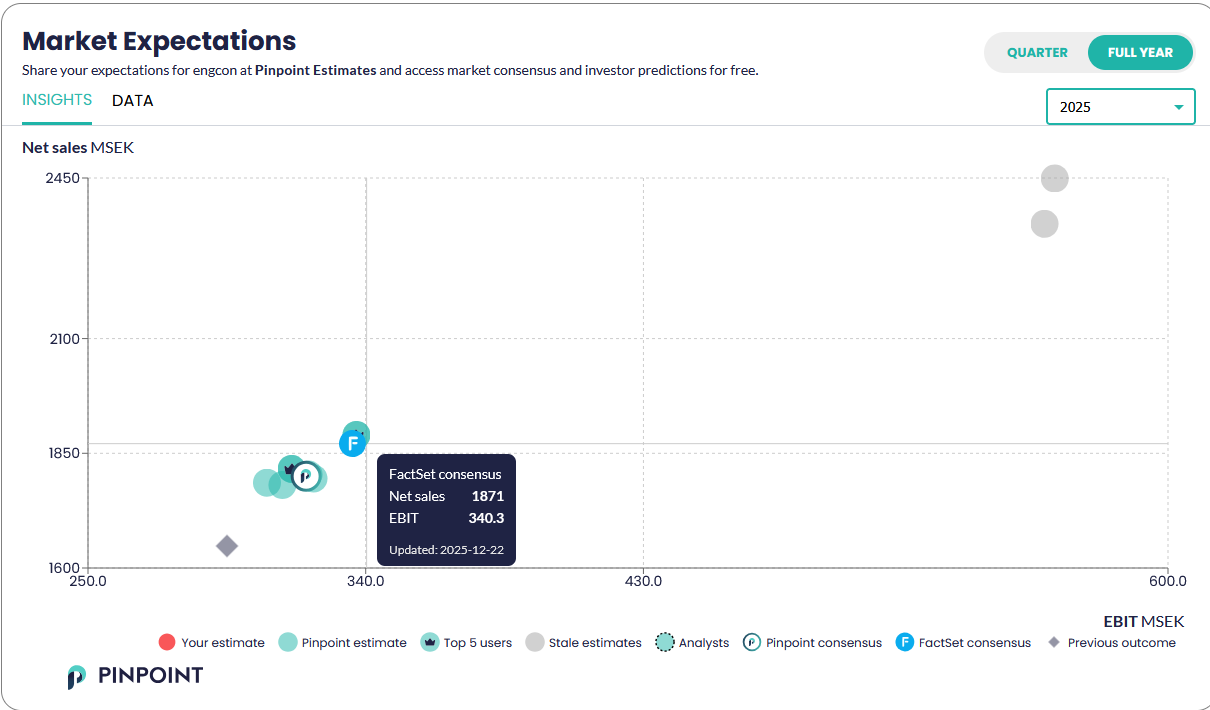
Full year

Revenue 1871

EBIT 340

If you compare those full-year expectations to the Jan-Sep actuals of 1,441, consensus is expecting around 430 in revenue for Q4 :grin: and with EBIT at 248 for the same period, the expectation there is 92.

Edit: Looks like 2026 forecasts slipped into the full-year figures; figures updated.

In any case, consensus is expecting strong growth for this year.

2 Likes

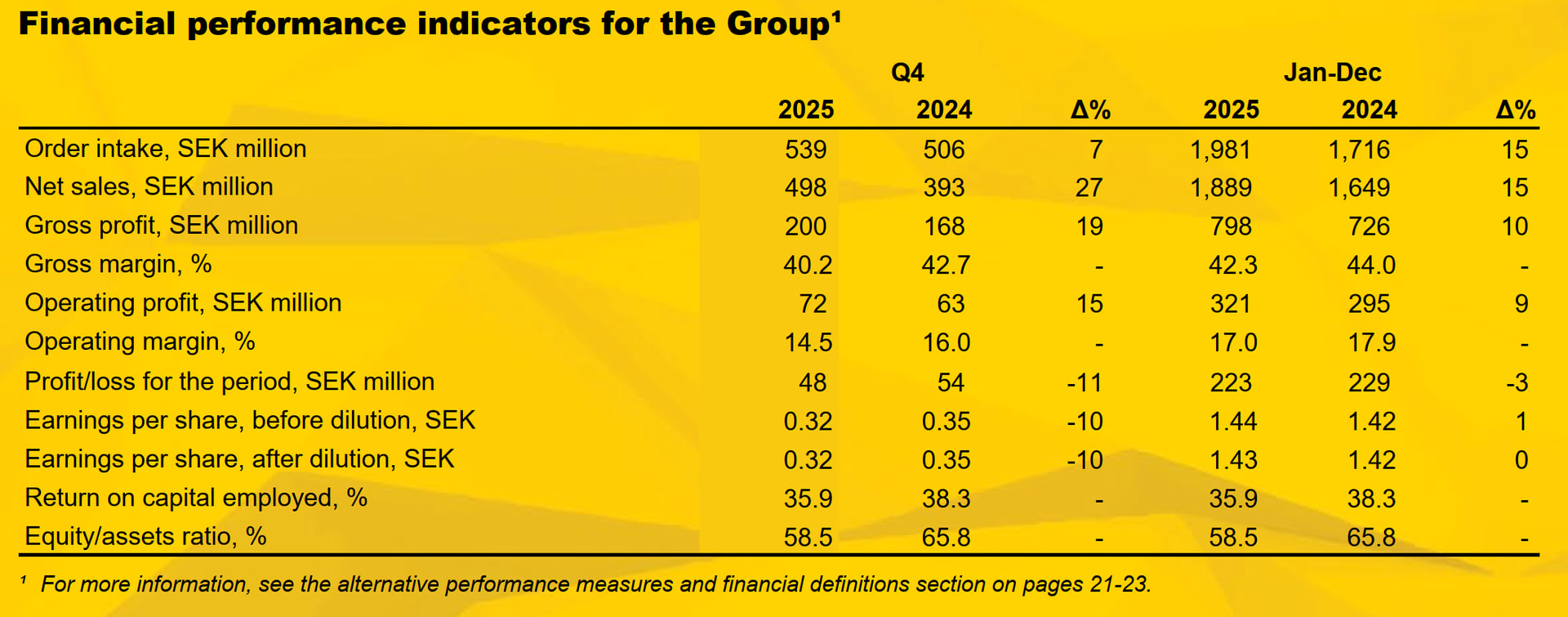
Alright, Q4 results are out

Revenue beat, operating profit missed.

5 Likes

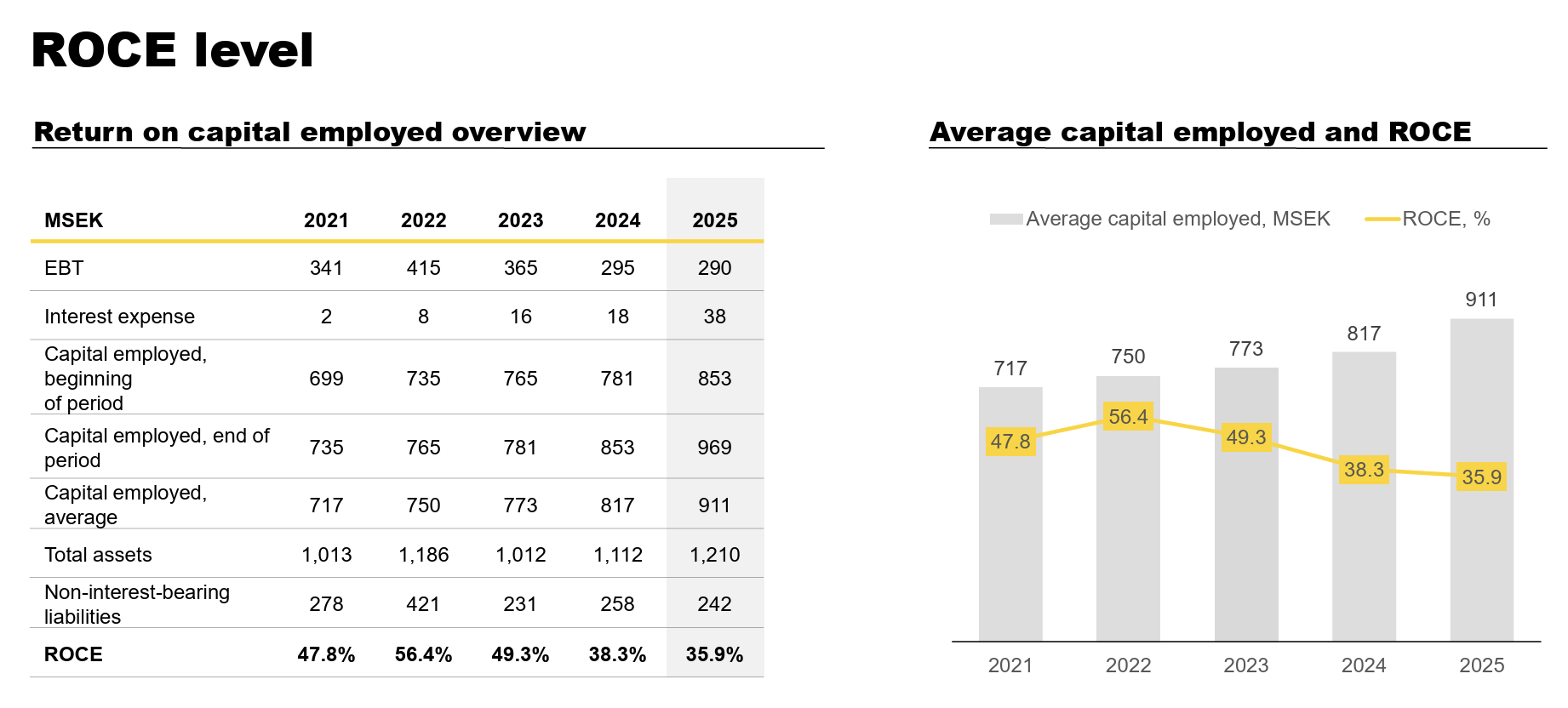
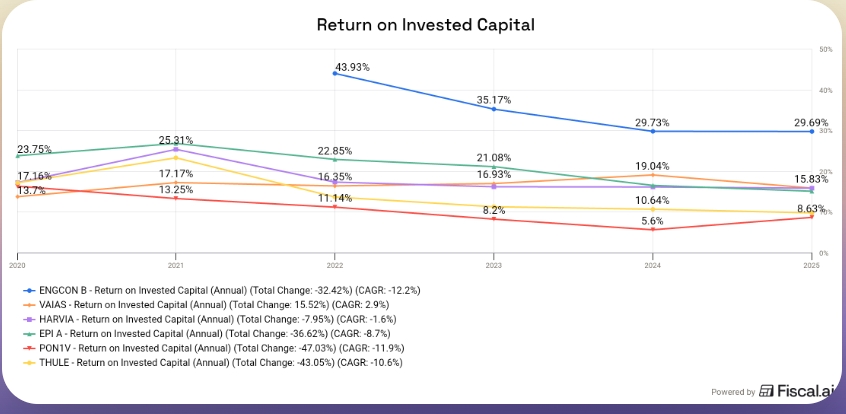
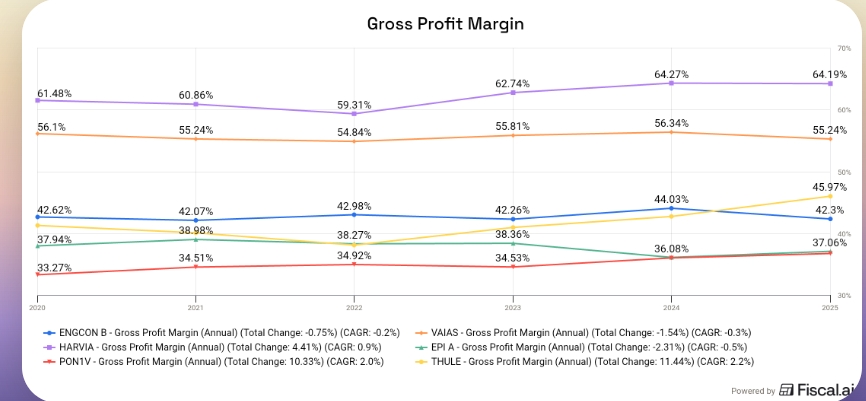
I’ve been eagerly following Engcon’s stock performance, but the company is still expensive. Especially since profitability (gross margins, ROCE) has been trending in the wrong direction in recent years. One can ponder these things for a while through “product mixes” and what not, but I wonder if there’s some structural pressure here. Even though the market is competed by a certain group, there is still competition.

The company’s NOPAT is roughly ~260 MSEK. Enterprise value is 8.8 billion. EV/NOPAT 34x.
Forward P/E with analyst estimates is 27x.

As written in the thread, there is considerable potential here, but it’s still a bit too expensive for my taste.

11 Likes

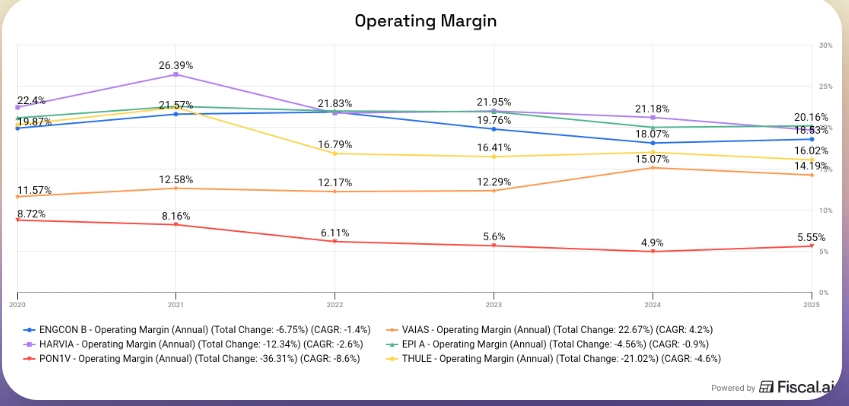
I’ve put together some comparative views.

Comparisons

  • Harvia
  • Thule
  • Ponsse
  • Vaisala
  • Epiroc

Let’s start with the valuation Forward EV/EBIT
It is expensive, as noted. The valuation has certainly come down from its peaks, but it is still over 24x.

Then ROIC. Although it has been trending downwards, it is significantly better than the comparables. If we stay at the 30% level, a higher valuation is justified. Here, calculation methods and adjustments certainly vary depending on the sources. Perhaps it’s better to look at the trend and the relative difference to the comparables.

Regarding gross margin, it must be noted that sheet metal (Harvia) is cheaper to bend than to build complex hydraulics.

In terms of EBIT margin, comparables are between 15-20%, excluding Ponsse.

I would say that a higher valuation is earned, but I still lack a margin of safety for myself.

4 Likes

On a side note, NOX is also a Finnish innovation. It was only sold to Kinshofer at one point.

4 Likes

Swedish optimism is seemingly an inexhaustible resource. When I commented on the stock being somewhat expensive less than three weeks ago, even in the 55 kronor range, the stock has rocketed back up to 70 kronor.

I don’t normally write or encourage commenting too much on price movements in threads, but the Engcon thread is quiet and I’m following the stock “with real intent.”

It is justified, of course, if one truly believes in a rosy future for excavator attachments. But the best profits are made by buying something rosy when others see it as a dandelion. In Engcon’s case, only the yellow color of the logo resembles a dandelion.

13 Likes

Hmhmh, the CEO is leaving after a 15-year tenure in a warm spirit, but a departure is a departure.

After 15 years as CEO of engcon, Krister Blomgren has agreed, after discussions with the company’s board, to leave the role as CEO. engcon’s board has also decided to appoint Stig Engström, engcon’s founder, as the company’s new CEO. Engström will take up the position on 1 May 2026 and shortly thereafter, in connection with engcon’s AGM on May 5, a farewell ceremony will be held of Krister Blomgren.

The founder is back at the helm. There has been room for improvement in profitability. It’s light-years better than the average stock investor’s profitability, but in relation to engcon’s own super ambitious goals, that is. :smiley:

8 Likes

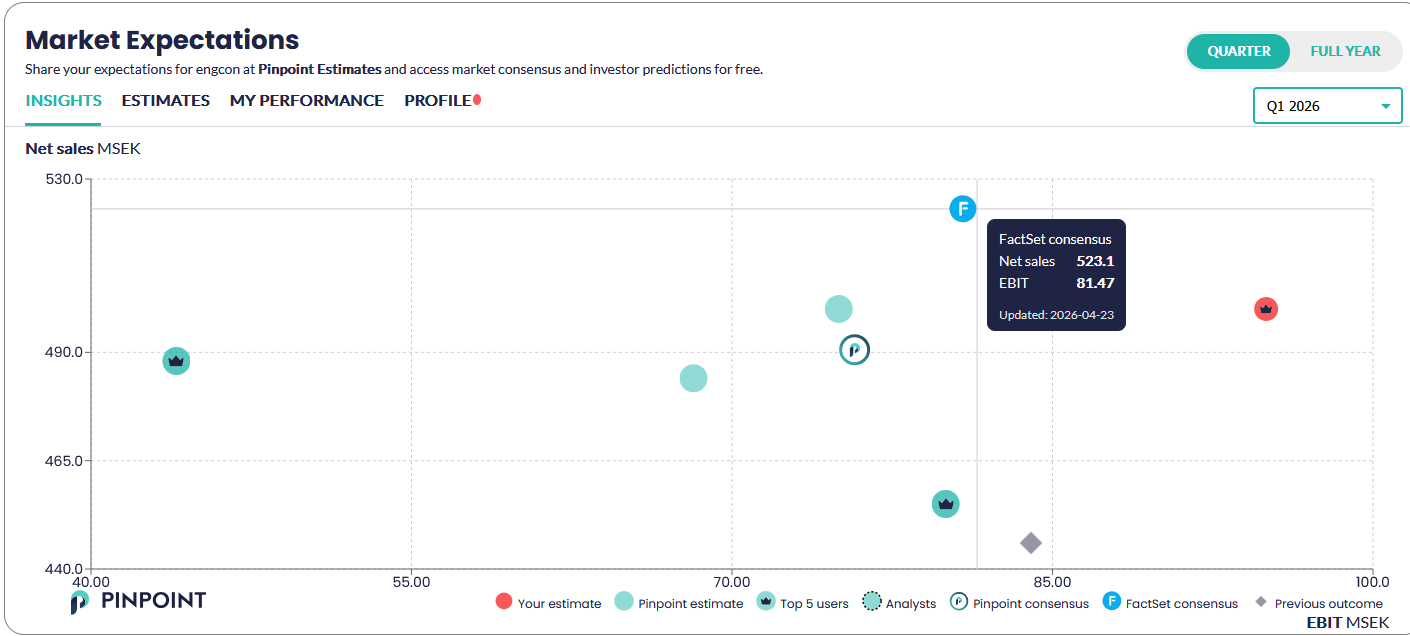
Tomorrow the Q1 interim report will be rolled out again

Consensus expects revenue of 523
and an operating profit of 81.47.

1 Like

Revenue beat expectations by a fair margin. Operating profit was also slightly above expectations.

And the share price says thanks +7.00%

2 Likes

Gross margin weakened 46.1% → 38.2%** (= -7.9 percentage points)

According to my estimate, this is due to:

  • Currency effect ~45–60%
  • Mix (product + market) ~25–40%
  • Capacity increase/ramp-up ~10–20%

So I wouldn’t be worried about this just yet.

It’s a shame the presentation didn’t include an updated penetration chart.

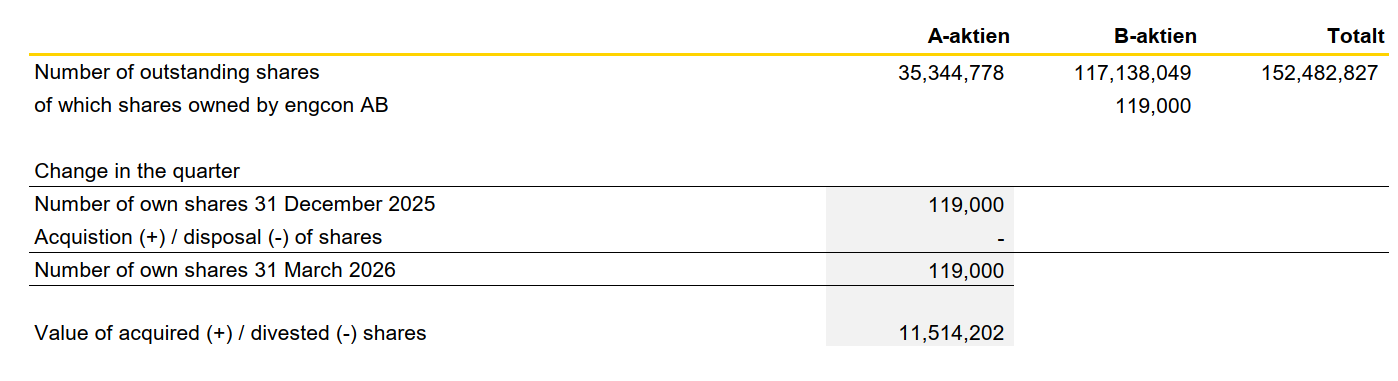
One note if you are evaluating the company by market cap. At least Google Sheets provides incorrect data on the number of shares. It only accounts for the listed B-shares.

4 Likes

To start, thank you Verneri for starting this thread. It is one of the most interesting threads on the forum.

I first came across the company through user experience in 2022. I was digging drains at my own home with a Yanmar ViO17 (my first experience with excavators), which had a tiltrotator and swing boom. For changing the soil in the yard, I borrowed a ViO57, which also had an Engcon. The machine was like from another planet compared to the previous one, and its versatility was a surprise. Back then, in the spirit of Lyncheily (investing strategy style), I ended up checking if Engcon was a listed company. It was, but the valuation was terrifying, so it stayed on my watchlist. In the fall of 2023, I missed the dip due to a lack of cash, as whatever little cash I had went into the spun-off Mandatum. Now, earlier this year, I’ve been able to buy in at more reasonable levels, and Engcon has grown into one of the largest holdings in my portfolio. Speaking of my own experience, there is always digging to be done, and since the possibility of borrowing machines ended due to a company acquisition, I decided to acquire my own small Komatsu. Being a cheapskate, of course, I got an older one with a rigid boom (at least it has a swing boom). I have to say, I miss the previous machines, especially that ViO57 equipped with an Engcon. I can only wonder at the low penetration rate and I believe that these devices will become more common globally in the future.

I talked with an acquaintance of mine in earthmoving earlier this year about peer companies. He was of the opinion that Engcon is the Mercedes of tiltrotators, that Tiltrotator is just okay, and he trashed Steelwrist for its usability. This, in turn, strengthened my belief in jumping on board with the market leader.

To avoid making this just about storytelling, Engcon also released a decent result today:

Second quarter 2026

Order intake increased 8 per cent to SEK 487 million (451); organic order growth was 10 per cent.

Net sales increased 12 per cent to SEK 594 million (530); organic net sales growth was 13 per cent.

Operating profit (EBIT) increased 8 per cent to SEK 102 million (94). Operating profit (EBIT), adjusted for items affecting comparability, amounted to SEK 115 million (94) and increased by 22 per cent.

The operating margin amounted to 17.2 per cent (17.8). The operating margin, adjusted for items affecting comparability, amounted to 19.4 per cent (17.8).

Profit for the period increased 18 per cent to SEK 82 million (70).

Basic and diluted earnings per share amounted to SEK 0.55 (0.46) and SEK 0.55 (0.45), respectively

January – June 2026

Order intake increased 7 per cent to SEK 1044 million (975); organic order growth was 10 per cent.

Net sales increased 16 per cent to SEK 1132 million (976); organic net sales growth was 18 per cent.

Operating profit (EBIT) increased 5 per cent to SEK 186 million (178). Operating profit (EBIT), adjusted for items affecting comparability, amounted to SEK 199 million (178) and increased by 12 per cent.

The operating margin amounted to 16.5 per cent (18.2). The operating margin, adjusted for items affecting comparability, amounted to 17.6 per cent (18.2).

Profit for the period increased 23 per cent to SEK 151 million (123).

Basic and diluted earnings per share amounted to SEK 1.00 (0.80) and SEK 1.00 (0.79), respectively.

CEO Stig Engström comments:

“I took over the role as the company’s CEO on 1 May tasked with bringing Engcon back to the financial targets set by the Board of 20 per cent annual growth with a 20 per cent operating margin. The quarter shows that our underlying business remains strong, with an increase in organic net sales and order intake. The operating margin is recovering despite restructuring costs of SEK 13 million, at the same time as we have more to offer. The journey is long, but we are moving fast. Now begins a new chapter in an old story, focusing on R&D, production and sales, the core areas that helped the company to grow quickly, at scale and profitably – Back to basics.” says Stig Engström, President and CEO.
16 Likes