In this thread, you can discuss various energy-saving tips, for example, what kind of arrangements have been used to reduce household energy consumption, and you can also discuss all sorts of energy-saving matters.
Here you can also talk about electricity consumption figures, as well as more broadly and freely about the topics of the heading.
If you want to discuss electricity sales contracts, i.e., their prices and terms, there is a separate thread for them here:
In addition, there is also a separate thread for general discussion about electricity markets in Finland and globally, where you can discuss more freely about electricity production, transmission, and other matters generally related to the electricity market:
Feel free to move this post to a more suitable thread if one exists. There’s been a lot of talk in recent messages about bathroom comfort heating. How much electricity on average do you save by turning this off in a two-room/three-room apartment?
Follow-up question: If you are renting, have you considered what the landlord might say about the heating not being kept on? Could it, at least in theory, cause damage to the landlord’s property? Opinions?
Why don’t you keep it on? Is it worth taking even the slightest risk of moisture damage and additionally compromising on comfort for the sake of a few hundred a year?
If the airflow levels in an apartment building bathroom are correct and the surfaces don’t stay damp for long after a shower, the comfort heating can very well be turned off. That comfort heating won’t save you, however, if there are defects in the waterproofing and moisture has reached the concrete.
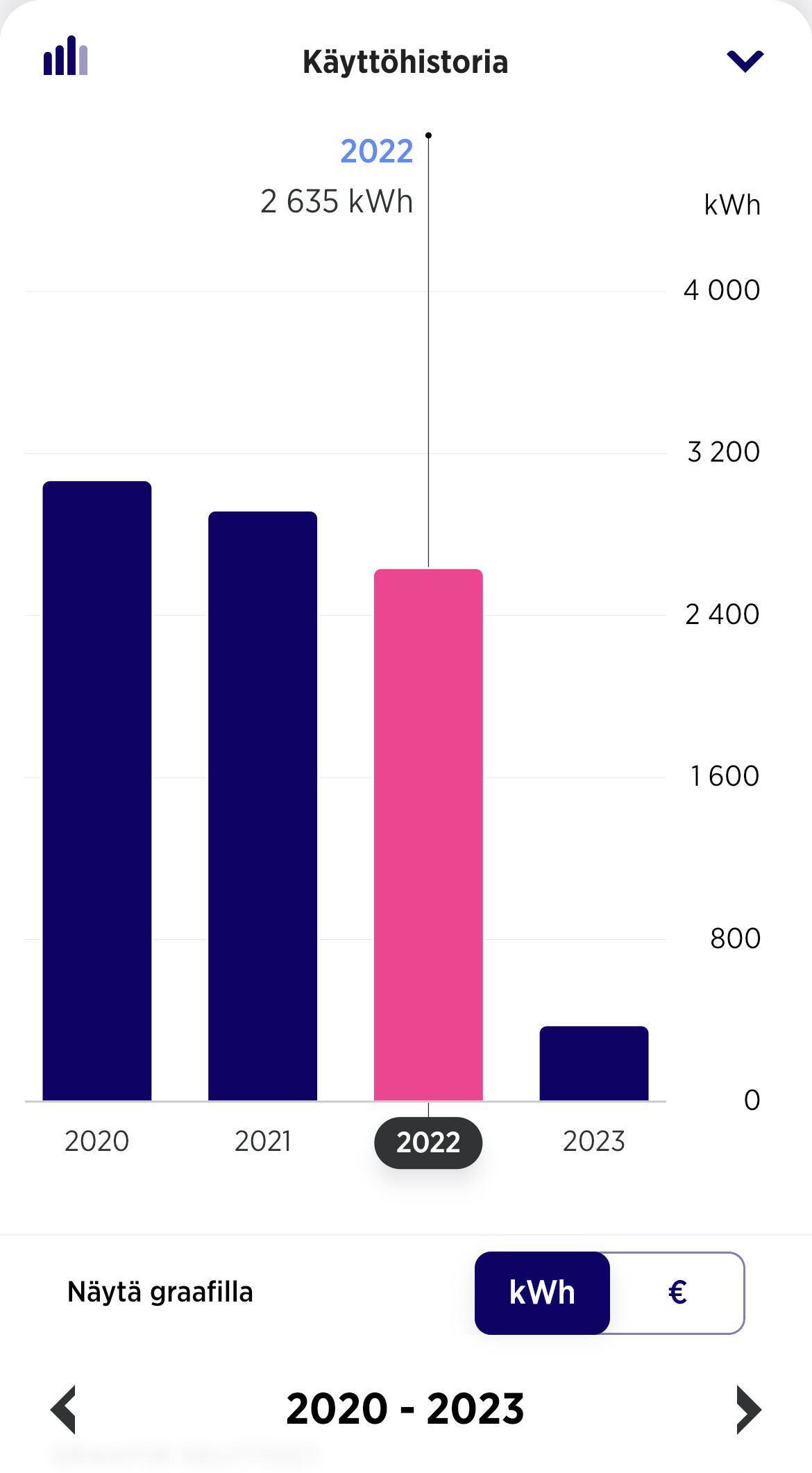
This went off-topic and I suppose we’re not meant to talk about consumption in this thread either, but here we have an 81m2 three-room apartment with centralized exhaust ventilation and approx. 2600 kWh/year consumption.
Electricity consumption in apartment buildings seems quite low. The other side of the coin is likely that they pay €300–500/month for district heating and the same amount for the city’s leased plot.
We are quite the wasters. Electricity consumption is 8,000 kWh per year and for heating (a drafty old house), 2,200 liters of oil.
Underfloor heating isn’t needed in an apartment building; the bathroom dries even without it. Comfort underfloor heating is specifically for comfort! We also have a “heated towel rail” for heating.
Where did you get the idea that floor heating in wet rooms is just for comfort? It might dry eventually without it, but heating helps the drying process. Just sell some of your stocks if you have to, so you don’t need to keep the shower floor cold…
It might not be necessary, but underfloor heating is definitely worth it. According to my information, 20–21 °C is enough for underfloor heating to dry wet rooms, while comfort temperature is around +23–24 °C. Two different things.
In wet rooms, it should be warmer than in the rest of the apartment/house so that moisture never condenses there, but instead evaporates and dries the surfaces. Therefore, for example, even during the summer heat, the heat should be maintained so that the wet rooms are the warmest place in the flat. Personally, I have kept the underfloor heating setting at 24-24.5 degrees for comfort, but now while saving electricity, it’s at 22.5-23 degrees. I believe some magazine article once recommended as a safe option not to set the floor heating below 22 degrees.
So, I would comment that 20-21 is starting to be a bit too low. The areas might usually dry out, but under certain conditions, not necessarily always well enough. In my opinion, it’s not worth the risk to lower it quite that far..
Yes, it can cause damage if the bathroom gets wet and drying is not taken care of. It’s not worth “freestyling” if you don’t know what you’re doing. And if you do, you should make a careful sensory assessment. If the bathroom feels damp and smells even slightly musty for a long time after showering etc., everything is not quite normal. Then again, if, for example, electric underfloor heating is on, closing the bathroom door can save electricity because, in theory, the bathroom might start heating the entire apartment. But this is affected by, among other things, the thermostat’s setpoint. There is no simple solution.
Most older apartment units do not have floor heating. It’s often installed during bathroom renovations. So, it’s not possible to implement in many cases.
If you want to turn off the floor heating, it’s especially good to use a squeegee to wipe the water off the floor into the drain. And I recommend this anyway. If the bathroom doesn’t have a so-called towel radiator (water-circulated or electric), turning off the floor heat can cause a gap in the apartment’s designed heating requirement. As a starting point, however, it would be desirable for the bathroom to have its own heat source, for instance, if the door is closed and the ventilation is what it is. If ventilation is insufficient, there is no heat source, and the door is closed in a wet bathroom, it certainly won’t dry then.
If, for example, an apartment building unit doesn’t have an apartment-specific ventilation unit or electric floor heating in the bathroom, the base load of electricity consumption for an individual unit (with its own electricity meter) is the fridge-freezer while other devices are off. Why couldn’t such an apartment be bought?
if you’re interested, the Energy Authority has funded free energy advice for consumers on a regional basis. Advice is available via email and phone. I recommend getting in touch if you’re interested in energy advice!
If you want to turn off the floor heating, it is especially important to use a squeegee to wipe the water from the floor into the drain. And I would recommend this regardless. If the bathroom does not have a so-called towel radiator (water-circulating or electric), turning off the floor heating can create a gap in the apartment’s calculated heating requirement. In principle, however, it is desirable for the bathroom to have its own heat source, for example, if the door is kept closed and the ventilation is suboptimal. If the ventilation is inadequate, there is no heat source, and the door is closed in a wet bathroom, it certainly won’t dry then.
Yeah, generalizing isn’t a good idea since buildings are of different ages and were constructed according to the building regulations of their time. I should have realized this myself. But at least in a twenty-year-old apartment building like this, with only mechanical exhaust ventilation, the bathroom dries perfectly well without floor heating. Of course, this requires the airflows to be correct. Bathrooms were typically designed in the middle of the building due to drainage, so the heat transfer coefficient is often zero because there is a space of the same temperature on the other side of the walls, floor, or ceiling. Replacement air, on the other hand, comes as transfer air from other rooms, so it is also at room temperature. The space has circulating water radiators as heat sources, providing a couple of hundred watts of heating power. But I still believe that if the waterproofing fails, moisture will get into the structures, and floor heating won’t save you from that. In bathroom renovations, bare concrete sometimes has to be dried for weeks with fans and infrared heaters, so the benefit of floor heating is quite marginal if you’re still showering daily. I assume everyone knows how to check that water isn’t beading on wooden trims or ceiling panels and that nothing is growing on them.
Building regulations directed towards apartment-specific ventilation units starting from, if I recall correctly, 2003, when heat recovery became mandatory. In these systems, the user’s responsibility is emphasized—ensuring the equipment is maintained and kept in working order. Around the same time, at least in this city, they started “requiring” electric towel radiators instead of domestic hot water (LVK) radiators in new constructions.
Our new building’s marketing material refers to it as comfort floor heating. There is no other heat source in the bathroom, so I’ve kept it on just in case with a moderate thermostat setting. The consumption is reasonable.
That bathroom floor heating is to some people a bit like maintenance heating for a summer cottage in winter. I’ve lived in five different apartment buildings and one terraced house in my life that didn’t have any kind of floor heating in the bathroom, and not a single housing company, let alone my own bathroom, had any kind of mold problem. There was a radiator on the wall, of course, which ensured it was always the warmest room in the apartment, as someone mentioned, and mechanical ventilation.
Speaking from experience, the family summer cottage also just turned 60, and no maintenance heating has ever been kept in that cottage; instead, it’s been left cold all winter, and mold hasn’t appeared there either in 60 years. Of course, there are no water pipes to freeze etc., which would be a completely different matter. This is not a recommendation in any direction, and everyone should do with their own cottage and floor heating as they see fit and based on how the apartment or cottage was designed.
It’s true that, especially in older houses where the waterproofing is a bit hit-or-miss, it’s worth paying attention to the maintenance of wet rooms if they are used every morning and evening. Squeegee the floors, ensure proper ventilation, and it’s good to have some form of floor heating.
In summer cottages, the moisture load is very intermittent. As long as the interiors are well-ventilated, in my experience, they don’t smell musty and mold doesn’t grow on the walls.