Electronic Arts - "We Inspire the World to Play"

https://www.youtube.com/shorts/Nf_bK3vbFPo


image NHL'94 | History

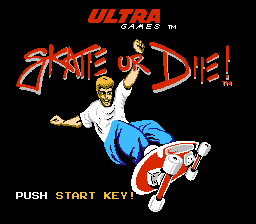
Electronic Arts is an American video game company headquartered in California. The company was founded in May 1982 by former Apple employee Trip Hawkins. EA was one of the pioneers of the early home computer game industry. EA released numerous games, but all of these were developed by external individuals or groups until 1987, when Skate or Die! was released. After this, the company moved towards its own internal game studios, often through acquisitions, such as when Distinctive Software became EA Canada studio in 1991.
Through EA, games like these have become familiar to gamers: Battlefield, Need for Speed, The Sims, Medal of Honor, Command & Conquer, Dead Space, Mass Effect, Dragon Age, Army of Two, Apex Legends, and Star Wars. And of course, EA is known for its sports games, such as FC, FIFA, Madden NFL, NBA Live, NHL, PGA, and UFC.

Since 2022, the company’s PC games have been available on their own EA App platform. EA also owns and “leads” several significant game studios, such as DICE, Motive Studio, BioWare, and Respawn Entertainment.

The story of Electronic Arts is one of the biggest in the gaming industry, with which many have a love-or/and hate relationship. The company continues its growth and development by bringing new innovations and games to the market. EA’s influence in the video game world is enormous, and it has managed to stay current, even though the gaming world has changed and evolved significantly over the years.


Investor’s thoughts:

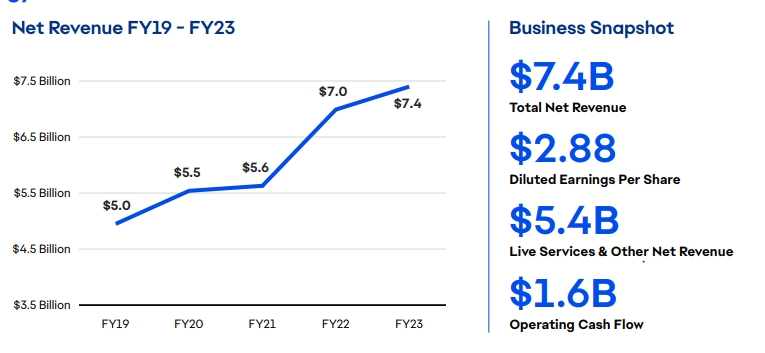
Electronic Arts is not currently considered particularly attractive because revenue fell short of the previous year’s level, and the outlook is not glowing either; for example, console sales have decreased, and sales expectations are somewhat negative even in the longer term. However, the new PS5 Pro is expected to potentially revive console demand and thus also EA game sales. Additionally, the company’s “financial matters” are in order, meaning there is sufficient liquidity.

The valuation cannot be considered cheap, but not particularly expensive either.

P/E ratio: 34.90
P/B ratio: 5.22
P/S ratio: 5.18

The company is expensive for many relative to expectations, but it has resources, and if the company can reverse the trend, then it can be re-evaluated more closely.


Here’s a brief summary of recent quarterly results:

https://x.com/Quality_stocksA/status/1818391970672189527


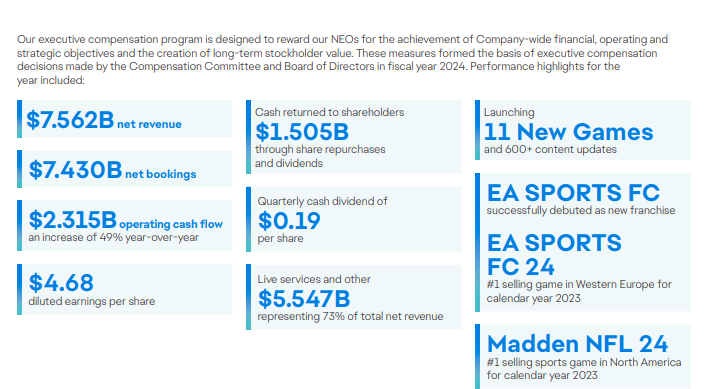
Spotted in EA’s reports:
:smiling_face_with_tear:

Me and @Pohjolan_Eka

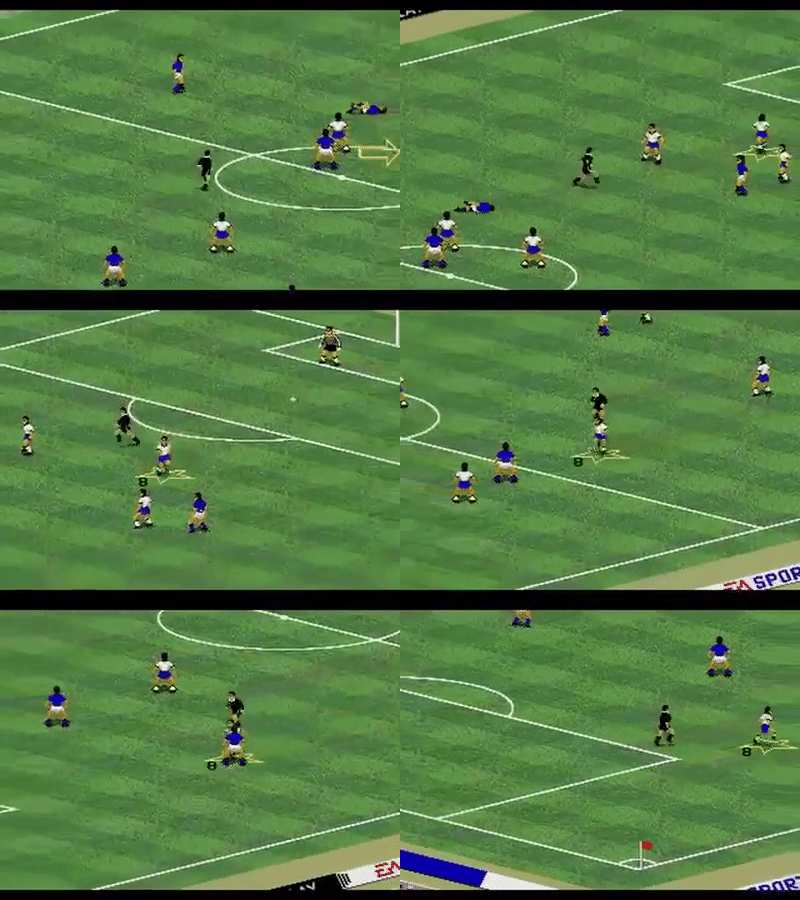
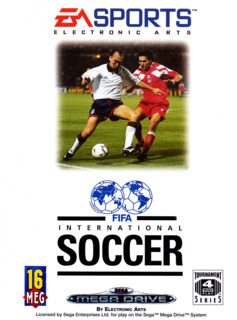
When the ref tried to book you on FIFA 94... on Make a GIF

My usual Tinder dates:

8 Likes

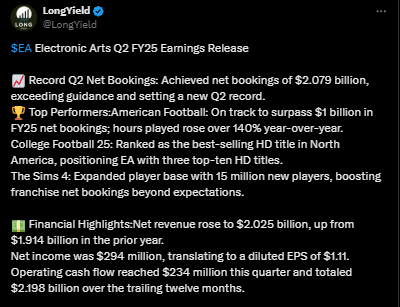
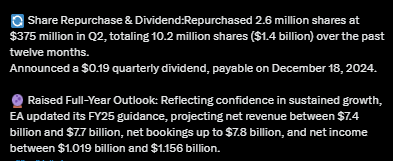
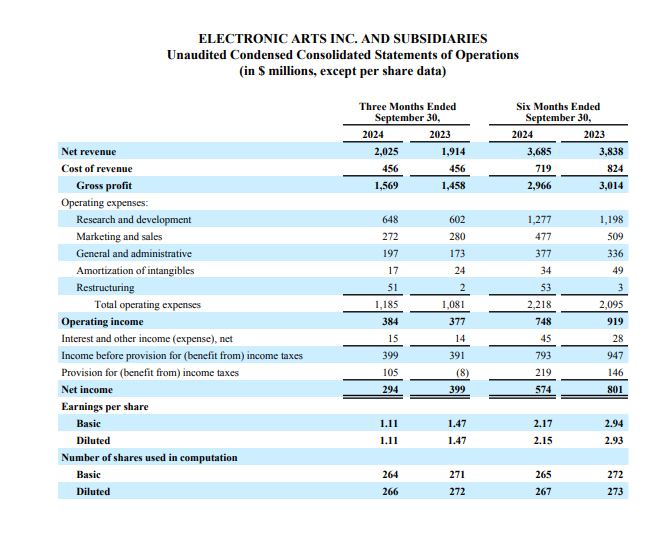
EA’s second quarter performed strongly and was released over a month ago :sweat_smile:, exceeding market expectations.

The company’s game sales and live services grew significantly, driven particularly by sports games and The Sims franchise. The launch of the College Football game was a success according to the figures, and EA Sports FC significantly expanded its player base.

EA raised its full-year outlook, which likely reflects the company’s confidence in growth. On the other hand, the slowdown in Apex Legends’ growth and rising costs were issues.

https://x.com/LongYield/status/1851368310446686704
image
image


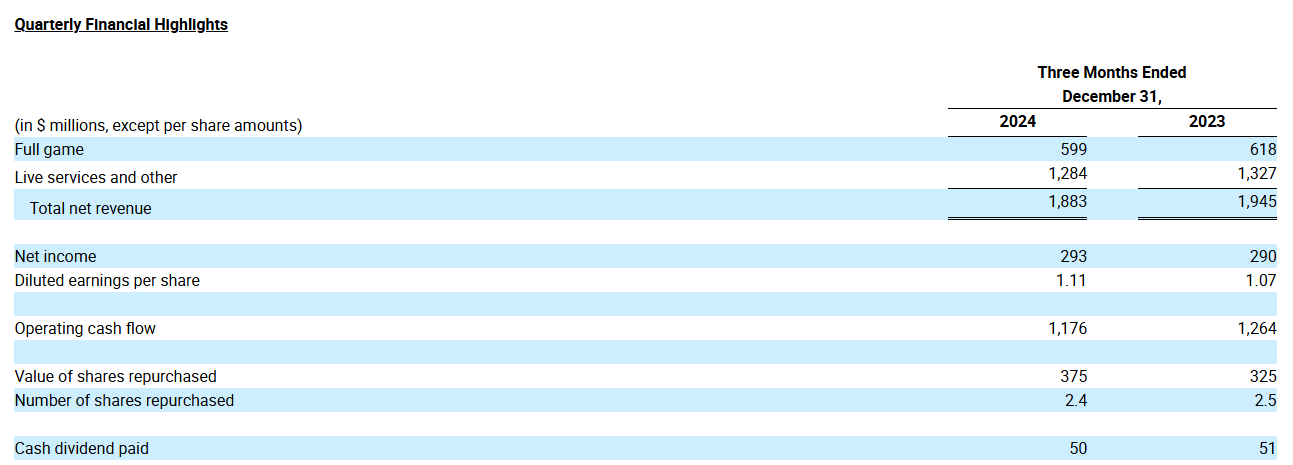
Here’s the official quarterly material :slight_smile:
https://s204.q4cdn.com/701424631/files/doc_financials/2025/q2/Q2-FY25-Earnings-Release-FINAL.pdf
image

5 Likes

Preliminary Q3 FY25 Results (negari).

Pallon potkiminen kiinnostanut yleisöä odotettua vähemmän ja Dragon Age jäänyt maltillisista myyntitavoitteista. Dragon Agea pelannut vain 1,5 miljoonaa pelaajaa, kun edellinen sarjan peli myi yli 10 miljoonaa kopiota. Jäämme siis jännittämään sulkeeko EA Biowaren tämän flopin jälkeen kokonaan.

https://ir.ea.com/press-releases/press-release-details/2025/Electronic-Arts-Pre-Announces-Preliminary-Q3-FY25-Results/default.aspx

Business Outlook as of January 22, 2025

EA’s initial guidance for fiscal year 2025 anticipated mid-single-digit growth in live services net bookings . However, the company now projects a mid-single-digit decline, with Global Football accounting for the majority of the change.

Global Football had experienced two consecutive fiscal years of double-digit net bookings growth. However, the franchise experienced a slowdown as early momentum in the fiscal third quarter did not sustain through to the end. As a result, EA revises its outlook for Global Football to end the fiscal year down mid-single-digit at the midpoint of the new outlook.

Separately, Dragon Age engaged approximately 1.5 million players during the quarter, down nearly 50% from the company’s expectations.

EA will announce its results for the third fiscal quarter ending December 31, 2024 on February 4th, 2025

3 Likes

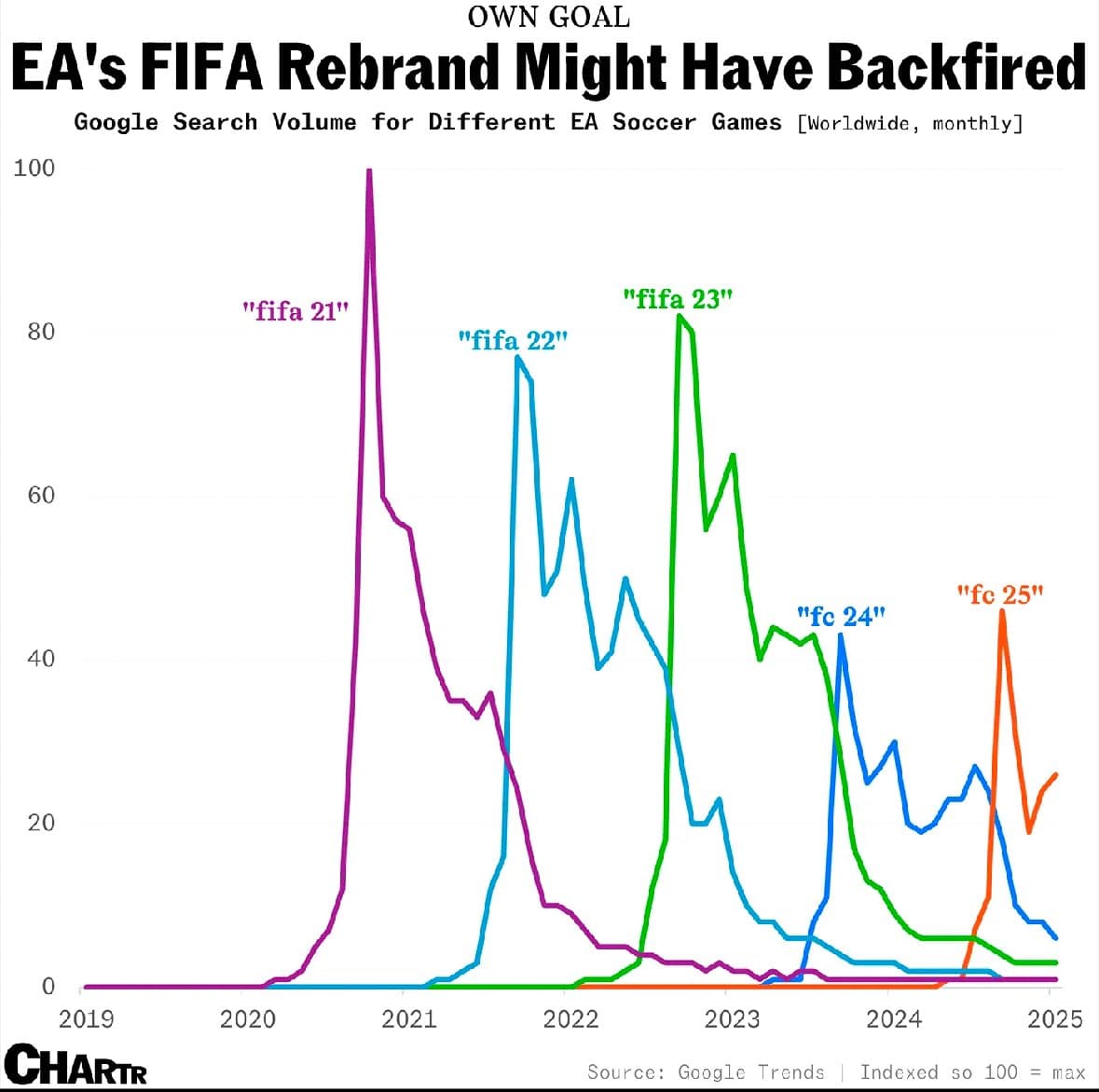
The FIFA game isn’t as big of a deal as it once was. :slight_smile:

https://x.com/StockMKTNewz/status/1882791838127665644
image
image
image
13 Times We've Been Truly Evil to NPCs - IGN

3 Likes

The sales of the new soccer game indeed fell short of expectations, but on the other hand, the revived American football series was EA’s biggest hit of the year and the series will certainly be continued annually alongside Madden.

https://www.sportsbusinessjournal.com/Articles/2024/12/18/ea-sports-college-football-25-best-selling-sports-video-game-all-time

If you are interested in following and owning the company, then the development of this situation should be closely monitored.

1 Like

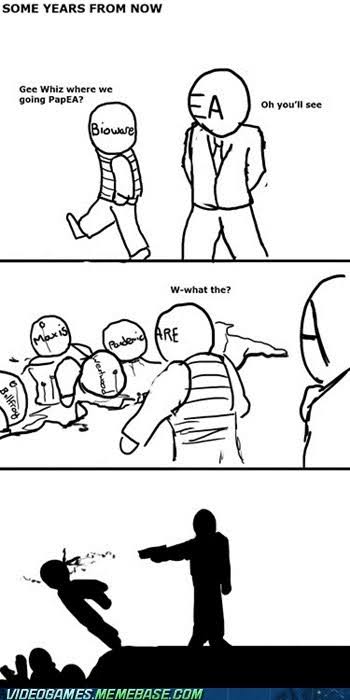
EA decided to reshape Bioware into a “more agile” organization, a few developers moved to other EA companies, a large part were laid off, and the remaining 70 developers will continue pre-production of the new Mass Effect, at least for now.

bioware'images

3 Likes

EA has lowered its full-year earnings forecast and now expects slightly lower revenue as well as increased operating expenses. The operating profit margin is expected to remain strong. EBITDA forecasts have also been “revised,” but investment plans remain unchanged.

In the last quarter of the year, EA expects bookings to decline, mainly due to the waning popularity of Global Football and Apex Legends. However, this is expected to be partially offset by new releases.

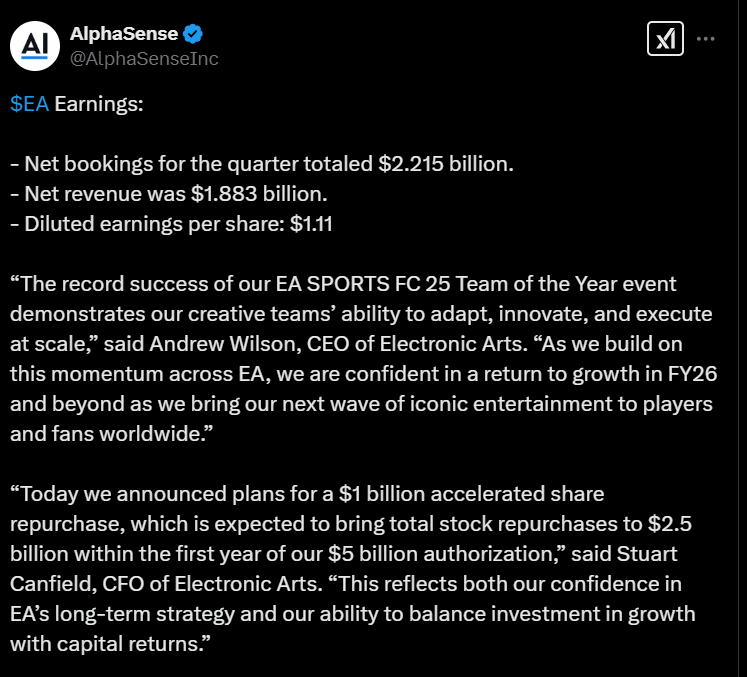
https://x.com/AlphaSenseInc/status/1886884463554256902
image
image

1 Like

One could highlight about EA that a couple of days ago they launched the rescue project for the next Battlefield: Battlefield Labs – Electronic Arts

After the 2042 flop, they are trying to bring the community back to the game series by developing the next game in the direction the community wants. It remains to be seen if the player community will actually be listened to this time either, or if they will again go in the direction that the leaders think players want (i.e., what has worked elsewhere and brings money to the company from microtransactions. Practically, a COD copy spiced with a BR mode, full of paid skins).

As a veteran of the game series, I see this as a positive development, but I’m not setting my hopes too high this time.

3 Likes

Let’s bump the thread.

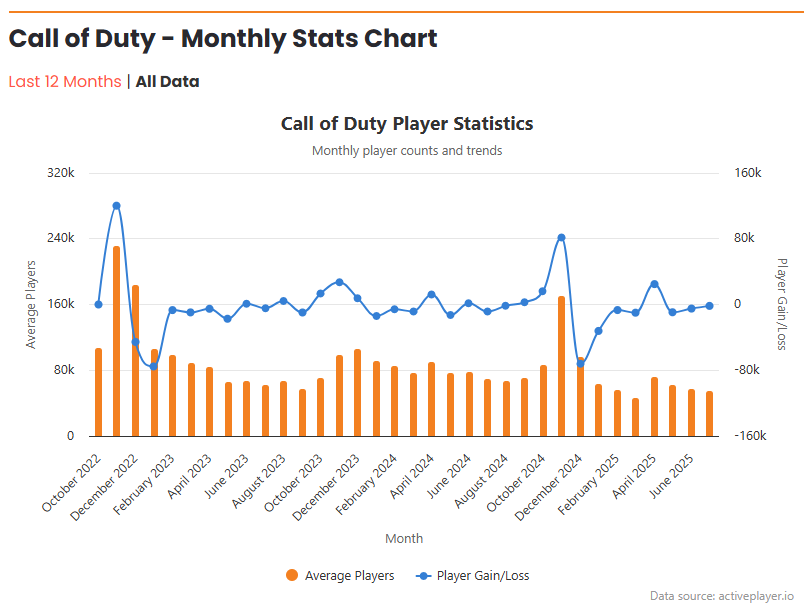
Battlefield 6 will be released on October 10, 2025. The game will also include a free-to-play battle royale game mode. I personally look forward to the release, as COD Warzone is practically the only game I play, and it’s starting to lose its appeal. The game has mostly turned into jumping, sliding, and silly characters. Player count development is also on a downward trend:

image

Could BF6 take over the market? The release is timed well.

https://www.youtube.com/watch?v=pgNCgJG0vnY&ab_channel=Battlefield

EA released better-than-expected results this week:
https://www.investing.com/news/transcripts/earnings-call-transcript-electronic-arts-q1-2026-beats-eps-estimates-93CH-4158698

3 Likes

Electronic Arts’ stock rocketed because the Wall Street Journal reported the company is close to a $50 billion deal that would take EA private.

Investors from, for example, Saudi Arabia are involved. If realized, it would reportedly be a record-breaking leveraged buyout.

https://www.cnbc.com/2025/09/26/electronic-arts-buyout.html

5 Likes

The mega-deal was confirmed, here are Ate’s comments on the matter. :slight_smile:

2 Likes

The deal requires shareholder approval and is expected to close in Q1 2027. What do you see as the likelihood of shareholder approval? I think EA has potential for much more. And I wouldn’t want to let EA become a Saudi propaganda machine. I would rather not sell at this premium. A weakening dollar and eventually recovering global demand easily lead to numerical growth, and I expect, for example, BF6 to be a massive hit.

2 Likes

This fits here after the latest news. :slight_smile:

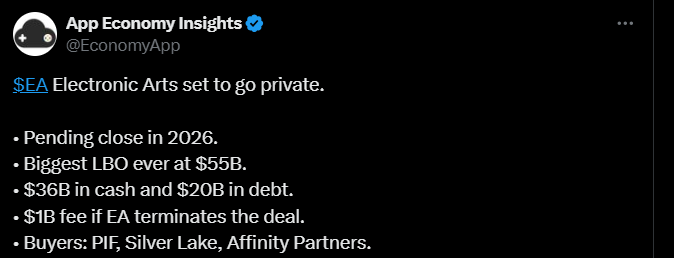
https://x.com/EconomyApp/status/1972708051586261420


image

I also have the same thoughts regarding EA. The potential of BF 6, at least based on the hype during the beta, is so significant that the valuation makes me wonder a bit. Secondly, that Saudi element in this purchase is particularly puzzling; is Saudi money now expanding from the sportswashing field also to the video game side?

2 Likes

Saudis have acquired stakes in almost all major game companies in recent years, both through the PIF fund and Savvy Games. PIF already owned nearly 10% of EA, so participation in the arrangement is not a surprise.

Saudis own, for example, SNK, Scopely, Niantic (Pokemon GO). In the e-sports field, Saudis own the ESL FACEIT group, Evo, and of course the Falcons team.

PIF/Savvy also owns (from memory) ~8% of Embracer, ~8% of TakeTwo, and 5% of Nintendo, Capcom, and Nexon.

3 Likes

Such a 20 billion loan is certainly classified as a very high-risk credit, which is why the interest rate can be assumed to be 7-8%. Therefore, S&P also expects to downgrade EA to junk bond status.

20 billion at 7.5% interest makes 1.5 billion per year. That is 1.5 times EA’s net earnings from previous years. However, I believe that in the year-end quarter, we can reach a pace of 1.5 billion EPS.

In practice, there are thus two probable scenarios if the deal goes through:

  1. One possibility is that the Saudis only want to keep the EA Sports brand, and EA Entertainment is sold off to pay down the staggering 20 billion debt.
  2. The other: Drastic cost cutting, studio closures, use of AI in development, etc.

However, I believe that the use of AI for cost cutting, as in option 2, is something that will happen regardless. They just announced a partnership with Stability AI. Texturing, 3D modeling, and coding are all things that can already be done with manifold efficiency using AI as support.

If costs can be cut even by a fraction, while sales grow as good games have finally started to be made, and on top of that, a decline in the US dollar and falling interest rates, and hopefully a recovering global economic demand next year boosting the entertainment sector, we could easily see crushing records in EPS next year.

The more one thinks about this, the more one believes that EA shareholders should refuse the deal. If the Saudis have any chance of increasing profitability so that the loan can be paid off, why wouldn’t the same be done under current ownership without the burden of debt?

Traditionally, the US administration, especially the MAGA sector, has been very critical of US companies being under foreign ownership. But certainly, precisely for that purpose, the deal is being facilitated by Trump’s son-in-law Jared Kushner, and the USITC is entirely under the president’s control, so from the administration’s side, the deal will 100% certainly go through. However, there are still possibilities that shareholders reject it, the board backs out (in which case they pay a billion-dollar fine), or someone bids more.

An interesting case indeed. I am quite sure that even if the deal eventually goes through, we will see a bit more drama and speculation about the deal’s success in the coming months. I sold the shares and took a few speculative options that would pay out if the deal falls through. The options markets, at least until recently, considered the deal practically 100% certain, so summer 2026 options were almost free.

3 Likes

EA’s result was satisfactory. However, the news of the company being sold to an investor consortium took all the attention.

Battlefield 6 and Skate were successful, and Apex and Madden returned to growth, but the clear weakening of the Live Services business was a major concern for investors. The decline in net bookings continued – even more steeply.

As I understand it, the deal sets a certain floor for the stock and removes significant upside potential in the market. The most important future questions relate to the acquisition timeline, regulation, and how the company’s strategy and priorities will change under private ownership.

https://x.com/earnings_guy/status/1983264283996893630


image


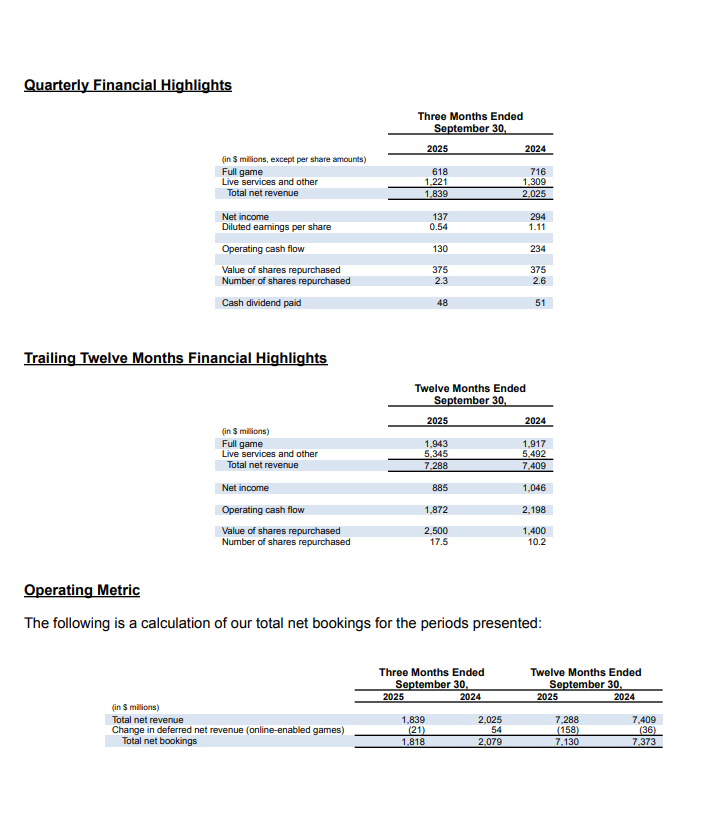
Company’s own materials

image

I expect a clear beat on EA’s Q3 results. The consensus ($1.45 EPS) is, in my opinion, outdated, as the company stopped providing guidance due to the LBO deal (Saudi Arabian PIF, Silver Lake). My own rough rabbit-hat model conservatively yields an easy $1.62 EPS, but the beat could be significantly larger.

Naturally, this has no impact on the stock price, as the stock’s vega has been crushed and the paper is currently priced like a bond, with the price remaining firmly around 200 USD. An interesting question is whether there exists a quarterly result so good that shareholders would not accept the premium offered in the deal.

​Biggest reasons for the beat:

Battlefield 6: The consensus completely underestimates the record sales of the premium game (over 7 million units immediately at launch, perhaps 10-12M over the quarter), which falls entirely into Q3. Many confuse this massive cash flow with the negative feedback on the free REDSEC game mode, which has no significant Q3 earnings impact. Additionally, I believe that due to the implementation method, player counts published on Steam, for example, are sometimes misinterpreted, as Redsec exists both as a free standalone version and in conjunction with the purchased game, which are tracked separately. The poor reviews for Redsec are precisely from those who have not bought the game. Paid add-on purchases (battle pass, etc.) are more likely to come from those who also bought the full game.

To my knowledge, there is no precise statistic on Redsec’s player count covering all platforms, but on Twitch, for example, it has been watched for almost as many hours in a week, only 20% less than Counter-Strike, whose player count at any given moment hovers around a million, and 20% more than Fortnite, which, according to forecasts, is expected to generate about 5 billion dollars in revenue this year, mainly from battle pass sales. Battle pass sales could be a positive surprise, but the biggest earnings are to be expected in the spring quarter, if the company isn’t taken off the stock market before then. It’s a shame the company has decided not to provide guidance.

​FC 26 & Accounting: The company previously shifted high-margin “Ultimate Edition” revenue from Q2 to Q3, which provides an accounting “free” earnings improvement for this quarter.

​Weak comparative period: Last year, the corresponding quarter was very weak after the Dragon Age game flopped badly, so the bar is low. In other respects too, EA has been high on sales charts in recent months.

3 Likes

The latest earnings release is out. The company reported record net bookings of $3.05 billion for Q3, driven by Battlefield 6, but accounting net income plummeted 70% to just $88 million.

This blatant discrepancy is explained by management moving a staggering $1.15 billion in sales revenue to the balance sheet (deferred revenue) instead of recognizing it in the income statement. Meanwhile, the company’s cash flow was a massive $1.83 billion, proving that the company is actually performing much better than the reported earnings per share (EPS) of $0.35 suggests. Even though BF6 sales were a jackpot, BF’s poor retention rates (daily players dropped from a peak of 750k to around 50k due to a lack of new content) or EA’s laziness in fixing game bugs don’t provide a very solid justification for such a massive deferral of sales in the accounts.

At the same time, the company seems to have front-loaded all expenses. Management’s handling of expense recognition is blatantly front-heavy when comparing the figures to a year ago. Marketing and sales expenses exploded with a 42% increase ($356M vs. $251M), and R&D expenses grew to a record $704 million (up 16% from the previous year). In total, these expenses grew by over $200 million compared to the prior year. The report doesn’t name or hype any upcoming “top-tier games” that would explain such a massive increase in R&D costs. After all, the most important named headline titles are already finished. There are no mentions of upcoming major titles, no schedules for FY27, and no hype regarding future growth.

FYI: Law firm Kaskela Law LLC has launched an investigation into whether the proposed buyout price is adequate and whether management has acted in the best interests of shareholders (investigating adequacy of proposed buyout price).

This somewhat confirms the hypothesis I’ve been brewing that management wants to push the deal through by any means necessary. At least I can’t think of any rational explanation for why the company refused to provide any guidance and ended conference calls even before shareholders voted on the deal. As soon as the news of the Saudi consortium’s buyout offer went public, management stopped providing future outlooks.

In practice, management is asking us to sell the company at a valuation based on an earnings per share (EPS) of $0.35, even though the company actually generated over $4.00 in economic value per share this quarter. Accounting deferrals obscure the fact that the company is currently 10 times more profitable than the GAAP calculation suggests. If management hadn’t engaged in accounting gimmicks and aggressively increased expenses right before the deal, the earnings per share would be $4.66.

Portion of sales moved to the balance sheet (Deferred Revenue):

  • Q3 FY26 (Current report): +$1,145 million (Record amount hidden from earnings)

  • Q2 FY26: -$21 million (net recognition of previous sales)

  • Q1 FY26: -$373 million (Recognition of previous sales) ​

  • Q4 FY25: approx. -$100 million (net recognition of previous sales)

  • Q3 FY25 (One year ago): +$332 million

  • Q2 FY25: +$54 million

7 Likes