🇬🇧 Dominos Pizza Group PLC (DOMI): Dividend Play or Value Trap?

Domino’s Pizza is a globally recognized American pizza brand. Its image is characterized by speed, affordability, and predictability: it’s not the best pizza, but customers know what they’re getting when they order a pizza from a Domino’s pizzeria. Domino’s Pizza’s operations in the British Isles are run by the publicly listed Domino’s Pizza Group PLC. :united_kingdom:

Everyone knows what pizza is, but from an investor’s perspective, pizza has delicious characteristics (in addition to taste). It’s relatively inexpensive to make (low in protein), quick to prepare, and it retains heat well, making it excellent for delivery.

Delivery or pickup from the pizzeria is precisely Domino’s pizzerias’ strength. Delivery times are fast. The restaurants are relatively small, which means smaller investments. The company argues that logistics and technology are its trump cards. Previously, it was quipped that Domino’s is a technology company that happens to make pizzas. Nowadays, there’s a buzz that it’s a logistics company that bakes pizzas.

Domino’s doesn’t operate all restaurants itself; most are run by franchise entrepreneurs. Franchisees bear the entrepreneurial risk, investments, and pay for part of the marketing, while Domino’s focuses on selling them raw materials at a reasonable price. As far as I understand, Domino’s takes approximately a 5.5% slice of sales as commission.

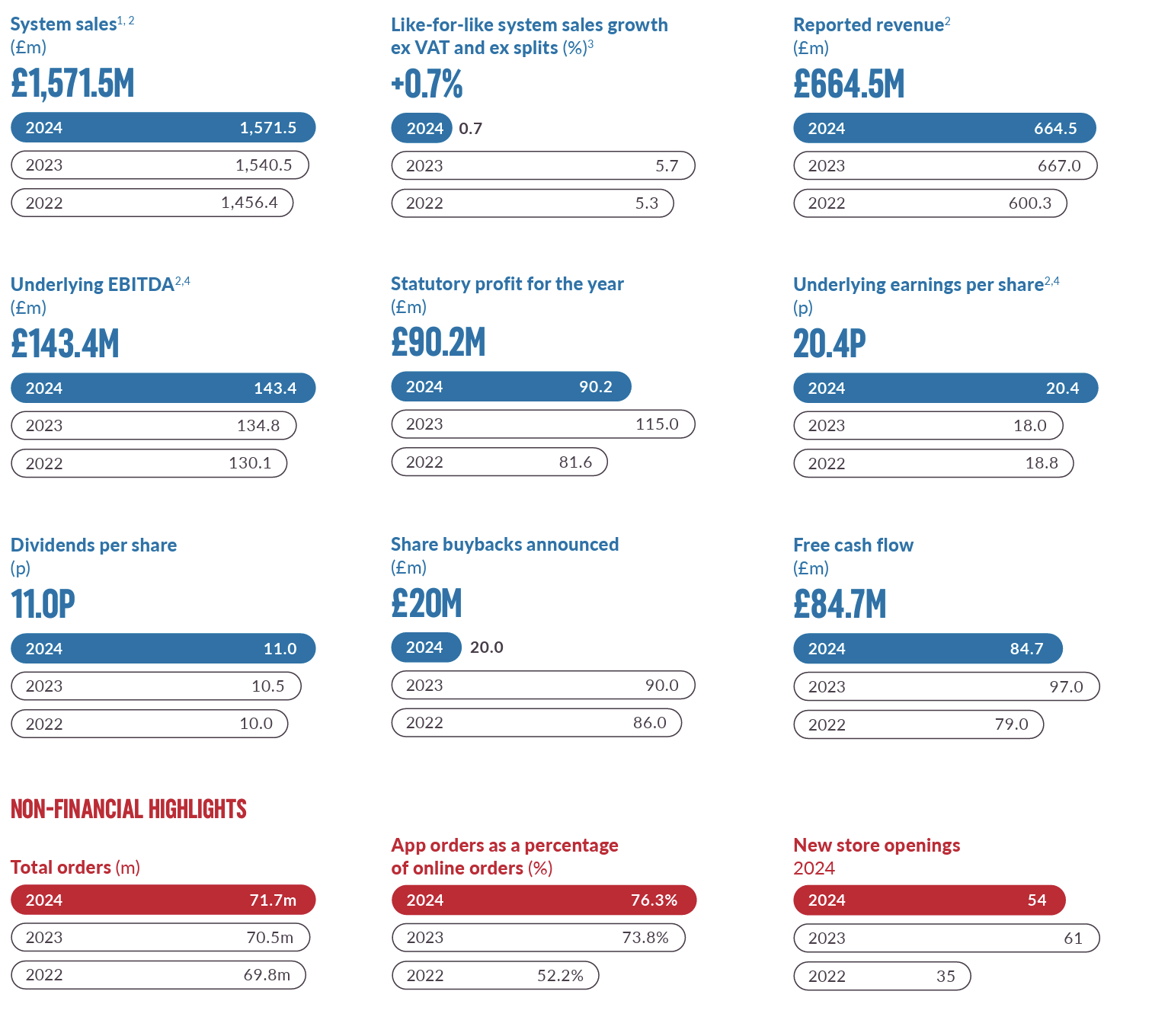
Globally, Domino’s doesn’t even directly operate the franchise operations itself, and this is where we get to Domino’s Pizza Group itself. It is, therefore, a perpetual master franchise company operating the Domino’s brand’s UK operations. The model is practically the same: DOMI runs logistics and marketing in the UK itself, but it pays half of the 5.5% commission to American Domino’s. System-wide sales are around 1.5 billion pounds, but DOMI’s own revenue, which includes raw material sales and fees from franchisees, is just under 700 million pounds.

Here are some key figures from the 2024 annual report.
Screenshot 2025-09-09 at 11.58.09

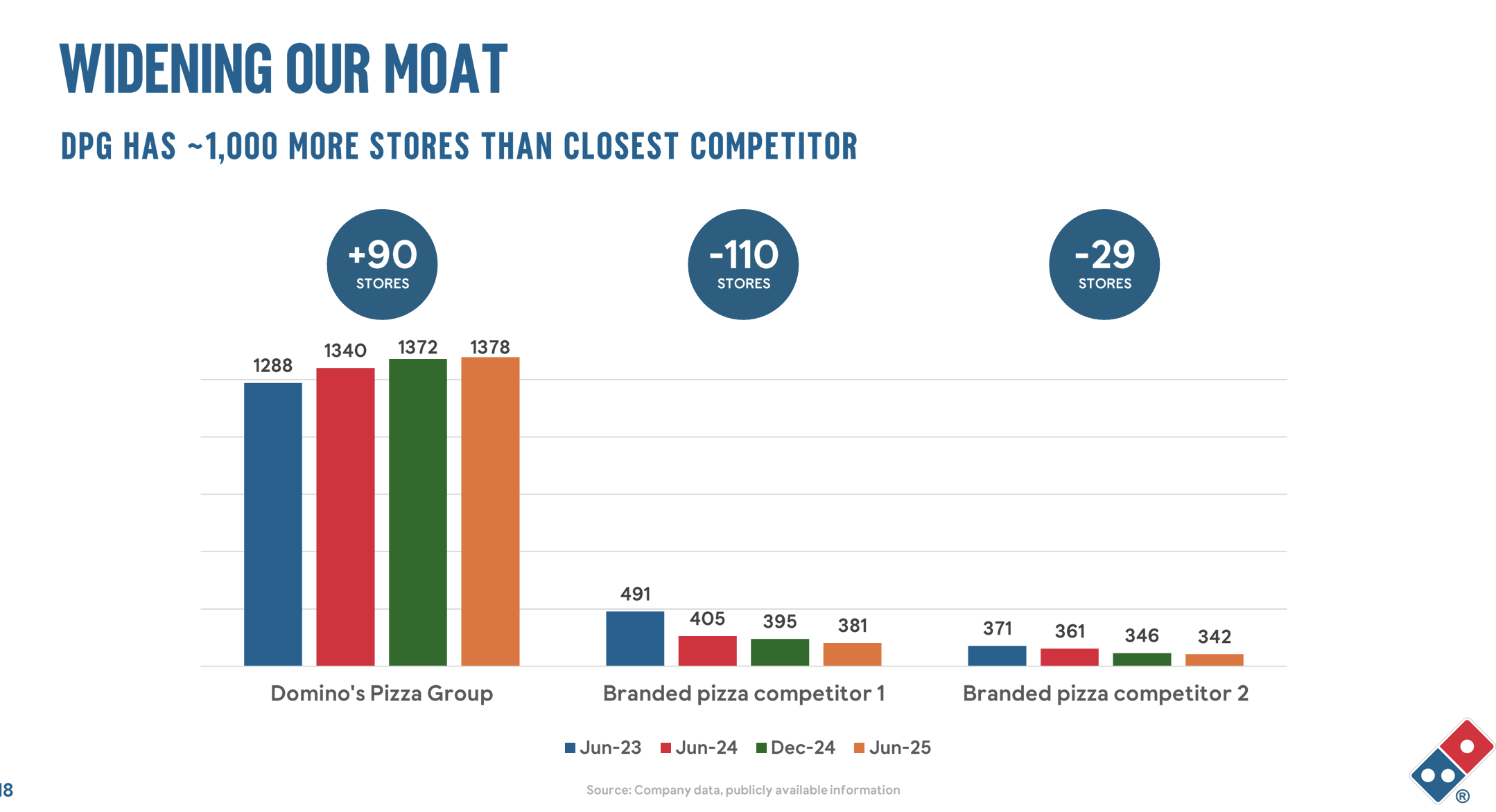
The company has achieved a dominant market position in the UK with over a 50% share. Domino’s talks about ‘fortification,’ strategically placing pizzerias at optimal distances so that there’s no room for another pizzeria to compete. Competitors have been in trouble, and in a difficult economic situation, Domino’s relative position has strengthened.
Screenshot 2025-09-09 at 11.54.39

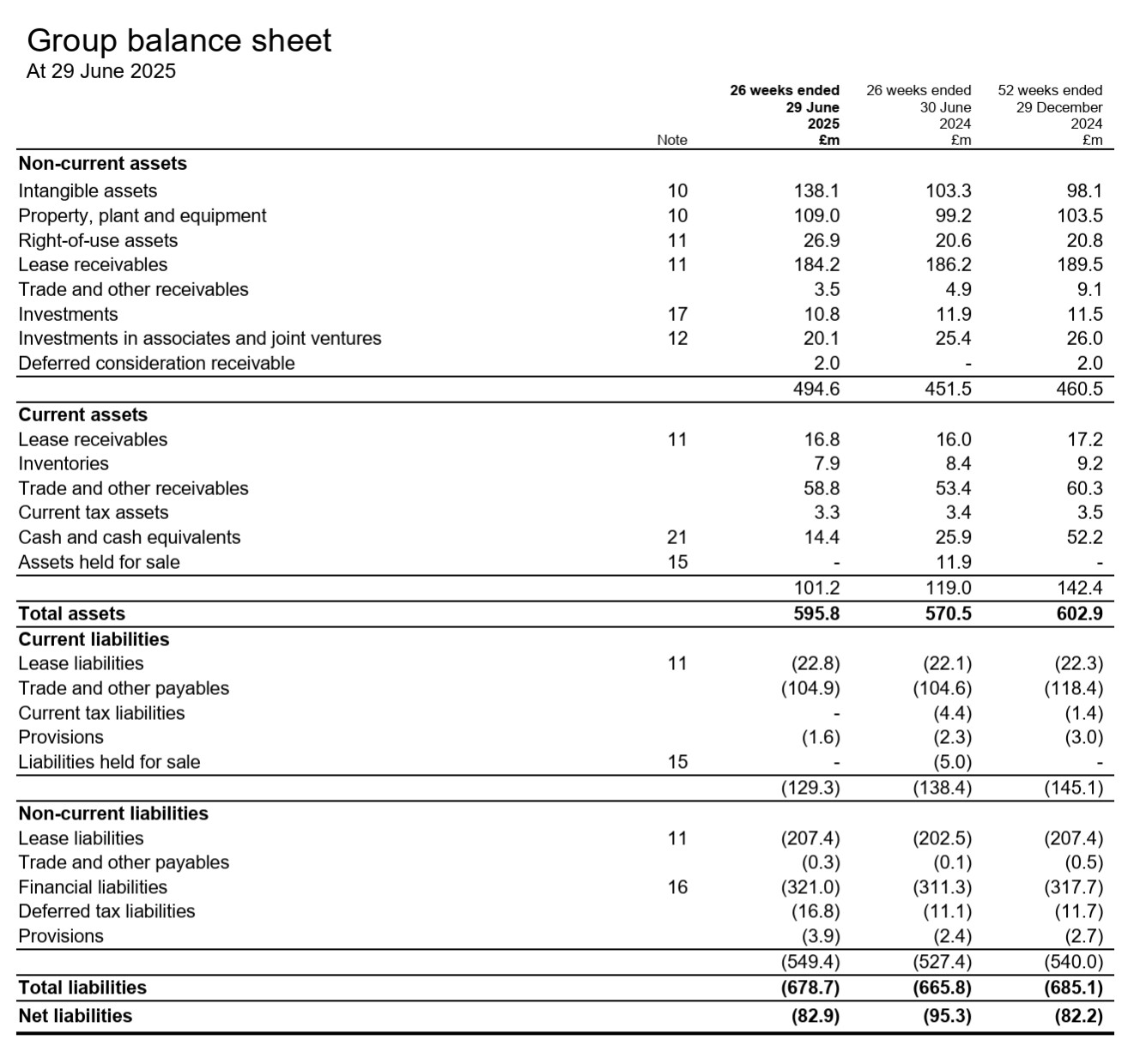
The quality of the company’s operations is demonstrated not only by a fast average delivery time of 24 minutes and 99.99% logistics functionality but also, of course, by a high return on invested capital. The company doesn’t actually tie up much capital. This is well illustrated by the fact that equity is currently negative. The balance sheet is a bit peculiar. There are a couple of hundred million in lease liabilities, but these are practically netted to zero by lease receivables from franchisees.

In practice, invested capital is equity + long-term interest-bearing liabilities, meaning capital committed to the business is -80 + 321 = approx. 240 million pounds. If the profit is around 90 million, the return on capital would be roughly ~40%.
Screenshot 2025-09-09 at 12.01.25

Alright, so we have an excellent business with a strong brand and a solid market position. The stock trades at a forward P/E ~11x. What’s the catch?

It’s easy to dig up reasons why the business might not be interesting to own, such as
-Slow growth in recent years.
-The company talks about plans to expand into another brand where it could utilize its logistics machinery. The market considers this a distraction, the company knows it, and that’s why the CEO has reassured by saying “we won’t do anything silly.” In fact, the company recently launched a 20 million pound share buyback program, which suggests that a suitable brand has not been found.
-The dire economic situation in the British Isles. The economy is flirting with stagnation, inflation is rapid, interest rates are high, and public finances are under immense pressure for tax increases.
-As far as I understand, American Domino’s has some deal where the number of pizza restaurants in the UK must grow at a certain rate per annum. This could be a conflict of interest if DOMI doesn’t benefit from growth and has to pay some compensation to American Domino’s, but the cooperation has reportedly been in good spirits for decades.
-A few franchisees hold a significant share of all pizzerias: the two largest each had almost 20% shares! In past years, the company had some disagreements with franchisees, but agreements were renewed, and there is peace, at least for now.
-If all the best pizza locations have already been opened, why would opening new ones create value? This is a common counter-question in retail and the restaurant business. To that, one can indeed say that few firms have a complete understanding of how well their concept works geographically; instead, it is continuously learned by opening stores and experimenting.

But is a P/E of 11x still too low? As mentioned, the business doesn’t tie up much capital, so the company pays out a dividend of 11 pence per share (approximately 40 million pounds). On top of that, there was another 20 million pound share buyback program, meaning the shareholder yield is 60 / 800 market value = 7.5%.

If one doesn’t believe the business can grow, then naturally, the stock’s pricing should be close to the required rate of return. If it’s 9%, a P/E of 11 is perfectly correct. When debts are considered, the enterprise value of the entire business is currently approximately 1140 million pounds. If operating profit is roughly 15% of revenue, the EV/EBIT would be 11.4x.

But I don’t believe the company’s growth will stop anytime soon. CEO Andrew Rennie, a franchisee entrepreneur himself at one point, ran a pizzeria in an area with only 6,000 residents (the average Domino’s today has an area with over 20,000 customers). He believes that there is still room for a few pizzerias in small towns on the islands, and there is additional potential in Ireland.

Previously, this has traded, like quality restaurant brands, in the P/E 20x range. If the situation eased slightly, one could see a nice multiple correction here. While waiting, one can enjoy dividends and share buybacks.

48 Likes

Another moderator might have already opened a thread about this :wink: Edit: it was another Dominos….

https://forum.inderes.com/t/domino-s-pizza-inc-domin-oh-hoo-hoo/58536

It might also be due to my own reading comprehension. :sweat_smile: I quickly skimmed the beginning and only noticed a reference to America, not Britain.

1 Like

That thread is specifically about American Domino’s, this thread is about the British one. :slight_smile: Is my opening post a bit unclear? :smiley:
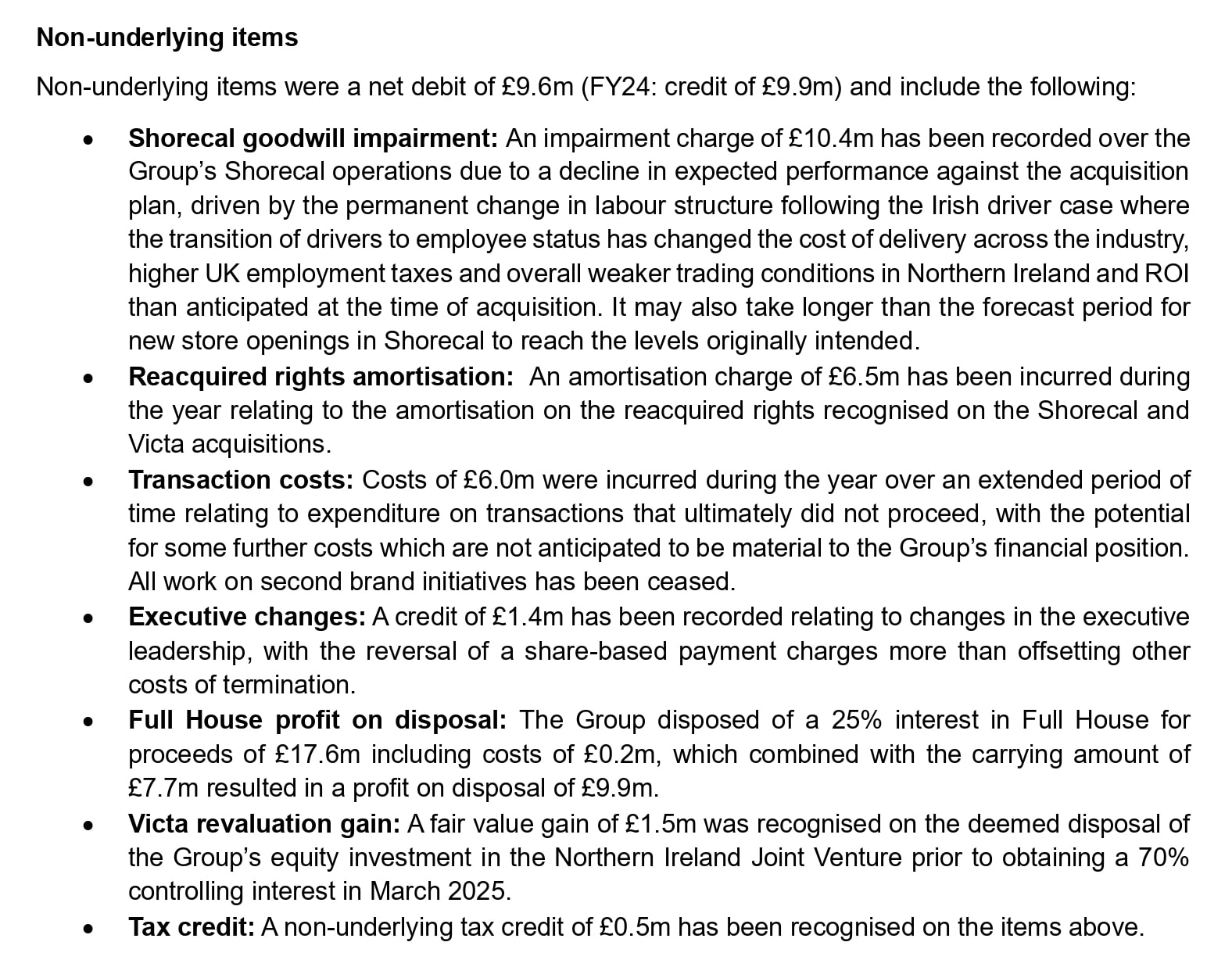
Edit. I clarified the opening post.

1 Like

Under Finland’s old Companies Act (Osakeyhtiölaki), this would have required immediate liquidation. Of course, Finnish legislation, neither old nor new, is not followed in Britain, but the Inderes forum has many who once internalized the old OYL, and who may be confused by these latest twists of IFRS. Former economic realities are shaken when the rules of the game are changed mid-game.

The IFRS accounting for lease liabilities, introduced some years ago, is a bad thing as it obscures the company’s indebtedness. It’s even worse if, as an accounting item, it further undermines the reliability of equity valuation.

Juurikki promises to examine British Domino’s more closely, both empirically and in terms of financial analysis, if Verneri kindly promises to consider a 15-minute public summary of how IFRS changes have altered the fundamentals of an individual company. Deal?

Investing should be easy and enjoyable for popular capitalism to be realized. It’s not fun when, for example, for us representatives of the old OYL review method, i.e., the +50-year-old demographic, debts are not presented itemized into three different elements: interest-bearing debts, non-interest-bearing debts (e.g., for Honkarakenne, these might be completely ignored, causing key figures to be misleading), and notional debts, primarily notional debts based on existing lease agreements for years to come, and of course, the aforementioned notional lease liabilities and lease debts.

Thank you.

2 Likes

Unfortunately, I don’t promise to delve into IFRS regulation! :smiley:


Domino’s is holding an investor day in December and launched a new chicken food brand under the Domino’s brand.

3 Likes

Q3

Highlights

  • Positive system sales growth:

    • Q3 25 total system sales up 2.1%.

    • Q3 25 like-for-like system sales (ex. VAT, ex. splits) up 1.0%.

  • Total orders down 1.5% in Q3 25:

    • Collection up 1.7% reflecting some continued benefit of national collection campaign

    • Delivery (down 3.4%) impacted by weaker consumer sentiment across the QSR sector

  • Positive initial customer reaction to the introduction of Chick ’N’ Dip and the new Ultimate Indian Feast. Industry leading delivery times maintained.

  • FY25 guidance remains unchanged:

    • Underlying EBITDA in range of £130m to £140m

    • New store openings expectation unchanged at mid-twenties (YTD 18 NSOs including our first new POD format)

Mielestäni hyvä suoritus haastavassa markkinassa ja ohjeistus pidettiin. Uusi kanaruokabrändi/Indian feast konseptit lähtenyt ilmeisesti mukavasti liikkelle ja toimitusajat pysyneet toimialan kärjessä. Eit kait tässä

10 Likes

Rennie’s immediate departure was amicable. Threat or opportunity. :smiley: Rennie had a proactive approach, but chasing another brand didn’t sit well with investors.

Following Andy’s arrival, the Company intends to review its capital allocation priorities. The Company does not envisage pursuing a second brand acquisition until the new CEO is in place.

The Company’s planned Capital Markets Day on 9 December 2025 will be rescheduled to a later date.

There is no change to Domino’s previously announced FY25 outlook or profit guidance.

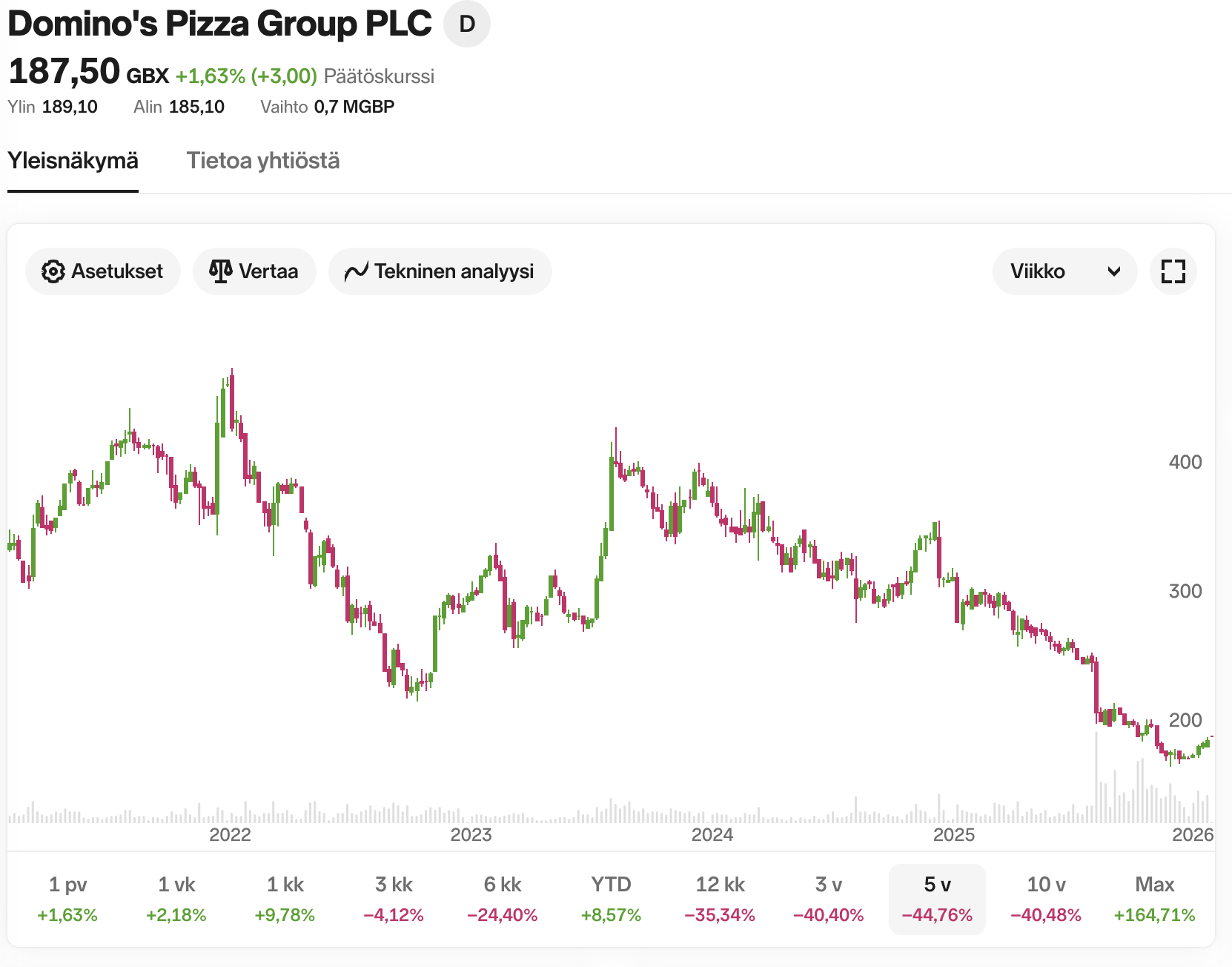
The stock has now almost halved since the beginning of the year. With cut forecasts, the P/E is 9x. :smiley:

15 Likes

Apparently, a couple of days before his dismissal, Rennie had gone around proclaiming about “peak pizza”.

Unfortunately, such independent thinking and pushing one’s own investment agenda by undermining the brand is not allowed for CEOs. :smiley:

(Telegraph)

The chief executive of Domino’s has stepped down unexpectedly after warning that Britain was hitting peakpizza.

Andrew Rennie, who ran the chain for two years, will leave the business immediately just days after unveilingambitious plans to tilt Domino’s towards fried chicken amid a slump in pizza demand.

Nicola Frampton, the chain’s current chief operating officer, will take over as caretaker chief executive whileIan Bull, the chairman, and senior director Natalia Barsegiyan search for a permanent replacement.

Mr Rennie’s exit comes just days after he warned that the UK’s pizza market was approaching saturation, witha supply glut of chains pushing diners towards burgers and fried chicken.

13 Likes

I can’t deny that the smell of pizza from this place makes my mouth water, but the biggest obstacle for me is the incredibly high costs. It seems that this cannot be bought through Op. Nordnet, on the other hand, shows that if you buy, say, 1000 units, the costs will be 26.16 GPB at the current price of 173 GBX.

To a purchase of 1730 GBP, 26.16 GBP is added, which, when converted to euros, means a 30€ fee is added to a 1971€ purchase. That’s such a ridiculously large sum in fees that it makes me want to throw up, and the pizza doesn’t taste good anymore. Buying in larger quantities doesn’t seem to work, as the fee increases the more you buy, even if it marginally decreases percentage-wise.

Have you, @Verneri_Pulkkinen, bought through Nordnet, and have you swallowed these costs without choking on the pizza, or do you have better terms? Does Nordnet’s calculation seem wrong, or have you managed to get the costs to a reasonable level through some other means?

With such costs, at least long-term owners are likely acquired. When 60€ goes for a round-trip transaction, it corresponds to half a year’s dividends for a 1000-unit position.

5 Likes

I have swallowed them, because as I understand it, it includes the 0.5% stamp duty desired by the British Chancellor of the Exchequer, and then also the currency exchange fees. :smiley:

Admittedly, one doesn’t trade with these transaction costs…

5 Likes

Nordea is having a stock savings day for the UK on February 13th (these happen once a month with a rotating target country).
€1 per trade + 0.5% British stamp duty + 0.3% currency exchange fee.
It’s a bit of a bummer that my equity savings account (OST) is with Nordnet, as these UK companies should apparently preferably be bought into an OST..?
Then again, with a book-entry account (AOT), you can deduct the losses if the pizzas start burning in the oven. :sweat_smile:

3 Likes

The thread is fairly inactive, so let’s allow this kind of casual “kitchen talk.”

DOM’s stock was in a slide for practically all of last year. This year, however, the stock has risen 9% without any significant down days, even though global markets have been shaken. At the same time, trading volume is quite high, as it tends to be at turning points (some are dumping their nausea-inducing shares in a panic, while others are running with buckets in hand to catch the falling knife).

Analyst forecasts haven’t decreased for a while either.

Screenshot 2026-01-27 at 9.56.29

That’s not to say a turnaround is right around the corner (and deteriorating fundamentals will eat the share price if it continues), but when the valuation is P/E 10x and the dividend yield is 6%, and cash flow is strong, perhaps at some point the stock will also show some universally attractive features in the stock market beauty pageant.

10 Likes

I’ve been following this company and the share price decline with interest since you started writing about it on the forum. Nordea is having a stock savings day for the UK on February 13th, where shares can be bought for €1 per trade, and I’ve been mulling over whether to buy this for my Equity Savings Account. A P/E of 10 and a 6% dividend yield (tax-free in an Equity Savings Account) would certainly appeal to my inner value investor.

However, over the past few years, I’ve increasingly prioritized high-quality growth (or growth potential), especially in the long term, and for that reason, I’ll likely pass on investing in Domino’s. Here is my biggest concern:

If the company’s market share is over 50%, where can further growth come from? Sure, there’s still room to increase it, but obviously, market share cannot exceed 100%.

While I think pizza as a concept works very well and people will surely be willing to pay for it in the future, in my experience, Domino’s pizzas aren’t exactly a premium experience, so I believe their pricing power is somewhat limited. By this, I mean that as prices rise, McDonald’s, for example, looks like an increasingly poor option in terms of value for money, but a high-quality steakhouse (like Texas Roadhouse) can, in my opinion, raise prices in the same proportion without the value for money suffering nearly as much as it does with cheap fast food. Pizza and Domino’s sit somewhere in between, where cost increases caused by inflation can likely be passed on to the customer, but that’s where the pricing power ends.

I still like the company’s business model (franchise model) and its focus on logistics. However, I believe that most of the market to be won has already been won, and opening pizzerias in increasingly smaller areas might work, but not as profitably as before. Therefore, I see future growth relying mainly on the UK’s population growth (forecasts suggest growth will be slow in the future), consumer purchasing power (which doesn’t look particularly good in the UK right now or in recent years), and consumer behavior (I believe some people are becoming increasingly lazy, which may well increase the demand for fast food and pizza, but at the same time, I also believe the “health-conscious” segment of the population is growing, avoiding pizza-style food or making it themselves, so the net result is likely slow growth or ±0).

The final result of all this is pretty much ±0 or slow single-digit growth, and thus it’s hard for me to see where that future growth and earnings growth will actually come from. In my own investments, I want to see double-digit revenue and earnings growth, and while I believe Domino’s still has room to grow, it’s unlikely they can achieve double-digit growth. Therefore, I would say the current price is somewhat attractive, but not yet “dirt cheap” enough in my eyes to make it a must-buy. So, I will likely continue to just monitor it. Of course, with valuation multiples this low, even one positive interim report could easily drive the share price up by 50% or more if growth accelerates even temporarily, so I certainly understand the appeal here.

11 Likes

I think you’ve hit the nail on the head here.

Domino’s is already the most efficient and dominant (heh heh) player in the UK. The former CEO who got the boot always used to tout that he started as a franchisee in a town of 8,000 residents, whereas on average Domino’s territories have over 20,000 residents (numbers from memory). He was hinting that there’s still plenty of room for more pizzerias on the islands. But on the other hand, he famously went and talked about “peak pizza,” after which the announcement of his departure followed.

If a company (any company) doesn’t grow, it’s destined for “base multiples,” which, depending on the required rate of return, are around P/E 10-12x. The stock is at 10x now.

But growth can accelerate if, for example, consumer spending recovers. A year of 10% growth would be huge, but not impossible if the fast-food market grows. As a shareholder, that’s essentially what you’re waiting for. The wait is made easier by the 6% dividend yield.

The best-case scenario would be if the company also had a credible path for profitable capital allocation toward growth. But that’s pretty much missing, aside from small store openings; perhaps there’s still a bit of room in Ireland. If such a path were in sight, I would make my position much larger.

9 Likes