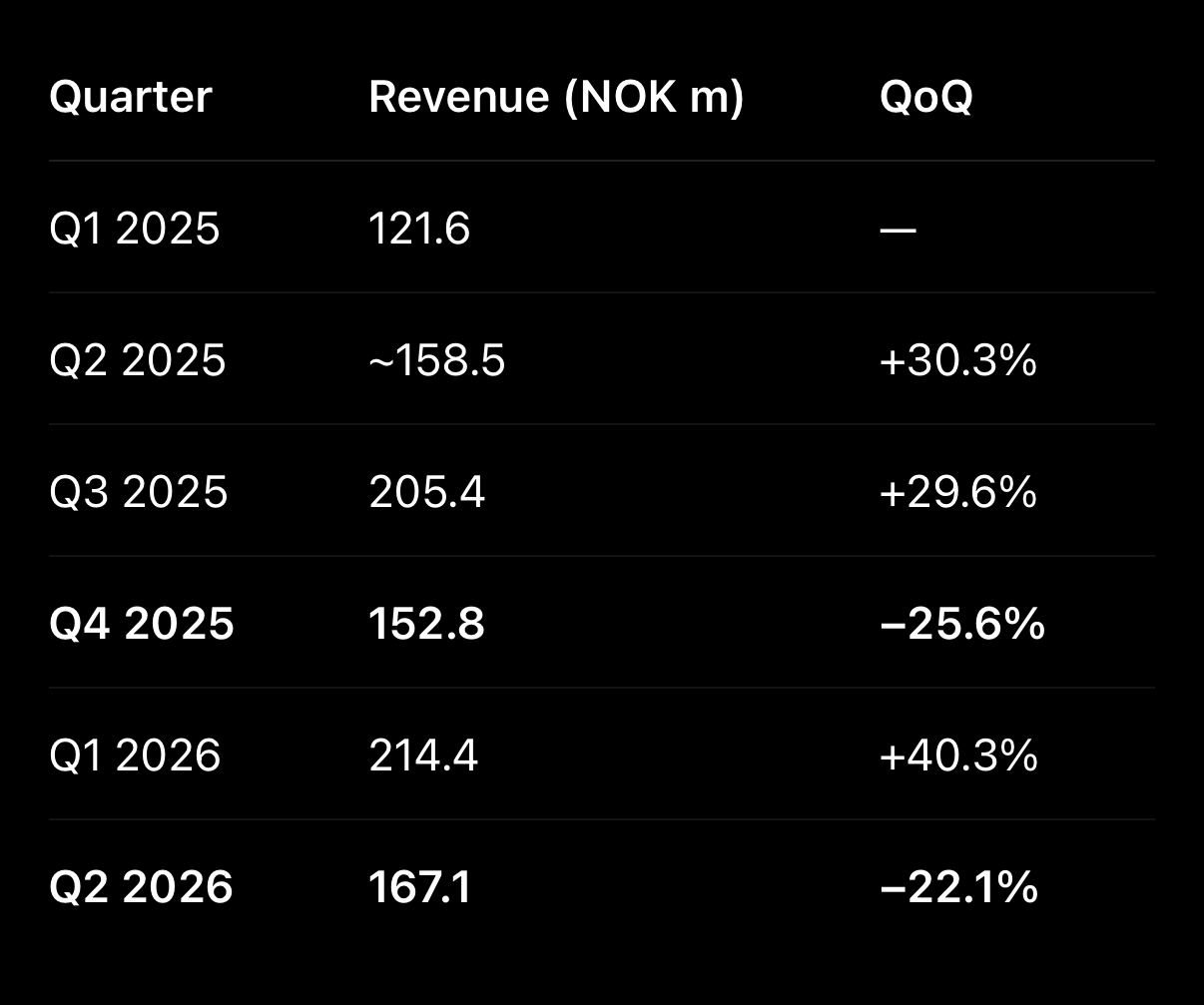
The stock price nosedive is likely due to the q-o-q revenue drop this was supposed to be a high revenue growth case, which has now been broken..?
Personally, I was willing to overlook an EBIT% <= 10%, but I can’t stomach the revenue slowdown. I dumped my shares since my investment thesis was broken
Admittedly, the saturated Nordic market makes up such a large portion of the current revenue that rapid revenue growth elsewhere in Europe and Asia is not enough to push total growth beyond twenty percent or so. The continuation of future growth will be determined by whether one believes that the mangoes will sell elsewhere, too, and not just in the cold Nordics.
I suspect that the margin level will continue to decline in the future, but that revenue growth in the Nordics will pick up. It feels like almost every store in Helsinki has been buying end-cap displays for Delia’s products this summer.
That’s a good idea, getting the customer to try the product and get hooked on mango. A hooked customer will then eventually grab their bag of mangoes from the regular shelf. At least in theory.
I personally decided against investing in the company because there’s a scent of desperation in the visibility Delia is buying in supermarkets, for which Eka provided good examples from Sweden. Furthermore, there are no significant differences between the dried mangoes of various manufacturers, which one would expect to lead to price competition. I generally consider the mango and date boom a fad that will have subsided in two years.
The company is certainly a very interesting investment target. An affordable, high-growth consumer products company at that. I’m always wrong in these assessments of mine, so I suppose a golden age for mangoes is just beginning
The product is indeed good, but I don’t see any moat here that would prevent it from having many copycats from established brands in 1–2 years if the segment grows. You can get onto those K-market end-caps just with money (and only with money). The price ranges from 300 to 500 euros per end-cap per month depending on the size of the store, and often the margin on the quantity sold isn’t enough to cover that, meaning it’s purely a measure to increase customer penetration. With a good product, it can of course boost baseline sales in the long run and increase sales (turnover per store) so that it earns better shelf space in stores. However, the product is an impulse buy, and few people put it on their shopping list, which means that as competition tightens, they will run more campaigns and buy the best spots. That increases volume but erodes profitability.
I’m taking a quick look at this and it might be that the services are showing incorrect data, but at least Yahoo Finance is still showing a trailing P/E of 23.86 after the drop, and Stockanalysis shows exactly a P/E of 20. It would need to drop another 25-50% for it to even start being of interest to a value investor. How are you getting a P/E valuation of 15 with the current figures, or is this the midpoint of the company’s own guidance for this year, or based on next year’s earnings growth estimates? It could indeed be that those services are also displaying incorrectly due to currency or something similar.
Edit: Looks like these services haven’t updated yet. Still, it’s unlikely it would drop all the way to a P/E of 15, though…
I nearly choked on my mangoes when I opened Nordnet and later the forum.
Good points above, and I won’t repeat the same things. What I’m left wondering myself is where the EBIT margin will eventually settle. Is last year’s 11-12% the norm, or is it the 9.5% seen in Q1? There is a fierce battle for shelf space, and money is being pumped into better locations in stores, yet growth is fading → are we left with both mangoes (revenue) and declining margins? Could the new normal for margins actually be somewhere at the 5-6% level? Yuck.
At the same time, it must be said that the company’s management seems somewhat clueless. That talk of “interest from third parties in the company” started to look suspiciously like pumping now that the Q2 figures are going to be ugly. Even if there were a line of interested parties, this fading growth won’t exactly increase the company’s value in a buyer’s eyes.
It’s a tricky situation, and admittedly difficult to assess the current valuation when the EBIT margin is unknown. I will say this, though: if the Q2 EBIT% drops significantly below the Q1 margins, the downward slide may well continue.
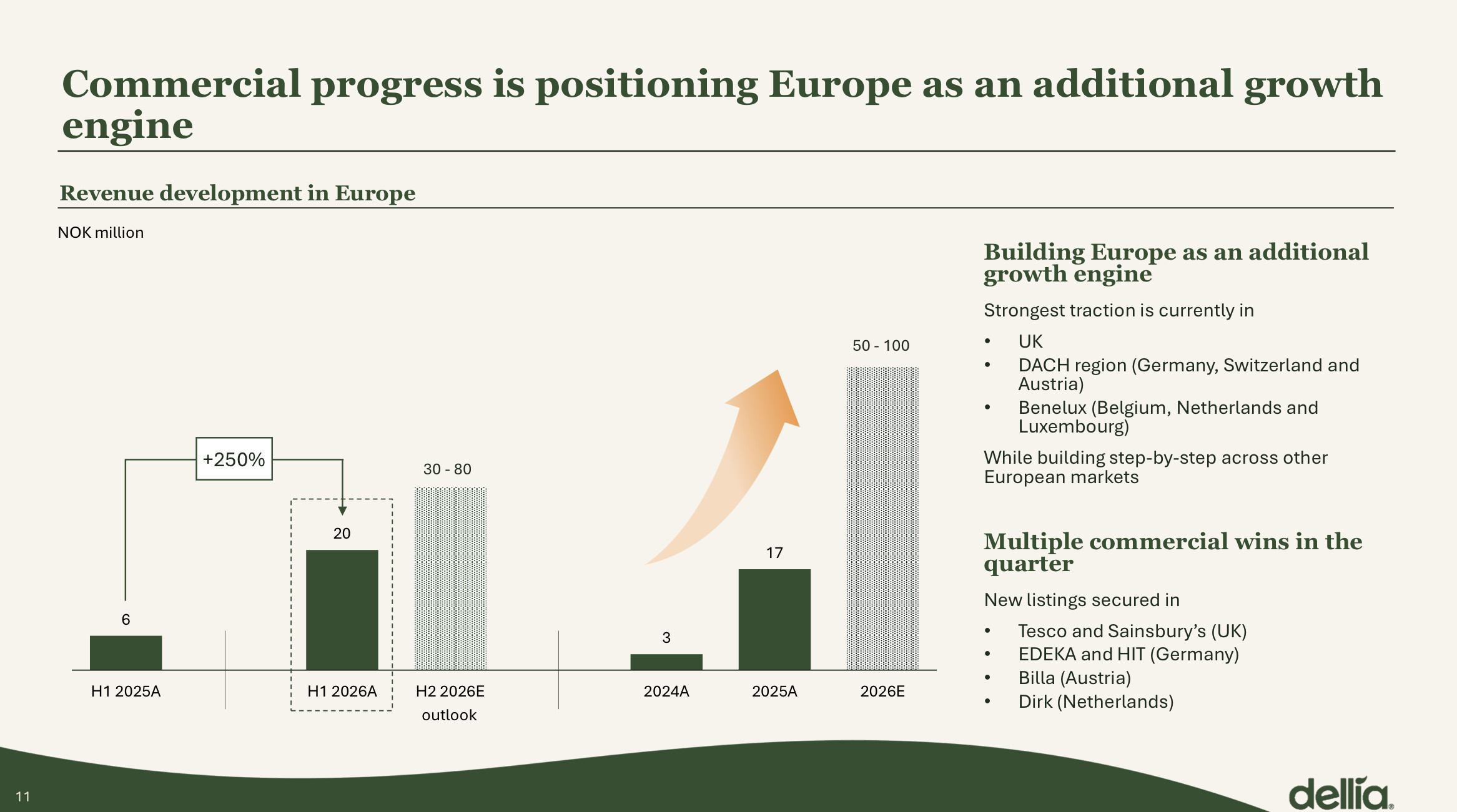
About 2/3 of the year has already passed, so using the 2026 P/E is justified. 56 MNOK looks like a credible result in my own models, as European sales are now turning profitable for the first time, which would give us that P/E of 15. The Kirirom acquisition, the one-off costs it brings, and the share issue to be carried out upon the completion of the acquisition, of course, complicate the picture.
Because of seasonality, the most important quarterly result is always achieved during Q3, which will largely determine how this year turns out.
I am also looking at this quickly and haven’t delved into Dellia any further, so these are just superficial details. However, a P/E of around 15 is a fair ballpark estimate. I don’t really understand the obsession with looking at P/E ratios, as the ‘E’ component always contains more or less one-off items, and furthermore, ‘P’ does not take the company’s financial position into account. P/E works well for index-level analysis, but looking at a single company’s single year is not very sophisticated. Regarding Dellia, the market cap is about 1.25 billion Norwegian kroner. However, there is over 100 million in negative net debt (cash), so taking that into account, the value is 1.1 billion. The company has a rough EBIT margin of 10%, and it is likely that it could rise with higher revenue. Even if it requires marketing investment, I assume higher revenue would scale quite nicely in production. The company has revenue slightly under 1 billion kroner, and if one expects growth for next year, the revenue could hover around 1.1–1.2 billion. This would result in an operating profit of 110–120 million kroner. That would mean a 9–10x EBIT multiple, which sounds quite reasonable. Of course, you still have to pay taxes, etc., on the operating profit, but cutting corners, this implies a P/E of around 12–13. Naturally, with higher profitability, for example, a 12% EBIT margin (which is slightly above the 11.7% in 2025), the company would already be making around 150 million in operating profit at those revenue levels, so the EBIT multiple would be 7–8x and the P/E under 10. That could already be considered quite cheap.
These assumptions naturally require growth from the company, and I cannot judge how possible 10–20% sales growth is for next year. In FactSet, analyst forecasts (3 in total) appeared to expect about 30% revenue growth, which feels steep, but as stated, I don’t have enough knowledge to judge the probability of that. If, on the other hand, the company fails to grow and profitability remains sluggish, then of course there is still plenty of room for the share price to fall. At the latest, the decline will stop at 0 kroner, and one could draw up scenarios that bring nice returns on the upside. In any case, this cannot be considered tightly priced if one believes that growth is even somewhat possible. So, the share price no longer includes any major growth assumptions.
Perhaps the general point is that staring at a single year’s P/E really leads to a rather superficial view when so many factors are left ignored. It should be remembered, however, that shareholder wealth does not accumulate from the results shown on the income statement, but from the cash remaining in the coffers. In the short term, there can be a huge difference between these. That is why it is much more meaningful to assess a company’s ability to generate cash flow than to stare at the earnings lines.
I haven’t been an owner of “mangos” (Dellia shares), and I likely won’t become one. Maybe I could take a small position if the market granted even more of a margin of safety, because in that case, the expected value of a more or less binary case could be quite interesting. It is definitely not expensive, but the products are susceptible to competition. That is the free market at its most beautiful.
Hopefully, they manage to prepare a directed issue and don’t take the route of a public offering, which would dilute the holdings of existing shareholders more than necessary!
The stock is being sold off aggressively before the ex-date anyway, because the playbooks used by Arctic and Pareto in these offerings are along the lines of “the volume-weighted average price of the stock over X days minus 30%.” The incentive to remain a holder is quite poor. The major owners acting as underwriters for the issue get bonuses for their work, so the terms are better for them than for us small-time players.
On the other hand, the Kirirom deal isn’t sealed (as you, @Pohjolan_Eka, have noted before), and from the seller’s perspective, the immediate dilution of shares received as part of the purchase price (unless they put their own money on the line in proportion to their ownership stake) can cause understandable friction. If I understood the terms of the deal correctly, it included front-loaded payments, so if anyone is netting anything from this deal, it’s at least the lawyers and consultants.
Like @Ituhippinen, the Pareto communication raises my eyebrows as well. It is, of course, up to the investors to interpret how to evaluate the different options. I am likely being too pessimistic, but I’ve seen all sorts of growth-seeking hustlers (like Hans Gude Gudesen) in the small-cap segment of the Oslo Stock Exchange, and there’s never a dull moment with them!
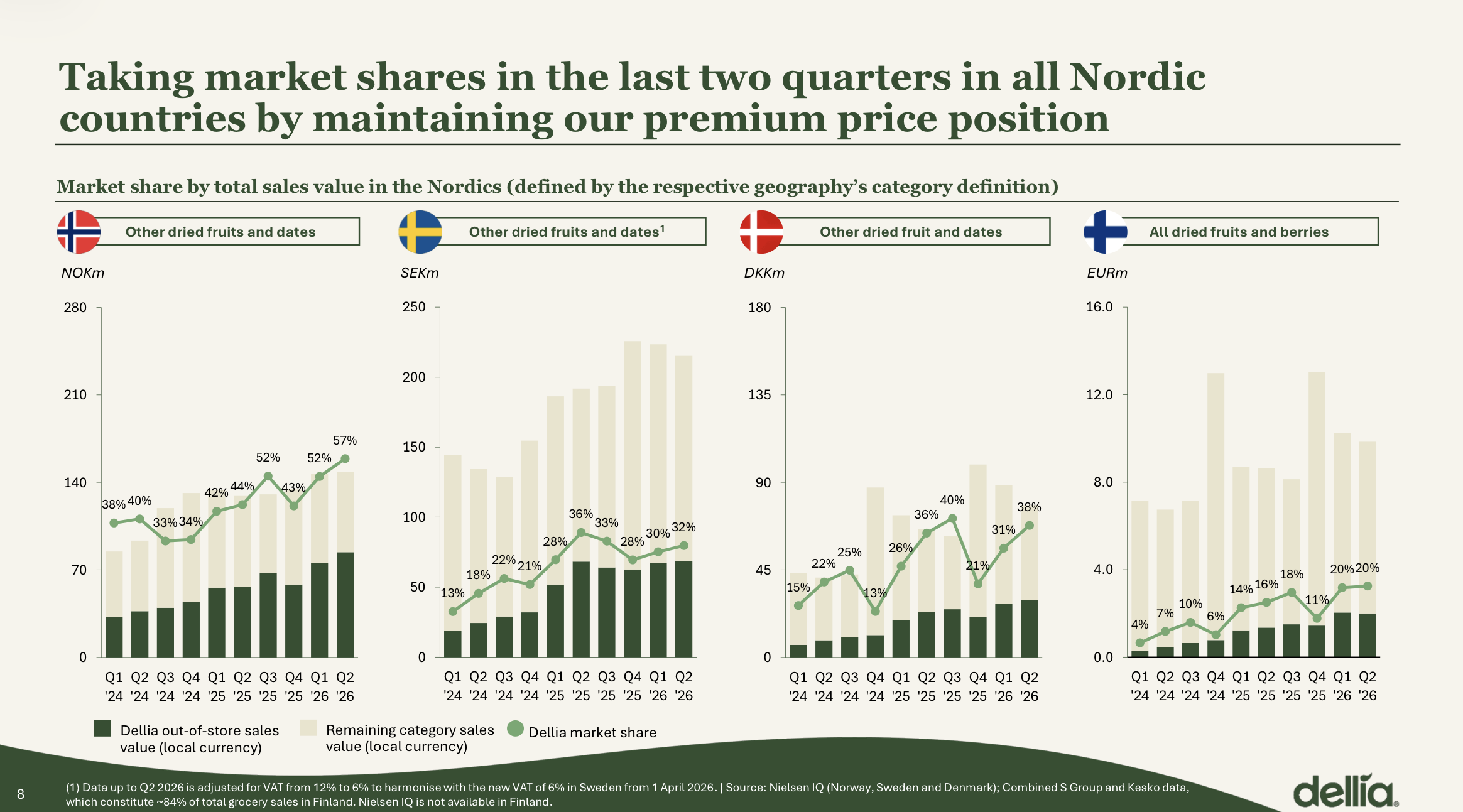
I don’t think I have anything new to add either, but if I had to guess, Q2 profitability will be somewhere between bad and miserable In Q1, the message was how increased competition in the Nordic region requires action on the ground, and these were clearly implemented during Q2, as end-cap displays, special offers, clearance bins at registers, etc., were visible in stores.
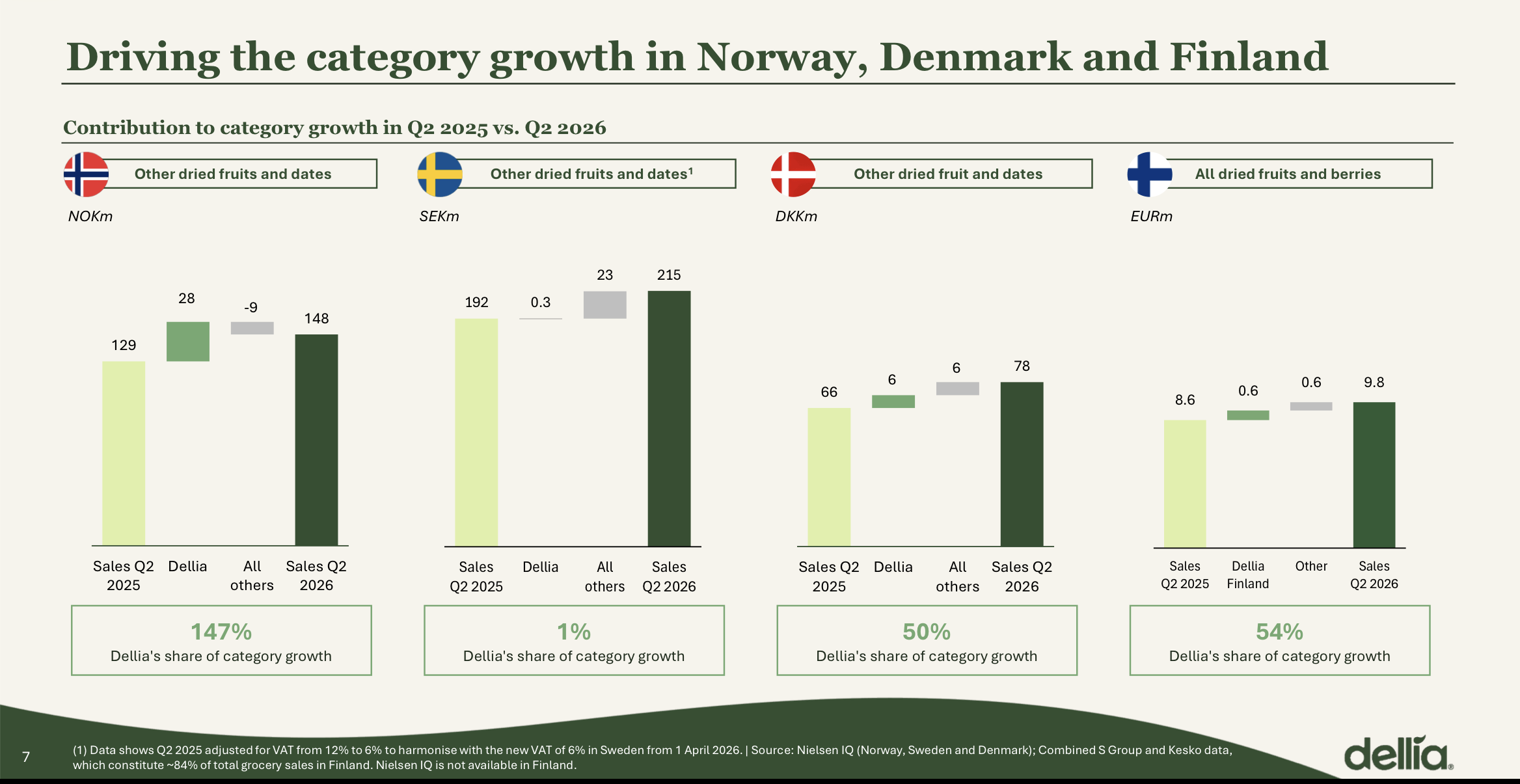
This was, of course, just a matter of time as the category grows rapidly and competition turns cutthroat. Future cash flows and the narrative will increasingly require proof of success outside the Nordic countries. If there’s any positive, the profit warning only concerned sales in the Nordics
A major factor could be a price that is higher than that of equally high-quality competitors, even when discounted. This is a field observation from my trip to Norway. If they are unable to respond to price competition, they could be in for a rough ride.
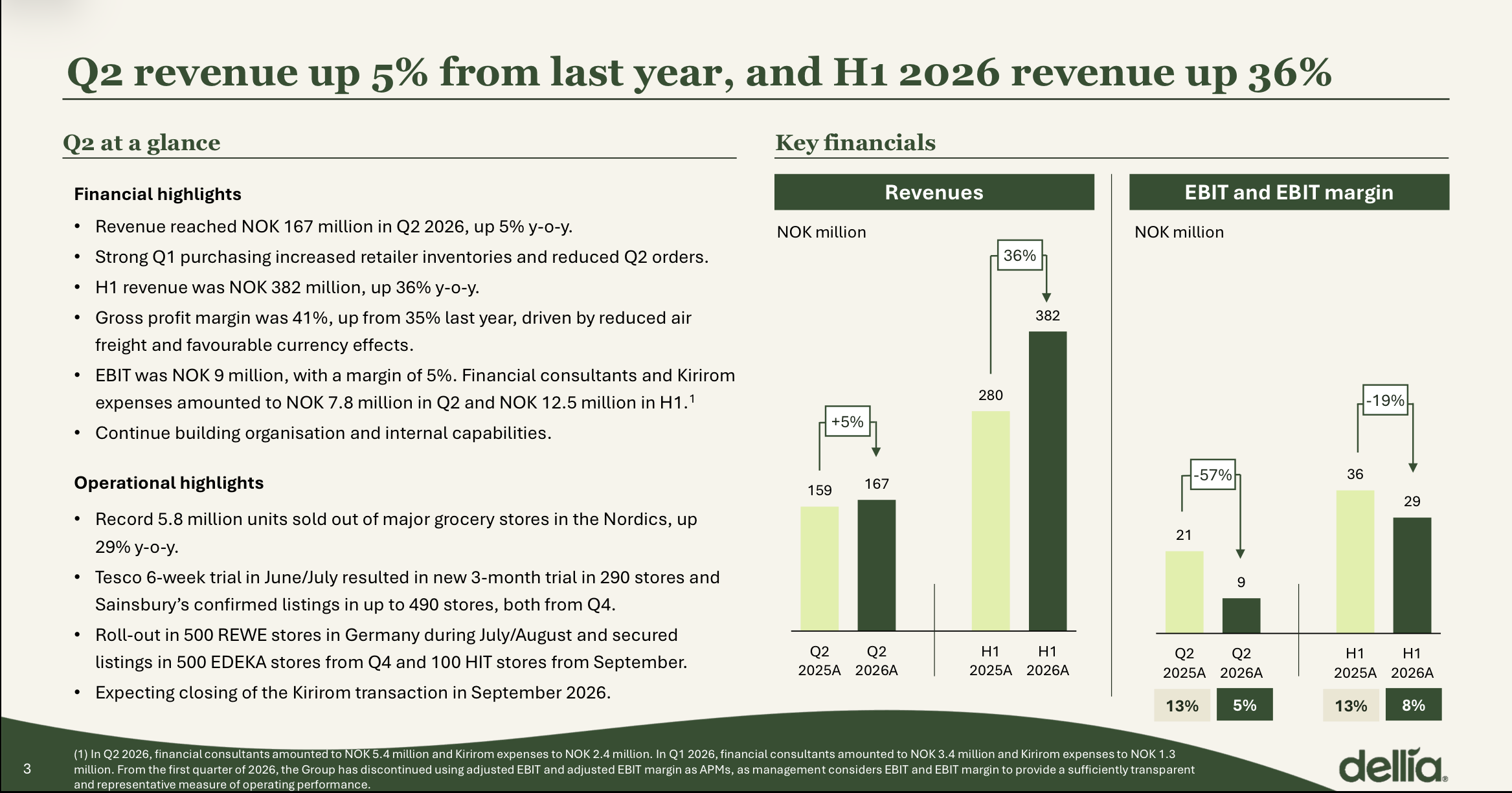
It wasn’t anything special. The Kirirom deal is expected to close in September. Gross margin on turnips grew, but EBIT took a big hit from transaction costs and investments in the rest of Europe:
 this was supposed to be a high revenue growth case, which has now been broken..?


 In Q1, the message was how increased competition in the Nordic region requires action on the ground, and these were clearly implemented during Q2, as end-cap displays, special offers, clearance bins at registers, etc., were visible in stores.