Dellia Group AS - Can dried mangoes be more addictive than Heroin?

Even strong market leadership is no guarantee of the future. Oatly practically built the entire oat milk category, but as competition intensified, market shares, growth expectations, and multiples dropped like a rock.

Competition is not my biggest concern at the moment. On the contrary, an increase in competitors often indicates that the category is growing and attracting new players. Few want to enter a market that is already dying.

What worries me most is the need for capital. If the goal is to build the next European or global snack brand, significant investments are needed in marketing, distribution, working capital, and potentially acquisitions. History is full of examples of food brands that have grown rapidly while constantly raising more capital to finance that growth.

Dilution (Annit) wouldn’t be an issue for me per se if Dellia were listed on the “healthy and deep” US capital markets, where fast-growing consumer brands often receive high valuations and capital is plentiful.

My concern is more related to the fact that this story is being built from a Nordic small-cap list. If the market prices the stock “incorrectly” or too low at the same time as more resources are needed for growth, management’s hands may be tied, and the available options could be destructive to shareholder value.

The question spinning in my head is more: “Is the cash flow and current balance sheet enough to finance super-growth?” rather than “Can someone else also dry a mango?”

37 Likes

Many investors have burned their fingers with these high-growth food companies, but Dellia’s biggest difference compared to the likes of Oatly is that Oatly and many similar firms were never profitable during their growth phase, whereas Dellia is already at a stage where annual dividend distribution can be considered.

Quite enough capital was raised in the IPO for expansion, and digesting the Kirirom acquisition will certainly take until at least 2028 before any new M&A activity can even be considered. The Rest of Europe will be a self-funding and profitable segment as early as next year, so I don’t understand where your ideas about continuous share issues come from. If more capital is needed, the primary course of action should be cutting the dividend instead of conducting share issues.

25 Likes

Amendment of the Articles of Association – stock split

The Board proposes to carry out a stock split to achieve a more appropriate trading price, as the Board assumes this will contribute to increased liquidity in the share. It is proposed that each share is split into 8 new shares, such that the nominal value of the shares is changed from NOK 1 to NOK 0.125 and the total number of shares is increased from 5,460,000 to 43,680,000.

The Board proposes that the AGM passes the following resolution:

“Each of the Company’s shares is split into eight new shares. The Company’s Articles of Association section 4 is amended to:

'The company’s share capital is NOK 5,460,000, divided into 43,680,000 shares, each with a par value of NOK 0.125.

The company’s shares shall be registered with the central securities depository Euronext Securities Oslo (VPS).'.“

They want more movement for the share and a stock split is coming (1:8). So one share will soon be eight shares! MAGIC. I think this was done surprisingly quickly, considering the Delliant share is only about 20 euros a pop. Is there a bit of a “let’s quickly do something soon” vibe in the air? :thinking:

I’m still following Mangofirma™ with mouth watering. The product is solid and the company’s performance has been impressive; let’s see what the future holds.

20 Likes

When comparing to Oatly, it is also good to note the difference in the nature of the competition. Oat milk is a direct substitute for cow’s milk: no one buys their usual batch of cow’s milk AND an equal amount of oat milk. It is a zero-sum game where one’s gain is another’s loss. Consequently, dairy companies immediately engaged in very aggressive competition for market share.

Dried mangoes, on the other hand, do not cannibalize the sales of other snacks in the same 100% manner. Some customers will still buy that bag of candy/chips in addition to the mangoes, and some did not consume other snacks at all before. While some cannibalization certainly occurs, in the eyes of snack companies, the rise of Dellia is not a matter of life and death. The battle for shelf space is, of course, always intense, and this is no guarantee of Dellia’s success, but the starting point is nonetheless easier than in the dairy category.

10 Likes

Split ratio: 1:8, i.e. one (1) old share gives eight (8) new shares
o Date on which the corporate action was made public: 9 June 2026
o Date of approval: 9 June 2026
o Last day including right: 11 June 2026 (trading inclusive right of split)
o Ex-date: 12 June 2026 (trading exclusive right of split)
o Record date: 15 June 2026
o New number of shares outstanding after share split: 43,680,000

7 Likes

“I. Pursuant to the Public Companies Act Section 9-4, the Board is
authorised to acquire treasury shares with an aggregate nominal
value of up to NOK 273,000, corresponding to 5% of the Company’s
share capital, which may only be used as consideration or as a
means in connection with acquisitions, mergers, demergers or other
transactions, as well as for subsequent cancellation or sale. This
authorisation is in addition to the authorisation granted under item
11, such that the two authorisations together amount to NOK
546,000, i.e. 10% of the Company’s share capital. The Company
may not buy back shares to the extent that its shareholding will
exceed 10% of the Company’s outstanding share capital, cf. the
Public Companies Act Section 9-2. The authorisation also includes
the right to enter into agreements regarding the pledging of own
shares.
II. The amount payable per share shall be not less than NOK 1 and
not more than NOK 100

When the share price drops below 100 kroner as a result of the split, couldn’t the company start buying back its own shares, since the maximum price for buybacks is 100?

5 Likes

Is this the reason for the split? The price wasn’t so high that it would have restricted trading in any way. On the other hand, what is the rush to buy back shares—or rather, why such a rush that they can’t wait to hold a general meeting on the matter?

4 Likes

One would assume that the split affects that in the same proportion as well. It’s hard to see them pulling any schemes like that here.

4 Likes

That’s what I would think too. And how much joy is there in first ‘creating’ more shares and then buying them back? What would be the benefit in that?

2 Likes

The market’s disappointment with the latest interim report has still been on my mind. The reaction was really harsh, and the trend has been heading southeast even after that. I don’t dare to be quite as pessimistic about the company’s direction as the market is. Personally, I expect growth from a growth company, and there was plenty of that in the last report, even though profitability took a hit. Whether the decline in profitability remains temporary remains to be seen.

Admittedly, the biggest threat is tightening competition, as there is no real moat. Growing, drying, and bagging mangoes is, in itself, a relatively low-barrier business with no massive entry barrier. It’s unlikely that any great trade secrets can be hidden in the business that competitors couldn’t replicate.

Now during the summer, in particular, I’ve been traveling around different parts of the country and observing store layouts. I’ve seen Dellia products prominently displayed in the produce section aisles at least in Halpa-Halli and Citymarket stores, where the bags are surely easy to grab. I haven’t seen similar displays in S-markets; there, Dellia products were among other dried fruits. In terms of growth, this store placement is a good thing because I would argue that people don’t necessarily think to look for dried fruits for snacking or treats from the specific shelf designated for them. We’ll have to wait for information on how much this fun costs and eats into profitability. To my delight—or disappointment—it has happened at least twice that Dellia mangoes were sold out in the store, and I couldn’t get them for my car trip. Otherwise, the goods seem to move quite well even from the dried fruit shelf in a “rural village” like this that titles itself a city.

In my opinion, the product is very good, and I have replaced other treats with Dellia products myself. I can’t buy these as a snack, because I’m forced to eat the whole bag at once, which results in quite a lot of sugar. People are so conscious nowadays that many probably don’t consider this a health product by any means. But many could well replace unhealthier treats with, for example, dried fruit, which can shift demand to the product category, in addition to store visibility creating a completely new market.

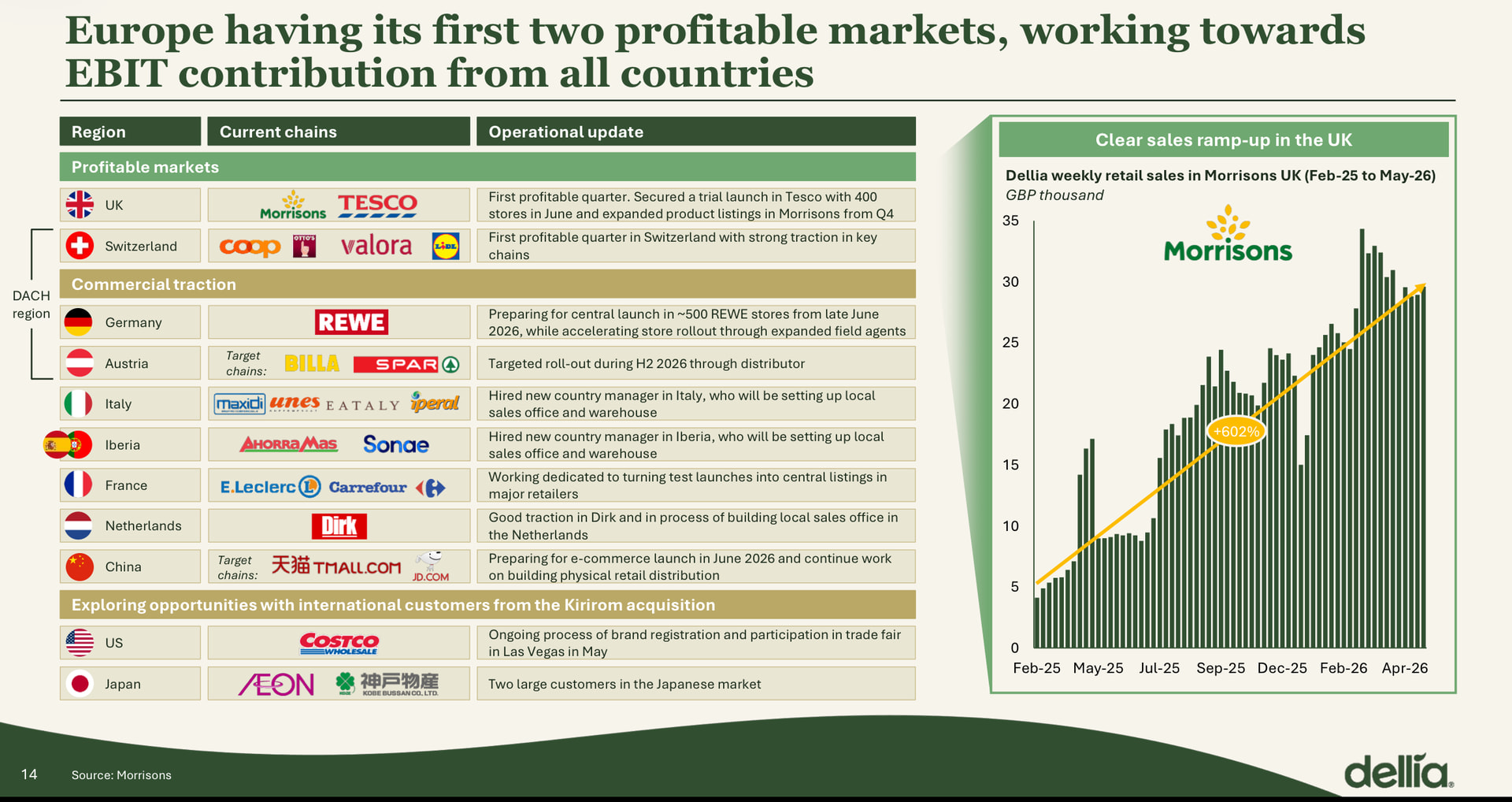
Because the product is genuinely good and there is still market to conquer, I believe there will be more growth, but tightening competition is the most worrying factor. However, the last report had good announcements regarding, among other things, the Tesco collaboration and expansion into the UK through that. The path is also being cleared in other populous European countries. There are many opportunities, and that’s why aggressive shelf wars in a few Nordic countries don’t worry me that much yet. However, the position was opened lamentably early with a small weight and perhaps a bit of FOMO, but every dip is an opportunity. In my opinion, it is still too early to declare the game lost for a growth company like this based on a single quarter.

17 Likes

Dag Skipperud Johansen, a primary insider of Dellia Group ASA (“Dellia”), has on
12 June 2026 purchased 10,895 shares in Dellia at an average price of NOK 27.50
per share.

Following this transaction, Dag Skipperud Johansen holds 2,704,983 shares in
Dellia.

6 Likes

As a more-hardcore-than-average dried mango enjoyer, the absolutely horrific price per kilo of these premium mangoes has always rubbed me the wrong way, and it’s not at all surprising that the margins have been high.

A couple of weeks ago, I was greatly surprised to find Dave & Jon’s branded mangoes at -50% on the shelf of a K-Citymarket; naturally, I grabbed 4 packs and didn’t even glance in the direction of the Dellia mangoes.

Compared to Dellia’s mangoes, I thought they were just as good, and Dave & Jon’s branding is also clearer and more “consistent” to my eye vs. Dellia having something like 5 different product brands. Dave & Jon’s became familiar especially through their flavored dates that were everywhere a few years ago, and it seems smart that the same brand has been kept for other products.

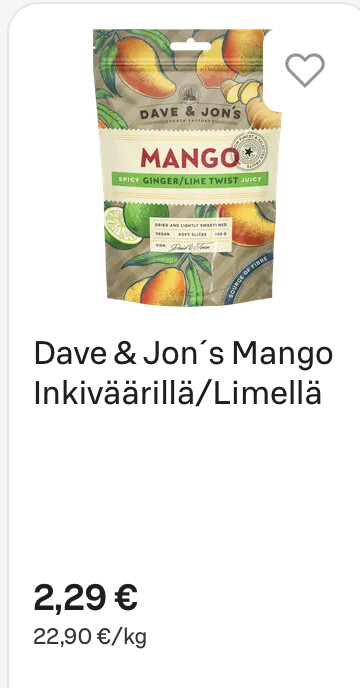
Then the day before yesterday, I visited an S-Market and compared some prices while looking for snacks. Dellia’s top-shelf robbery-mangoes were €36/kg. Dave & Jon were €26/kg (the ginger lime twist came home with me—very good, perhaps the best mango I’ve tasted, the lime-ginger twist balances the sweetness of the mango nicely).

Then I noticed there was also a “budget-premium” mango, “Exotic Snacks” or something similar, at €16/kg (not those dry Lidl-style poverty mango chips, but the same texture as Dellia and Dave & Jon). I took some of these too; they weren’t as good as Dave’s or Dellia’s, but they certainly weren’t over 50% worse either—just a perfectly okay “economy” mango.

I didn’t pick up any Dellia because why would I buy a completely comparable product at €10/kg more than the equally good Dave’s? Of course, I understand that when buying e.g. Coca-Cola, consumers have clear preferences due to decades of habit, billions in ad campaigns, and brand imagery (Pepsi Max is always my choice if it’s an option), but what consumer cares enough to buy Sunshine Delights branded mangoes for €10/kg more than Dave & Jon’s?

The point is, how on earth are Dellia’s margins not going to take a massive haircut as the mango market matures?

28 Likes

Clearly @Voimakyykky, you know what you are talking about, and I think your experience as a Finnish “mango maniac” hit the nail on the head.

The Swedish second-generation family company that manufactures Dave & Jon’s products has, in my opinion, a stronger brand and clearly nicer bags. For a long time, Dellia had several confusing brands and they only started rationalizing their operations this year. I believe Dellia’s basic mangoes are better than D&J’s and very competitive in price, but D&J is light years ahead of Dellia in flavored mangoes. Because of this, they get an unfairly large amount of shelf space, and good seasoning also covers up a lot regarding the raw material. Dellia has expanded so rapidly that they haven’t had enough raw material to get dozens of flavor options on the shelf, or even the time to develop them, which is why volumes are lower and prices are not competitive with D&J in flavored mangoes. The D&J fandom is definitely well-deserved.

But, let’s put the investor glasses back on now. D&J is a conservative family company struggling for a local “district championship.” Their starting point is the same as Hartwall’s: they want to be strong in the home market and leave other markets to other companies. D&J’s sales outside the Nordics are small-scale, and there is no indication that the company is seriously expanding on a large scale into Europe. Then let’s take a look at everything Dellia has done in Europe and Asia during the last 12 months:

Winning in the Nordics is not enough for Dellia; they have set out to build a truly global company. With the stock market listing, they also have enough dry powder on the balance sheet to open several new countries and markets every single quarter. Even though D&J has a larger selection of flavored mangoes and they gain shelf space and brand awareness from products where Dellia doesn’t compete—such as flavored dates—they have no chance of stopping Dellia’s expansion abroad. Even in the Nordics, they haven’t succeeded in doing much more than slowing Dellia’s growth at most, as the growing market segment has lifted the sales of all players.

In any case, these are not ‘winner-takes-all’ markets. You can be Finland’s most valuable trademark, Fazer Blue, which additionally has the exclusive right to use the color blue. As a consumer, you can be of the opinion that Fazer makes the best chocolate in the world. Yet, you will always find Marabou chocolates on that shelf, and when we go to the European level, Fazer can no longer compete against Marabou or even other local firms and loses the sales race in Europe and globally.

With Dellia, you are buying a rapidly expanding growth company whose individual local office’s TAM (Total Addressable Market) is larger than the TAM of the entire D&J brand. Instead of the shelf competition in local S-markets and K-markets, what is more relevant is, for example, how quickly new countries can be opened and made profitable in Europe, how sales start to take off in China and possibly later in Japan, and how quickly they can enter the U.S. market.

41 Likes

Counter-question: what percentage of consumers actually look at the price per kilo when buying a bag of chips or candy? On an investment forum, price-conscious consumers are likely overrepresented, but I still believe the majority here don’t look at whether that bag costs two or three euros.

I would argue that when it comes to impulse treats, people aren’t nearly as strict about price per kilo as they are with basic pantry staples. Of course, if dried mangoes fall into the category of products that must always be in the cupboard, then price awareness increases.

I asked my wife in passing the other day if she had ever tried any mango bags other than Dellia’s or if she considers trying others (she didn’t know what Dellia was until I showed her the bag). She replied that she had tasted something inferior a long time ago and doesn’t intend to test others unless she has to. When buying treats, people buy what they know is good.

18 Likes

Prices must be store-specific, as a quick search shows a 200g bag of Dellian mango costs €4.50, which means a price per kilo of €22.50/kg.

7 Likes

It seems to be in the €22.50–25/kg range. For example, in Lidl, an Alimondon 100g bag is €22.50/kg, so there isn’t a big difference. I really should get around to testing Delia’s product; it just feels like they are quite scarce in shops. I tested Lidl’s and the sweetness is definitely enough for me, no added sugar needed. They were just a bit shoe-leather-like in texture, even though the flavor itself was good. Actually, they reminded me surprisingly much of dried prunes.

3 Likes

The company does indeed have quite systematic pricing, as even the largest bags follow the same price per kilogram.

At least Rusta (I wonder if the Swedish origin is relevant here) has started selling 400g packages at a price of €22.48/kg: Kuivatut hedelmät Sunshine Delights | Rusta.com

Bargain hunters and mango lovers won’t be getting any special deals on these :face_exhaling:

2 Likes

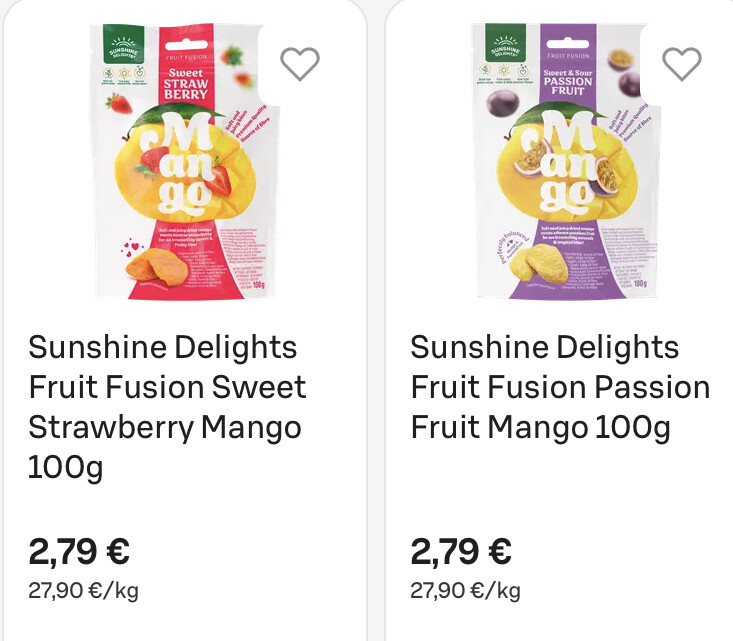
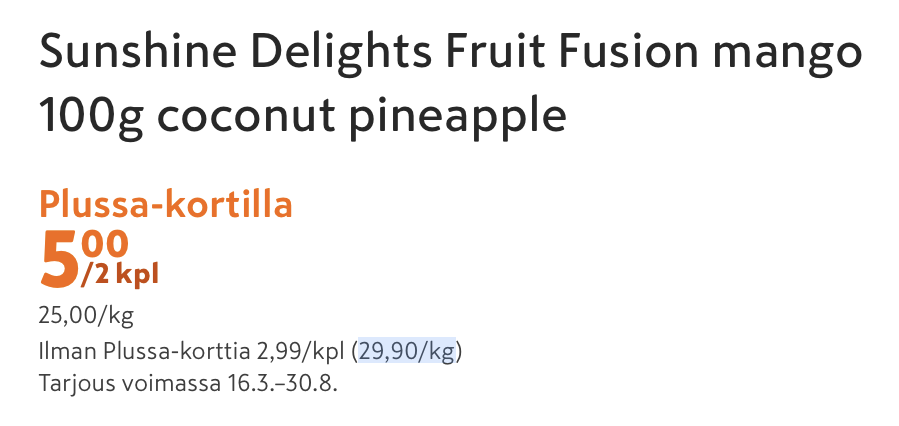
As for the unflavored mangoes, prices are at the same level, but the per-kilo price for Dellia flavored mangoes is in the thirty-euro range, which is not price-competitive with D&J flavored mangoes:

They can also be found on sale every now and then. Two bags for five euros is what gets people to buy:

Of course, to be completely honest, the average person might not necessarily notice or care whether a bag of mangoes costs €2, €2.50, or €3. If you have a craving for mangoes, that bag is coming with you regardless of the price :grimacing:

15 Likes

Has anyone compared these Sunshine Delights mangoes to Foodin’s dried mangoes? Which one is better? Foodin’s product is more expensive, but on the other hand, it is 100% mango. Personally, I avoid additives at all costs, so if I were to buy dried fruit, I would choose Foodin’s mangoes.

Is there anywhere to find Duell’s shareholder data/changes? It would be interesting to see which entities are selling at these levels.

1 Like