What does the following mean in practice?
“The group’s internal restructuring debt to the parent company has been fully settled by converting the restructuring debt into a new bond loan.”
I was expecting a directed issue like Tecnotree’s, but it’s the same as long as the restructuring is completed. I’ve been involved in this before, and since I got out dry, it’s probably time to get back in.
2 Likes
This is a very quiet thread, and the forum’s collective intelligence would be helpful in interpreting this investment case. I’ve been looking into the company and its numbers, but I’m not sure how to read the impact of the end of the restructuring on the figures and expectations, let alone rationalize the risk/reward ratio of the investment.
I’ve looked into Componenta’s past to clarify how it arrived at its current configuration, and I’ll share some highlights here in case anyone else has recently become interested in the case and hasn’t followed it before. The past decade has been quite a slide, with Componenta boasting in 2014 that it was “one of Europe’s largest suppliers of cast components and solutions,” as shown in this image from the 2014 annual report:
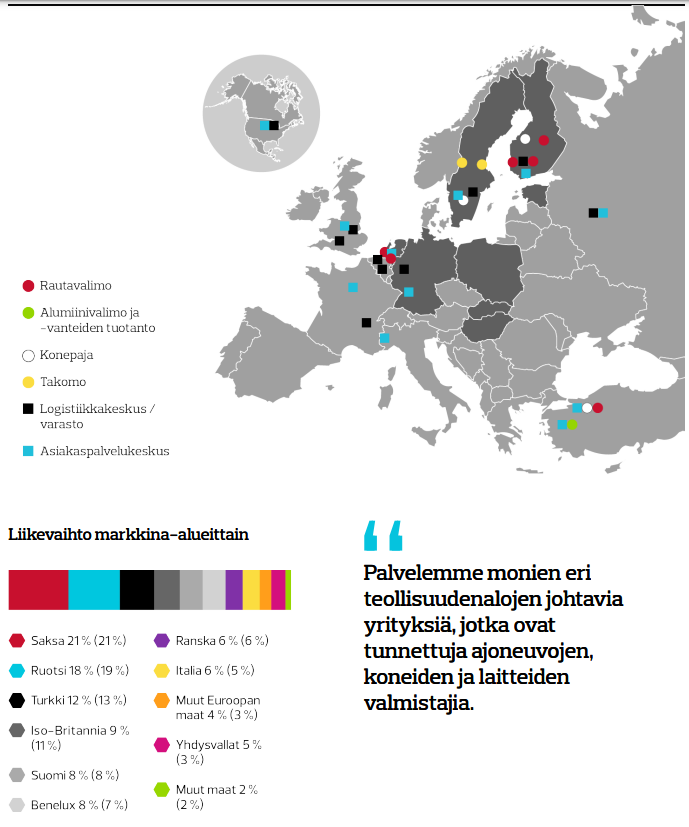
In 2014, Heikki Lehtonen was still the CEO, and in the annual report, he spoke strongly about efficiency measures and growth targets. Componenta’s revenue was just under €500M, and it had 4250 employees. In 2020, revenue was €70M, and it had 564 employees, with operations only in Finland.
I interpret the history to mean that the investments and acquisitions were simply poor, even irrational. In 2015, Lehtonen was fired, and Chairman of the Board Harri Suutari took over at the end of the year. Suutari stated in the annual report that the efficiency program did not work, and the profit development “did not meet the targets set for it at all.” Under Suutari’s leadership, it seems that a new era of restructuring began, the final stages of which are now being completed as the restructurings end. Initially, these efforts were made to rescue the dire financial situation and drive structural changes.
In 2016, things started to happen when the Finnish and Swedish units applied for corporate restructuring, the Dutch operations were driven into bankruptcy, and operations were divested. Management and the management system were overhauled.
In 2017, Componenta achieved its first profitable financial year since 2009. Divestments and efficiency measures continued, with only the Finnish and Swedish operations remaining in the company. Part of the operations in Sweden were also declared bankrupt. In 2018, restructuring and efficiency measures continued.
In 2019, the restructuring payment program began, and the last remaining operations in Sweden were driven into bankruptcy. The machining company Komas Oy (later Componenta Manufacturing Oy) was acquired from Finland to diversify the remaining foundry operations. Marko Penttinen briefly served as CEO, and Suutari returned to his role as Chairman.
In 2020, Sami Sivuranta became CEO (apparently from his position as development director). The annual report already exudes confidence in Componenta’s survival and the realization of the turnaround. The integration of Komas progressed, and despite COVID-19, business apparently went quite well. At the end of the year, the share issue that brought Etola and Kakkonen to the top of the ownership list was arranged to prematurely settle the restructuring debts. The original target for ending the restructuring was in 2023. The business model has also been adjusted, as extracted from the 2020 annual report:
Componenta aims to shift from a traditional technology-centric operating model towards a deeper business model that identifies customers’ overall needs and to be a primary full-service supplier with a broad offering for its customers.
Customers are no longer named (names can still be found in the 2016 annual report), but in the webcast, Sivuranta praised the customer portfolio as excellent, stating that “it primarily includes all global domestic quality brands and OEMs.”
Numbers from the 2020 annual report:
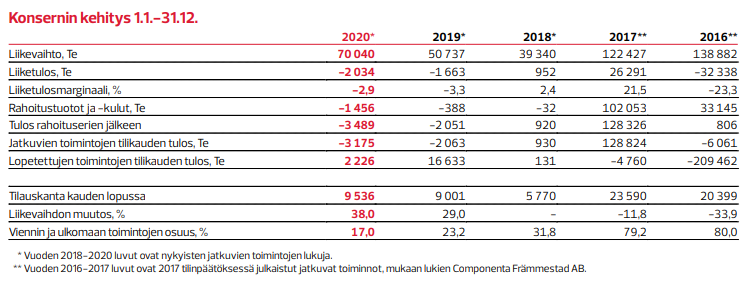
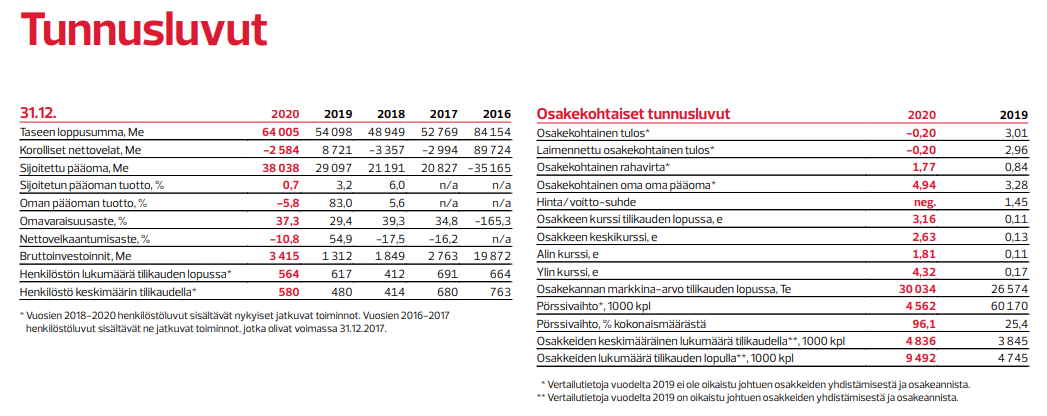
And so we arrive at October 2021, during which Componenta expects the restructuring of its last subsidiaries to be completed. The parent company’s restructuring ended already in Q2/2021. The half-year review praised the business development as proceeding according to plan, with order intake starting to grow and the financial situation also appearing to improve, although the balance sheet still contains deferred tax and trade payables. The latest guidance promises clear growth in revenue and an improvement in EBITDA from the previous year. In H1/2021, EBITDA has already accumulated almost as much as for the entire last year, so its magnitude can be estimated with a fairly wide range. Here are the key figures for H1/2021:
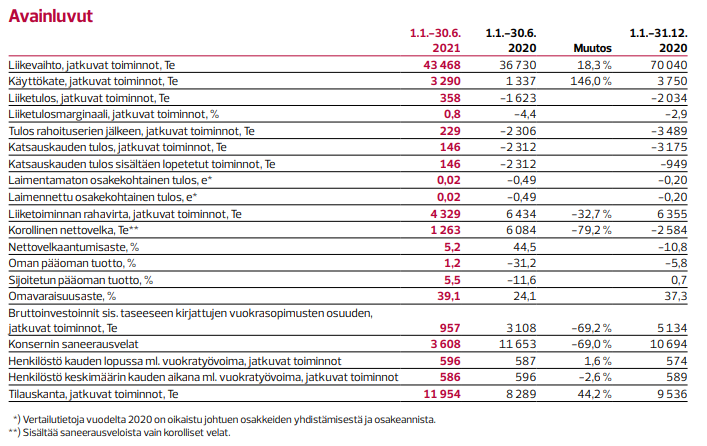
The restructuring figures indeed distort the numbers so much that I don’t trust my calculations for the EV/EBIT ratio or the potential profit in future years. On paper, the net gearing ratio is almost zero, but this will no longer be true in Q3 figures when the interest-free restructuring debts are paid from cash, and interest-bearing debts remain (I think???)
The above is my train of thought without guarantees of the veracity of any claim, but mostly based on annual reports. As I noted elsewhere, this has some Tecnotree vibes (without the profitability and potential of the software industry, of course), meaning there’s a genuine turnaround investment case on offer. It has taken five years to remove unhealthy business and settle restructuring debts, so the long downturn has probably shaken most investors off, and the company is now mostly flying under the radar. Of course, there are threats and challenges even after the restructuring, the most acute being the current rise in raw material and energy prices, so the turnaround achieved so far does not yet guarantee a good investment case. I am also somewhat concerned about the largest unnamed customer’s 23.5% share of continuing operations’ sales (2020 Annual Report). For a company with large fixed costs, losing that customer could potentially drag a good upswing into the mud.
My wild hope would be that once the restructuring constraints ease, Componenta would acquire Inderes’s coverage, and we would get an analyst’s interpretation of the situation  While waiting for that, it would be interesting to hear other forum members’ views: is Componenta worth its current valuation of €35M, and on what grounds would you invest or not invest?
22 Likes
Depreciation consumed the entire operating profit, at least in the first half. Did you look more closely at when something would start to be left below the line?
I don’t have the expertise to dissect financial statements, but if I interpret the 2020 financial statement correctly, there’s at least €30M worth of depreciable balance sheet value, meaning €6M in depreciation would suffice for another five years. However, investments totaling €3.4M were also made last year, and a large portion of those likely also go into depreciable assets.
Attached are the tangible assets from the 2020 financial statement, from which most of the depreciation is made, in case someone can interpret them better:
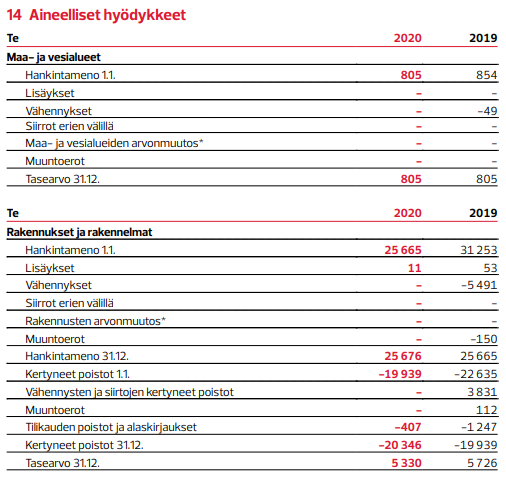

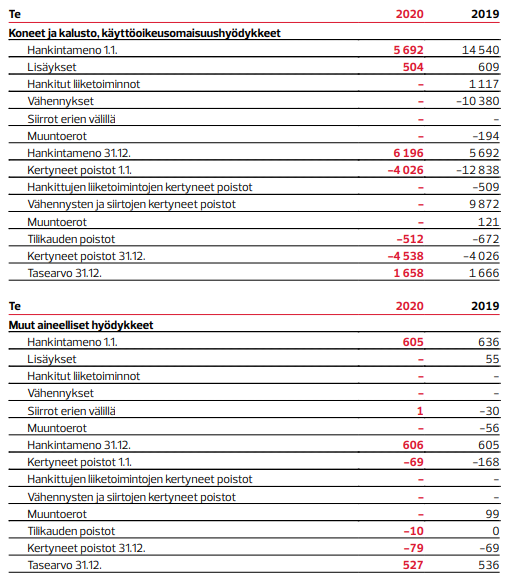
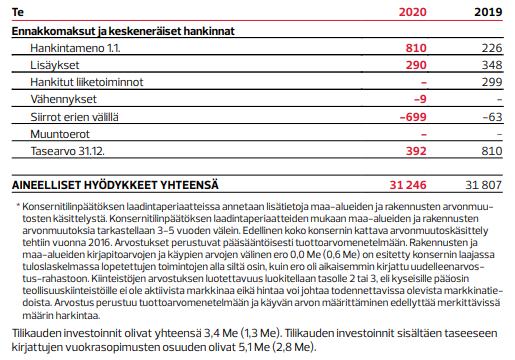
E: There’s a lot of related information in the notes to the financial statements, but I lack the time and skills to go through them. So, clearer answers might be found if one knows what to look for 
3 Likes
I started with a much shakier analysis, but this reminds me of Incap’s turnaround. There’s one big seller that’s ruining the market value. And by the numbers, Incap shouldn’t have survived bankruptcy either.
1 Like
Roughly 30 million euros of acquisition cost can be eliminated when land areas are deducted. It’s good to note that nowadays, assets acquired through lease agreements are practically fully capitalized on the balance sheet. The valuation of assets capitalized on the balance sheet is, in simplified terms, based on the lease liability balance (the so-called lease agreement debt, which arises from the lease period).
Before the new regulation came into force, listed companies practically only capitalized finance lease agreements. The standard has changed recently. My personal opinion is that the regulatory change unnecessarily inflates companies’ balance sheets.
2 Likes
This thread’s title probably needs an update 
7 Likes
Agreed. The restructuring is completely over.
1 Like
I support changing the name of the thread. The company is trading at bankruptcy prices, perhaps €5 is the next target we’ll reach starting Friday. Suutari’s average price when he became CEO was around €18, if I remember correctly 
4 Likes
Q3 out:
Highlights:
January–September 2021
• Net sales increased to EUR 62.0 million (EUR 52.5 million).
• EBITDA improved to EUR 3.6 million (EUR 1.9 million).
• Operating result was EUR -0.8 million (EUR -2.5 million).
• Cash flow from operating activities was EUR 0.5 million (EUR 6.9 million).July–September 2021
• Net sales increased to EUR 18.5 million (EUR 15.8 million).
• EBITDA was EUR 0.3 million (EUR 0.6 million).
• Operating result was EUR -1.1 million (EUR -0.9 million).
• Cash flow from operating activities was EUR -3.9 million (EUR 0.5 million).
The profitability of the third quarter was affected by higher raw material costs,
as well as a temporary decrease in productivity caused by the rapid increase in production volumes in certain units.
We have increased our capacity and, among other things, increased production personnel resources
to meet customer demand throughout 2021. However, there have been challenges in the availability of labor
regarding both domestic and foreign labor. Especially regarding the addition of foreign labor,
the long processing time associated with work permit processes has been a challenge.
The upward trend in material purchase prices continued to be exceptional in the third quarter as well.
However, for our main raw materials, cost development is tied to
customer agreements with indices, and these will be updated in sales prices with a delay. We have
also agreed with our customers on a one-time transfer of non-indexable material prices and labor
cost increases to customer prices. These price agreements came
into force at the beginning of the last quarter of the current year.
Numbers are moving in a better direction, demand is growing but there are challenges to meet it. Inflation can be passed on to sales prices. The order book has swelled to over €16M (an 81% increase year-on-year), while the Q2/21 order book was just under €11M.
4 Likes
There seem to be bottlenecks in the way. I’m following the labor situation in those industries, and it was mentioned that there are productivity issues because foreign labor cannot be obtained due to bureaucracy. I calculated that without an increase in labor, the 85-90 million revenue might not be realized or would just barely exceed that. Of course, it was also mentioned that prices are passed on to customers with a delay. The operating profit seems to be better than last year. Debts are being paid, the direction is right, but the result hasn’t turned positive yet.
3 Likes
"Having worked in the field for 15 years myself, I believe there are no hocus-pocus tricks for the labor shortage. It’s been around as long as I can remember and will continue for the next 15 years. All skilled Finns are already employed and won’t switch jobs unless the employer’s reputation is exceptionally good. Good young people are recruited from school, and there are few of them too. Coding, etc., is more appealing.
Then there are foreigners; there are a few good ones doing work, but a large part has been quite subpar when considering productive work.
There are people for assembly line work and pressing buttons, but actually getting things done is another matter."
4 Likes
Then there are these foreigners; a few good guys come from there to work, but a large part has been quite subpar if we consider productive work.
This is my first message here; I am a foreigner myself, BUT I AM NOT SUBPAR. You should be careful when you write.
10 Likes
https://www.tehotec.fi/sarmari-nayttaa-erikoisen-puhtaalta/ Agreement made in summer.
1 Like
https://yritma.fi/uutiset/teollisuus/osaamista-ja-kestavaa-kasvua-valutuoteteollisuudessa
Let’s put some numbers in here.
And one more interesting stock transfer took place on the Christmas list, where Suutari Eero dropped off the list and Barry Staines Linoleum Oy appeared in his place.
3 Likes
Compo Q1 was released…
January-March 2022
- Revenue grew to €25.5 million (€20.4 million).
- EBITDA was €1.5 million (€1.5 million).
- Operating profit was €0.0 million (€0.0 million).
- Operating cash flow was -€0.1 million (€0.9 million).
The order book is growing and seems to support management’s estimate of revenue growth towards €100 million. They have also successfully recruited personnel, so it looks pretty good in that regard.
There was some mention of a corporate arrangement that did not materialize. I wonder if someone would like to ask Sivuranta questions about this?
3 Likes
A couple of raises for a quiet thread…
- Compo has received more orders for PV equipment. As a result (?) the share subscription limit would have been utilized by 500k.
- In September’s owner list, additions have been made (Citibank 270k->508k) (SEB 0k->12k). (Siementila Suokas is reducing its ownership from 50k->26k).
- No profit warnings have been issued and there are 3 months left of this year
6 Likes
Comptel announced that it will reach over 100 million in revenue, and its operating profit will increase from last year. The stock is rising by huge percentages…but the robots will soon take control of the price
Comptel has a clause in its contracts that the energy price is passed on to customers.
We are eagerly awaiting the completion of this year, to see if there will be a surplus at the end of the year.
6 Likes
A nice surprise from a totally messed up kid.
Quote from Kauppalehti’s forum, username warrantti-veeti.
This is a wonderfully excellent situation. In a nutshell:
- Compo’s operating profit is strongly positive, equity items (incl. liquid assets) have developed positively,
- interest-bearing debt is already very small
- order book is bulging.
- the company’s stock market value is still below what it was when bankruptcy was a realistic option.
Future outlook:
- customers are looking for suppliers closer to home, and reliability is more important than price.
- it is a security of supply company with demand potential in the defense industry in addition to previous key industries
- the company’s financial situation is good and 7.5 million euros are available for acquisitions if suitable targets are found
- the price of raw materials, materials and energy is weighing on the outlook of all manufacturing industry companies
- availability of personnel has so far limited growth
6 Likes