Cardlytics – Purchase Data-Driven Advertising Platform

Opening a thread for Cardlytics!

A couple of days ago, I stumbled upon the Business Breakdown podcast, which delved deeper into Cardlytics’ business. The link to that podcast is here:

The company’s own introduction translated:

”We are an advertising platform in banks’ digital channels.
By using purchase data, we can see where and when customers make purchases both online and in-store. We use these insights to identify opportunities, target the right people at their bank, and measure the true sales impact of our ads. With over 168 million bank customers on the platform, we help brands grow sales and increase market share."

A few quick facts about the company:

  • The company’s equity market value at Friday’s closing price is USD 4 billion.
  • The company reaches 168 million customers monthly, who use the services of their client banks.
  • The company has generated $46 billion in additional sales for advertisers on the platform.
  • The company is listed in the United States: NASDAQ: CDLX
  • The company generated revenues of USD 53.2 million in Q1 2021.
  • In 2020, the company generated revenues of USD 186.9 million.
  • The guidance for 2021 is USD 260–285 million. (Growth of 39–52% YoY)
  • Currently, the company is operating at a loss.

The Company’s Business

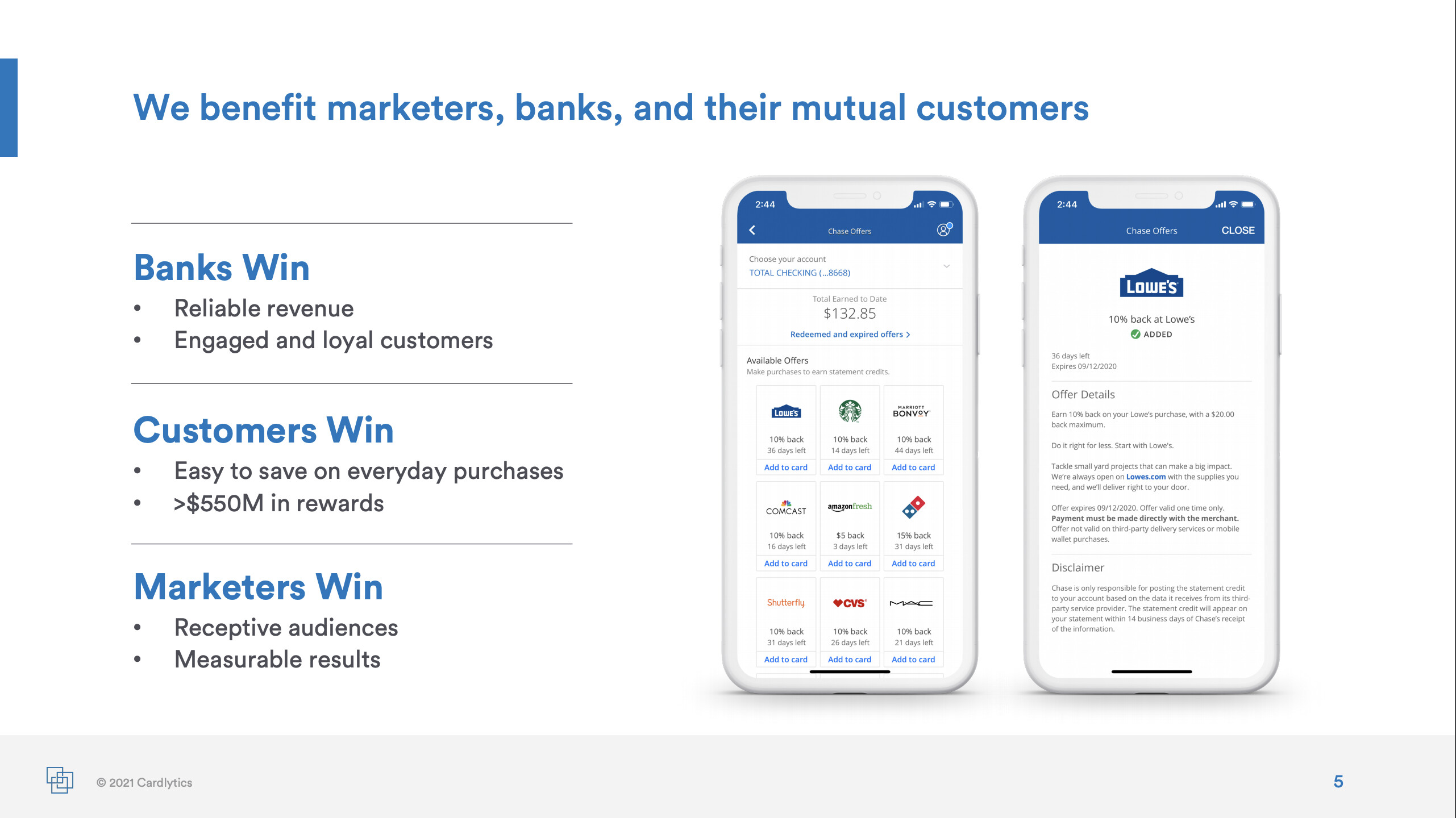
This is a platform that allows advertisers to target their spending very effectively to the right customers. Cardlytics targets offers to people based on their purchase data, allowing them to save money. At the same time, advertisers get proven additional sales. Cardlytics thus creates value for every party on the platform. Banks get more transactions, advertisers get additional sales, customers get the products they want at a lower price, and Cardlytics receives a fee from advertisers for the service.

The purchase data utilized by Cardlytics is invaluable to every marketer, so in the future, this could be a truly important marketing channel for various companies. What makes Cardlytics’ platform an exceptionally effective marketing channel compared to Facebook or Google is that the effectiveness of ads can be monitored with significantly greater accuracy by creating random samples within a segment and feeding the ad to a random customer. If an ad works in a segment, the advertiser should put every possible unit of money into this ad channel until the ad is no longer profitable.

For example, keywords displayed in connection with Google search results are auctioned off among interested bidders. However, there is no full certainty about the effectiveness of the ad, as this customer might have searched for the product on Google and made a purchase decision without the ad. Cardlytics, on the other hand, gains greater certainty from this, as I understand it, because comparing it to a control group is much more precise.

Disruption in the banking world is not a problem for the company, at least according to the podcast mentioned above, because the company offers two different platforms for its bank customers. They have a lighter platform intended for newer players offering mobile payment services. In addition, the company has a platform designed for traditional banking operators, which is a bit heavier but better suited for integration with bank systems. Thus, changes in payment methods from traditional credit cards to mobile payments do not hinder the company; on the contrary, they help it.

Finally, I will add the latest interim report. The investor relations presentation can be accessed here.

Q12021_earnings_supplemental_deck_FINAL_2021.05.04.pdf (2.6 MB)
9 Likes

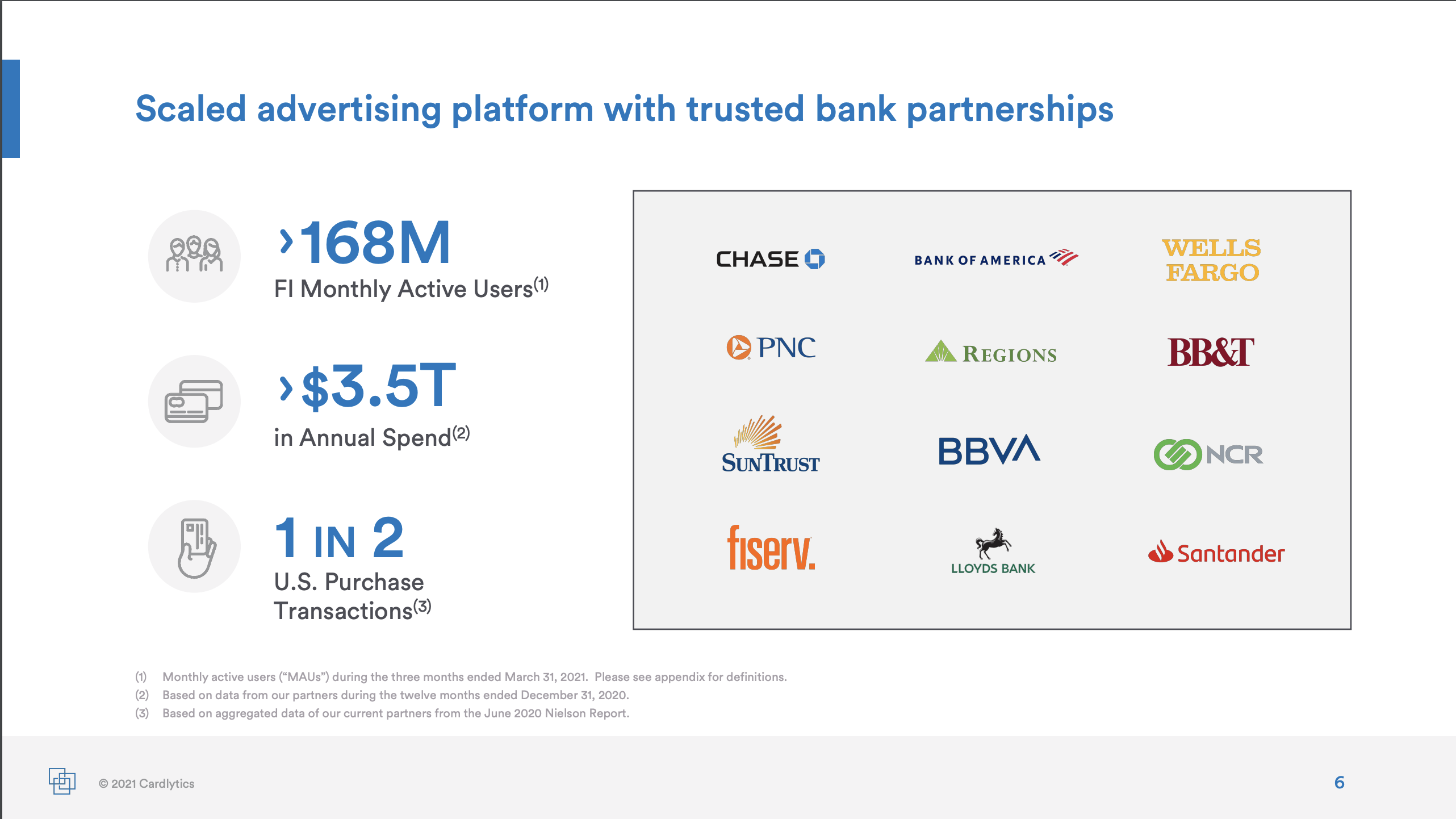
Here are a few pictures from the investor communication slides. A significant part of the platform’s usefulness comes from having as many customers as possible being users of Cardlytics’ (Cardlytics) client banks. From the lower image, you can clearly see that the list includes quite big names and major players, which leads to more customers utilizing marketers’ offers.

In addition, switching banks is relatively rare, which supports the company’s business moat. I have not yet found any other company that provides a similar service and would be a serious competitor to Cardlytics (Cardlytics). For these two reasons, I believe the company has a very good competitive advantage in the long run, as long as as many banks as possible integrate the product into their systems.

2 Likes

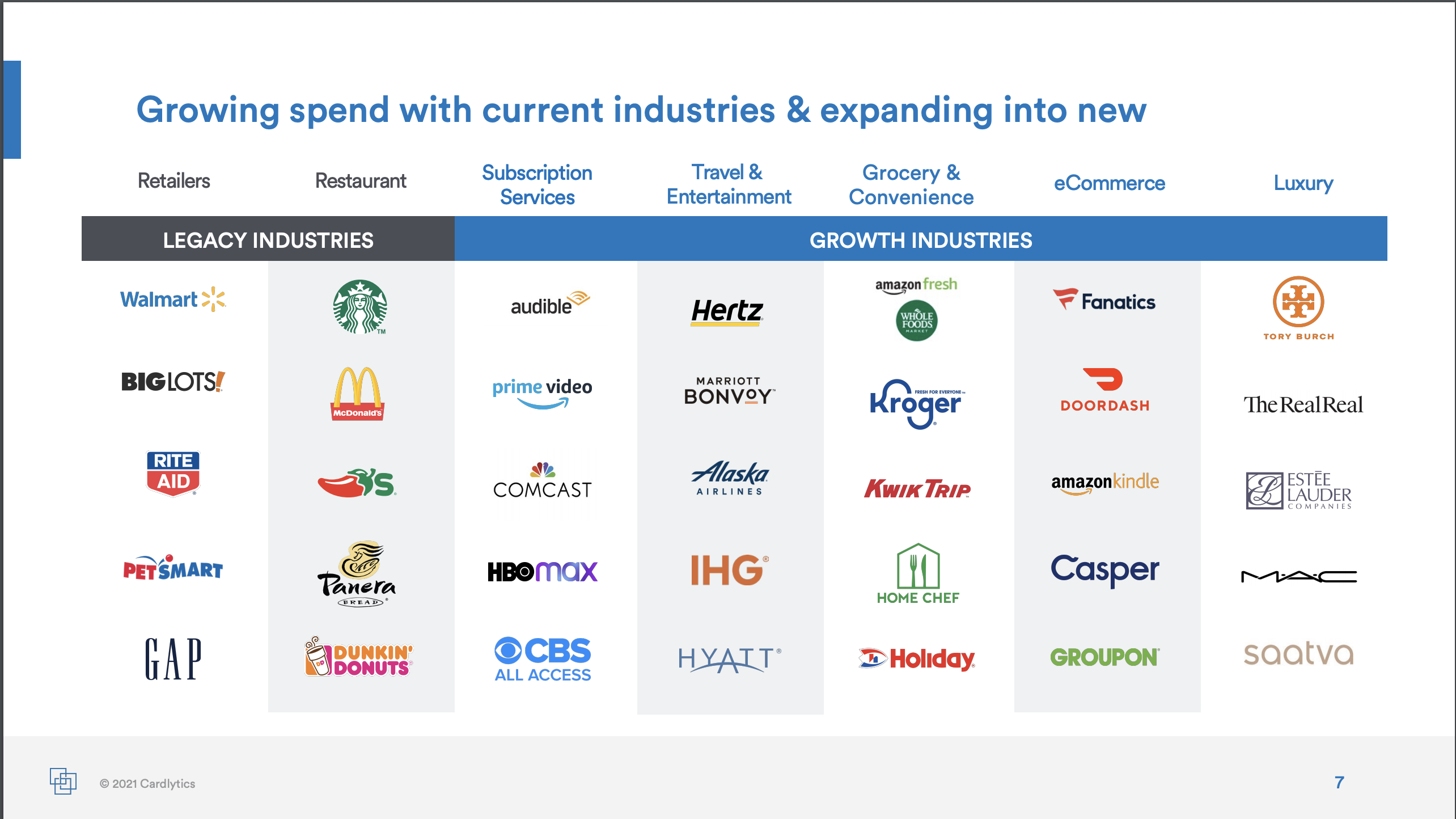
Here are some more advertisers the company serves.

4 Likes

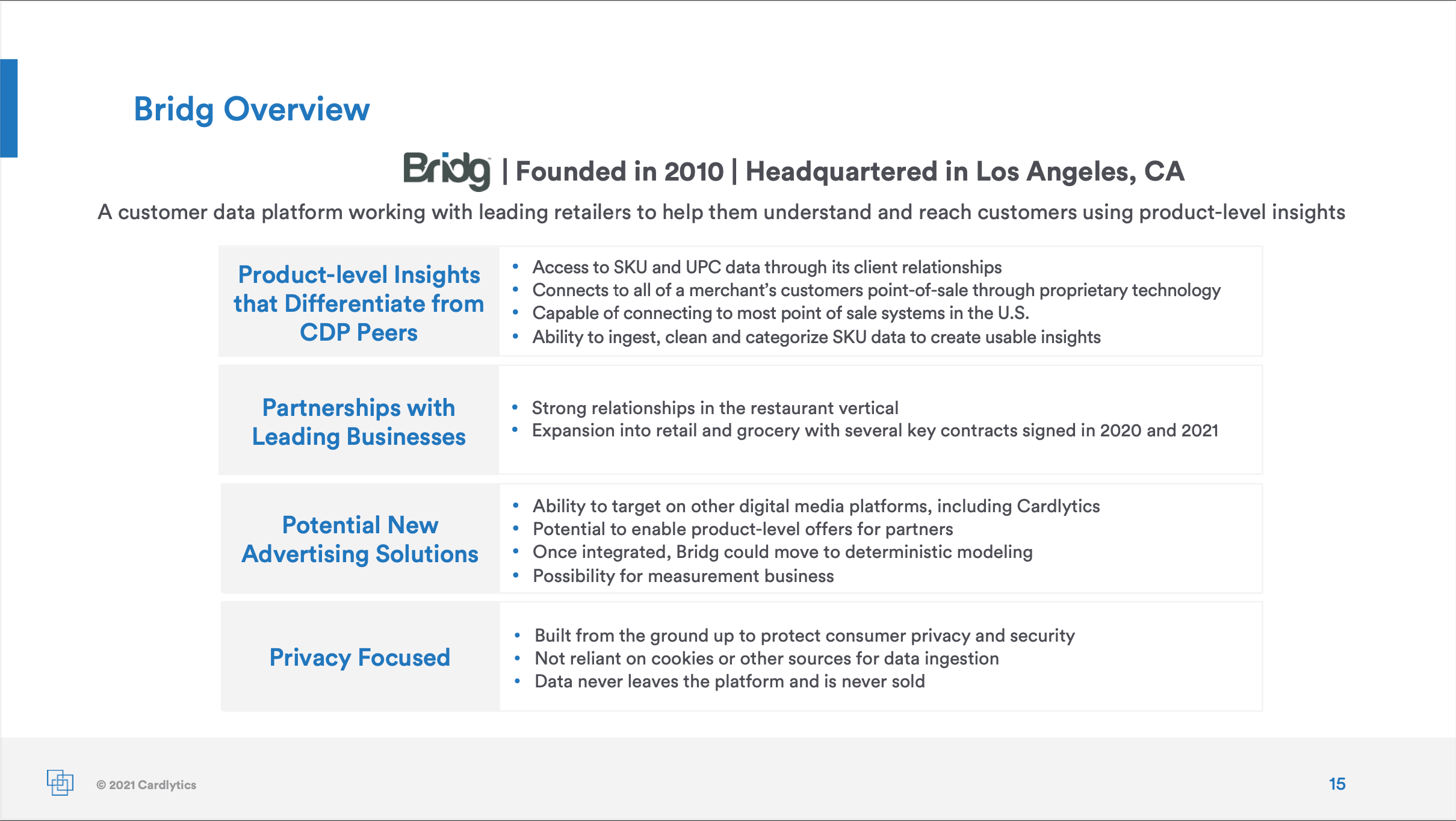
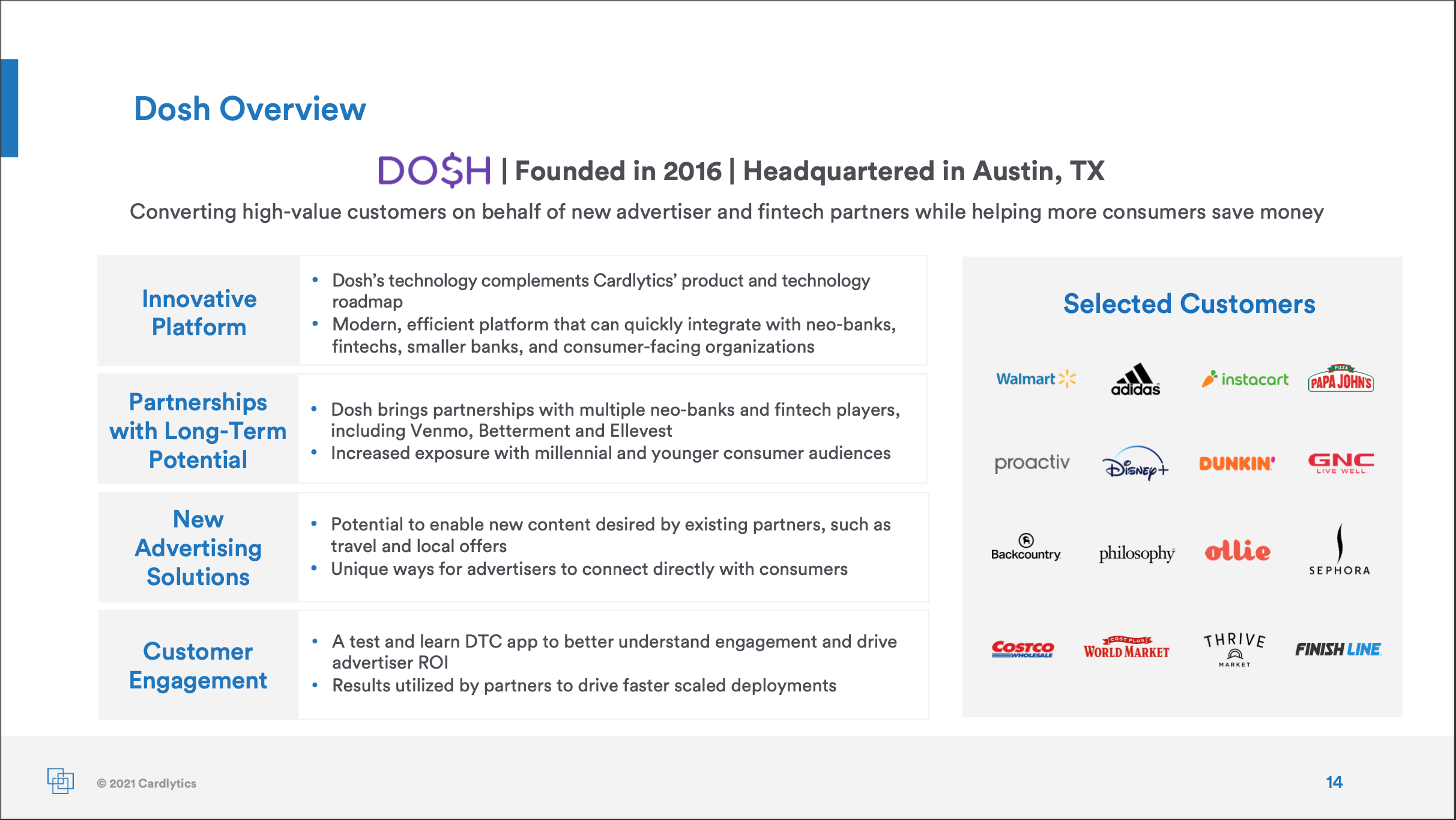
This year, Cardlytics has acquired two companies, DOSH and Bridg, to support the growth of Cardlytics’ business.

DOSH is a service that gives consumers cash-back for purchases made.

Bridg is a customer data platform that helps retailers better understand their customers.

Here’s Cardlytics’ management’s view on these two companies:

1 Like

Here’s some more reading material about the company. I’ll try to break down Austin Swanson’s thoughts on the company. You can read the full text from the links.

Let’s go through Cardlytics’ cooperation with Venmo. The analysis was written by Austin Swanson. I only translated the text into Finnish.

In June, the company announced that it would start cooperating with Venmo, one of the largest “neobanks” in the United States. The trick of the scheme is that Cardlytics offers deals in Venmo’s payment application that consumers can take advantage of. In this way, Venmo can commit its customers to using its services, and these users generate cash flow for Venmo. Advertisers benefit from the next additional sales from a new advertising space. Cardlytics, in turn, would receive a commission from advertisers, which is shared between the payment intermediary and the company. Basic stuff, but repetition is the mother of learning.

Cardlytics’ investor presentation states:

“Our continued focus on growing our Venmo partnership…the team is focused on expanding rewards to additional payment types, creating a rewarding experience with Venmo, regardless of what payment instrument the consumer uses…We will also continue to invest along with product in our teams, supporting the build and partner integrations for enhancements, including currency conversion, pay with QR code currently live at Venmo.” - Farrell Hudzik, Executive Vice President, Financial Institutions, Cardlytics Investor Day Presentation

Venmo is a huge player, so this collaboration alone should have some monetary value, right? Let’s calculate some kind of rough estimate of this. Or rather, Austin does and I refer to his analysis.

Assumptions

There are 60 million Venmo users in the world. Let’s assume a 5% annual user growth, although the number is likely slightly higher as young people start using banking services in increasing numbers.

Not all users can be monthly active Cardlytics users. People don’t use Venmo constantly or they use another bank for offers. Assume that 50% of new customers coming through Venmo are already online banking that offers Cardlytics deals. Of the remaining 50%, only 50% use Venmo for purchases at all, which leads to 25% MAU (Monthly Active User).

Assume the consumer benefit to be as follows: once a month, a $10 offer, of which -10%, so a total of $12 in savings per year. For every dollar of benefit received by the consumer, Cardlytics has previously received $2 from the advertiser, resulting in an ARPU of $24 (Average Revenue per User).

Let’s deduct the operating costs of DOSH, a company owned by Cardlytics, from the figures. These are obtained by scaling the operating costs of 117 million according to the number of employees. Dosh has 100 employees and Cardlytics has approx. 400 employees, i.e.

Finally, a cash flow multiplier of 20x is chosen.

” If we assume a 20x CF multiple, it would be a multiple that is lower than comparable companies. If we put 20x CF multiple in relation to the present value of future cash flows, it could be explained by a 5% risk free rate + 3% equity risk premium - 3% growth (( 1 /( 5% + 3% - 3% )) = 1 / 5% = 20.”

60 million Venmo users
x 25% use offers
x 5% growth per year for 10 years
= 24.43 million MAU
x $12 consumer incentive redeemed
x $2 revenue / consumer incentive
x 50% gross profit margin
– $29.25 million DOSH operating costs
x 70% for taxes (30% tax rate)
x 20 Cash-Flow multiplier
= $3.695 billion value for Venmo offers

This is an estimate by Austin Swanson (Twitter: https://twitter.com/Swany407), which I am referring to.

However, with these assumptions, a value is reached that is already very close to Cardlytics’ total market value.

Here is an excellent text on the company’s business case. The text is long, but I find the arguments to be truly convincing as a whole. If you read this entirely, you will have a very good understanding of the company.

Quite a drop in the share price after the Q2 results. Revenue seems to be coming in but operations are unprofitable.