Cadeler A/S - Offshore Wind Turbine Installation

Let’s open a dedicated thread for Cadeler A/S, which installs and maintains offshore wind turbines and is part of the larger Swire group. The company recently listed on the Oslo Stock Exchange, and DNB Markets has initiated coverage with a target price of 38 NOK and a buy recommendation.

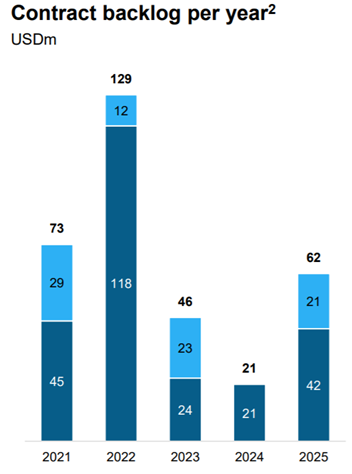
A bit of background: Cadeler installed its first wind turbine in 2010, and since 2012, the company claims to have completed over 20 wind turbine projects. The current backlog stands at USD 249 million in orders, with an additional USD 83 million in optional orders. The largest orders currently seem to be concentrated in 2022, but the situation may change considerably due to EU green investments. Below is a picture of the backlog in November 2020.
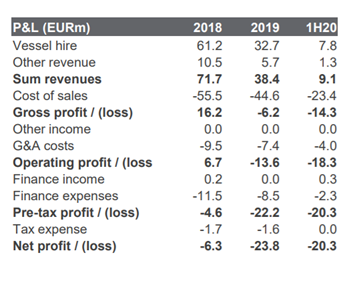
Looking at the financial figures, the company’s performance in the three previous reported years (2017-2019) was weaker than in the preceding three-year period (2014-2016), but from 2017 to 2018, the direction of EBITDA was upward. According to the company, the 2019 figures were negatively affected by one vessel being in dry dock (the vessel is simultaneously being fitted with a larger crane for future, larger wind turbines), apparently due to an accident, but I do not have more detailed information on this. Additionally, the weakening EBITDA is attributed to strengthening the organization with an eye on the future, as well as the working vessel being involved in a lower-margin project. Below is a picture of the financial figures.

image

The company currently has two vessels that are among the industry leaders in lifting height, vessel length, and depth installations (i.e., the vessels are capable of installing turbines in deeper waters than competitors). However, in terms of lifting capacity, there seem to be a couple of other vessels on the market with more lifting power than Cadeler’s vessels. According to the company, with crane upgrades, their ships will once again rank among the best. The company also plans to acquire a third vessel, which was apparently one of the reasons for its listing.

As we have all probably noticed, renewable energy is projected to have tremendous growth prospects. According to a European Commission study, offshore wind power is set to increase fivefold by 2030 and 25-fold by 2050. To achieve this goal, the study estimates that approximately 800 billion euros in investments in wind power will be required. According to the company itself, offshore wind power is expected to grow sevenfold from 2018 to 2030. Floating wind turbines will also play some part in this, but currently, they are still a relatively small component compared to offshore turbines. (Energy produced by floating turbines 40MW vs. offshore turbines 12GW). I cannot assess whether Cadeler has a role in floating turbines.
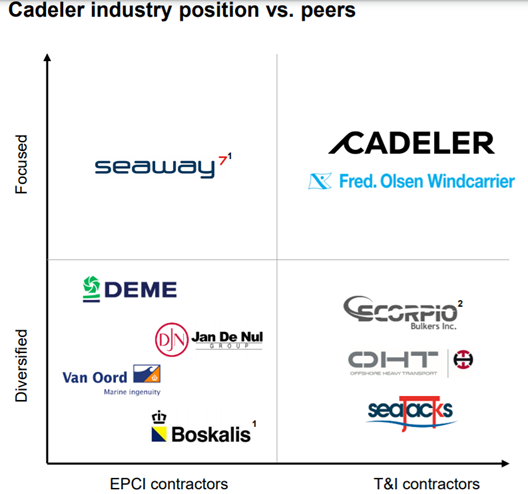
According to the company, its most direct competitor is Fred Olsen Windcarrier, but other companies have focused slightly differently. A picture of the competitive landscape according to the company’s view:
Additional material on the topic:

European Commission’s offshore wind strategy: Energy - European Commission)

Cadeler company presentation from November 2020: Chicken Road ▷ Casino Spil | Gratis Gambling & Rigtige Penge

What do you, esteemed forum members, think? Is this a potential company for the future, and what are its main challenges?

Adding the company’s website: https://www.cadeler.com/
26 Likes

Thanks for opening the thread. So far, Shareville has mainly shown Norwegians and Danes trading this, so it’s good to get more knowledge here. You can also buy Fred. Olsen Windcarrier through the stock exchange via Bonheur shares.

2 Likes

Norwegian Sparebank 1 has also started following the company with a target price of NOK 40 and a buy recommendation. “Oslo (TDN Direkt): Sparebank 1 Markets initiates coverage of the Cadeler share with a buy recommendation and a price target of NOK 40, according to an analysis on Thursday. (7.1.2021)”

2 Likes

Another new tracking with a buy recommendation and this time with a NOK 50 price target: “Oslo (TDN Direkt): Clarkson Platou Securities initiates coverage of Cadeler with a buy recommendation and a price target of NOK 50 per share.”

3 Likes

Cadeler held its own pretty well during the past weeks’ bearish market, and now we got some news.

4 Likes

If you believe in wind power, then order intake has increased and guidance has been raised.

https://finance.yahoo.com/news/cadeler-reports-strong-q3-results-070000537.html

Mister Cunha’s analysis
https://x.com/mvcinvesting/status/1875650380161593784?t=E2RbWTTr7FKxX8b9vxtmTg&s=19

3 Likes

Let’s revive this thread a bit. There have been quite interesting developments for the company over the spring:

  • Made a decision to purchase yet another new vessel from China, which, according to the company, should positively impact this year’s results. The vessel will be delivered to Cadeler in Q3/25.
  • The company bought back its own shares (for remuneration purposes) at a very opportune time. The entire program proceeded very quickly when there was temporary market turbulence related to the cancellation of the Hornsea 4 project (which is not part of the order book, but was a potential addition).
  • Today, a fund located in London reported a holding of over 5% in the company.

Once the company manages to slightly reduce its debt burden within a couple of years, I believe this will become a very good capital returner.

Additionally, sales will grow significantly as the fleet expands in the coming years (of course, there will be debt associated with these). But overall, the company is capable of such good returns that these will certainly be covered.

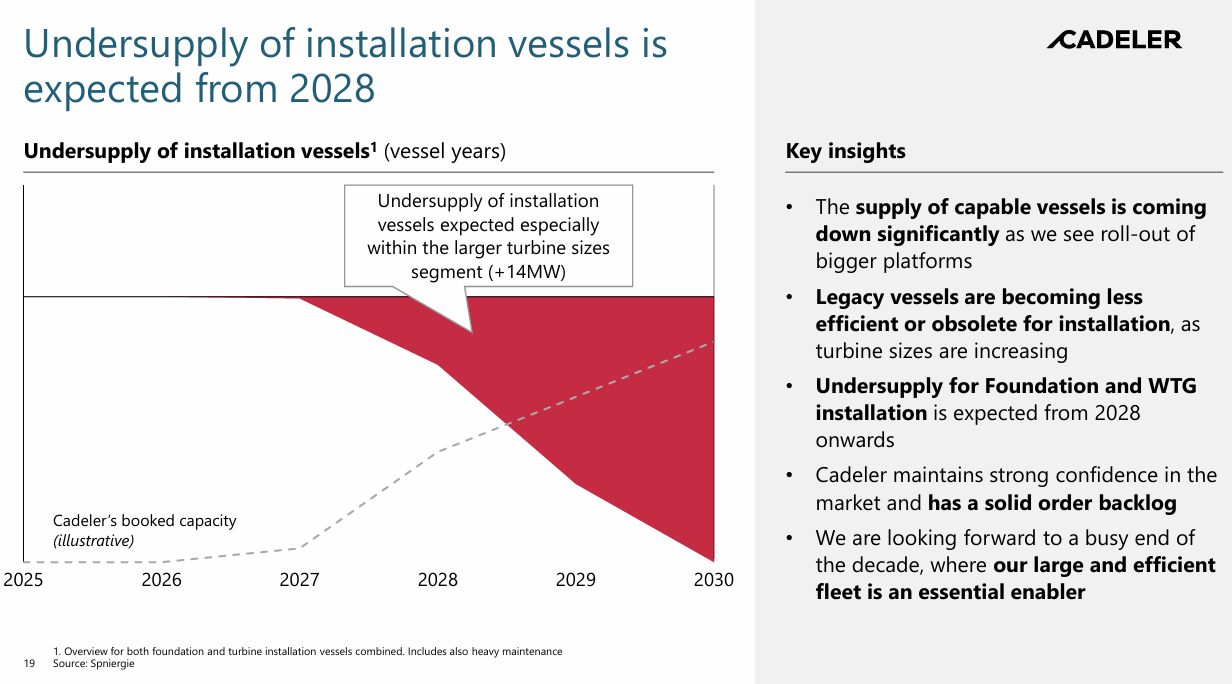
And when one also looks at the supply/demand situation for these large installation vessels, one can believe that the risks for the company are moderate:
image

That’s from the company’s website, but BRS has also highlighted the situation in this segment (i.e., there aren’t enough vessels - e.g., BRS Review 2024 pp. 134-135). Only 13 vessels capable of installing the largest wind turbines are coming to the market, and a significant portion of these are with Cadeler.

So, even though offshore wind power took a slight pause in its strong acceleration, there is still a lot of work ahead in this sector, and Cadeler will be able to take a significant share of these jobs.

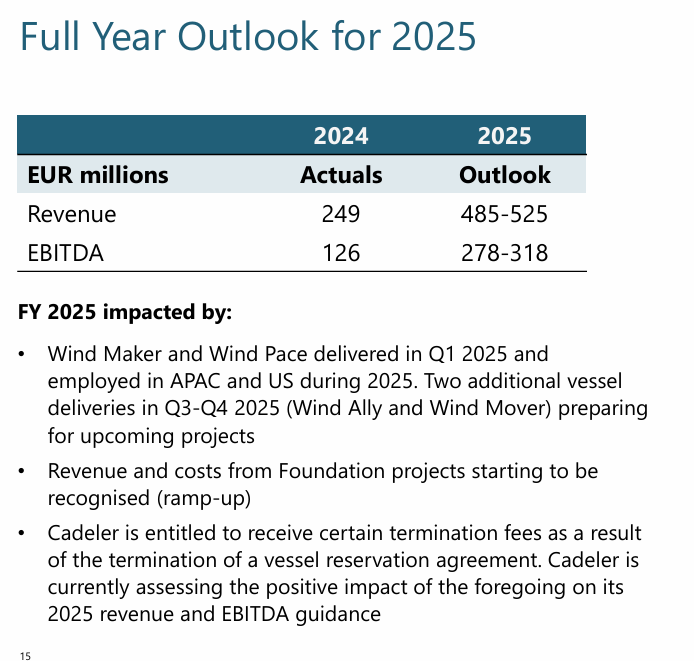
Let’s also include the company’s reported outlook for this year below (before the announcement of the new vessel).
image

8 Likes

CADLR: Cadeler takes delivery of Wind Keeper and locks down first three years of utilisation with the signing of a long-term firm contract - Inderes

So today, Cadeler has taken delivery of the vessel from China, the purchase of which they announced earlier this year. In addition, they simultaneously report that a long 3-year contract has been made with Vestas for the vessel, starting from 2026.

They previously stated that the vessel would generate sales already this year, so I assume there will be some work available somewhere within this year.

Regarding the price, they commented as follows: “a purchase price significantly below the vessel’s estimated replacement cost,” meaning they apparently bought it at a very favorable price, and since the financing is also affordable, this should be an excellent investment in this rather tight market.

By the end of the year, Wind Mover should join the fleet, followed by Wind Ace in the latter half of 2026, and the final newbuild, Wind Apex, in the first half of 2027. Then the fleet project should be complete and working on installing or maintaining wind turbines. This should largely translate into revenue and profit growth in line with already signed contracts. EPS is guided to double this year from last year, and a new doubling is predicted for 2026 (last year was somewhat incomplete as old vessels were upgraded in terms of cranes).

In August, in connection with the Q2 results, it will likely be seen to what extent Wind Keeper changes this year’s guidance, which is: “full-year revenue is expected to range between EUR 485-525 million and EBITDA is expected to range between EUR 278-318 million”.

2 Likes

Cadeler reported its Q2 results today, and the company’s growth is now starting to show, with revenue and profit growing significantly:
Revenue Q2: €233.1M (2024 Q2: €63M)
Profit Q2: €165M (2024 Q2: €20.9M)

In addition, the company raised its full-year guidance as follows:
Revenue: €588-628M (previously €485-525M)
EBITDA: €381-421M (previously €278-318M)

It is worth noting, however, that the results are also affected by the contract termination fee related to the Hornsea 4 project.

More detailed information in the press release Interim Financial Results 2025: Cadeler delivers financial performance above expectations :: Cadeler A/S (CDLR)

Of course, on Friday, news also appeared on the forum regarding Trump’s actions concerning the Revolution Wind project off the US coast (Orsted shares sink to record lows after US halts wind farm off Rhode Island | Reuters). However, it is still difficult to assess the final impacts of this, and what exactly is at stake here (assuming the intention is not to make the USA completely unsuitable for investments). In any case, Cadeler has the necessary contractual protections in place, and even if the worst were to happen, the vessel connected to the project has already been inquired about elsewhere immediately after the news broke. This perhaps partly indicates how strong the demand for these vessels is.

6 Likes

Cadeler’s Q3/2025 is out:
Q3 2025 Earnings Release: Cadeler Delivers Strong Q3 Performance With High Utilisation, Improved Earnings and Continued Fleet Expansion :: Cadeler A/S (CDLR)

9-month revenue for 2025 grew a modest 178% compared to the previous year. Of course, debt also increased as three new vessels joined the fleet this year. But the order book also continues to grow (now €2887M), so there is demand for these vessels.

Furthermore, in the Hornsea 3 project, the company’s vessels are performing the foundation installation themselves, in addition to erecting the turbines (the traditional core area).

Full-year revenue guidance remains in the range of €588-628M, with EBITDA accumulating to €381-421M. Of course, depreciation will be made on the vessels, and interest and debts will be paid, but there will still be a comfortable amount left on the bottom line – €212M for the 9-month period.

The share price has suffered a bit since October, and now the company seems to be available at a discount relative to its vessels (although NAV definition is quite vague here, as there isn’t an active market for these in that way, but it’s an affordable stock even relative to book value). But with that order book, debt repayment seems to be quite manageable, and thus the company’s outlook is very stable. In addition, service-side contracts come up occasionally as the number of parks grows, so I believe there will be work for these vessels for a very long time.

EDIT: Comments based on the investor call. Quite a lot of questions and comments revolved around the outlook for 2028, 2029, and 2030 and beyond. Some wind farm project schedules have apparently slipped a bit, and this has seemingly put pressure on this company’s future prospects as well. The company itself sees the situation as follows for the entire market and the company itself:

  • They admit that some projects have been delayed in terms of schedules, putting pressure especially on the supply/demand picture for 2028. For 2029, 2030, and beyond, the company sees the market as tight for vessels, and the company believes it can pick the best projects from its own perspective.
  • Especially concerning 2029 and 2030, the company stated that they are confident, particularly based on how their customers are willing to commit money now for those years (this is how I understood it, the exact wording was slightly different).
  • For 2028, the company does not see the situation as worrying, as there are also many projects in Asia (Japan, South Korea, and Taiwan).
  • Also, regarding the supply/demand situation, the company commented that they see the situation differently from many analysts, because projects are very diverse and not all capacity can participate in all projects. That is, especially these largest projects (they seemed to say ‘Utility scale’) must be built with a much narrower pool of vessels (essentially a shortage of these most capable vessels).
  • Also, securing contracts is not just about price; wind farm developers also carefully assess risks and supplier reliability. Here, the largest fleet brings a clear advantage, as Cadeler can better offer a clear view with its own equipment on how project completion can be ensured with their fleet.

Generally, when considering the company’s market position, this indeed does not seem to be very price-competitive, and thus the impact of small changes in project schedules on the company’s results is smaller, as it is most important for customers to get their projects completed within the agreed schedules with their clients and considering risks (for example, wind and waves can bring their own challenges).

EDIT2: It would be good if someone else also participated in the discussion about this company, as the limits on the number of consecutive messages seem to be approaching threateningly..

8 Likes

On the sea, competition is indeed not about price. I’ve been involved in offshore wind power projects. There, safety and precision come first. It’s supposed to cost a lot, and not just anyone does that kind of work. This is also reflected in Cadeler’s gross margins of over 70%, which are so high that with their current order book, I can only wonder about the current share price development (e.g., 20% better than AWS). The loans will definitely be paid off. I think that at some point, European demand will grow really large.

Even in Finland, three offshore wind projects would cover 37% of all electricity production (reference year 2023). When these will be realized, there’s no information, but one EIA has just been under review. So many data centers are coming that these offshore wind power projects will surely get moving.

4 Likes

I’ll just state that I have never spent so much time researching a company as on this one, with the end result being negative. For several hours I watched offshore wind power documentaries on YouTube, analyzed the offshore wind market, etc. In the end, I couldn’t make enough sense of offshore wind power, which at the same time sealed the decision to put the money elsewhere.

2 Likes

First of all, thank you to both @Sahti-Laine and @Avokado for participating in the discussion. I believe this will be beneficial for others as well, not just for me.

@avokado, I am at least curious to hear a bit more about how you arrived at this conclusion. I have also delved quite deeply into the entire global energy market and the forecasts from various parties related to it.

It is true that offshore wind power will not be a significant piece on a global scale, but I am at least strongly under the impression that it will still find its own niche in the overall picture. Especially when looking at things more on a local level.

And @Sahti-Laine, many might be interested in practical experiences of how these projects work and what all happens during installation. I myself followed the construction of the Moray West park quite closely to get a better understanding of how that process progresses chronologically, etc. But many details inevitably remain obscure without a direct connection to the projects. So, could one hope for a brief summary of the main phases and which work stages are particularly demanding and why? And I’m also a bit interested in what kind of margins are used with conditions during operation?

3 Likes

It took me a moment to consider if I could answer this while maintaining my anonymity. I am a geologist and have studied the foundations of future offshore wind farms before anything exists at sea. In my opinion, the demanding phases are not necessarily the installation phases, because a lot of planning, research, permit applications, etc., have been done for that. Or, based on what I’ve seen of Cadeler’s materials, a wind turbine can be completed very quickly. No wonder, if they have world-class vessels and crew.

The seabed may have too many soft layers, which prevent the economically viable installation of a wind turbine. Generally, however, the Baltic Sea is a good place to install wind turbines because the sea is shallow and windy. The seabed layers and geology can vary rapidly even over short distances. Some locations are therefore rejected, but before studies, there is no realistic understanding of this. Soundings made with different wavelengths are used as data for planning boreholes. Boreholes are used to take samples of sediment and bedrock, if the bedrock is reached at a specified depth. Other drilling methods can also be used to determine various physical properties. The outcome of these studies can even determine the profitability and feasibility of the project.

Perhaps Cadeler’s margins describe the industry well. It is dangerous at sea, and there are not many proper vessels, regardless of the work phase. Skilled seafarers are needed. I don’t know how much wind Cadeler’s vessels can withstand, but research workers quite easily head to port to spend windy days. Despite that, the margins are good.

6 Likes

Thank you!

Yes, I know these are complex and long projects. Of course, the significance of seabed geology is a new perspective for me on this matter. However, the research methods are probably somewhat similar to those used in oil exploration (seismic surveying and measurement?).

In my opinion, the margins reflect more the scarcity of bidders and certainly also the challenges. This is certainly not risk-free.

The wind and wave limits for vessels can indeed be found in the basic vessel information on the company’s website. So, I’m more wondering how to operate when approaching those limits and how close we are willing to go. On the other hand, these things are very familiar to me, i.e., how those limits are defined (methods, etc.), but all this from an office perspective and from more traditional offshore projects.

1 Like

In renewables, I believe decentralization and adjustability are important. Only water offers adjustability. Decentralization is possible with solar and onshore wind power. Offshore wind power doesn’t really have any advantages. It’s a large project that almost resembles a nuclear power plant without offering the advantages of nuclear power. Furthermore, the sector requires a lot of capital, government support, and decisions, etc.

It suits places where energy is needed, there’s no space to build on land, and solar power isn’t enough. Mainly Central Europe and the East Coast of the United States come to mind.

Offshore ventures are expensive, and even in the oil sector, half of the companies go bankrupt at the bottom of each cycle. The fear here is the same.

It doesn’t suit my portfolio, at least not now. Of course, I follow US politics, and if the winds start changing there, I might take a trade on this. In the time horizon of a retirement portfolio, there’s too big a risk that the company will be washed into the ocean’s foam.

2 Likes

In that sense, the methods can be similar to oil exploration, in that in the southern Baltic Sea or the North Sea, where the bedrock consists of young sedimentary rocks, samples can be taken as a single core regardless of whether it is sediment or bedrock. All in

2 Likes

However, offshore wind power does have some advantages. At sea, there are fewer obstacles to the wind, and thus more energy can be obtained. Of course, the higher the pole is located, the less friction affects wind speed. In many countries, however, terrain features are more challenging for wind power than at sea. This therefore means that offshore wind power produces more consistent output than onshore.

I also see regulation at sea as easier. All noise, aesthetic, etc. aspects are easier at sea.

The cost is indeed significantly higher than onshore, but I believe the newest ones will be better in this regard. Cadeler’s operating logic can also lead to lower project costs (they aim to ensure higher utilization rates for vessels).

Yes, a lot is happening on this wind power front in Asia as well. Taiwan, South Korea, and Japan, in particular, are very interesting in this respect. Japan, however, has a windier side that requires floating solutions.

I understand that if one wants safer investments, this is probably not at the top of the list. I myself clearly see this as an investment that requires more monitoring. Like many other investments related to floating capital items.

4 Likes

A slightly more topical matter for a change.

The fleet now has 10 vessels.
CADLR: Cadeler expands fleet with delivery of 10th wind turbine installation vessel, Wind Mover - Inderes

This is also the most significant reason for me to invest in Cadeler in this market, as it has the largest fleet in this market. So, one can think of this through risk diversification. As already discussed above, the risks in these are not entirely negligible. Admittedly, some competitors operate in several different sectors and thus achieve diversification, but I do believe that specialization in a specific market also brings significant benefits.

1 Like

If anyone is wondering why this (and other wind power) stock has seen a strong rise lately, here is a bit of positive news from yesterday:

European nations reinforce wind power commitment with 100 GW pledge | Reuters

The 100GW in the headline specifically concerns offshore wind power in the following countries: UK, Belgium, Denmark, France, Germany, the Netherlands, Iceland, Ireland, Luxembourg(??), and Norway. This also involves developing grids and transmission links together. So, quite significant news in my opinion, which guarantees work for Cadeler’s vessels far into the future (300GW by 2050).

4 Likes