Berkshire sold its shares with a very good profit and probably at the right time.
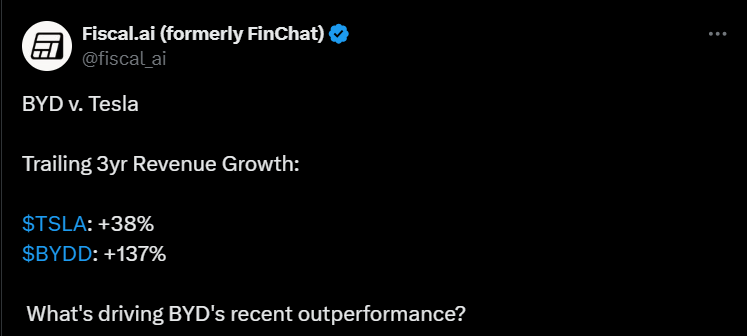
It is difficult to get reliable information about BYD’s current situation, but discussions have increasingly suggested that BYD’s period of enormous growth is over. However, the company still holds, for example, an exclusive right granted by the Central Committee to important electric vehicle minerals in Tibet.
But
BYD is reported to have reduced production at several of its factories.
The cuts have been made due to slowed car sales.
BYD’s average inventory at Chinese dealerships is 3.2 months, which is more than double the time compared to other Chinese car brands.
BYD is believed to have suspended plans to establish several new production lines.
Data from the China Association of Automobile Manufacturers has revealed that BYD’s average production in April and May 2025 was 29 percent lower than in the last quarter of 2024.
BYD was supposed to start electric car production at its Hungarian factory in October 2025. Now it seems that the start of production has been postponed by a year. Mass production of electric cars was supposed to start in Szeged, Hungary, but now there is talk of a few tens of thousands of electric cars per year. On the other hand, BYD has promised that the first BYD Dolphins will roll out of the factory in October, but this is not about mass production.
Instead, BYD has accelerated the schedule for its Turkish factory and added production lines there. This means mass production would be moving to Turkey, where labor is even cheaper.
The shift towards cheaper production in Turkey would highlight the challenge for Chinese automakers, as they want to build cars in Europe to avoid punitive tariffs but resist the region’s higher wages and energy costs.
The influence of the Chinese state is also evident in the production of Leapmotor cars brought to Europe by Stellantis. Production was indeed started at Stellantis’ Tychy factories in Poland. But production was halted because it was decided to move production to Zaragoza, Spain. The Spanish government, however, generously assisted the transfer with several hundred million. Industry insiders refer to Beijing’s quiet pressure on Chinese automakers to limit investments in countries that support the European Union’s tariff system for electric cars made in China. Poland was one of these countries, and the Polish Leapmotor project is reported to have fallen victim to a change in policy. The decision also highlights the delicate balance within Leapmotor International, a joint venture led by Stellantis. Stellantis holds a majority stake of 51%, but the influence of the Chinese partner remains evident in strategic decisions, such as the choice of production locations.
I emphasize that there are no facts, but rather speculations gathered from various sources. The hand of Beijing’s Central Committee is long.