Bufab Ab - Boring, more boring, Bufab?

Neighboring Sweden has many listed industrial quality companies that are rarely discussed in Finland. Let’s take a superficial look at Bufab, which listed on the Stockholm Stock Exchange in 2014.

Bufab supplies components and related services to the manufacturing industry, such as contract manufacturers. For example, Scanfil is one of their customers. Bufab’s “components” consist of screws, nuts, fasteners, fittings, and other low-value items and related services. Boring, right?

However, these low-value items are critical to the end product. Bufab manages the logistics for these globally and also assists the customer with, for example, internal logistics and warehousing. A customer’s problem might be, for instance, that the right components cannot be found in a messy warehouse, and Bufab helps the customer streamline these processes. From the customer’s perspective, these are not core business activities, but they ultimately improve productivity. Bufab handles the replenishment of C-parts automatically based on inventory levels, avoiding production shutdowns and manual orders.

According to Bufab, 20% of the costs of C-parts arise from the price of the C-parts themselves, and the remaining 80% from indirect costs, such as component procurement, quality, replenishments, potential production shutdowns, time, etc. On the other hand, Bufab aims to provide added value to the customer by also reducing the number of component suppliers and lowering total costs. Bufab also has solutions that provide added value to the customer, such as sub-assembly.

Some of Bufab’s products have high quality requirements; fasteners and such must withstand corrosion for decades, or parts must withstand corrosive chemicals or high temperatures. Bufab’s products are thus used widely, from Ikea furniture to aircraft. Bufab lists customers such as Saab, Safran, Sampo Rosenlew, Scania, Assa Abloy, ABB, IKEA, Metso Outotec, AbbVie, Alstom, and Bombardier.

Bufab grows both organically and through acquisitions by buying smaller local companies. Bufab’s business does not require a massive amount of capital for equipment; instead, costs can be adjusted according to demand. The customer base is diversified, and dependence on a single customer or industry is quite low. As a side note, it should be mentioned that Bufab has made a profit every year for over 40 years. Furthermore, the company’s growth has been funded by cash reserves. The outlook for organic growth remains reasonably good going forward.

Bufab’s market is highly fragmented. Bufab is well-positioned in each of its 28 countries of operation. In addition to this, Bufab supplies products to a total of 70 countries.

Bufab’s strategy is based on long-term relationships with customers and suppliers. Bufab’s financial goals include profitable growth: 10% annual revenue growth and 15% p.a. growth in earnings per share for the coming years. Regarding profitability, the goal is an EBITA margin of at least 12% by 2023 at the latest. Dividends are distributed at 30-60% of the annual result. The target for the ratio of net debt to EBITDA is between 2-3.

The most significant financial risks relate to customer demand, which is affected by general economic development and manufacturing industry activity. A dip was seen, for example, around the financial crisis in 2009 and due to COVID-19 in 2020. Large customers may deal directly with manufacturers and bypass the wholesaler (Bufab). However, Bufab provides added value that reduces this risk. Additionally, Bufab faces risks related to suppliers (price increases, legal risks, a supplier running out of stock and being unable to deliver goods on the agreed schedule, or quality deviations in products). Bufab’s suppliers are located mainly in Asia and Europe, and Bufab aims to procure components from several suppliers and is not as dependent on a single production facility.

Most of Bufab’s capital is tied up in inventory, the movement and management of which is expensive. If inventory management is inefficient, it can pose risks for impairment losses and, on the other hand, the risk of having to fill depleted inventories at any price or paying compensation to customers if components cannot be delivered on time. Bufab’s customers can also move their production to low-cost countries, and Bufab may not necessarily follow or be able to follow suit.

Bufab also grows through acquisitions. There are naturally various risks associated with the success of acquisitions.

The war between Russia and Ukraine causes some uncertainty. The Russian unit has been sold. Russia and Ukraine’s share of revenue was only about 0.5%, so the effects are mainly indirect.

Regarding balance sheet risk, it should be mentioned that Bufab has significant goodwill on its balance sheet. While this does not have direct cash flow impacts, it is good to be aware of.

Bufab is susceptible to fluctuations in raw material prices, especially steel and stainless steel. Additionally, energy and oil prices affect manufacturing and freight costs. Furthermore, Bufab is to some extent susceptible to global supply chain capacity, although it has managed quite well through recent challenges. There is a risk that Bufab may not be able to pass on increased prices to end-customer prices.

The barrier to entry for new companies is quite low, so competition may increase in the future. However, Bufab has been well-positioned and at the top of its field in its countries of operation.

Bufab also faces regulatory risks; states may impose heavy tariffs on standard parts imported from China, for example. In such cases, alternative production facilities would have to be sought elsewhere.

Risks related to IT systems. IT systems play an important role in Bufab’s efficiency, inventory management, etc.

Other risks include currency risks (mainly USD), although some are hedged.

More about risks here:

Business profitability and stock valuation:

2017 2018 2019 2020 2021 2022e
Revenue 3 201 3 786 4 348 4 756 5 878 8 458
EBITDA 347 408 517 635 855 1 092
P/E 18.9x 12.6x 19.3x 24.5x 36.3x 14.3x
EV / S 1.58x 1.17x 1.70x 1.84x 3.18x 1.44x
EV / EBITDA 14.6x 10.9x 14.3x 13.8x 21.8x 11.2x
EBIT 304 358 368 457 688 855
EBIT margin 9.50% 9.46% 8.46% 9.61% 11.7% 10.1%
ROE 15.7% 16.9% 15.1% 16.2% 23.0% 23.0%
EPS 5.61 6.79 6.75 7.95 12.3 16.4

In 2013, Bufab’s revenue was 2,031 million SEK and EPS was 3.43 SEK. In 2021, revenue was 5,867 million and EPS was 12.57 SEK. On average, revenue has grown by 14.2% per year and EPS by 17.6% per year.

During the first three quarters of 2022, revenue amounted to 6,358 million (+49%). The EBITA result grew to 748 million (526 million) and the EBITA margin was 11.8%. The adjusted EBITA operating profit was 845 million and the profit margin was 13.3%.

The rolling 12-month order intake was 7,874 million and the rolling 12-month revenue was 7,953 million. The EBITA operating profit % was 11.5%.

Operating cash flow was weak, which was due to an increase in working capital resulting from organic growth and inventory growth. Inventories grew due to slowed deliveries resulting from a strained supply chain.

In 2021, Bufab’s ROIC was (695 - 145) / 3,828.5 = 19.4% and for the rolling 12 months (918 - 171) / 5,664 = 13.2%. I could not find the taxes paid for Q4’21, so the latter might not be entirely accurate, but it should be indicative.

Earnings forecasts for the next couple of years are 8,420 million revenue for 2023 and 8,900 million revenue for 2024. Corresponding EBITDA results are 1,119 and 1,144 million. EPS forecasts are 17.0 and 19.8 SEK.

I am very much a beginner with DCF calculations, but with an 8% cost of equity (WACC) and expecting 4% annual EPS growth for the next 10 years followed by 2% per year, the DCF value would be 308 SEK, which is clearly higher than the current price of 234 SEK. However, you should check this yourself, as it is a calculation made by a novice.The company’s business looks high-quality. In my opinion, the valuation is not bad at all considering the favorable outlook and the quality of the company. I also believe the company falls into the “value creator” category, and the intention is to hold it in my portfolio for the long term.

Hopefully, this sparks at least some discussion.
38 Likes

Slow-moving and large inventories traditionally burden the industry.
In practice, products almost always have to be bought directly from manufacturers because of price, as purchase batches are usually quite large.

The manufacturer network is very extensive because manufacturers often focus on a narrow range, and then there are various materials and coatings, etc.

Import duties from the Far East have complicated and somewhat changed sourcing channels, and passing price increases on to customers has consequently also been challenging.

Customer relationships are often long-term, which provides continuity to the business.

In Finland, the industry is not very fragmented; in practice, Bufab has 3-4 significant competitors.
In my opinion, they have a competitive advantage in a clearly broader product portfolio, which is emphasized as industrial customers continue to want to centralize their procurement to a smaller pool of suppliers.

5 Likes

Thanks!
On DI’s pages, it shows (the table does not include 2022 interim reports) that the equity ratio has at times been over 40%, and for the past couple of years, it has been below that. In the current year, the Q3 equity ratio has dropped to 30%. I wonder how much debt Bufab has and how debt costs will evolve in 2023 and 2024?

For 2022, some quarterly series are visible. It seems earnings are coming in at over a krona more compared to a year ago for every quarter, or alternatively 25% growth (if I happened to read those columns correctly). Debt has increased by about 3,000 MSEK and was about 9.5 billion SEK in Q3. (Doesn’t the word skulder refer to debt?)

Let’s do a cautious mental math exercise. Interest rate levels have risen by a few percentage points. A one-percentage-point increase on 6 billion SEK means 60 MSEK in additional costs. Let’s guess it rises by 2 percentage points. Let’s also guess that the approx. 3 billion SEK is bond-financed and the cost is 10%. That results in an annual cost of 300 MSEK. In total, interest expenses would therefore rise by 420 MSEK.

This would eat a significant chunk of the profit in 2023. The guesses above are probably a bit on the gloomy side and not realistic (all loans are unlikely to roll over to more expensive ones in 2023, for example).

1 Like

Is that really a significant disadvantage for Bufab?

Bufab’s range covers over 140,000 products, but are there any critical gaps there?

Can you say whether Bufab’s (Finnish) competitors offer “value-added services” like Bufab does, or is their advantage a better product mix?

1 Like

Bufab’s stock range in Finland is nowhere near that level; I am not familiar with the situation in Sweden, but they clearly have a stronger market position there.

Competitors offer at least the same level of value-added services, so it is not a competitive advantage for Bufab, at least in Finland. I do not want to name those competitors “publicly” here.

As I understand it, this is also one reason why revenue in Finland has not developed in recent years. Finland is, of course, just one small part of Bufab, and I cannot assess its significance when considering investing in the company.

The product range is of very high importance for customers in the equipment manufacturer segment when choosing suppliers.

4 Likes

Bufab has slightly more net debt this time than its target level. At the end of September, net debt stood at 3,276 million and the debt/equity ratio was 131%. Net debt/EBITDA was 3.4, while the target is 2-3. Last year, acquisitions were made that were financed with debt, and there was also a setback from currencies.

Q3 interest expenses were 36 million compared to 8 million a year ago. On the other hand, debt also grew from 1,807 to 3,752 million. If you calculate roughly from that, the average interest rate on loans during the quarter would have been approximately 3.8%. That is, quarterly interest expenses / net debt x 4.

Rising interest rates affect the net result, but in my opinion, the picture is not quite as bleak as you interpret. This is an exercise for me as well, but I thought I’d dump my thoughts into written form in this opening post. Of course, someone more knowledgeable can correct me if I’m wrong.

3 Likes

Growth has been so strong that a significant amount of capital has been tied up in inventory. Of course, the component shortage etc. has also played a role in inventory levels being kept a bit higher. These will level out in due time, and debt levels will return to target levels.

A great and simple business, yet so very difficult for other companies. As the business grows, cost-efficiency, logistics, and negotiating power on the procurement side improve continuously. Acquisitions have worked brilliantly, and integration has been easy. Suddenly, a small local player gains the advantages of a large firm and gets direct access to strong synergies.

I expect this will continue its steady performance. If I remember correctly, I think I bought for the first time in 2015 or 2016 and have been adding to my position occasionally since then.

8 Likes

Bufab’s “US peer” released a quite decent Q4 and FY2022 result today:

https://investor.fastenal.com/news-releases/news-details/2023/Fastenal-Company-Reports-2022-Annual-and-Fourth-Quarter-Earnings/default.aspx

There wasn’t a thread for Fastenal, but I thought I’d share it in this thread. I have both in my portfolio. I finally snagged some Bufab at the end of last year, aiming for better company-specific diversification.

Fastenal’s full-year revenue grew 16% ($7B) and EPS 18% ($1.89). The dividend was also raised from 0.31 → 0.35 per quarter (+13%), and the current price of $47 offers, for the first time in a long while, almost exactly a 3% dividend yield. The price is very close to my own target for adding to the position.

Bufab looks perhaps more clearly attractively priced, and one could certainly invest more in it. Especially if the strong growth of over 10% continues and profitability could be nudged up toward Fastenal’s 15% net margin level.

8 Likes

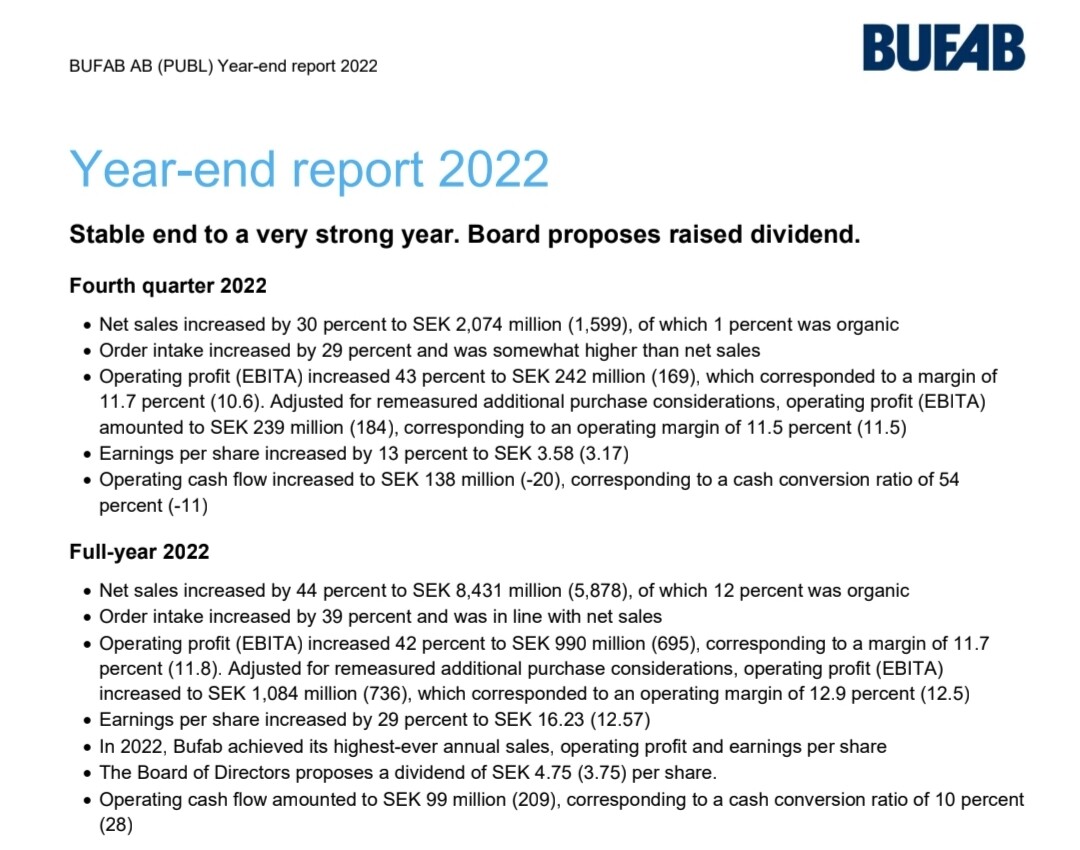
Stable end to a very strong year. Board proposes raised dividend. Fourth quarter 2022

  •  Net sales increased by 30 percent to SEK 2,074 million (1,599), of which 1 percent was organic
  •  Order intake increased by 29 percent and was somewhat higher than net sales
  •  Operating profit (EBITA) increased 43 percent to SEK 242 million (169), which corresponded to a margin of11.7 percent (10.6). Adjusted for remeasured additional purchase considerations, operating profit (EBITA)amounted to SEK 239 million (184), corresponding to an operating margin of 11.5 percent (11.5)
  •  Earnings per share increased by 13 percent to SEK 3.58 (3.17)
  •  Operating cash flow increased to SEK 138 million (-20), corresponding to a cash conversion ratio of 54percent (-11)

Ei oikeastaan hirveästi yllätyksiä, kuten ei tässä ole normaalistikaan. Hieman pehmeähkö viime kvartaaliin nähden asiakkaiden luultavammin purkaessa inventaarioita, joka ilmenee ajoittaisena pumppaamisefektinä. Täytetään ekstraa ja myöhemmin puretaan. Alkuvuodesta hieman piristynyt heikkoon joulukuuhun nähden

5 Likes

The dividend was raised from 3.75 to 4.75, which is in the same proportion as the FY22 EPS growth, approx. 30%. Pretty nice.

Looking at the full year, revenue grew significantly (44%), but organic growth accounted for only 1%. Bufab attributed this to customer inventory management, as you mentioned.

Debt is starting to be quite high (99 SEK per share), and based on the CFO’s presentation, the focus over the coming years will be on integrating acquisitions, achieving synergies, debt repayment, and improving cash flow. I like this, especially in the current situation!

Valuation still seems quite reasonable. The FY23 EPS consensus is 16.76 SEK, giving a P/E of 16.3 and an EV/E of about 22. Due to the high level of debt, I would prefer to increase my position only at a price below 235 SEK.

3 Likes

To be precise, organic growth for the last quarter was that one percent. For the full year, it was 12 percent.

Cash flow should improve significantly if growth levels off. It might be enough to get inventory levels to a lower level as the component shortage etc. eases.

3 Likes

Oops, I grabbed the wrong number from memory. I just noticed that organic was clearly lower than total growth, but still positive.

1 Like

Q4 interest expenses were 47 MSEK and 117 MSEK for the full year. Q3 interest expenses were 36 MSEK, so there was an increase compared to that as well.

If Q4 interest expenses are annualized, the full-year interest would be 188 MSEK, but I suspect interest expenses will grow to the 200-220 MSEK range this year, which is already about 5 SEK per share. Not a critically high level yet, but it clearly affects the bottom line already. The rise in interest rates is likely not fully reflected in the financing costs yet.

From the Q3 level, the amount of interest-bearing debt decreased slightly from 3,276 MSEK → 3,173 MSEK. If calculated based on that Q4 average interest cost annualized, the interest paid on debt would be 5.925%. That might be a somewhat simplistic calculation, but it should give a reasonable picture of the prevailing interest rate level.

Money is clearly starting to have its price, so it’s certainly sensible to digest the debt load a bit. The company’s reported net debt/EBITDA is 3.2 (Q3 3.4) and remains slightly above the target.

This year’s guidance (though no numerical guidance was given) reflects uncertainty. I don’t really believe that earnings will increase this year; rather, they might stay at last year’s level or be slightly lower due to higher financing costs.

The current valuation level is starting to reach the pain threshold again, so the negative reaction to the annual report was, in my opinion, quite justified. At a slightly lower level (somewhere around 230 SEK or below), I might even add to my position.

2 Likes

The company generated approximately 900 million crowns in free cash flow before changes in working capital last year. It’s hard to say how the demand situation will evolve, but if market demand softens and inventories can be reduced, debt could easily be paid down by over a billion crowns during the current year.

After all, that money has a price. Perhaps this will also be reflected in the prices of acquisition targets, so there will be some compensation through that route.

2 Likes

More detailed information on interest and debt is not yet available as this was a year-end report, not the actual annual report.

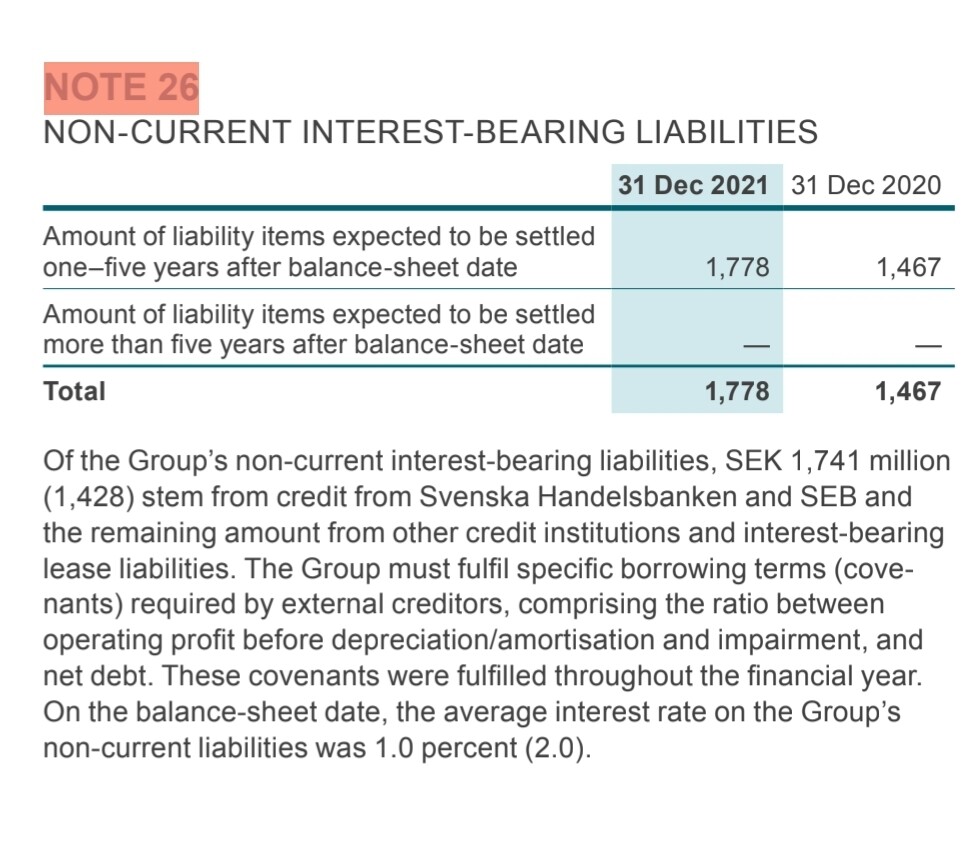
For the year 2021, the following information was found:

The interest rate on long-term debt was 1%, but the debt is relatively short-term, and refinancing has been carried out to fund last year’s acquisitions. I wonder when the annual report is expected to be released?

2 Likes

It’s still not clear from that whether the interest rate is fixed or floating. I assume the latter.

Tuossa vielä Q4 presentaatio:

A few highlights:

Outlook
– Given the geopolitical and macroeconomic situation, there is big uncertainty ahead of 2023
– A higher level of caution noted among customers in certain segments
– During the end of 2022, we have prepared our operations for potentially more difficult times and subsequently lower demand. We have a well-diversified
customer- and article portfolio, with a good diversification of risk in various industries

Short term Priorities
– Continue taking market share
– Protect margins, secure cash-flows and reduce debt
– Continuing working on efficiency improvements, development of our operations (productivity, digitalization etc) and NWC

Last year, the annual report was published in July, so it’s unlikely to come out this year before the snow melts.

Inventories have on average been at a level about a third higher than annual revenue (one could probably use some other calculation method for that as well). By that metric, approximately 800 million crowns of capital would be released.

During the Covid year, Debt/EBITDA almost halved, so those will certainly come down quickly as well.

That’s very true. Perhaps the interest cost I estimated above for this year is overly pessimistic, as the debt burden will presumably shrink by as much as hundreds of millions this year.

First quarter of 2023

  • Net sales increased by 19 percent to SEK 2,386 million (2,002).
    Organic growth was 0 percent and order intake was somewhat lower than net sales
  • Operating profit (EBITA) increased by 33 percent to SEK 323 million (243) and the operating margin was 13.5 percent (12.1). Adjusted for items affecting comparability related to the closure of the Russian operations of SEK 0 million (-15), remeasured additional purchase considerations of SEK -2 million (-15) and acquisition costs of SEK 0 million (-8), operating profit increased by 16 percent to SEK 325 million (281), corresponding to an adjusted operating margin of 13.6 percent (14.0)
  • Earnings per share increased by 21 percent to SEK 5.33 (4.42)
  • Operating cash flow amounted to SEK 336 million (-22), corresponding to a cash conversion ratio of 99 percent (-8)
  • Bufab once again achieved its highest ever sales, operating profit and earnings per share for a single quarter
8 Likes

Went quite well. Net Debt/EBITDA is coming down fast.

5 Likes