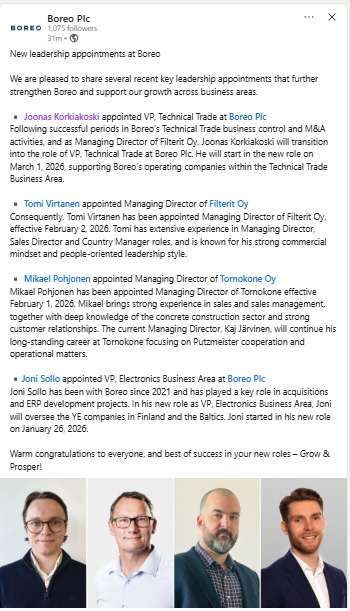
Leadership changes at Boreo. Although the group’s top brass are changing now, fortunately, there are more familiar names at the lower level, and the business area heads are staying the same. Former Inderes analyst Joonas Korkiakoski is advancing in his career at Boreo 
18 Likes
The weekend before next Friday’s interim report, and my own subjective thoughts below.
- According to the latest reported quarter:
- revenue €146m (R12)
- €7.3m operational EBIT
- 23 companies
- In the rearview mirror, strong growth and a market rollercoaster
- 2019-2022, rapid growth phase
- 2023-2024, challenges (Ukraine, Finnish economy)
- 2025, back to growth
- After the market dip, four consecutive quarters of growth are already behind us
4. The business model has proven its functionality both in the general market (=Boreo’s peer companies in Sweden) and under Preato’s ownership (=Consivo)
- In next week’s financial statements, the following are of interest:
-continuation of organic growth
-growth opportunities for Milcon, Delfin, Signal Solutions, and Filterit
-performance and outlook of the RS businesses acquired in 2025
- On the strategic side, hopefully we will hear something in the financial statements or the review about the status/continuation of the previously announced 2026 portfolio review.
Boreo has implemented its strategy quite exemplarily over the long term; below are the strategic targets compared to the 5-year average 2020-2024:
-EBIT growth/year: target 15%, realized 26%
-ROCE: target 15%, realized 10%
-net debt: target 2-3x, realized 2.5x net debt/EBITDA
And since that is the case, it would be worth considering measuring these parameters over a longer period than annually.
4 Likes
I share similar expectations with Justus above, especially regarding the portfolio review. It has already been two years since the updated strategy was released. Nothing concrete has happened in that regard other than the Machinery demerger (autumn 2024). As a shareholder, I am waiting for some moves to be made so that we can head toward the next steps.
Here are Olli’s preview comments as Boreo reports its Q4 results on Friday, Feb 13. 
We expect the company’s revenue to have grown significantly from the comparison period, supported by acquisitions and improved organic demand. We also forecast the operating result to have strengthened alongside volume growth, although integration costs and development investments are hindering the full realization of operating leverage. Boreo does not typically provide short-term numerical guidance, so in the report, our attention will be focused particularly on the development of order books and comments on the market situation for 2026. No dividend is expected for investors as leverage remains high.
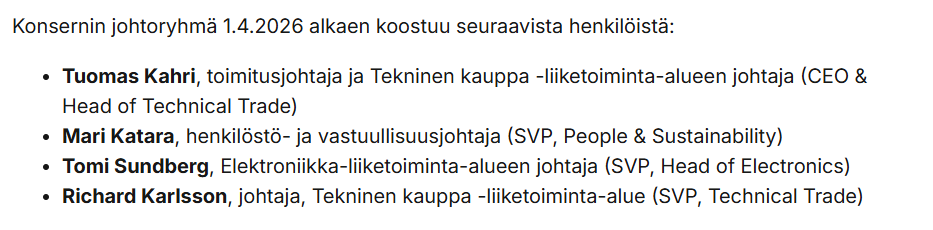
Why is Kahri also responsible for technical trade if the business area still has its own director, Richard Karlsson? Or is Karlsson now only a director in some sub-area of technical trade?
“In addition to the duties of CEO, Kahri is responsible for the Technical Trade business area.”
2 Likes
Yesterday, an update was also released regarding the continuation of the company’s CFO role. For the time being, the role will be split into two parts: M&A / Financing and financial reporting. Rafael Osmanov, who apparently leads a private equity firm called Helix Partners, has been appointed as M&A Director. Rafael has over 15 years of experience in M&A etc. Sami Hanerva was found from within Boreo for the reporting side.
From an investor’s perspective, this looks a bit messy at the moment, but I think the new CEO wants to have a say in the selection of the new CFO in the future. This is perhaps why the change was announced as a temporary solution.
5 Likes
Information about Boreo’s Delfin has been relatively scarce, so I did a little analysis using AI for my own amusement. The AI dug up some quite interesting points, especially regarding market position, the technical competitive landscape, and competitiveness. Below is a summary:
Delfin Technologies has high growth potential as a key player in the specialized skin measurement instruments market. The company is positioned at the intersection of several rapidly expanding sectors:
Competitiveness:
-
Core Competitiveness: Delfin is recognized as a significant market share holder alongside industry leaders like Cortex Technology and Courage + Khazaka.
-
Scientific Validation: Their devices are used in peer-reviewed research, making them essential for claims substantiation in the cosmetics R&D sector.
-
Global Reach: With a presence in over 40–60 countries and a strong focus on North America, Europe, and Asia, Delfin is well-integrated into the most lucrative regional markets.
Delfin’s product portfolio aligns with the fastest-growing niches in dermatology and aesthetics.
Market Share:
Delfin Technologies is a significant player in the specialized skin measurement instruments market, which is characterized by a high concentration of established European and North American companies.
- Market Share: As of 2025, Delfin Technologies holds an estimated 11.5% of the global skin measurement instruments market.
Technical Specification Comparisons
Delfin’s competitive advantage lies in its closed-chamber technology and portability, whereas competitors often prioritize high-precision open-chamber systems or integrated laboratory workstations.
1. TEWL (Transepidermal Water Loss) Measurement
Comparing the Delfin VapoMeter against the Courage + Khazaka Tewameter:
-
Measurement Principle: Delfin uses a closed-chamber method, which is less sensitive to ambient air currents and allows for measurements in any orientation (e.g., vertical or upside down). The Tewameter uses an open-chamber gradient method, which is the historical “gold standard” but requires a strictly controlled environment.
-
Sensitivity: Research indicates the Tewameter can detect smaller incremental differences in low water-loss levels, while the VapoMeter is faster and more consistent across varied environments.
2. Skin Hydration
Comparing the Delfin MoistureMeterSC against the Courage + Khazaka Corneometer:
-
Sensitivity: The MoistureMeterSC often shows a three times larger relative range of readings than the Corneometer, making it more sensitive to subtle differences in glycerin effects or individual variations.
-
Interference: Delfin’s capacitive principle is largely insensitive to salt and electrolytes in topical formulations, whereas the Corneometer may be more affected by salt concentration.
-
Depth: Delfin offers unique depth-specific probes (0.5 mm to 5.0 mm) through their MoistureMeterD line, allowing for measurements beyond the stratum corneum into the dermis and subcutis—a feature competitors rarely match in a handheld format.
3. Portability and Software
-
Form Factor: Delfin devices are typically fully wireless and handheld. Competitors like Cortex (DermaLab) often use a central PC-based “main unit” that probes plug into, though they have recently introduced more portable options.
-
Integration: Delfin’s DMC Software allows for modularity, where data from multiple different types of probes (hydration, TEWL, color) are synchronized into a single research database.
Global Skin Measurement Instruments Market Share (2026)
Cortex technology 26,10%
Canfield scientific 18,08%
Courage + Khazaka 16,40%
Delfin technologies 11,50%
Biox systems 7,90%
Others 19,30
2 Likes
Oleee!!! Finally a proper beat on estimates and strong performance. Just celebrating the result for now, more detailed comments later. Great job Kari and the rest!
With a report like this, it’s a pleasure to pass the baton @Rosskopf. Good luck going forward!
15 Likes
Yes, a truly breathtaking turnaround report.
Boreo Plc, FINANCIAL STATEMENT RELEASE 1 Jan – 31 Dec 2025
13 Feb 2026 at 9:00 AM
A strong finish to the year
October–December 2025
-
Net sales increased by 18% to EUR 46.3 million (2024: 39.2). Organic growth was 12%.
-
Operational EBIT increased by 33% to EUR 2.8 million (2024: 2.1) and was 6.0% of net sales (2024: 5.3%).
-
Operating profit (EBIT) increased to EUR 2.1 million (2024: 1.7).
-
Net cash flow from operating activities was EUR 5.6 million (2024: 7.1).
-
Earnings per share (EPS) increased and was EUR 0.35 (2024: 0.13).
January–December 2025
-
Net sales increased by 14% to EUR 153.3 million (2024: 134.0). Organic growth was 11%.
-
Operational EBIT increased by 17% to EUR 8.0 million (2024: 6.8) and was 5.2% of net sales (2024: 5.1%).
-
Operating profit (EBIT) rose to EUR 6.7 million (2024: 4.1).
-
Net cash flow from operating activities was EUR 7.5 million (2024: 12.0).
-
Earnings per share (EPS) rose significantly and was EUR 0.72 (2024: -0.30).
Order books continued to strengthen
The order books of our companies strengthened from the previous quarter and are clearly higher than the level at the beginning of 2025. Although the economic cycle, especially in Finland and the Baltic countries, is expected to remain modest in 2026, the prerequisites for earnings improvement are good.
Due to the order book’s higher-than-normal weighting toward the end of 2026, as well as system projects weighted toward the beginning of the year, we expect the company’s performance to improve toward the end of the year.
PS: Inderes was completely off with their forecasting, again. It is quite unfortunate if the analysis just follows the general sentiment in Finland, and the company-specific turnaround is missed even though there were already 4 quarters of growth before this and all economic forecasts from banks and forecasting institutes had already turned.
3 Likes
Well, we weren’t completely off the mark
Strong growth was predicted, as was growth in operating profit, and the target price was quite a bit higher than the share price! The company’s technical trade exceeded sales expectations, which then translated into the result with good leverage! This is certainly worth analyzing now.
| Forecast table | Q4’24 | Q4’25 | Q4’25e | Q4’25e | Consensus | Difference (%) | |||
|---|---|---|---|---|---|---|---|---|---|
| MEUR / EUR | Comparison | Actual | Inderes | Consensus | Lowest | Highest | Act. vs. Inderes | ||
| Revenue | 39.2 | 46.3 | 43.2 | 7 % | |||||
| Operating profit (adj.) | 2.1 | 2.8 | 2.3 | 23 % | |||||
| Operating profit | 1.7 | 2.1 | 1.6 | 33 % | |||||
| EPS (adj.) | 0.25 | 0.35 | 0.26 | 36 % | |||||
| Dividend/share | 0.00 | 0.00 | 0.00 | ||||||
| Revenue growth % | 5.7 % | 18.1 % | 10.1 % | 8 %-points | |||||
| Operating profit % (adj.) | 5.3 % | 6.0 % | 5.3 % | 0.8 %-points | |||||
| Source: Inderes |
18 Likes
What a pleasant surprise. The changes in key personnel caused some uncertainty for me, but fortunately, it was for nothing. It’s also good that no dividend is being paid; now it’s time to strengthen the balance sheet and execute the strategy. The core concept of this company is solid. The most pleasant surprise of the earnings season so far.
8 Likes
In my opinion, Olli has actually been quite well on top of things. Predicting exact numbers is naturally difficult, but after watching all the content/interviews Olli produced during the winter, the insight/content has been correct. Sometimes the numbers just surprise you one way or another. The stock price decline has mostly been due to uncertainty regarding management turnover, and the same uncertainty naturally applies to the analysis, which is why it was probably difficult to take a stronger stance as the share price fell.
15 Likes
Usually, when management changes as completely as this, the figures don’t tend to surprise on the upside, but this is certainly a good position for the new management to build from. You can post questions here for Kari’s final interview or go ask them yourself in the webcast starting at 11:00! Boreo, Webcast, Q4'25 - Inderes
15 Likes
@Olli_Vilppo, could you ask what is behind Kahri taking responsibility for Technical Trade and what Karlsson’s role will be going forward?
Edit: Kari actually just clarified this in the webcast – responsibility is now being shared more, and Kahri will share the Technical Trade segment together with Karlsson.
3 Likes
That operational EBIT was indeed at a surprisingly strong level, especially considering that SSN’s result was exceptionally robust in the comparison period. Furthermore, knowing that the metal industry and other industries are just starting to gain growth momentum while construction is still at rock bottom, the potential for earnings growth is significant this year. On top of this, the major restructuring of Delfiini has been completed, and we can expect the profit level there to improve towards the end of the year, creating a quite favorable outlook for this year. All of this translates to the bottom line with good leverage, given the strong debt leverage.
Financing costs were also more moderate than Olli’s expectations, which resulted in a significant beat in earnings per share.
8 Likes
Here’s Kari’s interview!
11 Likes
I asked AI a bit about what kind of reception Fronius’s Velocity has received:
The user reception of the Fronius Velocity Assistant (Velo), introduced in late 2025, has been highly positive, with early reports from testers and industry experts highlighting it as a significant innovation in manual MIG/MAG welding. It is described as a “game changer” that bridges the gap between manual welding and automation, particularly for long seams and consistent, high-quality results.
Pronius has a good video at the link:
https://www.linkedin.com/company/pronius-oy/posts/?feedView=all
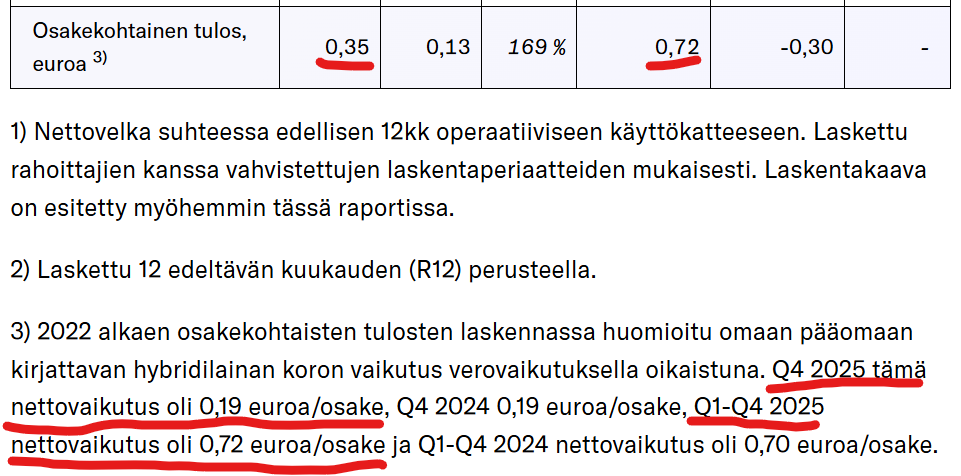
A question regarding that hybrid: Above is a picture from the financial statements. Am I understanding correctly that the interest on the hybrid is eating up a massive amount of the earnings per share at the moment? If we imagine a situation where the hybrid didn’t exist and the earnings level was the same as now, would the total earnings per share for 2025 be twice as large (i.e., the net effect of the hybrid interest would be added to the realized earnings per share)?
Can an analyst or a forum member answer this?
AI or Artificial Intelligence assessment:
If this hybrid loan were converted (refinanced) at a typical bank loan interest rate:
-
Annual interest expense for the hybrid: €20m x 10.75% = €2.15m
-
-
If the bank loan interest rate were, e.g., 5%: The financing cost would be approx. €1.0m, resulting in savings of approx. €1.15 million per year.
-
The EPS impact of that €1.15m is (1.15/2.7m shares) approximately 42 cents per share.
-
and my own comment: there are opportunities here to lower financing costs as the general interest rate level has fallen: Boreo has the chance to either obtain a new hybrid at a lower interest rate or increase the share of bank loans in the loan portfolio (by renegotiating covenant terms). In other words, the drop in interest rates works in favor of the Boreo investor now, as the company has returned to a growth path after the challenges of 2023-2024. So, falling interest rates will certainly benefit investors in one way or another when the hybrid is renewed.
-
1 Like
I hadn’t noticed this myself either. 2025 result 3.9 and 2.7 million shares = EPS €1.44. Apparently, the adjustment for the impact of hybrid bond interest on the reported EPS is made after this, resulting in the reported 0.72. Good this way; I had thought that hybrid interest was ‘profit distribution’, i.e., separate from these key figures.
Or are there other interpretations?