Aspo - Diversified Company

It looks like the CEO is now scooping up shares a bit more aggressively.. ESL will probably be sold off soon and we’ll focus on Telko..

11 Likes

Jussi Halme has made a pretty good video about Aspo. :slight_smile:

When a nearly hundred-year-old listed company decides to split itself into two parts, investors should take note. Aspo is not just any diversified conglomerate – it is a company that has navigated through history, crises, and strategic turns, and now wants to tell a clearer story to the market.

In this video, I delve into Aspo’s Q3 results, which may not have been headline-grabbing, but reveal something essential: the company is preparing to build two of its segments, Telko and ESL Shipping, into potentially independent listed companies.

I go through Aspo’s third-quarter figures, assess the performance of the segments, and explain why this split could be exactly the right move – or why the market might never fully value it.

What does this mean for investors? Is the conglomerate discount finally breaking? And what risks are associated with the separation?

4 Likes

Aspo’s Rolf Jansson was presenting their company as an investment target at the Sijoittaja 2025 event. :slight_smile:

2 Likes

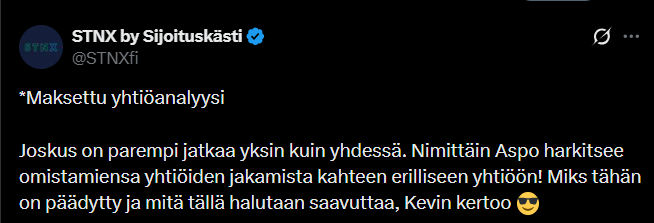
Sijoituskästi has made a 2.5-minute video about Aspo and its “demerger” :slight_smile:

https://x.com/STNXfi/status/1996969391657718215
image
image

Link for non-X users:

https://twitter-thread.com/t/1996969391657718215

3 Likes

I added more Aspo today and thought I’d share my thoughts on the stock here, as this thread has been so quiet.

What I like most about the company is that its management clearly cares about shareholder value and strives to choose deliberate actions that maximize investor returns in the long term. Management is also somewhat in the same boat as the investor, as all members of the management team (incl. the CEOs of Telko and ESL) own shares. You would think this is a given, but unfortunately, in the Helsinki Stock Exchange, it isn’t always the case for some reason.

Management has significantly increased their holdings in the company in the wake of the demerger news. During the latter part of the year, we’ve seen these purchases shared in this thread (date according to the notification):

  • 21.11. Mikael Laine (Board member) 10,000 shares (previous holding 10,000 shares)
  • 13.11. Kaarina Ståhlberg (Board member) 4,000 shares (previously 0 shares)
  • 7.11. Mikko Pasanen (CEO of Telko) 10,376 shares (previously 50,624 shares)
  • 7.11. Rolf Jansson (CEO of Aspo) 23,200 shares (previously 76,800 shares)

Now with the demerger at hand, the company’s investment thesis is primarily about unlocking hidden value. As a conglomerate, Aspo’s stock still seems to have a conglomerate discount, although in my opinion, the demerger news has already reduced this. If Telko and ESL Shipping are separated, the true value of these operations will likely be better reflected in the share price.

Insiders don’t seem to have paid much attention to Kasper’s target price. If the stock is good enough for insiders at November’s higher levels (€6.7–6.8), then why wouldn’t it be for me too. The company itself also seems to believe in the demerger to such an extent that they have even commissioned an analysis from Sijoituskästi.

Personally, I see the biggest risk as ESL Shipping being sold off at an undervalued price (cf. Tieto’s Tech Services divestment). However, management’s track record in transactions is good, and CEO Jansson has communicated that the change is specifically intended to maximize shareholder value, which is also why both a sale and a listing of ESL Shipping are on the table.

ESL Shipping is currently in a good position. It has recently received several new low-emission vessels (making them competitive in a changing regulatory environment). The company is in good shape, and a new owner wouldn’t need to make significant changes to see returns. Therefore, I see no reason why ESL Shipping wouldn’t fetch a good price if sold, and on the other hand, there’s no forced sale as listing is an alternative.

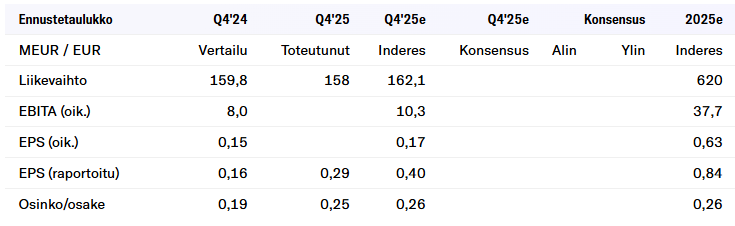
Finally, I should say that, in my opinion, Aspo’s multiples are also reasonably priced, even though both Telko and ESL Shipping are suffering from a weak cycle. Based on next year’s figures, the adjusted P/E is 11.1 (unadjusted P/E 6.2), P/B 1.2, and EV/EBIT 10.8 (Inderes). Strengthening industrial activity next year could improve the companies’ performance. On the other hand, interest from foreign investors could boost valuation levels (Aspo itself states on its website that over 99% of shares are under Finnish ownership).

For these aforementioned reasons, I’m personally in on the stock and following the story. Feel free to challenge me, and I’d love to hear others’ thoughts as well :slightly_smiling_face:

20 Likes

Kassu has been proactive on New Year’s Eve and produced a new company report on Aspo. :slight_smile:

In our view, Aspo is well-positioned for an eventual pickup in industrial demand, in addition to which the upcoming structural reorganization offers an interesting special situation. We are raising our target price for Aspo to EUR 7.8 (prev. EUR 6.8), which reflects our view of the value of the businesses as separate entities. The moderate valuation offers a strong expected return, so we are also upgrading our recommendation to Buy (prev. Accumulate).

8 Likes

This demerger is quite an interesting case, and many positive drivers have been well highlighted here.

However, there are still a fair number of question marks. As Kasper mused in some video, the parent company is in debt, and does the distribution of those funds threaten to eat into Telko’s acquisitions? Additionally, I am wondering where the added value arises in the demerger, besides savings in corporate costs? The valuation levels of two different companies will be clearer to understand after this, but does it actually bring added value? What are the other concrete benefits? Any potential undervaluation might not necessarily be corrected very quickly, and before that, both companies must perform according to expectations.

Moving on to valuations, @Kasper_Mellas, could you elaborate on these? When Varma and OP got involved with ELS a couple of years ago, its value was calculated at 300 million. In that same video, you commented that the valuation was quite high and that ELS is unlikely to reach such a level as a listed company. How do you see ELS’s value now as a separate listed company? And if ELS were to be sold, could one then assume the price would be better?

What about Telko’s valuation as a separate company? OP’s conservative estimate was 200 million. I couldn’t find a corresponding estimate on Inderes’ website, but could you also comment on Telko’s value?

And has there been any talk with Aspo regarding the 2026 dividend distribution? Does it make sense to pay a dividend, considering the parent company’s indebtedness, the demerger plans, and Telko’s growth plans?

4 Likes

I don’t see this as a major problem anymore, as the sale of Leipurin clearly strengthens the balance sheet. In principle, ESL finances its own operations, so according to comments from Aspo’s management, the remaining debts and assets would go to Telko in the event of a potential demerger.

This is a very relevant question. In addition to group costs, concrete benefits can come from more flexible capital allocation, as segments will no longer have to compete for capital in the future. Previously, major policy decisions were made at the parent company level. However, it is true that the closing of any potential valuation gap may take time, especially for ESL, as current investment programs will only be completed during 2028, and their impact on results will be visible from 2029. Nevertheless, a clearer reporting structure, strategy, and a more suitable shareholder base are factors that, in my estimation, should fundamentally have a positive impact on the business’s share price.

In the sum-of-the-parts (SOTP) analysis of the latest report, ESL’s enterprise value is 250 MEUR and Telko’s is about 220 MEUR. These are based on estimates as separate listed companies. If ESL were sold outside the group, the value would likely be higher (it makes no sense to sell for less). The key questions are 1) ESL’s normalized earnings power and 2) the required rate of return for the business. Of these, the required return specifically can swing the value significantly if a buyer views ESL more as an infrastructure investment and is thus ready to accept a lower return requirement than the stock market. Of course, there is also considerable uncertainty in estimating earnings levels, as there is with forecasts in general.

Aspo’s policy is still to distribute at most 50% of the net profit for the financial year. According to my own forecasts (2025e: dividend per share €0.26), the total dividend would be about 8 MEUR. Thanks to the strengthened balance sheet, this would not cause problems. Whether the dividend distribution is sensible is another question. After the demerger (one way or another), I hope that the dividend policy will be adjusted to match the businesses’ value creation opportunities and investment needs. The current model can be seen as a kind of compromise.

14 Likes

Thank you for the very comprehensive answer! The demerger seems like a very good decision considering all factors, and as the dividend matter shows, compromises have certainly had to be made over the years. Selling ESL would be quite a jackpot for shareholders, not only in terms of price but also regarding the timeline for the undervaluation to be resolved. Unfortunately, as a layman, it is impossible to estimate the probability of that sale. Personally, I have woken up to this special situation a bit late, as there has no longer been the same kind of margin of safety available in the share price since the turn of the year as there was before. I will have to keep an eye on the situation and study the topic further.

3 Likes

Arvopaperi published a list yesterday of Helsinki Stock Exchange companies popular among insiders in 2025. Aspo ranked fourth on the list, based on the total net value of acquisitions and disposals (€319,340). Ahead of it were Nokia, Tokmanni, and Kamux.

List of Helsinki Stock Exchange companies where insiders are buying shares in bulk | Arvopaperi

7 Likes

Aspo’s CEO will also become the CEO of Telko. It sounds like a strategic reorganization is approaching fast.

Aspo announced in November 2025 that it would continue evaluating the company’s strategic options, with the primary options being a potential partial demerger of Aspo or the sale of ESL Shipping. A change is occurring in Aspo’s Group Management Team as a result of an agreement that Mikko Pasanen, CEO of Telko, will leave his position.

Aspo’s CEO Rolf Jansson has been appointed CEO of Telko as of January 23, 2026.

”Under Mikko Pasanen’s leadership, Telko has grown in Western markets in recent years, both organically and through acquisitions. I want to thank Mikko for his significant contribution and wish him all the best for the future. In the near future, we will continue to focus particularly on serving our partners, further developing Telko’s investment story and profitability, and evaluating the integration of Telko’s and Aspo’s operations. Telko is excellently positioned to develop into an independent, growth-oriented listed company,” says Rolf Jansson, CEO of Aspo.

Change in Aspo’s Management Team - Inderes

2 Likes

Acquisition interest in ESL might even rise as a result of the orange one’s fixations.

Yesterday, I watched shipping and rare earth companies related to Greenland rise by double-digit “hype percentages.” The Greenland deal Trump squeezed out of Europe, its schedule, and terms are unclear, but the probability of seeing significant activity in Greenland in the coming years is quite high, especially due to rare earth metals and the Golden Dome.

Several US shipping companies rose yesterday, such as Matson Inc slightly and Pangaea Logistics Solutions (PANL) more significantly; these have operated in the Arctic Ocean under Arctic conditions, and investors are clearly speculating that activity in the area will increase in the future.

As a result of this thought experiment, ESL Shipping has become a degree more interesting to me in just a few days, as Aspo’s demerger approaches at the end of the year and the sale of ESL has been on the table. A buyer of ESL would acquire a whole fleet of Ice Class 1A cargo vessels at once. The likely construction of the Golden Dome and potential expanded mining operations in Greenland would offer long-term shipping contracts to US and perhaps also Canadian shipping companies, necessitating a significant and potentially rapid expansion of current Arctic fleets. As climate change melts ice on Arctic routes, such as the Polar Silk Road, acquiring a fleet like ESL’s would be a fast and efficient solution for increasing cargo capacity.

If I further speculate irresponsibly about a potential buyer, it could be Pangaea Logistics Solutions, which has operated in Greenland and might, under optimal conditions (e.g., a preliminary agreement with the Trump administration), pay a +20-50% premium compared to a normal dry bulk shipping company (usually 5-12 x EBITA), because this involves a ready fleet suitable for Arctic regions.

Thus, the minimum purchase price for ESL could be an average year’s EBITA of €23 million x 10-12, i.e., €230-276 million minus allocated debts (+ perhaps a premium on top if there is competition). It is also possible that a competing shipping company could be interested in the fleet if Denmark/Greenland and the USA reach a swift agreement and Trump’s plan actually begins to progress.

The need for vessels operating in Arctic regions will likely rise in the coming years, so ESL probably won’t need to be sold at a discount. A recovering economy and heavily increasing Arctic shipping traffic could raise multiples even further, especially if the cycle takes a strong turn for the better. In an optimal case and what I consider a reasonable scenario, ESL’s purchase price could be 12-15x €25 million EBITA; i.e., EV €300-375 million minus debts. Strategically, ESL may be an extremely attractive acquisition target due to long-term US government contracts, giving the shipper who lands such a contract an incentive to secure sufficient Ice Class 1A fleet on a fast schedule.

I have full confidence in Aspo’s management to achieve an optimal solution for the shareholder (the sale of ESL or a demerger). There is also no rush for a deal, as the situation is developing in the right direction.

Irresponsible speculation ends.

10 Likes

Hmm.. I’m a bit skeptical about this:

First of all, PANL’s total fleet DWT is 897,000 tons (slightly over) and ESL’s is 116,000 tons. So, acquiring those ESL ships would bring quite little additional capacity (it seems ESL’s ships might be too small for those plans).

Secondly, I don’t know, but I’ve understood that those mines would require massive investments first. Of course, this would also mean freight needs (suitable fleet exists for this), but on what schedule would things start happening? You’d imagine that planning and procurement could take 2-5 years? In that time, you could acquire suitable new fleet relative to the projects’ needs.

And I believe those ESL bulkers also have COAs (Contracts of Affreightment) in place, so the vessels are already in demand and releasing them might involve costs.

I don’t want to completely dismiss the idea, because it requires assuming too many things. And there are other smaller ice-strengthened MPP or general cargo vessels out there…

As for ESL, I think there are other potential buyers. There might be a couple of parties in the Netherlands, for example. And these are operators for whom continuing current operations would be a natural fit. So I don’t think it will go for next to nothing.

That PANL case certainly piques curiosity about what it’s all about..

6 Likes

Here are Kassu’s comments regarding Telko CEO Mikko Pasanen leaving his position and Aspo’s Group CEO Rolf Jansson taking over the role in addition to his current duties. :slight_smile:

1 Like