Value Investing's Expected Comeback?

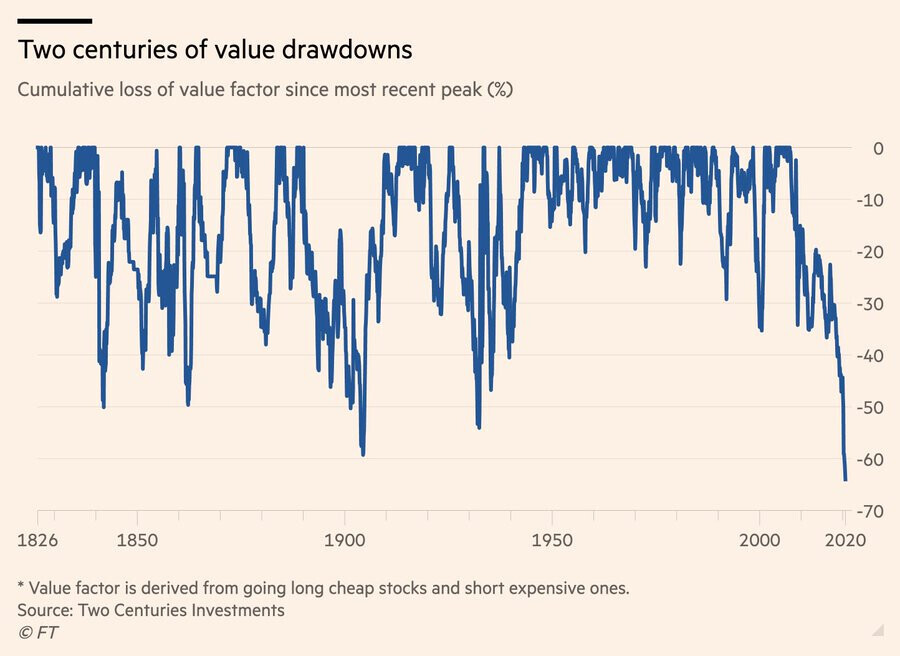
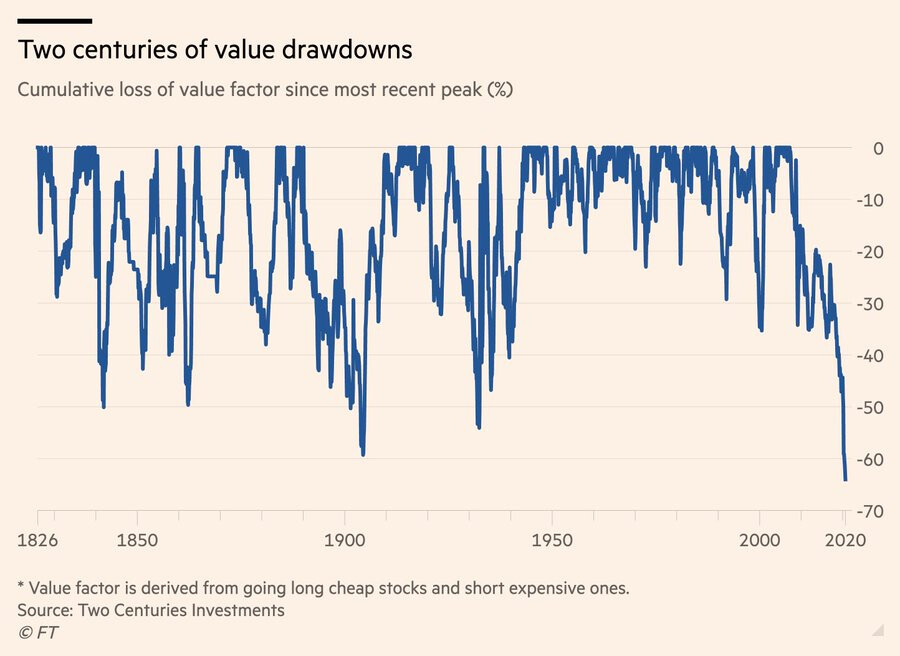
Value investors have famously had a difficult time in recent years, and according to a recent FT article, the dry spell is the longest in almost 200 years.
In the spring, FT journalist Robin Wigglesworth wrote a longer article about the dry spell of value investing. (You should also follow him on Twitter: https://twitter.com/RobinWigg)
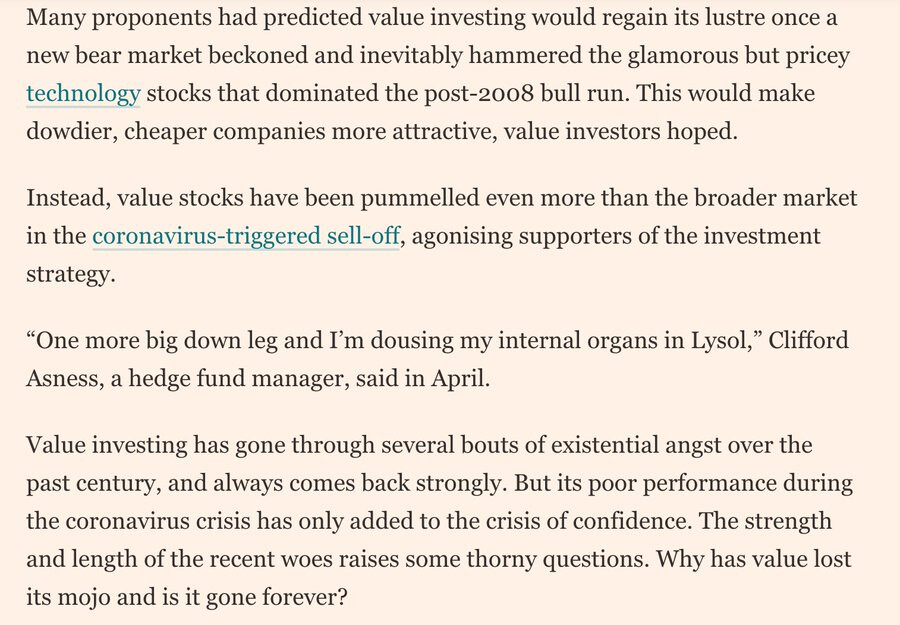

https://www.ft.com/content/00c722d6-760f-4871-a927-2c564fe17276

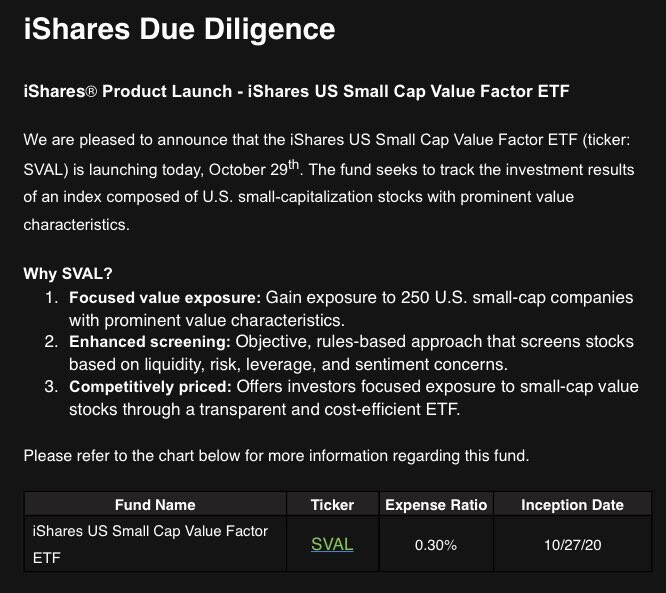
For these reasons, iShares’ new ETF can be considered particularly interesting. An ETF investing in the Small Cap Value theme was launched today. Currently, the theme is super “unsexy,” but the timing could prove to be brilliant. At some point, the bottom will eventually be seen, and now there are signs in the air.
Earlier this month, AJO Partners, a hedge fund specializing in value investing, ceased operations. In the closing letter, the founder wrote: “Our decision to close is a response to market forces. We still believe that value investing has a future. Unfortunately, the future is unlikely to come soon enough – for us,” he wrote in the memo.

Another investor legend, Clifford Asness, commented on AJO’s closure: “Ghoulishly, everyone throwing in the towel is often a good sign… But I don’t want to oversell it as a timing indicator,” he said.

Could a turning point be at hand now?
21 Likes

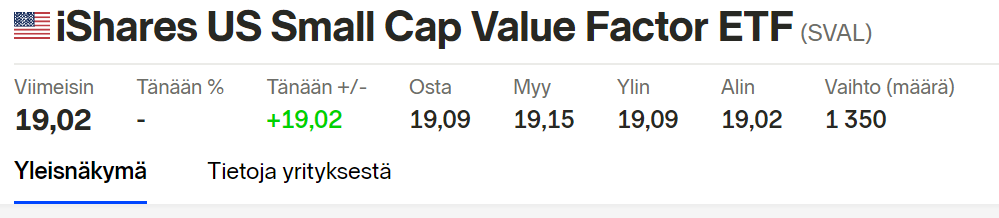
Is that ETF available from Finnish brokers…?

It’s visible at Nordnet, at least:

Wow, you’ve really brought some great insights to the forum! Thanks for those.

Regarding value investing, here’s an interesting study I shared in the history thread in February.

https://osam.com/Commentary/value-is-dead-long-live-value

Indeed, we’re currently in a historically long dry spell, but the underperformance of value investing is often linked to technological disruption. Could it be that the phase where disruption slows down and even the dinosaurs can get on board is gradually approaching? I’m not entirely sure myself if disruption is rather just accelerating. An interesting study nonetheless.

Admittedly, the taste of capitulation among value investors makes one wonder when it’s time for cheap stocks again? The only problem is that “cheap” in this market often seems to mean poor quality, problems, or inability to compete. :frowning:

6 Likes

Can an investor living in Finland buy Sval? It seems to be listed on NYSE and due to the infamous MiFID II, US ETFs can no longer be bought in Finland. Nordnet does find the ETF, but can it be bought? If so, it goes straight to my shopping list!

3 Likes

Regarding that Small Cap Value ETF, small caps have lagged behind this year anyway. If/when the economy improves, one would think they’d start to move.

1 Like

Isn’t this quite typical in value investing in general? If you rank companies by, say, P/B ratio, there usually isn’t anything premium at the bottom end, is there? Perhaps this is more emphasized nowadays (zombie companies?), but as a phenomenon, it has probably existed before.

An acceptable P/B ratio (or any other value metric) should be reflected against the prevailing interest rate level. A low interest rate “allows” higher multiples, so a formulaic guideline (e.g., “I only buy companies with P/B < 1”) doesn’t work properly.

It’s important to note that there is no law of nature that dictates that a certain investment style must work. So, in theory (of course, only in theory), it would be entirely possible for value investing not to generate excess returns for long periods, or ever. In practice, however, conditions will certainly change at some point to favor value investing, and value investing can once again generate excess returns.

I will follow with interest, the topic is interesting.

3 Likes

Yes, you’re absolutely right. But a value investor also assumes that the quality of a faded company will improve to average, and thus its valuation would normalize: “reverse to the mean.” Or ideally, one wants to get a good company cheaply, but as the market becomes more efficient, that seems increasingly rare, doesn’t it?

And value investors probably don’t intentionally buy duds for their portfolios, but technological disruption, zero interest rates, etc., have made the scene more difficult, I’d say.

2 Likes

What if economic growth permanently ceases, globally? If not quite permanently, let’s say that demographic structure and other factors in such a large part of the world cause a “Japanification” that has perhaps been ongoing in Europe for 10 years, and simultaneously in the US and China, while internal instabilities keep developing countries as developing countries. A rather grim scenario, but what would happen to growth companies in such a case? If growth companies, with a few exceptions, don’t grow, could that lead to a new rise of value companies?

How has value investing worked in Japan, by the way? And actually, such a grim situation isn’t even necessarily needed for similar effects to occur on a smaller scale.

Even among growth companies, there are those that grow in a stagnant environment. For example, automation is a no-brainer when you need to streamline operations as the working-age population declines and customer companies’ results no longer improve through growth.

In the IT sector, growth is sold to customers during good times, and savings during bad times.

Among value companies, I’m interested in cash cows that are sure to churn out good results.

If you had to choose ONE value stock, which one would you buy?

I suspect that in many sectors, technological development is currently faster than before, and in such cases, a company that has stumbled into problems finds it harder to get back on its feet and catch up with its competitors who have pulled far ahead. This creates a “winner takes it all” phenomenon, where the strongest company can dominate on an entirely different scale than in the past, thanks to its head start.

My gut feeling also suggests that low interest rates affect company operations in many different ways and, conversely, stock market valuations. The interest rate situation is quite peculiar overall. (Has the connection between value investing and interest rate markets been studied, by the way?)

Sometimes, even nowadays, good companies can be bought at a reasonable price (very rarely cheaply). This is the direction Warren Buffett has also moved towards, instead of traditional value investing. I myself bought a moderately growing, profitable quality company two years ago at reasonable multiples for the interest rate level (P/E 14, dividend yield 5%); not traditional value investing but quality at a reasonable price. Cheaply, it seems you only get problems, and I’m no longer enthusiastic about knowingly buying problems into my portfolio. Buffett once put it succinctly: “It’s easier to avoid problems than to solve them.”

Zombie firms are an interesting topic; does that phenomenon really exist? That low interest rates enable even the worst firms to stay afloat. In that case, this zombie group competes in the same markets as many value companies and spoils their business so they cannot rise because natural selection isn’t working normally. Of course, they don’t get money at zero interest, but much cheaper than before. I don’t have anything concrete to back this up, but looking at our stock exchange, there are indeed some companies that one might well ask if their place is truly on the exchange (or if these faded problem cases should even be alive at all).

3 Likes

I would interpret this the other way around, asking whether value investing shouldn’t produce good, positive, and cumulative cash flow over time, largely regardless of changes in stock valuation? And in a way that emphasizes current earnings, not earnings growth expectations.

So, in the spirit of Buffett, one should buy stakes in companies and then hold them indefinitely. Of course, there is a separate school of thought that emphasizes the realization of value through some catalyst.

1 Like

Hmm. This works well when the company’s current earnings are positive. At the cheapest end, there are also companies that are not capable of sustainable positive earnings, but instead make losses or ride a rollercoaster from profits to losses and back again. In the long run, the company owner earns roughly the same as the company, and if the company is in trouble and losing money, the long-term holder will certainly not get a positive return.

Of course, owning quality and profitable companies and holding them will yield a nice return over time, but such companies are not found at the cheapest end, i.e., among value companies.

1 Like

" *Value factor is derived from going long cheap stocks and short on expensive ones." (“Arvo-kerroin” johdetaan/lasketaan niin että ollaan longeina halvoissa osakkeissa ja shorttina kalliissa)

If cheap and expensive stocks are divided only by, for example, P/B, isn’t the initial setup already a bit too perverse for today’s world, and doesn’t really say much? If one of your longs doubles and one of your shorts doubles, that factor is hellishly negative, even though those expensive and cheap stocks have performed the same. Or am I missing something essential?

1 Like

In my opinion, a value investor is someone who generally looks at companies’ earnings and doesn’t want to overpay for future growth assumptions. Often, you see people saying that a value investor should buy Ovaro and short Kone because the former is cheap and the latter is expensive. I wouldn’t touch either.

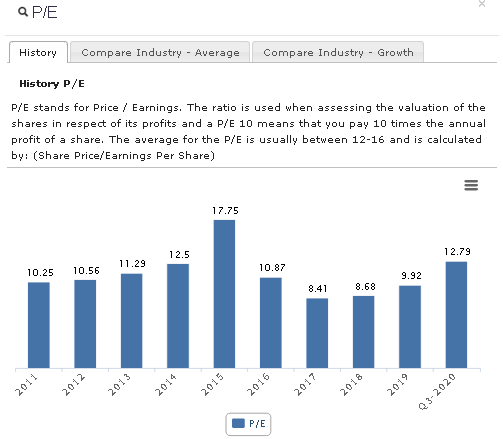
The idea of value investing, in my opinion, is that if you buy a company with a P/E of 10, you earn 10% per year. Someone else who buys a company with a P/E of 30 earns 3.33% per year, so their stock price development should be 6.66 percentage points better each year for the strategies to be equally good (simplified). But often, investors only look at price charts and completely ignore earnings. Value investing is based on the hypothesis that stock prices follow earnings growth, and it doesn’t work as long as there’s a popularity contest in tech companies where earnings don’t matter. I myself have achieved quite reasonable results with value investing, but it’s sometimes difficult to find actual value stocks.

I can’t think of what’s so “bad” and “risky” about those P/E 10 stocks. For example, the Swedish construction company JM has been valued at around P/E 10 for the past 10 years…

… while its earnings have been quite stable and even growing with the increasing size of its balance sheet:

What truly drives growth companies? The impact of zero interest rates can be illustrated with a discount calculation. Let’s start with a equally valuable value company that grows by 2% per year and a growth company that grows by 10% per year. In this model, aging Europe grows by 1% in the long term, and mature companies grow at the pace of GDP. The required rate of return is 10% for both companies:

Value company:

Growth company:

What if the required rate of return is lowered from 10% to five to simulate the effect of zero interest rates?

Value company:

Growth company:

So, the value of the growth company increases more than that of the value company, but at least with this 8 percentage point growth difference, a huge difference in performance isn’t yet apparent.

13 Likes

Doesn’t value investing, at least in academia, refer to investing based on a low P/B ratio, regardless of the companies’ profitability? So, even heavily loss-making companies are included. That is, companies are sorted by their P/B ratio and divided into value and growth companies accordingly. Some other criteria are used, but I guess that academic P/B classification is what long-term studies are based on and what the good returns of value companies are based on.

1 Like

There isn’t necessarily anything bad about it. Many “good” value stocks are pretty much what you see is what you get, meaning they are considered to be in a terminal phase. When the business doesn’t become more valuable, then investors should, for one reason or another, simply want to pay more than the current price for the current business.

This may not happen, because often more is only paid if more is expected from the future than the present. They remain cheap because no one wants to pay more, for now. Of course, one could argue that if the required rate of return suddenly drops, cheap companies based on earnings should experience rapid price increases. This may indeed happen over some period.

Of course, some earnings-based cheap companies also grow or otherwise surprise, and if the profile changes from such a cheap company to a growth company, the value development is particularly rapid. The highest returns are achieved when nothing is expected initially, and then things change. (In this category, however, also tech companies that move from losses to profits.)

In this sense, the financial sector, for example, can be the right place to look for affordable growing companies. The risk of losing capital is quite small, and the main negative scenario is the continuation of zero value appreciation.

In my own portfolio, about 15% consists of these small banks with an earnings yield of around 15% + growth on top. It just doesn’t mean much unless someone else wants to buy these, and admittedly it’s the poorest performing part of my portfolio. Currently, the financial sector is considered ridiculously risky and unprofitable, prone to disruption, and I know that P/E ratios may remain below 10 for years despite growth. It’s possible that opportunity costs will become high. I have decided to limit the risk by not buying more financial sector stocks, but these can stay until the end.

If many think like me, the valuation of the financial sector is a powder keg in a positive sense, but the catalyst is missing.

3 Likes

Many would have missed out on buying Qt Group then :slight_smile: The P/B is 46.08 at the moment according to Nordnet. The P/E is as high as 250. The P/S, on the other hand, is 14.53.

I was still thinking about “value investing,” as there are many different definitions for it, and on the other hand, someone like Warren Buffett is often called a value investor. I looked at Buffett’s largest stock investments (the 5 largest total 76% of his stock portfolio) and below are some key figures for them:

  1. Apple: P/E 34, P/B 26

  2. Bank of America P/E 12, P/B 0.8

  3. Coca Cola P/E 25, P/B 11

  4. American Express Company P/E 23, P/B 3.4

  5. The Kraft Heinz Company P/E 22, P/B 0.8

There’s a huge variation in these value metrics (quite logically, as the companies are from different industries, with different capital intensities and growth prospects). If one had to look for a logic in these (and the rest of) Buffett’s stock picks, and what “value investing” is, no clear metric can be found. When the metrics for the overwhelmingly largest investment (Apple) are P/E 34 and P/B 26, we are quite far from what value investing usually means in terms of key financial ratios.

2 Likes

Yep, many people would have missed out on buying Teslas, QTs, and FAANGs in the last few years :smiley:

The same applies to almost everything else “what you see is what you get”