I dug a bit for specifics on what value companies are, by name. If you mechanically search for value investments on the Helsinki Stock Exchange, I looked at the cheapest value companies among those followed by Inderes, based on their P/B ratio*:
Outokumpu
Citycon
Piippo
Ovaro
Tallink
Apetit
SRV
Finnair
Ilkka
Lehto
Stockmann is probably the cheapest value company, but Inderes no longer follows it, so it’s not on this list.
*I excluded negative special cases (2 pcs) from this
Funny enough, if you were to ask me based solely on the name, perhaps only SRV would come to mind as a value company. But of course, a value company doesn’t directly mean what I personally think of: steady growth year after year.
In that sense, for me, a value company would come to mind more from two perspectives: either steady growth towards heights (Qt, Revenio, Remedy) or a “too-big-to-fail” mentality (Sampo, Kone, Elisa).
The term “value stock” is confusing precisely because of the word “value”; it was a bit foolishly chosen by academics, as the word “value” usually has a positive connotation. However, what academics mean by “value stocks” are typically the weakest performers on the stock market (there’s often a good reason for a low P/B ratio). Deep value, in particular, is pretty much trash
When Buffett bought his Apple stock, the P/E ratio was probably a good third of what it is now. Indeed, Apple was not accepted for very good multiples before recent years. In fact, before 2019, it used to be around 13-14.
So, if we consider value investing from the perspective of Graham et al., it has practically meant determining a company’s current value very simply and then identifying undervalued targets.
In my opinion, even here, we have moved away from mere P/B magic, which might have worked at one time, but we still remain within some kind of DCF model. I have always been a fan of Aswath Damodaran’s approach to valuation, even though he emphasizes strong narratives. My own view is that value investing primarily targets middle-aged and relatively low-risk companies based on fundamental analysis. For example, all those companies on Buffet’s list are like this, including Apple nowadays. Apple is like this because it has stabilized its free cash flows and its potential for value return is quite steady.
QT and Revenio, on the other hand, are at a risk level that, in my opinion, makes them not value investments.
"I’m probably representing the wrong school of thought, but Arvo only hits one of these companies on my radar (Citycon). If I stretch the assessment a bit, Outokumpu.
There has to be more than just cheap multiples. Yesterday I bought Tokmanni for 13€. That’s a value company that’s still moderately priced and has very bright future prospects "
That’s right, and it’s probably wiser. I wouldn’t invest mechanically, even if its effectiveness has been academically proven, my psyche wouldn’t handle it Well, joking aside:
My point here is that the very long-term outperformance of value investing has traditionally been proven specifically for companies with low P/B ratios, so if you want to utilize academic research, it’s important to understand what value means. I don’t know, there’s probably been academic research on other metrics too, whether there’s some outperformance through a low P/E or some combination. If we start doing more subjective value investing, the academic basis disappears because there are too many subjective models to study them with long time series (or you can, of course, but it gets difficult).
Has anyone considered how current balance sheet optimization* affects that “magical” P/B = 1 threshold?
Secondly, fewer and fewer companies produce any tangible product; instead, new companies are increasingly operating in the fields of data, data processing and analysis, and data sales. Business thus requires far less capital than, say, a car repair shop, a bakery, etc.
*) By balance sheet optimization, I mean the trend where companies try to shift investments from the balance sheet to cash flow. Nowadays, companies can lease or rent almost everything. Premises, laptops, cars, cleaning, IT infrastructure, etc., are all paid for with nice monthly bills instead of the company buying them and bloating its balance sheet. For example, YIT rents/buys construction site containers/offices, traffic arrangements, laptops, and printers, etc. Increasingly, even employees come from a partner network, and YIT only handles management and supervision tasks. This should lead to higher P/B ratios, as unproductive but necessary assets are removed from the balance sheet.
I’ve always been perplexed by how value investing is often reduced to merely examining the P/B ratio. However, I recall that the classic value investing book, “The Intelligent Investor,” defined a value company as one that Mr. Market is willing to sell to you for less than its intrinsic value. Broadly interpreted, any stock trading significantly below its fair value would be considered a value investment.
The trickier part, naturally, is determining fair value. P/B < 1 is indeed a classic “value play,” but it’s just one example of a value investment. The idea there is that the book value realistically represents the firm’s fixed assets, and if the ratio is significantly below 1, the company could liquidate itself for a better price than its market capitalization. This logic, of course, doesn’t apply outside capital-intensive industries, such as IT, where the balance sheet mainly consists of laptops and office desks, and the real value is generated from intangibles.
A classical value investor divests their holdings when the stock price has corrected to the “right” level and moves on to the next target. Buffett, on the other hand, holds stocks for long periods (even decades), even if their valuation levels rise.
Buffett bought Apple when its P/E was under 20, but its P/B was already very high back then. Coca-Cola, at the time of purchase in 1988, was valued at a P/E of 15, a reasonably priced quality company at the time, but not dirt cheap. Buffett paid less than two billion for his Coca-Cola shares, and now the shares are worth 19 billion + over 7 billion in dividends.
Buffett’s “value investing” is more about investing in quality: “It’s far better to buy a wonderful company at a fair price than a fair company at a wonderful price.”
Is it an absolute requirement that a value stock’s P/B ratio must be as low as possible and the company preferably a large cap?
In recent years (pre-corona), for example, Harvia @€6, Kamux @€5, Titanium @€7, Viafin @€9 have been value stocks for me, and they have also performed well. I probably think about value investing with looser criteria than a classic value investor. I don’t feel that investing based on value criteria hasn’t worked in recent years.
In the corona dip, there were all sorts of stocks available even for a value investor, including large companies. A stock picker looking for value doesn’t have to settle for poor returns, or what do you think?
Of course, if one’s portfolio included, say, Qt, Remedy, and Tesla, one probably got even better returns. But surely this type of portfolio cannot be a benchmark portfolio to compare against, but rather an index?
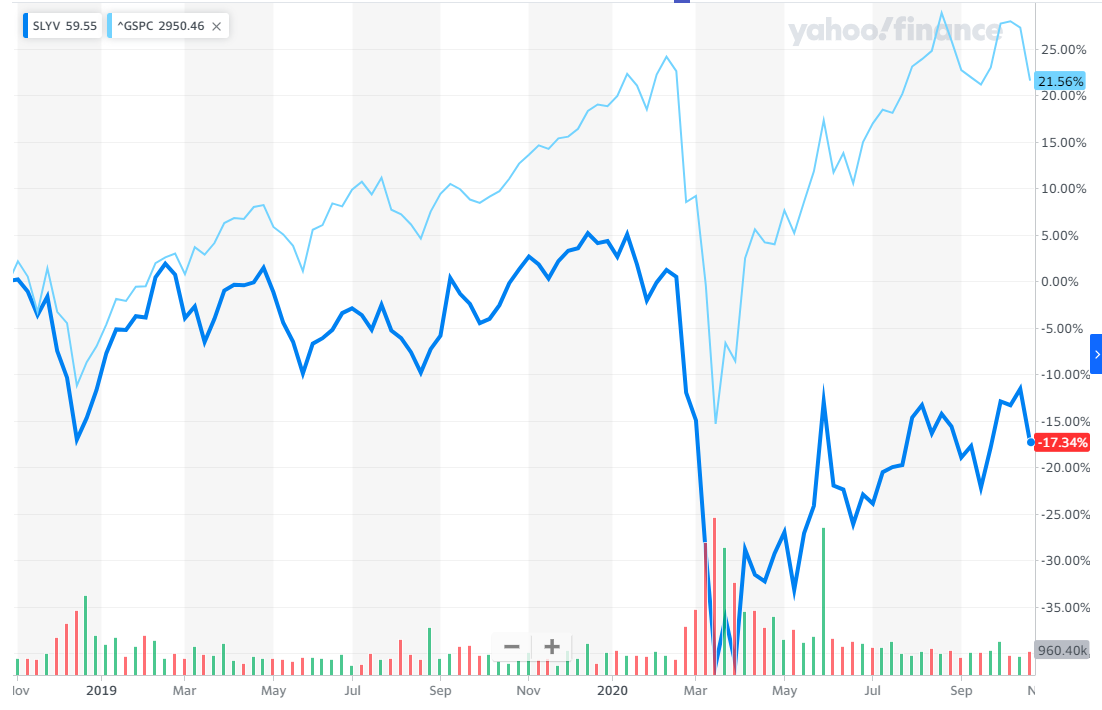
There have been good Finnish value small caps lately, for me personally Harvia (right from the IPO). But if we look at small cap value stocks as a whole, they have clearly underperformed the market index recently, e.g. below a small cap value fund vs. S&P500:
I also looked at the previous “Finland portfolio” with a three-year return*. Some of these were not value companies three years ago, but many were. This portfolio had absolutely shocking losses:
Stockmann -85%
Outokumpu -73%
Citycon -37%
Piippo -53%
Ovaro -26%
Apetit -32%
SRV -82%
Finnair -82%
Ilkka -1%
Lehto -89%
So even though individual stars can be found, these losses are so massive that they inevitably drag the value portfolio below the market return, which with dividends (OMX25-ETF) was +13% during the same period.
If someone had access to good data sources, they could check what key figures these companies had three years ago. At least Stockmann was “very cheap” then, I remember that, as it was a good example of a value company. These funds (e.g. the small cap value fund) screen value companies into their portfolios quite mechanically, which means that many such companies end up there, significantly worsening the portfolio’s return.
Somehow, when I ponder these, I get the feeling that index investing works better with regular market indices than with, say, value indices. That value investing works better when using common sense and discretion in stock picking.
*(There was no three-year data for Tallink, so I left it out)
The earliest value investors, with a great deal of effort, found companies that could be bought at a significant discount according to current assets, i.e., they could find “forgotten” companies where they could buy a hundred-dollar bill for fifty cents without paying anything for future prospects.
Then, gradually, analysis became more common, and totally mispriced cases disappeared, at which point a low valuation usually has a reason (e.g., severe unprofitability), and if that reason doesn’t resolve itself, no one can be found to whom the company could be sold at “full price.” Instead, a new buyer agrees to pay only a “discounted price” for the stock. In such a situation, a value investor has to take a stand on the company’s future prospects and predict some kind of turnaround that would improve the company’s outlook, and the next investor would pay “full price” for the company.
With the advent of information technology, number crunching is quite ruthless, and thus, it’s becoming impossible to find totally mispriced stocks.
To exaggerate a bit:
A quality investor’s return largely comes from companies making good profits and growing, with the stock price over time following the company’s real-world performance. A great company, over time, brings great returns*.
A traditional value investor, on the other hand, aims to make their profits by buying companies at low valuation multiples and making their money by the company’s valuation multiples improving. Then, the company is divested, and a new undervalued company is sought to repeat the valuation increase. In other words, they don’t hold onto bad/mediocre companies after the company has reached its “correct” valuation level.
*Charlie Munger’s comment fits this well:
“Over the long term, it’s hard for a stock to earn a much better return that the business which underlies it earns. If the business earns six percent on capital over forty years and you hold it for that forty years, you’re not going to make much different than a six percent return - even if you originally buy it at a huge discount. Conversely, if a business earns eighteen percent on capital over twenty or thirty years, even if you pay an expensive looking price, you’ll end up with one hell of a result.”
Yep. Traditional value investing hasn’t worked. You need to combine growth and quality into the value equation as conditions, and the results will improve tremendously. Of course, the selection also decreases significantly. In practice, you have to operate on the small-cap side or then buy during outrageous, extremely rare panic sales, like corona.
I started wondering if the underperformance of value could be due to the simple reason that there have been more “bombs” (poor performers) in portfolios than usual? If a portfolio ends up with even a slight weighting of losses over 70%, the other half of the portfolio needs to be quite the rocket to outperform the market.
So, has this been a polarized time where there have been more “value stock bombs” than usual, and they have dragged value investing down? Often, avoiding mistakes in investing significantly improves returns. So, an active value investor who has picked companies more carefully, avoiding the worst bombs, has done quite well, but value (index) funds, which screen more mechanically with various rules, have included these bombs.
On the growth and quality company side, there would have been far fewer bombs recently than on the value side, which is why they have performed well as groups. I don’t have access to old datasets to examine this more closely, so I’m just going by gut feeling here.
Yes, many cheap stocks have a good reason to be cheap. A weakening business is not a good investment, even if you can get it cheap. The markets are efficient enough in large companies nowadays that there are rarely any bargains in the discount bin without a good reason.
Even a value investor should be alert to the company’s prospects. These screening-based statistics can therefore be partly misleading if compared to a disciplined value stock picker who also emphasizes quality.
For example, I’ve been following Random Walker’s blog, and there’s one guy (a “modern value investor”?) whose approach works. He only invests in quality and only when the price is right.
RW is interesting, yes! I’d consider him more of a quality investor, quite far from traditional value investing and quite close to quality company investing. But this is an opinion, nothing more of an analysis than that
RW does indeed seem to use the term “modern value investor” for himself. Below is his classic text on the subject, which provides insight into Random Walker’s way of thinking:
 would come to mind as a value company. But of course, a value company doesn’t directly mean what I personally think of: steady growth year after year.
 "
"