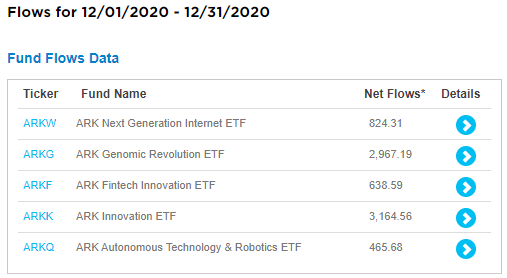
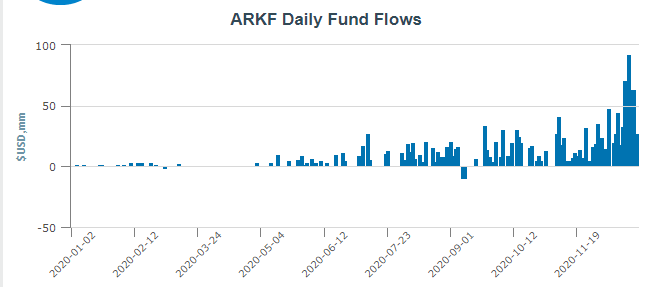
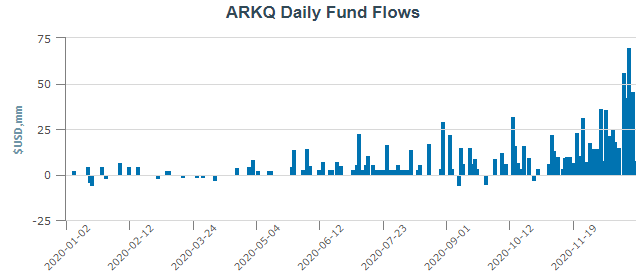
In total, ARK’s five actively managed ETFs hold approximately 150 different stocks, and the market value of the funds is about $34B. ARK’s founder and largest owner, Cathie Wood, is particularly known as a Tesla bull, but the combined weighting of Tesla in the funds is still only 7.65%. Meaning over 92% is something else.
For stock pickers, the movements of large investors can offer a good opportunity for mimicking. Generally, it is difficult to track fund purchases and sales because funds do not disclose their trades daily. Unlike the mainstream, ARK Invest discloses all its purchases and sales. Unfortunately, ARK’s funds cannot be bought from Europe, but almost all of the individual stocks can.
This Bloomberg interview is worth watching right at the beginning.
ARK Invest publishes the contents of its funds daily, as well as its trades, to those subscribed to its mailing list (a free service). ARK strongly focuses on marketing aimed at retail investors. The narrative is amplified by several YouTubers. Perhaps partly because of this, there’s a bit of a cult following around ARK. On this external website, you can follow ARK’s purchases and sales, as well as the development of stock weightings
Sven pretty much disses ARK Invest He highlights the factors behind its success:
Best marketing ever
Focus on exponential growth
Small cap hunting
Forget risks
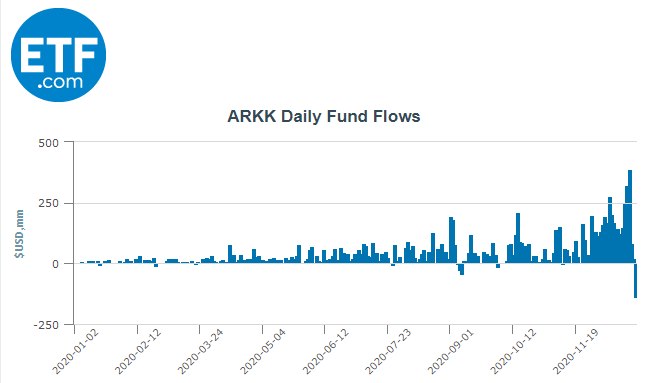
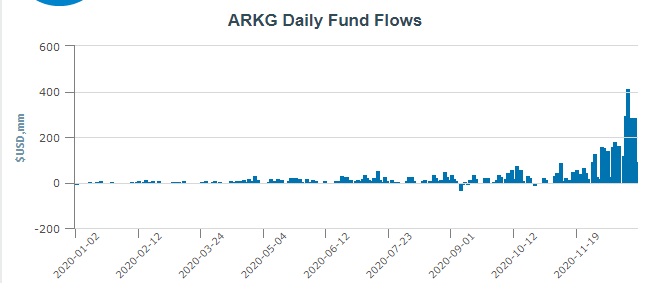
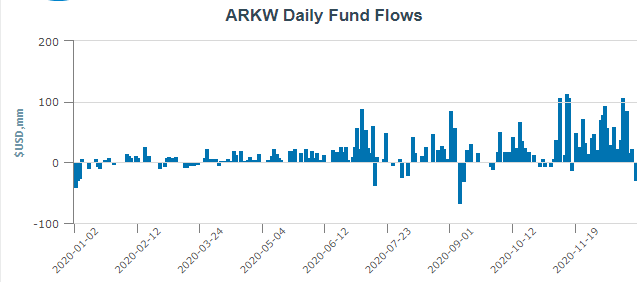
Sven’s hypothesis is that the value of ARK’s funds has increased because more capital has been invested in them, and ARK has then invested that capital into the fund’s stocks, which in turn has raised the prices of those stocks and the value of the funds. At the same time, the demand for the small-cap stocks in the funds has been pumped up due to ARK’s purchases. I interpret Sven’s message to mean that even though ARKK was the best-performing equity fund of 2020, this position was achieved through “shady tactics.”
I have to say about Sven’s hypothesis that, of course, growing demand tends to drive up prices. The same applies generally to growing equity funds. Now the question is how long this can continue before it collapses.
Sven’s story gets wild when he brings up JP Morgan’s structured products, which allow investment in ARK’s funds. Hype and FOMO are strongly present. There are, of course, clear warning signs in the air.
An interesting and timely opening. I’ve been following ARK for a while now because I owned Tesla between 2017-2019 (good exit timing, huh? I still made a good profit anyway…).
ARK’s truly massive growth easily leads to a situation where creating excess returns becomes more difficult as the fund has the opportunity to invest in fewer and fewer companies. ARK’s ETFs have focused on certain ideas that have been riding a very strong tailwind, if not even a bubble, so if market sentiment changes, the aftermath could be ugly. I’m not very optimistic in the slightly longer term. In the short term, who knows…
I’m not yet entirely convinced that Cathie Wood didn’t just happen to be in the right place at the right time. Perhaps a bit cynical, but it feels like she’s just willing to hype everything “disruptive” without caring about fundamentals. It will take longer-term success across cycles before I’m convinced that this is a sustainable advantage.
I don’t really understand this graph. According to this, there were no disruptions between electricity and computers, and then we should believe that there are more now than ever, listing all the hype without a real track record of actual disruption. I’m no historian, but this graph seems very tendentious.
I would add, for example:
Airplanes. Before, round-the-world trips took weeks/months by ship; now it can be done in a day.
Splitting the atom. Nuclear weapons led to global peace between superpowers when full-scale wars would be too total. Nuclear power, on the other hand, has been producing clean energy for almost 80 years. This was supposed to change the world even more, but cheap oil replaced it.
Women’s contraception. Doubled the workforce and saved the planet from overpopulation.
The Green Revolution, saved the world from famine.
Rockets. We went to the moon and made history. The space age with satellites, etc.
But then energy storage and crypto have been added now.
I’m a huge tech bull myself, but that image is a complete turn-off.
Well said. No medical disruptions have been listed in history. I’m not an expert on the subject, but surely antibiotics and vaccines should be included. In addition, robotics has been disrupting industry for a bit longer than the picture would suggest.
I like ARK’s way of boldly analyzing and predicting the development of various “disruption platforms,” but the message is somewhat watered down by that very self-serving marketing.
In my opinion, it’s also a really strange graph. Let’s consider, for example, the Y-axis, which is titled “Impact of Innovation - Scaled by degree of consensus across historians”
How does a historian even assess the significance of blockchains or AI?
Secondly, what is the scale or measurable value of this Impact?
Shouldn’t this graph be a Scatter type, not a line graph?
How can “Impact of Innovation” go into the negative 40-65 if there were no notable innovations? I would understand if plague or something similar was accidentally invented/spread.
Why do some innovations accumulate, but others don’t? One would think computers and the internet, for example, would accumulate.
How the hell is blockchain placed in 2020, when Bitcoin was invented in 2008, i.e., at the bottom of that pit.
I don’t remember the source, but somewhere there was an idea presented about an invention that has most affected productivity and equality. The washing machine almost completely freed women from doing laundry.
In my opinion, these over-hyped publications reduce the credibility of their publisher. Just like in Bitcoin discussions, some people paint a target price of $100,000 or $1,000,000 a year from now without any justification or critical thinking. For $100,000, 1200 BUSD net of new money would have to be found, and for the million-dollar milestone, 12,000 BUSD. However, I don’t believe the entire amount of money printed by the FED will sink into Bitcoin.
The same calculations can be made for Tesla if its market value equals the value of the 7 largest conglomerates. In any case, I would be very cautious about predicting any technology to revolutionize the world. Many technologies are at a stage where they are mainly evolutions of earlier inventions.
I ignored the y-axis completely. Good thing you also looked into that side.
My gut feeling is that the last real disruption was the smartphone. It opened up the world of computers and the internet for the first time to billions of people. In Western countries, it was only with phones that internet use became an inseparable part of daily life for almost everyone.
Of the disruptions listed by Ark, perhaps AI will revolutionize the world with a high probability. I’m not so sure about the others.
Apparently ARK isn’t generating much excitement on the forum. I, for one, believe that ARK has been right about Tesla, for example, and has bravely taken a stance when “production hell” was ongoing. Furthermore, ARK cannot manipulate Tesla’s stock price; in fact, it has to sell the stock during rallies. Additionally, Cathie Wood’s view on inflation (or lack thereof) is reasonable, meaning that accelerating innovation is fundamentally disinflationary. I am most skeptical about 3D companies, where they might be perhaps too optimistic. In any case, ARK Invest is a player that is difficult to ignore, and I, at least, believe that history will elevate her as one of the greatest investors of our time. This field is rather amusing in that, in the long run, there’s little room for excuses.
This ETF content page is handy. You can easily check which post-merge spaces have ended up there. If you stumbled upon it, they’re definitely worth holding onto for the long term. For example, Skillz is there, and it has risen quite a bit.
I’ve been piggybacking ARK since spring, and many of the best finds have come through it, such as Roku, Square, Niu, Pacific Biosciences of California, and many others.
It’s worth joining ARK’s email list so you get the previous day’s buys and sells in your email every night around 2 AM. Usually, especially if they buy a small company as a new addition to their portfolio, it then rises due to the resulting hype and buzz.
I actively follow ARK and have long had, for example, ROKU and BIDU on my shopping list, but they always seem too expensive or I haven’t had the chips at the right time. However, my portfolio includes at least SQ, NIU, JD, BABA, PLTR, NNDM, CRSP, TDOC, PACB, and ARCTUQ.
I’m eagerly waiting to see when Inderes will cover ARK in one form or another. I think Verneri would be the best person to comment on them, as we’re talking about economically significant matters. I’d like to hear his views on ARK’s core theses: are we living in “exceptional times” regarding innovation, or is this something that has been seen before? Then it would be good to take a stance on the future of the entire analysis industry and how ARK sees this field. Of course, the most interesting thing would be to hear how the disruptions mentioned by ARK affect individual companies, such as Wärtsilä or Metso Outotec.
What are all the space companies that could potentially end up there? List them here so we can get them in our portfolios before they start showing up there, which usually means good gains.

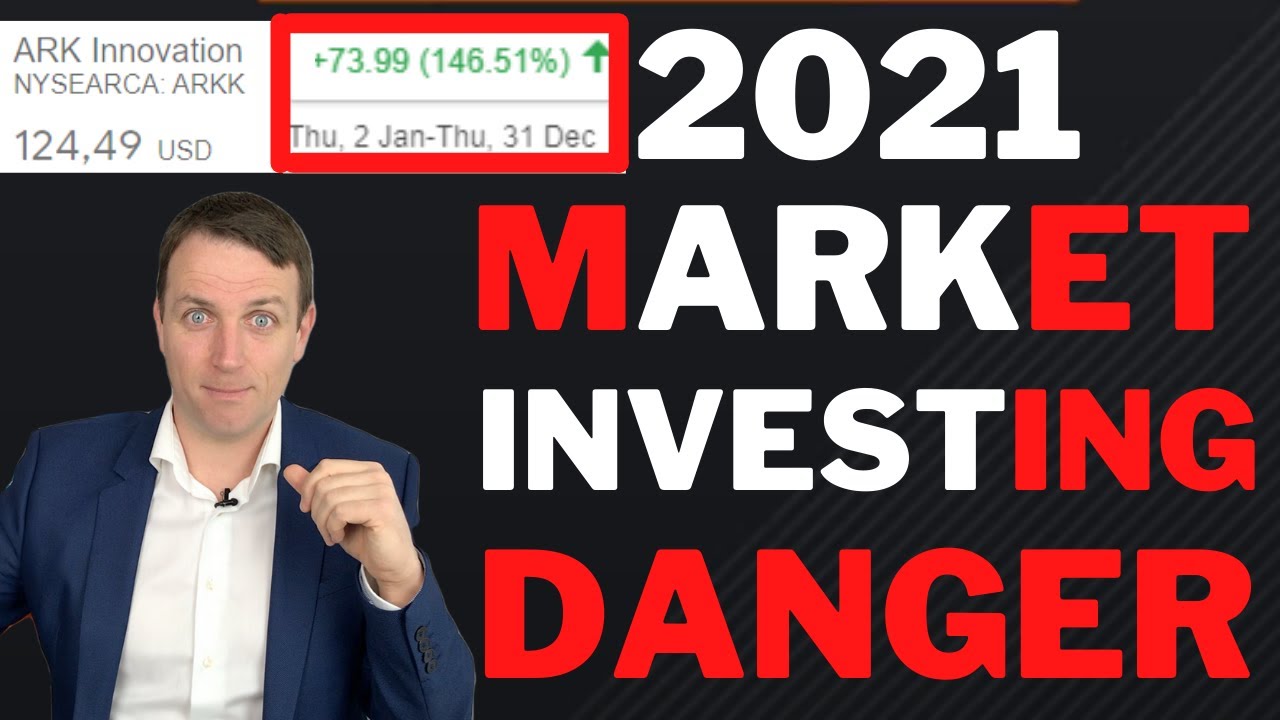
 He highlights the factors behind its success: