I’m thinking of going all in. Now that I’ve been using Claude for a bit after Gemini and ChatGPT, this is terrifying. I could pay 5x more than the current Ultra. This is going to make average people unemployed
14 Likes
Anthropic’s competitive advantages from the S-1 filing, in order:
-Mission and focus
-Talent and culture
-Research
-Approach to compute utilization
-Enterprise-level strategy.
At the headline level, these are very abstract concepts. Hands up, who spots any durable competitive advantages?
All of these are unpacked and substantiated in more detail starting on page 186 of the S-1.
In any case, all of the competitive advantages tie back to Anthropic having exceptionally talented people working there. Talent retention is also one of the key risks.
To add further, even if there are no durable competitive advantages right now, it may be that in the future one of the Frontier AI companies will achieve a very durable moat through its scale, and the market might turn into a duopoly. Anthropic is naturally a clear candidate to be one of the winners.
6 Likes
However, if you sift through that list of jargon in the S-1 prospectus through an investor and ROIC lens, one sustainable, genuine moat stands out that isn’t directly mentioned in those bullet points: B2B switching costs.
Simply having the “best team” or “cutting-edge research” is never a sustainable competitive advantage because, as you mentioned, brains can walk out the door to a competitor (or start a new one).
6 Likes
I’ve been sensing the same thing. Anthropic is targeting the enterprise market, whereas OpenAI seems to be more consumer-driven. Historically, tools tend to be sticky in the B2B space, while consumers are much more agile when it comes to switching services.
3 Likes
Howard Marks asks a lot of questions about AI, but offers very few answers.
There is at least one conclusion I agree with completely: out of all AI-related companies, AI model developers (frontier labs) carry the greatest future uncertainties of all. For this reason, they should be priced more modestly.
There is a certain analogy to biotech here. Huge investments, built-in uncertainty (even a training run can fail), potentially massive returns. Biotech is considered a specialist trade—a dart-throwing monkey would be better off picking another board, as on average one tends to just lose money in biotech. AI might develop into a similar niche.
11 Likes
It’s good to note, of course, that the “crushing loss” in this case is purely accounting-related. The actual business operations are already profitable; the massive loss on the income statement is due to the rise in the company’s valuation.
Not that I’m putting any significant amount of money into this myself, either. Rather than the income statement, my own reasoning is that it feels completely impossible to assess the market’s future development. Anthropic is currently the king of the hill by many metrics, but the landscape is shifting so fast that tomorrow it could be someone else.
6 Likes
Anthropic IPO: the thread’s enthusiasm for growth is justified, but price is what matters
In my view, the thread has rightly highlighted Anthropic, PBC’s strongest competitive advantage: Claude’s focus on enterprise customers and mission-critical workflows. If Claude becomes deeply embedded in software development, data analysis, and cybersecurity, customer switching costs could become significant. But will there be enough capacity?
In many AI “intelligence benchmarks,” Claude has been right at the very top, meaning it still holds a competitive edge over others. Many professional coders use Claude and rate it highly, though I have heard that the pricing gives them “pause”—of course, there are also “hybrid users” who work with multiple AIs in parallel and cross-check the outputs. Will this competitive advantage last, and for how long?
On the flip side are the heavy losses and the cost of compute capacity. Rapid revenue growth alone isn’t enough if every new customer demands an enormous amount of expensive compute and pricing power cannot be sustained.
Regarding the pre-IPO solution discussed in the thread, I share the view of several other posters: a structured note is not the same thing as direct Anthropic stock. In addition to the fees, it may involve issuer risk and a return calculation structure that is hard to grasp. Nordnet’s IPO offering is clearer in this sense, as it offers actual Class A shares.
The subscription period on Nordnet closes on Nov 18 at 3:00 PM. The estimated price range is 70–78 USD, but the maximum price is 120 USD. My own price limits would be:
- 70–72 USD: I’ll participate with a small amount
- 73–75 USD: still acceptable
- 76–78 USD: purely speculative
- over 78 USD: likely a pass
- 120 USD: an absolute no.
On listing day, a +20–40% pop is possible if demand is strong and allocation is tight. By the same token, a −15 to −30% drop is just as possible if the market starts questioning the valuation.
Personally, I would subscribe for at most 4–5 shares in a regular brokerage account (AOT). That’s a small enough position to participate in any potential IPO pop, while keeping downside risk manageable. If the stock opens above $100, I wouldn’t add to it and would consider selling a portion.
Alphabet Inc., Amazon.com, Inc., and NVIDIA Corporation, which were mentioned in the thread, offer more diversified ways to benefit from Anthropic’s growth, but they aren’t pure-play Anthropic investments.
My takeaway: The growth could genuinely be extraordinary, but oversubscription doesn’t eliminate valuation risk. Here, it pays to distinguish between a great company and a good entry price.
6 Likes
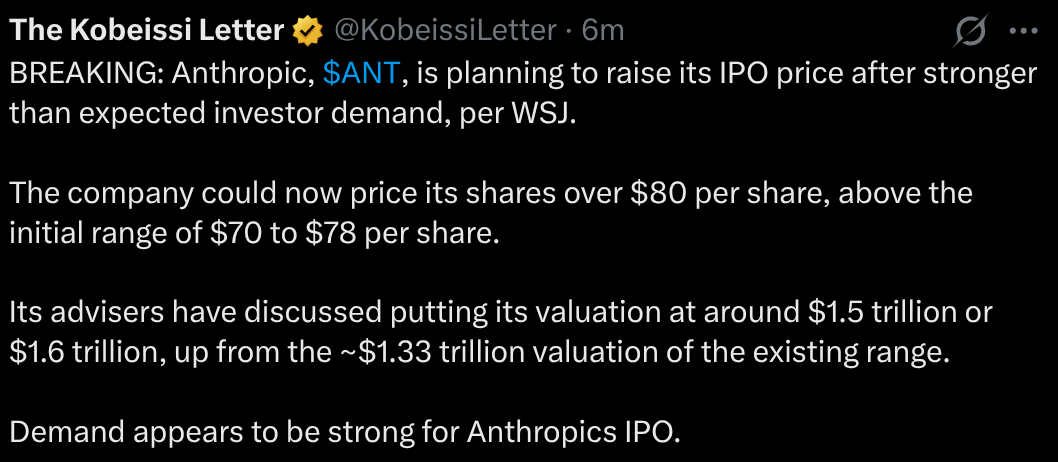
No need to hold our breath much longer for this trading launch either. Here is Juntunen’s blog post about it as an investment:
For now, I’m satisfied with Alphabet, Amazon, etc. exposure to Anthropic, meaning more indirect ownership. And I’m sure this will soon make its way into ETFs as well.
8 Likes
So, did ANT’s IPO price ultimately end up at $83?
The “conclusion” linked earlier in the thread looked like it was written by brainless AI, but the way I understood that Nordnet prospectus was that in Europe, $120 is reserved from your account for the IPO subscription, but once the allocation is settled, the shares would cost the same 83 dollars for all European and US residents alike.
Maybe I misunderstood, I do that often. Of course, that Nordnet IPO page can’t be opened anymore. Doesn’t trading start today? I didn’t subscribe myself.
3 Likes
The IPO price ended up being $83, and I was allocated about 10% of the shares I subscribed for.
6 Likes
In my Nordnet account transactions, there is a purchase of 5 Anthropic shares at $83 each.
8 Likes
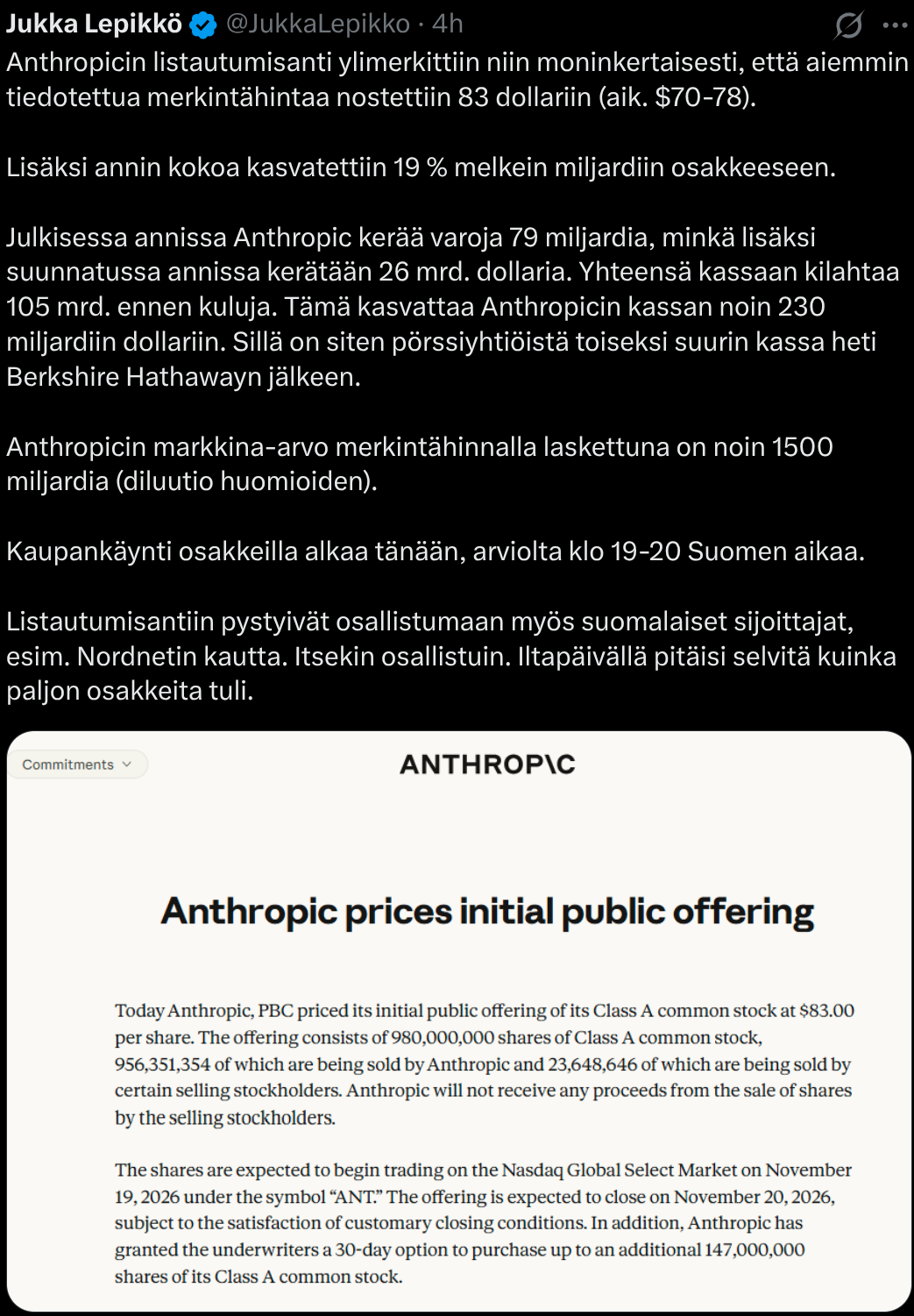
I also got 5 shares, half of what I wanted to subscribe for. The allocation criteria weren’t clear from the subscription confirmation message sent by NN. Apparently, 5 shares is some kind of minimum..?
What do you think of Anthropic, say, with a 3-year horizon?
- Hype stock. Staying away.
- Interested. Don’t own any, but following closely.
- Bought and considering buying more.
0
äänestäjää
Yeah, should have subscribed for 10x more if I’d had the guts; the allocation I got now is so small that I’ll just sell it off and buy a bigger slice later on sale.
1 Like
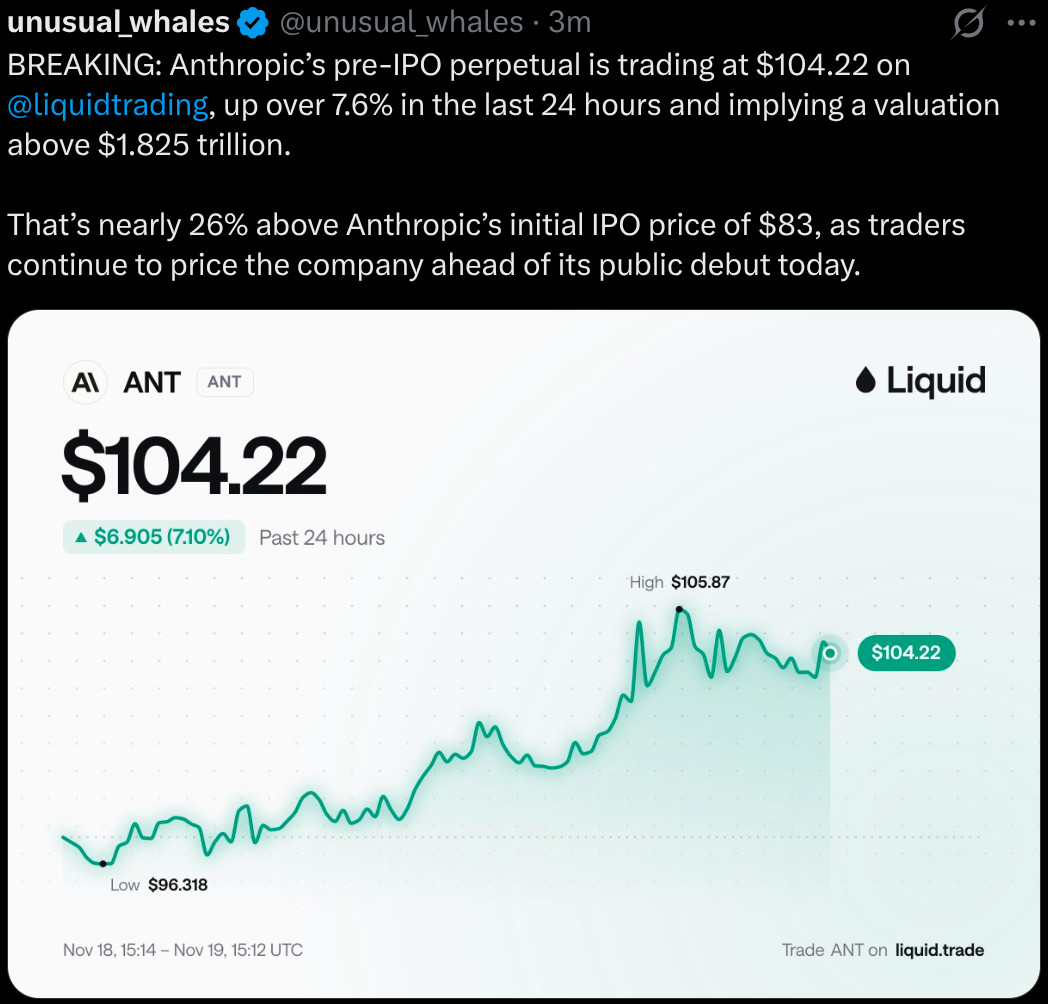
Opened at a price of $111.50, meaning +34%.
Demand will be sufficient at least for a while, as so many people missed out. Index funds are practically forced to buy, since the valuation is ~$2tn.
Sure, eventually, but no index adds them directly. They all have various waiting periods ranging from about a week to a year
7 Likes
A large portion of indices, with the exception of Nasdaq, weight companies based on their free float, not overall market cap. Based on a quick Google search, Anthropic’s free float is currently only 5% of the total shares outstanding.
During SpaceX’s listing, Nasdaq had some sort of workaround/twist that allowed it to enter the index with a higher weighting than what could have been expected based on its free float.
So, when/if it gets added to indices (rebalancing is usually once a quarter), the buying pressure won’t be as high as the market cap might suggest.
7 Likes