Amazon - When will growth limits be reached?

True. I could have googled Pacific Time instead of trying to calculate it myself :grin:

There was a slight weakness in the new guidance, though expected, that growth cannot continue as strong. The company puts a surprising amount of money into charity, perhaps this is some kind of “competitive advantage”.

According to the Wall Street Journal, Amazon’s first department stores will open in Ohio and California, among other locations. The paper’s sources indicate that the company’s plans are still incomplete and may change.
Amazon’s move into mall-level retail signifies a significant shift in the company’s strategy. Previously, Amazon focused on e-commerce, which was a contributing factor to the decline of many old-school department store chains.

According to the online magazine Gizmodo, Amazon’s physical expansion is primarily about data collection. Facebook and Google do this on a clearly larger scale than Amazon, which the e-commerce giant wants to change.

3 Likes

https://twitter.com/DeItaone/status/1489343435819655179

:cold_sweat:

Hopefully, this won’t ruin an otherwise good report. Edit: this time, the somewhat weak guidance didn’t seem to hit.

https://twitter.com/LiveSquawk/status/1489343827555110914

Inflation hits Amazon Prime’s monthly fee :smiley:

https://twitter.com/DeItaone/status/1489344006295334925

5 Likes

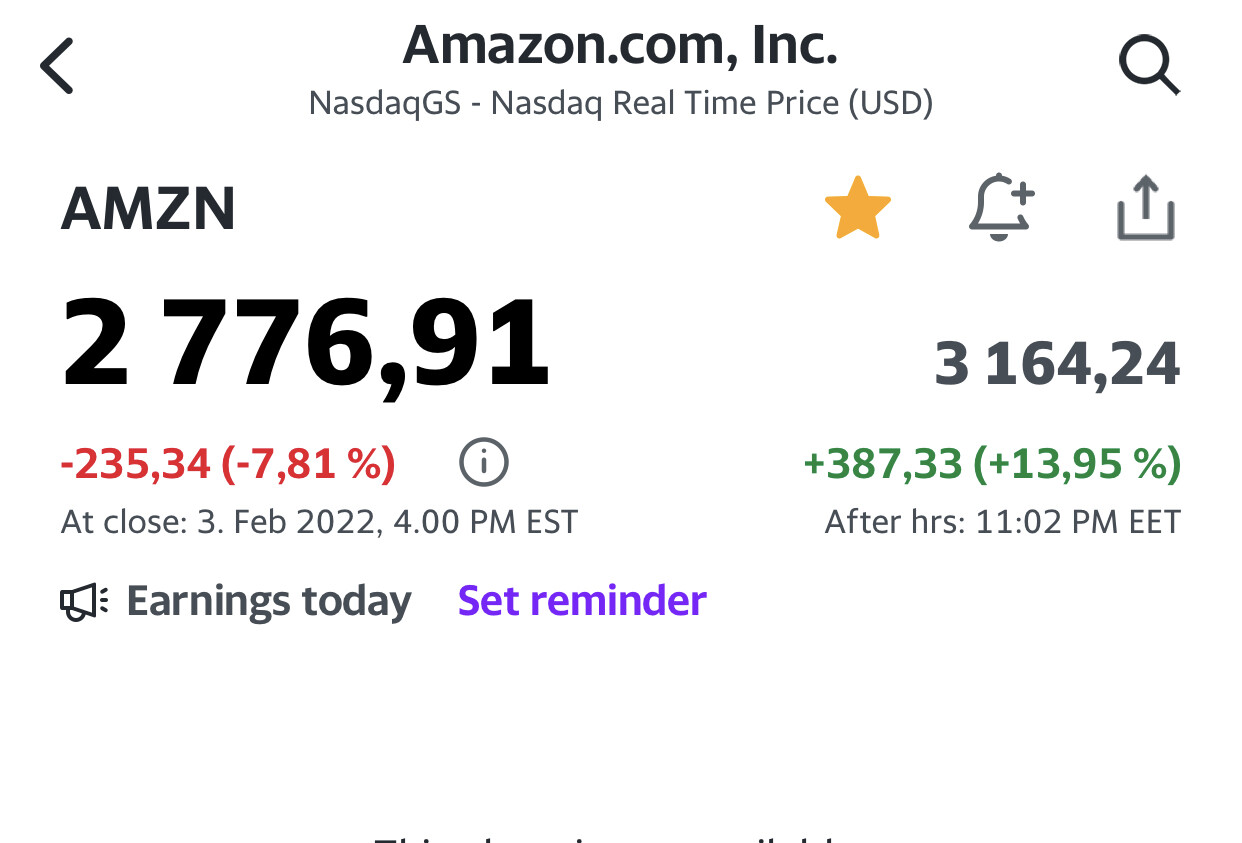
Up +15% after hours, up day tomorrow? :hugs: It’s a wild ride in both directions.

2 Likes

Hmm, a significant portion of the EPS figure comes from the appreciation of Rivian shares owned by Amazon.

https://finance.yahoo.com/news/amazon-com-announces-fourth-quarter-210100622.html

  • Net income increased to $14.3 billion in the fourth quarter, or $27.75 per diluted share, compared with $7.2 billion, or $14.09 per diluted share, in fourth quarter 2020. Fourth quarter 2021 net income includes a pre-tax valuation gain of $11.8 billion included in non-operating income from our common stock investment in Rivian Automotive, Inc., which completed an initial public offering in November.

I wonder if this will “fly” with the market, as without it, the earnings would have been significantly lower. And right now, Rivian’s stock is probably 40-50% cheaper than at the end of Q4


13 Likes

True! However, the guidance was for 0-3 billion dollars, so the net seems to be 2.5 billion.

2 Likes

Following up on this - in fact, that’s an accounting technicality. GAAP (and IFRS) require fair value changes to be recognized in profit. Conversely, this must be deducted from the cash flow statement.

AMZN’s valuation doesn’t follow EPS - the company practically reinvests everything possible back into the business, and precisely for this reason, EPS (and thus P/E) hasn’t had the same significance for AMZN as it has for so-called normal companies.

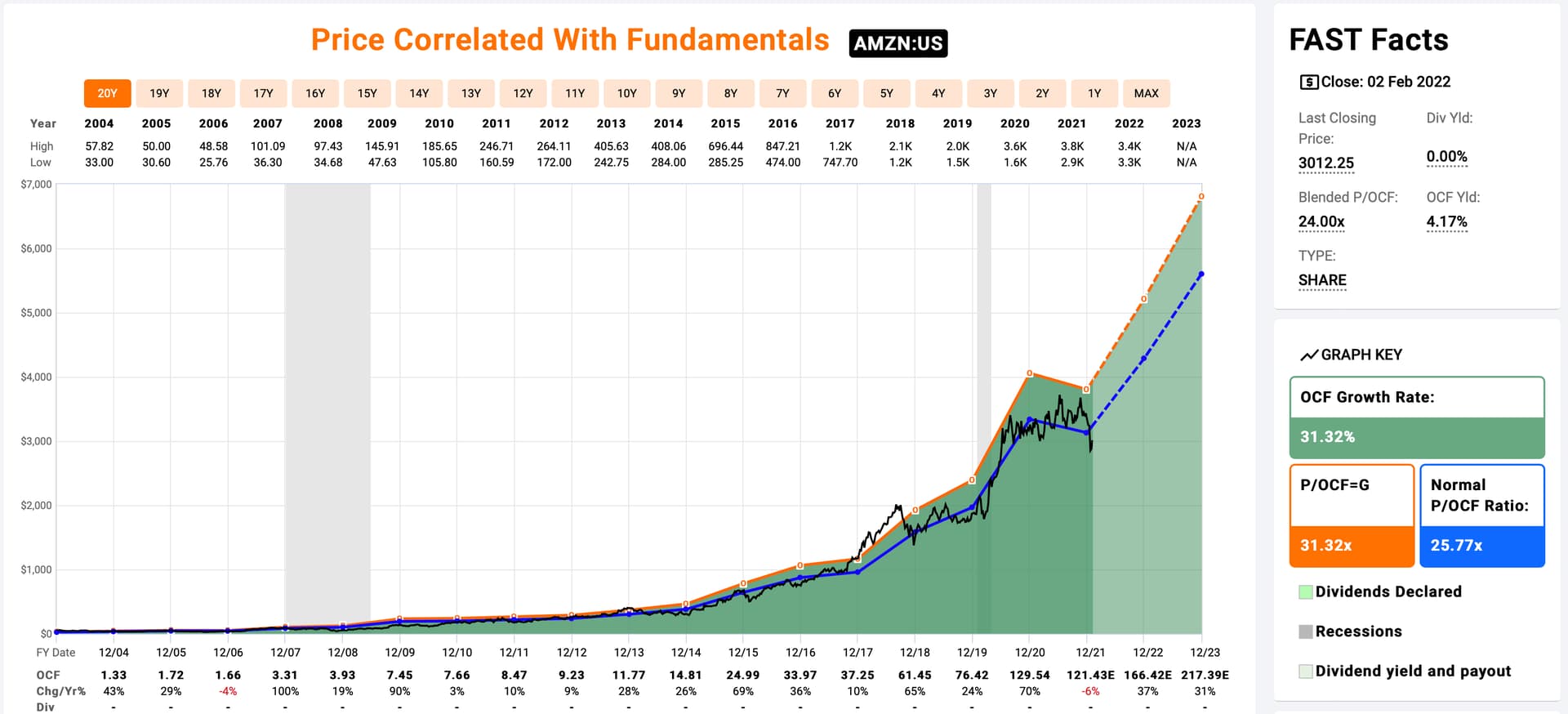
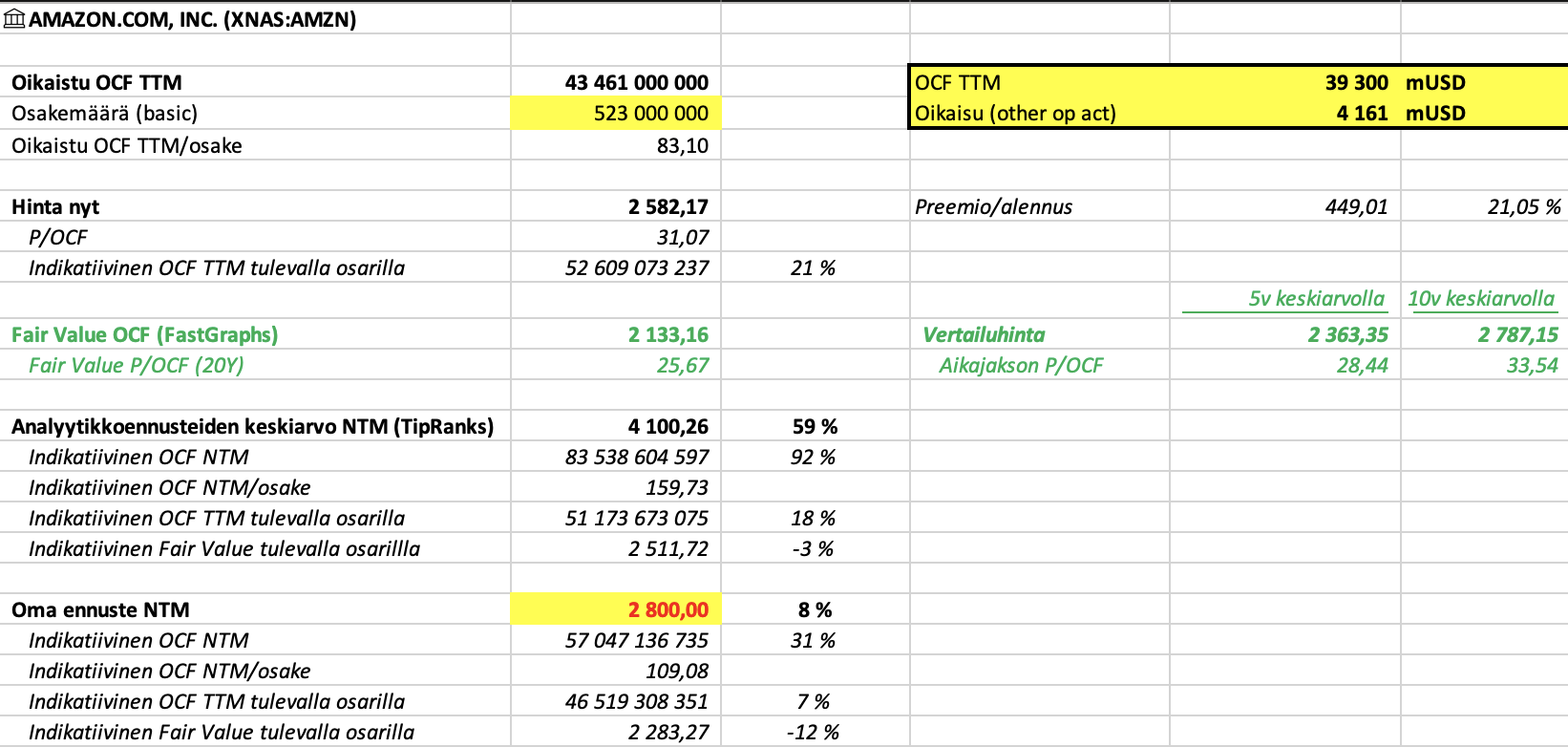
A better valuation method has been price/operating cash flow (P/OCF). In the long term (two decades), the “correct” P/OCF multiple has been around 25-26x, which is slightly below the long-term OCF growth (approx. 32% YoY). See the chart from FastGraphs.

If the OCF calculation is adjusted for RIVN and other non-cash flow items (a total of 14.3 billion), we arrive at an adjusted OCF figure of 60.6 billion. Multiplied by the P/OCF of 25-26x → approx. $3100 would be the so-called fair price based on the long-term multiple. Now that OCF growth has been slightly higher again (30-33% YoY), this math leads to the current after-hours trading price.

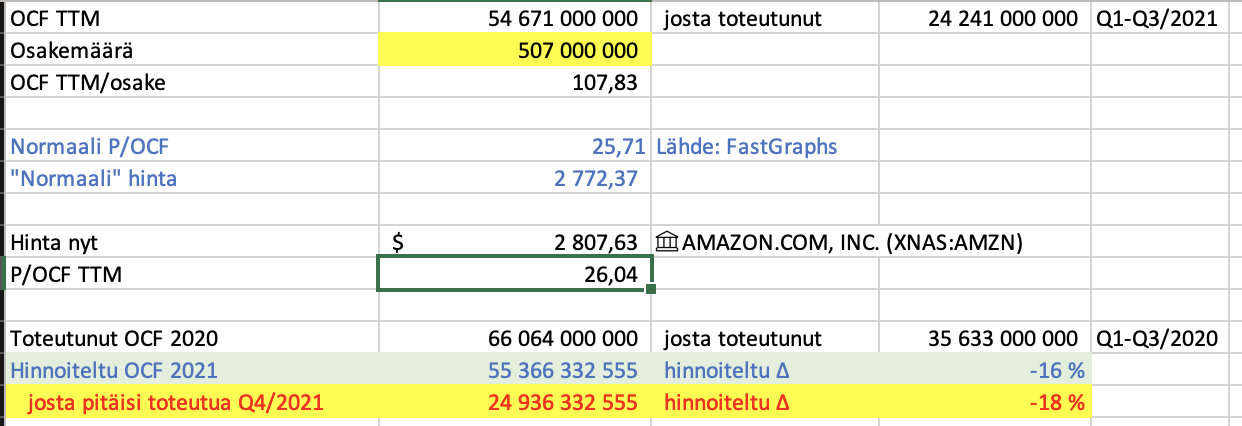
It was also no coincidence that the price dropped to the $2700-2800 levels. After Q3, TTM OCF was approximately 54.7 billion, number of shares 506 million → OCF/share ≈ $108. That multiplied by 25-26x ≈ $2700-2808! Here is the calculation before this latest earnings report:

And here is the latest (basic share count decreased from 507m to 506m):

None of this is, of course, the absolute truth, but it gives an indication.

72 Likes

Ah, excellent contribution, Pamir! :slight_smile: Everyone could learn from that.

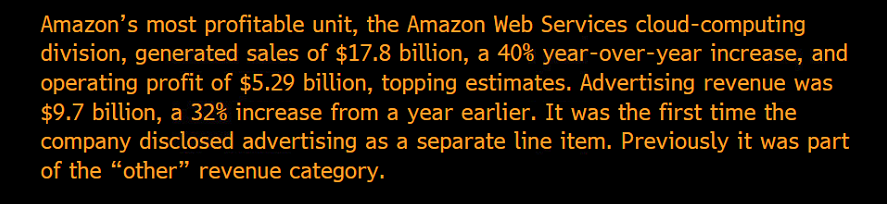
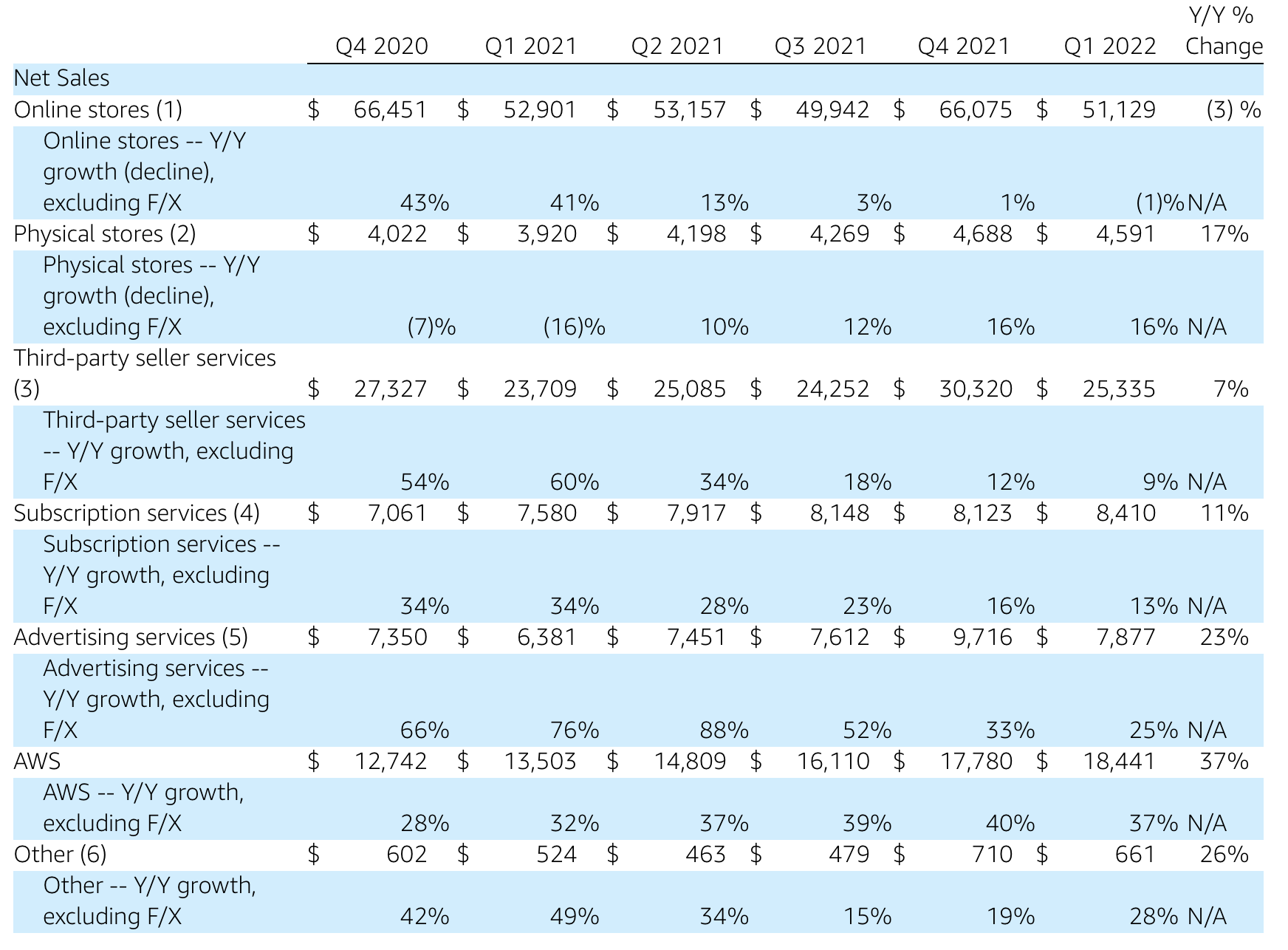
I’d also like to point out that in addition to EPS not mattering, AWS within Amazon grew exceptionally at +40%. The Ads business was reported separately for the first time, to my understanding, and it generates revenue at a rate of 10 billion per quarter and is, as far as I know, very lucrative.

17 Likes

https://www.barrons.com/articles/amazon-announces-20-for-1-stock-split-and-10-billion-buyback-plan-51646863502

Amazon announced a 20-for-1 stock split and a $10 billion stock buyback program, replacing its previous $5 billion program. The buyback program has no expiration date. The stock is up about 6% in after-hours trading.

This will also improve its chances of joining the Dow Jones Industrial Average, as the stock price is a very strong factor in the index’s calculation formulas. The Amazon split will be effective at the close of business on May 27.

Of course, it affects market liquidity when instead of $3000, a few hundred dollars are needed for one share.

12 Likes

Amazon’s AWS cloud platform seeks to address this challenge with Local Zone network areas, which bring the edge of the cloud closer to end-users. Local Zone areas are being built in numerous major cities in the coming years, one of which is Helsinki.

“Local Zone network areas offer the opportunity to develop applications with a latency of less than ten milliseconds. The end-user will notice this as an improved user experience,” summarizes Gunnar Grosch, who is responsible for AWS developer relations in the Nordics.

1 Like

Amazon has announced 37 new renewable energy projects around the world.

marking significant progress on its path to power 100% of its operations with renewable energy by 2025—five years ahead of the original target of 2030.

Upon completion of these projects, Amazon will have 310 renewable energy projects producing 42,000 GWh of renewable energy annually. In Finland, electricity generated from renewable energy sources in 2020 was 34.7 TWh (Tilastokeskus - SÀhkön ja lÀmmön tuotanto 2020).

According to its own statement, Amazon is the world’s largest corporate buyer of renewable energy.

6 Likes

Those familiar with concrete might already know this, but it was news to me that aggregating third-party stores on Amazon is a significant and apparently very profitable business.

I listened to an hour-long podcast on the topic (dated 11/17/2021). Here’s a summary below:
The concept of Amazon aggregators is relatively new, tracing back to 2018 with the founding of Thrasio. But the ecosystem is already huge and growing. Most recent numbers peg it at around $300 billion in revenue and growing faster than Amazon itself.

Amazon aggregators, run around and go buy up these storefronts [third party sellers]. If you think about what these storefronts are, they’re small businesses, they sell all kinds of things, might sell whiteboards, beauty creams, scissors, anything.

And what you do is you basically buy these seller accounts. You get the ASIN, you get the SKUs, you get the inventory, you get the reviews, the comments, all the assets, and you continue to operate them. The thought being that an Amazon aggregator finds these seller accounts more valuable than the seller themselves does, because the operator, the aggregator is able to operate at scale. They often have a point of view that post purchase they might be able to improve the assets. And so basically what these aggregators do is they run around, they raise a bunch of debt capital, they raise a bunch of equity capital, they use that capital to go buy these assets at what they think are reasonable prices and then operate them.

https://www.joincolossus.com/episodes/17446067/hamed-amazon-aggregators-buying-third-party-sellers?tab=transcript

3 Likes

Disappointing, to say the least. Net sales and net income roughly hit the guidance (EPS still doesn’t really matter with AMZN, as they are all over the place), but operating cash flow was a big miss.

The e-commerce business, which acts as a cash register in AMZN’s system, is sputtering despite large investments. Costs have increased across the board, and it seems they haven’t been able to pass them on to customers.

A very rough adjusted OCF (= operating cash flow adjusted for non-cash flow profit/loss components, such as changes in the value of RIVN) was approximately $43.4 billion, while my own expectations were around $62 billion. That would have been a slight improvement over the previous earnings report – based on analyst estimates, it should have been around $65 billion.

The sales mix and segments show that retail growth has generally slowed down, and e-commerce has even shrunk. AWS alone cannot be the savior, even though its growth is still very strong.


My position decreased in the after-hours, and the rest will be gone tomorrow. At this rate, the Fair Value based on the longer-term P/OCF ratio (25.67x, 20-year average) would be in the range of $2,100-$2,150.

Of course, this is just one, albeit effective, way to think about AMZN’s valuation. The more AWS or other higher-growth businesses take over as components of revenue, the more we need to rethink the approach. I am often wrong, and this is not an investment or sales recommendation :blush:

26 Likes

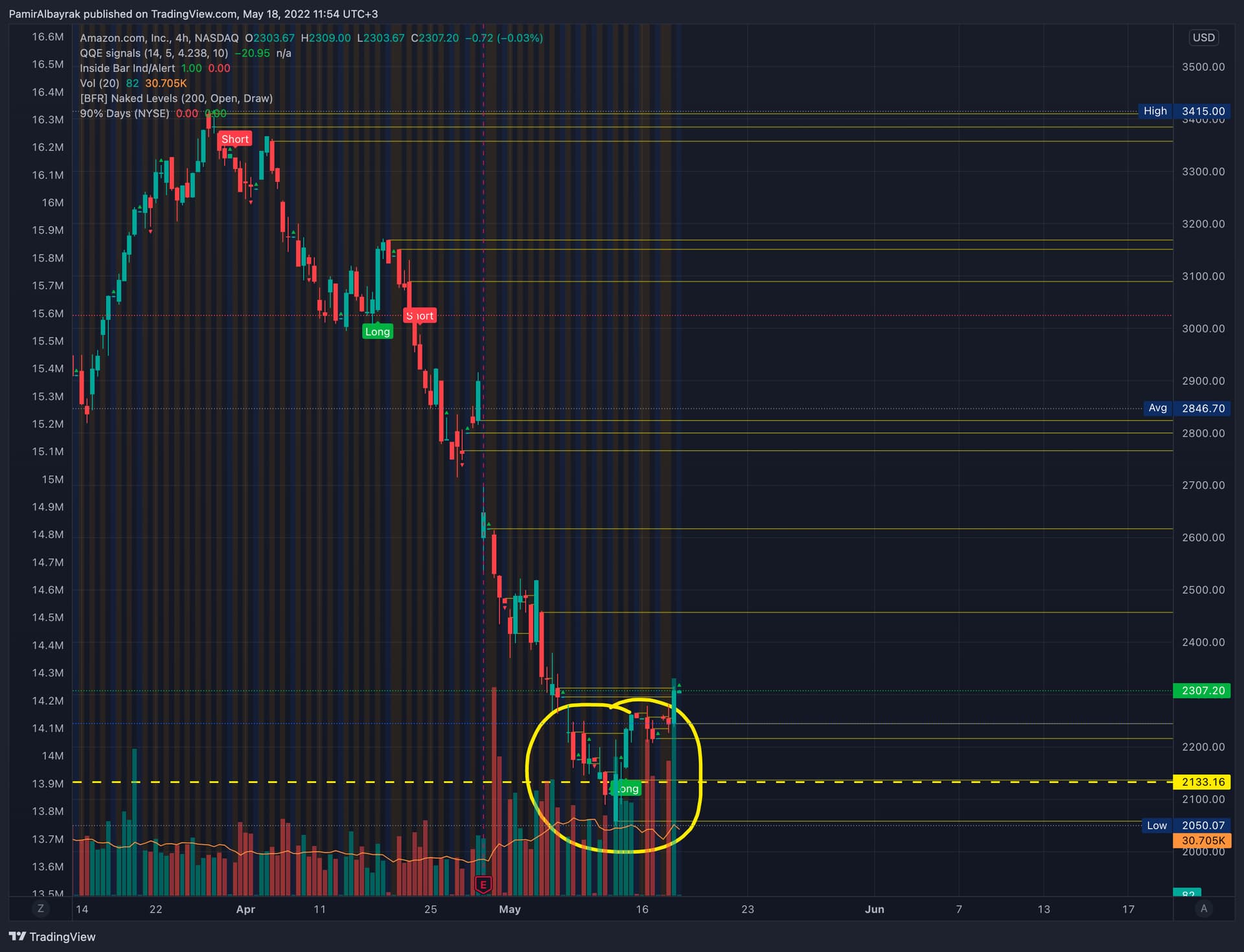
The price seems to have pivoted quite a bit from the Fair Value levels :blush:

Edit: if recession fears take hold again and/or consumer demand weakens significantly, this level may not hold.

image

6 Likes

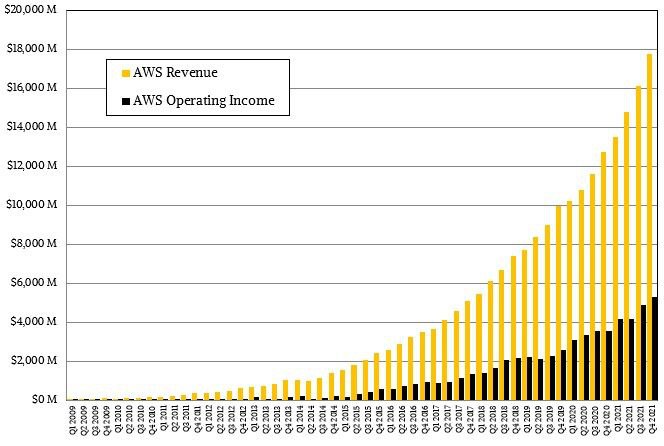
Here, it’s always clearly forgotten what the REAL CORE of Amazon’s investment case is. Hint: it’s not the amazon.com web store, it’s AWS:

AWS is still growing at 40% per year. After this year, Amazon market cap = AWS sales * ~10

Not at all a bad price for a company that has other business than just those servers as IaaS (Infrastructure as a Service) :slight_smile:

13 Likes

You seem to be very knowledgeable about Amazon, so I’ll bother you with some questions.

What is your understanding of Amazon’s retail business’s long-term profitability potential? In the US, I recall the operating profit margin has been around 2-4%, but internationally, it’s above 0%. Walmart’s EBIT% has been 4-4.5% in recent years.

The ads business has grown from nothing to $30 billion in a few years. In that business, judging by Facebook and Google, profitability is extremely high. Will the massive e-commerce ultimately be monetized through selling visibility? :smiley:

AWS is the most impressive growth engine here, but now the difficulties in e-commerce seem to dim its luster.

On the other hand, I’m a bit skeptical whether such high multiples would still be paid for this business alone, now that it’s already in the $70 billion range and facing competition from MSFT, Google, and others in the market.

10 Likes

Sure thing :blush:

I have to admit that I haven’t really thought about retail profitability beyond the following:

i) profitability can be compromised as long as the cash register rings, and
ii) it rings more over time, because by compromising on profitability, market share can be maintained/grown.

In other words, in my view, Amazon could even do retail at zero margin, because the purpose of this business is to bring liquidity to the company and grow the absolute number of users in Amazon’s ecosystem (buyers/sellers, users/IT solution providers, etc.) and maximize the network effects between them.

The most important driver in retail is the global growth of e-commerce. Amazon’s value depends on how this growth continues and how the cash can be utilized in creating network effects.

AWS is a damn good example of the company’s ability to generate cash: AWS was initially the engine room of the online store, which became a “platform within a platform,” and subsequently began to live a life of its own. Amazon hardly ever needs to consider how large investments they have to make in IT infrastructure for any business, because these investments are likely to be repaid by AWS users in the future.

The ad business is another good example of the same capability. It’s profitable, of course, when there was already a ready infrastructure (online store + AWS), as well as the parties involved (buyers and sellers, on the AWS side, sellers’ IT departments and their IT suppliers) :money_mouth_face: This business is currently most strongly linked to retail.

I don’t quite understand yet how Rivian fits into the overall picture, but it’s most likely an extension of both AWS and the ad business – and why not the online store too, if it can handle Rivian’s aftersales from maintenance to tuning?

The more ways they find to create new network effects, the more valuable it will become – and at the same time, harder to value solely on the cash flow from retail, if and when AWS grows larger than retail. Edit: I agree that retail alone would not justify such multipliers.

15 Likes

Following up on the previous point - some condensed thoughts from on the road - instead of retail profitability, the key would be to get back to growing operational cash flow, regardless of its source. However, this shouldn’t lead to losses either.

It will take some time for these new businesses, alongside AWS, to generate the same kind of operational cash flow (and its growth) as retail once did.

Hopefully, after these major investments, retail will see more substantial growth. It’s unlikely that we’ll return to past growth figures, so monetizing the platform through new means is essential.

At an opportune moment, it’s important to examine how the growth prospects of these different businesses might develop over the next 2-3 years. It’s probably not worth trying to see further than that.

8 Likes

Thanks, good thoughts! :slight_smile:

This is what makes Amazon difficult to value: how do decades and hundreds of billions of investments pay themselves back? AWS was a fortunate semi-accident, Ads a logical money-spinner on top of the current system.

This is a fun way to think of e-commerce and Prime as just a way to get people into the Amazon ecosystem, which is then monetized through other channels. :smiley: For FB, it was friends’ content and time will tell if that’s very sticky, but Amazon is, to my understanding, very sticky. :smiley: At least there’s always demand for affordable products.

I’ll have to mull it over


9 Likes