This Friday, it’s the turn of a forum member who, in certain aspects, is my median interviewee and perhaps even a median forum member.
Well… he is much more than that… fortunately.. he is a writer of good messages that bring added value to investors, which include essential information and good, high-quality personal reflection. In addition, he seems to have that kind of common sense which investors, especially, easily forget when emotional and overly confident.
He doesn’t seem to be playing tricks, but rather focuses on essential matters; partly, he perhaps has a back-to-basics style of investing.
Osinkoseilaaja comes across as an analytical, patient, and thoughtful fellow. He also seems grounded, practical, and determined.
His style is relaxed yet professional, and in my opinion, he exudes experience and tranquility, meaning he doesn’t seem like an overly hasty investor.
Seilaaja also conveys a genuine enthusiasm for investing, coupled with an appropriate humility towards the market. He truly puts into practice what is hoped for here on the Forum—that fellow investors help each other out—an activity that benefits the entire community.
I hope that with this interview, he will be inspired to become even more active on our Forum for our enjoyment.
I am a man in my early forties, with a Master of Science in Engineering and a Master of Science in Economics, working in industry, an active investor, and a part-time entrepreneur. I live with my wife far from the capital region. I much prefer collecting experiences over material things. I paid about a week’s gross salary for my car, but travel costs me thousands of euros a year.
2. Tell us three things that few people know about you.
I am a passionate homebrewer; I have lived in three countries; I have visited fifty countries.
3. What interests and hobbies do you have besides investing?
The gym, traveling, homebrewing, reading, good food & drinks.
4. What is a typical weekday like for you?
I usually wake up around 7 a.m., eat breakfast, and browse the news at the same time. I especially check economic news, but local news is also of interest. Half the week I am at the office and half at home, so I either commute to work or move to my home office.
5. What kind of investor are you?
Patient and cash-flow oriented. Nowadays perhaps even somewhat cautious. I don’t even try to find tenbaggers; rather, I aim to avoid landmines. I have – hopefully – already paid most of my tuition fees to the market.
6. What is your investment history?
I bought my first mutual funds back in the early '90s. If I remember correctly, they might have been Aktia Global and Aktia Secura. At the same time, I was bought a (faux) leather briefcase because I absolutely had to have one. So I was an investor about a meter tall at the time. As I recall, I held those funds for quite a long time, but eventually parted with them, and then I didn’t have any investments for years. Then, around the financial crisis, in the autumn of 2008 as I recall, I bought some stocks for the first time – Fortum, Pöyry, and Nokia – but this was by no means actual investing, rather speculation. I sold everything I had a couple of years later and put it as cash towards my first owner-occupied home. I would say that systematic investing started in 2012 when I bought my first investment property. Back then, real estate investing wasn’t very popular, and there was no experience in my family or circle of acquaintances. The idea just popped into my head from somewhere, and I started running an Excel sheet. Over the following years, I gained both experience and cash flow, and it was a time of falling interest rates, so I set off rapidly growing my real estate portfolio. In addition, I found a good counterparty at the bank who understood what I was building. Once I secured a bullet loan, I started investing the cash flow to the max, first into more properties and later above all into stocks. So, a snowball effect, years before the book of the same name was published. I haven’t bought properties for many years now, focusing nowadays purely on stocks and, of course, maintaining the real estate portfolio. I started systematic stock picking in 2017 and have stayed on that path ever since.
7. Does your username Osinkoseilaaja describe you well as an investor?
Yes and no. I never [again] invest in anything solely for dividends, and on a case-by-case basis, I also invest in stocks that pay no dividends at all. However, cash flow is at the core of my investment activity, meaning that on average, I do favor good dividend payers. Although theoretically it isn’t smart to withdraw taxable dividends that aren’t needed for living expenses, I appreciate the opportunities that cash flow brings.
8. What kind of portfolio do you have? If you had to hold two stocks for at least ten years, which ones would you choose and why?
About 60% is in investment properties and about 40% in securities. Cash is usually just a few percentage points. Leverage is currently around 35%. The largest positions in my securities portfolio are Nordea, Investor, Aktia, Sampo, and the S&P 500 ETF, in that order. My portfolio consists of four main groups: good dividend payers (e.g., Nordea, Sampo, Aktia, CapMan, Evli), exceptionally successful investment companies (Investor, Latour, Svolder, Lundbergföretagen), growth companies from boring industries (Harvia, Tokmanni, Kamux), and broadly diversified ETFs (e.g., SXR8, Amundi Nasdaq 100, IS3N).
In that case, I would definitely choose two investment companies with broad diversification, meaning that even if I only had two direct holdings, I would get good diversification through them. Right now, I would choose Investor and Latour, both Swedish. Both have an excellent track record, broad diversification, interesting unlisted holdings, low management fees, and solid family ownership.
9. What is your step-by-step stock picking process?
Very boring. I am actually quite satisfied with my current portfolio, and I very rarely open new positions, and even more rarely part with existing ones. Generally speaking, I favor boring industries and try to avoid all kinds of hype, so I mostly look at such fundamentally boring companies. If something interesting turns up, I try to get to know the company relatively comprehensively. I am particularly interested in steady earnings capability and a solid history.10. How do you normally research a company’s figures, do you crunch a lot of DCF models yourself, or do you look straight at an analyst’s report?
I don’t crunch numbers. I try to keep my operations as simple as possible by investing in steadily performing companies with reasonable valuations and rising dividends. The key metrics I mainly follow are P/E, EV/EBIT, P/B, dividend yield & history, and ROE-%. I also look at the debt-to-equity ratio.
11. In fifty words, what do you think of the following as investment targets?
- Aktia: boring, good dividend payer, I like it! The wealth management side has consistently been sluggish, but the dividend alone roughly matches the index return, so my view is that in a bad scenario I get ~index return while getting good cash flow, and in a good scenario something even better. I always buy the dips, as I have done for years.
- Aspo: boring, former good dividend payer, I liked it! Aspo was well on its way in the right direction when the war in Ukraine started. Unfortunately, this was a hard blow to Aspo’s operations, but now it looks like the transition from East to West is progressing well. Still, I haven’t increased my position for a long time, but are waiting until the ship has definitely turned – and the dividend rises again.
- Nordea: boring, good dividend payer, I like it! By far the largest position in my securities portfolio with a weight of over 15%. A few years ago it was one of the worst major banks in the Nordics, now it is perhaps the best of them. Good geographical diversification in safe Nordic countries. High dividend, heavy buybacks. I will continue to buy the dips in the future, as I have done for years, but now only moderately because my position is already so large.
- Tokmanni: boring, former good dividend payer, I liked it! Currently my worst stock investment of my career, calculated in euros. The headwinds are strong and have lasted for years. However, I am not ready to give up yet, because I still trust that Tokmanni can do better. In addition, good growth opportunities have been created both abroad (DollarStore/Sweden and Big Dollar/Denmark) and domestically (Spar).
12. Why do you pick stocks, why not just funds? 95 percent lose to the index and maybe a percent or a promille beat it in a way that you genuinely get an hourly wage per time spent on investment stuff?
A good question that is always worth asking yourself from time to time. I have three reasons for it:
(1) Cash flow - sure, there are also index funds that pay dividends, but I favor heavy dividend payers that might not be found in a suitable “index package”. In addition, prices always fluctuate, but at least so far the dividends I have received have, except for the corona year 2020, always consistently increased significantly.
(2) Interest – I think stock picking is a very enjoyable intellectual challenge, and I don’t enjoy buying index funds in the same way at all (although I do practice that too).
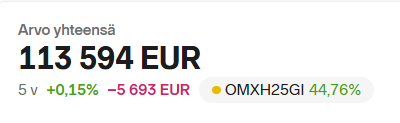
(3) Belief in myself – my five-year return is currently +74%, while OMXH25GI has returned +45% over the same period. Enough capital is tied up that this is a significant difference in euros too. Of course, I don’t know if I can keep doing this in the future, and at the point when the situation changes for a longer period, I am humble enough to be willing to consider a change; naturally while also taking point (1) into account.
13. In your opinion, what are your three best traits as an investor, and what do you think should be your most important area for improvement?
Best: perseverance, lack of FOMO, belief in one’s own actions.
Room for improvement: reacting faster to bad news (i.e. selling), reacting slower to falling prices (i.e. buying), increasing the weight of ETFs / index funds.
14. If you could teach all forum members one thing about investing just by pressing a button, what would it be and why?
A boring lesson from a boring investor: diversify! Especially when you have already accumulated a little capital, this is perhaps the most important lesson. If everything is tied up in one or a couple of targets and the famous black swan strikes, recovery from it can take years.
15. If you had to choose three from the Forum and 2 from Inderes’ staff to manage your portfolio for 10 years, who would you choose and why?
Forum: Lyly_ja_Immo, superg and NukkeNukuttaja. The first two have already achieved the kind of portfolios I am still working towards myself. In addition, the first always offers entertaining reading and the second a suitably relaxed approach to serious money matters. I don’t know the size of NukkeNukuttaja’s portfolio, but I’ve noticed that I very often identify with his thoughts.
Inderes: Sauli & Kasper, because most of my investments are tied up in companies they monitor. In addition, I like Sauli’s style and interviews.
16. In your profile you mention that you are a real estate investor, tell us a bit about your real estate investment activities?
I actually started in 2012, just before the zero-interest rate era. With relatively high leverage, passion, and a bullet loan, I ended up acquiring about twenty apartments in my home town over the following years. After a few years, I also founded an investment company through which I have invested in both real estate and securities. I am no longer growing the real estate portfolio, because the workload alongside a day job would be too large. The real estate portfolio provides relatively steady cash flow with which I nowadays partly pay off my investment loans and partly still continue to invest in securities.
17. What would today’s Dividend Sailor say to the Dividend Sailor who just started investing?
Diversify, be humble, sell [faster] on bad news.
**18. What goals do you have in investing? What concrete good have you gotten from the wealth brought by investing?**I am not a FIRE enthusiast (firettäjä), but I do plan to step away from the 9-to-5 long before retirement age. The intention is certainly not to rest, but to focus on my own projects and investments. I guess this could be summarized as aiming for [financial] freedom.
Even though investments sometimes stress me out (especially the real estate side), I would say I have a certain peace of mind. I’ve accumulated enough capital that I would manage even if I became unemployed tomorrow for the rest of my life.
19. In your profile, you mention that you favor profitable companies. What are the most important things you look at specifically regarding a company’s profitability? Alokas (username) finds it difficult to look at a company’s profitability when you have to consider the big picture, the industry it operates in, etc.
I still strive to simplify investing, so I mostly monitor how much is left on the bottom line (EBIT, EBITA) and Return on Equity (ROE-%). In addition, some kind of comparison to peers / competitors.
20. What would you like to thank Inderes and the Inderes investment forum for?
Inderes’ analyses and the investment forum currently play a pretty central role when I look for news, financial content, and insights, so a big thank you to the entire staff and also to all forum members!
Thank you for the great answers!
Seilaaja’s answers brought to mind that no matter what the matter is, always get the basics in order first, but I would say that this is often more or less forgotten by the vast majority - I have noticed this especially well in my beloved hobbies, such as investing and going to the gym. And I don’t even know if I myself have even been able to focus on them satisfactorily.
Thanks for the nice interview @Sijoittaja-alokas! It’s always good to get your thoughts down on paper, especially when someone else challenges you a bit.
By the way, I wrote my answers a couple of weeks ago, and quite a lot has happened since then, at least by my standards.
It’s nice to read your cheerful messages, which contain independent good reflection, and clearly, behind the reflection is knowledge and genuine understanding.
I still can’t quite manage that very independent reasoning, or I can, but my own independent conclusions are about 85-95 percent wrong, and because I sometimes present things in my thoughts even credibly as if I knew, some might even believe me. So there’s still work to be done on the basics, and no area is even satisfactory, except for the savings rate, which is excellent… as is the work ethic.
My investment career is entering its ninth year, here are the returns from my investment history:
This Friday, we’ll be interviewing someone who has recently caught our attention in a good way with their activity on the Forum. They have written plenty of interesting and high-quality messages in various company threads.
Many might already know them from X, but they haven’t really been seen on the Forum before, even though their user account has existed for a long time.
Tomi is an inspiring and knowledgeable investor whose clear and thorough writings have recently enriched the Forum’s discussions. His long experience, patient attitude, and sensible, calm approach to the market create a convincing picture of a long-term stock picker.
Tomi has done a wonderful job bringing useful and interesting information and his thoughts on various companies and related matters to the Forum. His concise highlights and individual reflections have also sparked good discussions in the company threads. Oh, and his good articles that he has written should not be forgotten either.
Through his actions, he helps other investors and seems like a thoroughly friendly guy—just the kind of guy who fits in well on this Forum.
I am a 41-year-old retail investor and part-time stock market journalist. I have a 20-year investment career behind me. I have worked in investor relations tasks for listed companies and acted as a equity analyst. Currently, I also serve on the board of the Central Uusimaa Shareholders’ Association (Keski-Uudenmaan Osakesäästäjät).
2. Name three things few people know about you.
I play chess at the club level and occasionally participate in competitions. On YouTube, I follow the @PowerPlayChess channel, where Grandmaster Daniel King analyzes games of top players like Magnus Carlsen. I like to travel—over the past 12 months, I have visited Switzerland, France, Spain, and New York. I especially follow British football. I go to watch various teams’ games, even though I support Chelsea.
3. What interests and hobbies do you have besides investing?
Exercise is a lifestyle for me and a significant part of everyday life. I play football in the men’s M40 league, play tennis and table tennis, and go jogging. However, a red light has been issued from home for all new hobbies.
4. What is a normal weekday like for you?
I wake up around 7:00 a.m., read the day’s news, and start writing an article or stock analysis. I review company materials and read or listen to Inderes’ analyses. During the day, I post interesting investment cases on X or the Inderes forum. I check the day’s price trends and stock market news. I am at the computer until about 4:00 p.m., after which I focus on family life and hobbies.
5. What kind of an investor are you?
I am a patient stock saver. My portfolio contains only direct stock investments, excluding my own home. I focus on small and mid-cap companies because mispricings can be found among them. I have learned that one should not panic during market corrections or crashes. Buying more shares during them has often proven profitable. I buy steadily with small amounts and avoid major moves. I am already waiting for the next market correction!
6. What is your investment history?
I made my first investments as a high school student in 1999–2000, speculating on IT companies. I don’t count that as investing yet, because I didn’t understand much about it back then. The investment bug bit me only at Jorma Kokko’s investment course in 2004. I started stock saving in 2005 when I began my studies for a Master of Science in Economics and Business Administration at the University of Jyväskylä. At the same time, I joined the Central Finland Shareholders’ Association and got onto the board at a young age. Since then, I have mainly bought companies on the Helsinki Stock Exchange, keeping almost all my savings in stocks. I have followed the markets daily for 20 years, excluding holidays. Every day you learn something new, and market reactions still surprise you.
7. What kind of portfolio do you have? What is your portfolio’s largest holding, and why is its share the largest in your portfolio?
My stock portfolio is well diversified across 21 stocks. The main emphasis is on small and mid-cap companies. I consider sector diversification more important than geographical diversification. The weight of the largest holding is about 10%. The portfolio includes growth companies, turnaround companies, and value stocks. I diversify because it helps me sleep better at night!
8. What is your stock-picking process normally step by step?
I familiarize myself with the company’s materials, such as interim reports, annual reports, and CMD materials. I try to get an idea of the company’s business, strategy, goals, and market. If I don’t understand the company’s operations well enough, I give up.
I check the products and potential product reviews through the company’s website.
If an Inderes analysis of the company is available, I read it through. I might watch video material and listen to the latest webcast.
I look at what has been written about the company in financial media and social media.
I check the valuation multiples from the analyst report or Inderes’ stock tool.
I decide whether to buy or leave the company on my watchlist.
9. What sources of information do you use the most in your stock picking, mention at least five with justifications.
Inderes’ company analyses, stock tools, and videos: Provide in-depth and reliable information about companies.
Koyfin: Key figures, charts, and valuation multiples help with the analysis.
Media (X, Arvopaperi, Kauppalehti, Viisas Raha, Talouselämä): I stay up to date on market trends and news.
Companies’ own investor pages: Provide first-hand information on strategy and business.
Investment events (Osakesäästäjät, Pörssisäätiö, investment fairs): Enable meeting company management and gaining a deeper understanding.
10. What are your three best traits as an investor? And what do you see as your biggest area for improvement as an investor?
My best traits: Patience, long-termism, and thoroughness.Area for improvement: I sometimes suffer from FOMO, for example right now regarding Bittium and Nexstim. Excessive focus on valuation multiples has caused me to miss out on good investment targets. My portfolio is too focused on the Finnish market and has too many holdings. I have learned to avoid falling knives, but in the past, I fell for them.
11. What are the five most important valuation multiples for you, justify your choices.
In no particular order:
EV/Sales: In growth companies, I see how much investors are paying for future growth.
EV/EBIT: My favorite! Shows earnings growth expectations and takes indebtedness into account, which is important in small companies.
P/E: Suitable for evaluating stable companies with steady earnings and a long earnings history.
P/B: Influenced my investing through Lindström’s books before the financial crisis. Still suitable for evaluating industrial stocks, for example.
Dividend yield %: Helps in understanding the valuation of slowly growing value companies, even though I am not a dividend investor.
12. You have been investing for about 20 years, what have been your most memorable moments in the stock market?
An acquaintance arranged for me to attend the Nasdaq bell-ringing ceremony in Times Square. After the market opened, I met Sanjay Mehrotra, the CEO of Micron Technology, a company with a market cap of over 100 billion dollars.
The 2008 financial crisis and the collapse of Lehman Brothers brought things to a halt. I thought the global economy was heading into a depression for a long time. The drop in stock prices in the USA and Finland was unbelievable.
My first general meeting in 2005 as a student. A friend of mine owned a single share of Lemminkäinen and invited me as his assistant. I got a free lunch in the cabinet room at Eteläranta.
At a Pörssisäätiö (Finnish Foundation for Share Promotion) event, I heard about the FDA approval issues at Revenio. I had just bought the company, and the share price crashed by 20%. It was frustrating at the time, but in the end, everything turned out great with the case.
Nokia’s strategy shift and the abandonment of Symbian. The share price dropped by about 15%, but I bought more, believing the market had overreacted. The market was right.
The coronavirus panic of 2020. The Helsinki Stock Exchange dropped 30% in three weeks. Kauppalehti’s headline “We are on the verge of total destruction. God help us” stuck in my mind. Blood was running in the streets, so I continued buying.
13. In your X profile, you state that you focus on Finnish stocks, why… isn’t Hesuli nowadays a “dumpster stock” exchange?
The more the newspapers write about Hesuli’s weakness, the more I research its stocks. Many large companies, such as Nokia, Fortum, Kone, Stora Enso, and UPM, have performed poorly over the last five years, which is reflected in the index. However, beneath the surface, there are many good stocks.
14. Tell us in about 100 words per company what you think of them as an investment target:
GRK
GRK has grown strongly both organically and through acquisitions. The listing coincided with a good cycle in the industry. The company’s long-term return on capital has been over 20%, which is a strong figure for an infrastructure builder. Successful project execution and faster-than-expected progress are currently supporting profitability. The mega-project in northern Sweden (EUR 400 million) is the largest in the company’s history, but its completion will significantly hinder growth in the coming years. Therefore, the company’s long-term financial targets are modest relative to its current earnings capacity. The valuation looks attractive compared to Kreate. Earnings are expected to decline after the peak year (2025), so I am monitoring the situation.
Kempower
Kempower is one of the most interesting potential turnaround companies on the stock exchange. The company is ahead of many of its competitors in rapidly growing DC charging technology. The electrification of cars continues, but the real opportunity is the electrification of commercial vehicles (buses, trucks, vans). Earnings are negative, but the level of the gross margin is encouraging. Cash flow is negative, but analysts expect it to turn positive in 2026. The company is net debt-free, so it can weather the current situation. Orders received this year have surprised positively in both Q1 and Q2, and customer inventories have begun to clear out. The case resembles the early years of Qt, although the industries differ. I started buying in late 2024 and have continued in 2025.
Nexstim
Nexstim is a new acquaintance for me. I met the company’s management at the Stock Exchange Open Doors event, and they seemed very competent. They talked my ear off about the company’s technology. I am just getting to know the company’s business. The price action causes FOMO symptoms, but I don’t own the stock yet because my analysis is still ongoing.
Olvi
Olvi has clear competitive advantages: a strong market position, a good brand, and cost-efficiency. The company makes steady profits, and its return on capital is good. The balance sheet is in excellent condition. Growth is a challenge, but I hope non-alcoholic products will support growth in the future. The new strategy is fresh, so I will give it time. Exiting the Belarusian business could boost the valuation. The company is not sexy, but such targets can be great investments for a long-term owner. I own shares.
15. You must choose three people from Inderes’ staff and three friends from the Forum to manage your portfolio for ten years, who would you choose and why?
Inderes staff: Mikael Rautanen, Sauli Vilén, and Juha Kinnunen. They are long-time analysts whose views I have followed for years. They focus on evaluating companies’ competitive advantages, which is essential in long-term investing.
Forum: I haven’t followed the forum enough to evaluate portfolio managers. I started following the forum recently, so I don’t know the users well enough.
**16. What are the top three investment or financial books you have read? Justify your choices.**One Up on Wall Street, Peter Lynch: Highlights the ordinary investor’s opportunities to find undervalued stocks through everyday observations and simple analysis. Also very entertainingly written.
Vaurastu arvo-osakkeilla (Get Rich with Value Stocks), Kim Lindström: I read this at the beginning of my career, and it influenced my investing for the first ten years. Inspired me to research stocks.
Miten sijoitan pörssiosakkeisiin (How to Invest in Stocks), Seppo Saario: I read it during my student days, and it provided practical tips. Strengthened my desire to focus on direct stock investments.
17. What do you think is the best thing about the Inderes Forum?
The best part is the company-specific threads, where stocks are monitored closely. Forum members dig up information about companies that even analysts don’t always notice.
18. What are your goals in investing?
Investing supports my current career. I aim for returns that beat the index, but I understand that I cannot beat the index every year.
19. Alokas has been picking stocks for about eight years and is in the red on stocks for their entire investment history. Give Alokas three tips to help turn their portfolio around?
I am not familiar with Alokas’s portfolio, but in general, I can give the following tips:
Look for companies with a clear competitive advantage (market position, brand, distribution, cost leadership, patents, technology).
Focus your investments on quality companies that you know thoroughly. Do not overpay for quality.
Cut your losses quickly. Do not catch falling knives, as bad news tends to continue. If you find a winning stock, keep buying even if the price has risen significantly. Let your winners run.
20. What would you like to thank Inderes and its Forum for?
Inderes’ analyst team is the best on the Helsinki Stock Exchange! The company analyses are high quality and versatile. They are a joy to read. I thank the Forum for quick reactions to news and continuous market monitoring. Keep up the good work!
Thanks Tomi!
Tomi has brilliantly and actively raised the standard of the company threads even further with his writings and highlights, and of course, his politeness has also contributed to the overall good of the Forum.
This is a high-quality investment-related Forum, the best parts of which are the messages that bring added value to investing and, of course, this very pleasant Forum community behind those messages.
This Friday, we’ll be interviewing a forum member who is analytical and a good writer, capable of clearly highlighting essentials that are beneficial to investors. He writes in a way that shows he possesses knowledge and understanding, and most importantly; he can present his points with convincing arguments (Statements without more detailed justifications are sometimes a bit useless). His work exudes confidence, deliberation, and an intelligent perspective.
It is always worth paying attention to this guy’s posts, because he brings up thoughts and excellent insights about various companies with well-founded arguments. He doesn’t repeat common knowledge or try to act superior, but always adds something new and valuable to the discussion from the perspective of other investors.
What’s also great about him is that he is a friendly and helpful investor who happily listens to differing opinions. He doesn’t resort to pointless arguing or writing in the heat of emotion, but instead approaches things rationally, openly, and with a healthy dose of criticality.
I especially appreciate that he brings high-quality discussion to threads instead of empty bickering. I recommend stopping to read whenever you see this gentleman’s post.
I am a forty-something passionate investor, athletic family man, and native of Tampere originally from Northern Ireland—wait, Northern Finland—and my dialect probably shines through badly in my writing sometimes. I am now a full-time investor, but that was enabled not by exceptionally successful investing, but by my successful previous career.
2. Tell us three things that few people know about you publicly.
Very little is known about me publicly, so I think the answers to questions 1, 3, and 4 cover this as well.
3. What interests and hobbies do you have besides investing?
I play soccer/futsal, cross-country ski, and orientate. The Jukola relay is currently my main hobby target of the year. In addition, I go to the gym to support and enable my hobbies as far into the future as possible.
4. What is a typical weekday like for you?
Up at seven in the morning, morning routines and breakfast with the whole family, and then after eight, dropping the child off at daycare. My own workday starts at 8:30 at the latest. Outside of earnings season, mornings are quite peaceful, going through fresh market comments, analyses, statistics, press releases, news, and all such things. At some point during the day, exercising or running family errands. Later back to the computer, which then includes everything related to my own investment activities (stock research, market research, market monitoring, discussions with other investors, etc.).
Earnings seasons are vastly different because I go through almost all reports at some level, naturally focusing on the ones I am following most closely at that moment. Back at the computer easily all day long as there are so many reports, interviews, and webcasts to go through.
In the evenings, family life, hobbies, and enabling my spouse’s hobbies. During earnings seasons, after the child has gone to sleep, I might return to the computer to go through things, and otherwise, my spouse bears a bit more responsibility for running family life during earnings seasons, which I then compensate for as best as I can outside of earnings seasons.
5. What kind of investor are you?
Risk-tolerant, focused, and passionate. I strive to follow the companies in my portfolio and potential portfolio companies very closely. If something significant changes in the companies I follow, I try to understand and react to it faster/better than the rest of the market. I try to turn every stone and log. I have also been in contact directly with CEOs, being positively surprised when getting answers without really expecting them.
6. What is your investment history?
Around the financial crisis, I made my first investments with poor knowledge; the 2010s were mostly spent watching from the sidelines (the biggest mistake of my investment career) except for small-scale index investing until the spark was reignited during the corona pandemic as investing rose to become my biggest interest.
7. What kind of portfolio do you have? If you had to guess the two top gainers in your portfolio over the next 12 months, which ones would you choose and why?
I handle international diversification purely through ETFs and Pyn Elite. They are the backbone of the portfolio that live their own quiet life. Relative to the size of the market, a large part of the portfolio is in Finnish small and mid-cap companies, and I manage this part of the portfolio very actively.
From Duell, I expect the biggest returns in my portfolio over the next 12 months. As @Iikka_Numminen states in some video, Duell has collected a royal flush of various misfortunes, and the company itself is not, in my opinion, as bad as the market thinks it is. That said, risks are also elevated as the balance sheet situation tightens after the market fell out from under them in the spring/winter aided by miserable weather conditions.
Boreo also has difficult times behind it after its Russian operations fell through and business cycles hit Boreo’s operations hard while debt was high. Now there is light at the end of the tunnel, and this wheel is starting to turn in the right direction with its debt leverage. They have also returned to acquisitions, which in my opinion also indicates management’s confidence in the future. Boreo’s companies have been trimmed in a poor economic cycle with Iivo Niskanen’s body fat percentages (greetings to @Harri_Sieppi) in mind, and when demand improves, the earnings level will likely rise sharply. In addition, investors will once again begin to appreciate the capital allocation abilities of Kari Nerg (@Rosskopf) and others, and Boreo will be granted higher valuation multiples.
**8. Which two stocks did you buy last? Also, tell us your rationale for the purchase.**I bought NoHo and Keskisuomalainen. I sold NoHo during the spring due to the miserable weather. I have been buying it back after the earnings report, and I bought the latest batch after fresh card data from Nordea confirmed my views of a reasonably strong late summer for restaurants. I bought Keskisuomalainen for my autumn dividend portfolio. I am not a dividend investor, but I know Finns love dividends, and this is reflected in the price performance of dividend stocks in the spring. I fill my dividend portfolio during the autumn and will empty it before the dividends are detached in the spring. The dividend portfolio is only a small part of the whole.
9. What is your stock-picking process normally step by step?
I follow most of the small and medium-sized companies on Helsinki Stock Exchange very closely. I have notes and calculations on these. I follow the statistics, news, analyses, etc. related to them, with interim reports being the most important, of course. I listen to recent and old webcasts/interviews. Portfolio companies and those closest to the portfolio are under closer monitoring. Eventually, some positive/negative event triggers a company to enter or perhaps leave the portfolio. The stock-picking process is therefore very long-term, although sometimes I might immerse myself in a company that is still a bit unfamiliar to me for a few days, and ultimately the buying decision can happen quickly in terms of time. An example of this was Enersense, which entered my portfolio in the summer after a few days of intensive familiarization, when it was still previously classified in the “uninvestable” category under its former CEO.
10. What do you think are the three most underrated valuation multiples? Justify your choice.
It is underrated to use a wide range of valuation multiples because different multiples suit different companies/industries in different situations to describe the current state. I appreciate cash flow-based multiples, but in interpreting them, it is more important than the numbers themselves to be aware of the reasons that make the cash flow look good/bad. The same applies, of course, to all key figures. You have to know the story behind the numbers.
11. Tell us in fifty words what you think of these below as investment targets?
Aallon Group: A proven strategy and reasonably priced on a cash flow basis. However, in my opinion, risks are currently slightly elevated as the new CEO has accelerated acquisitions while starting a transition to a business-based organization. The improvement in economic cycles will be visible in accounting firms’ figures over the next couple of years.
Duell: Caused many, many disappointments for investors through its own actions (acquisitions while already indebted) and with the support of a weak target market, which is why the valuation is at rock bottom. If consumers dare to spend again and trends turn around, investor confidence might also gradually return. Financial leverage will also amplify the development for the better. But why is the stock not appealing to the active management at these levels?
Orthex: An interesting situation as consumer sentiment picks up for Orthex in the larger Nordic market while at the same time growth challenges in the rest of Europe seem to have been temporarily overcome. There is potential for both markets to perform well during the following quarters, although I am slightly concerned about the competitive situation in the Nordic countries as budget competitors challenge Orthex’s market position. Headwinds at the beginning of the year also came from strikes, which are now a thing of the past. I like that management and other employees have a large equity holding.
Talenom: Finland and Spain are doing well. Poor acquisitions have been made in Sweden over the years, and it will take a long time before Sweden pays for itself. In a way, I like Talenom’s erratic strategy and in a way I don’t. It’s good to change direction if something isn’t working, but you still hope for some long-termism. The can is being kicked down the road all the time, but I believe that pot of gold at the end of the rainbow will still come up (but when?).
12. What are your three best traits as an investor? What is your biggest area for improvement as an investor, and if you could have anyone teach you this, who would it be and why?
Risk tolerance, passion, and long-termism. Perhaps I have the most to learn about how the board and management of stock market companies, as well as large owners, think/view things. Probably some successful board professional would be a good person to tell me. Mika Heikkilä might also have something to say about this.
13. Perhaps about 95 percent of retail investors lose to the index, and barely any of the index winners even make an hourly wage… why do you pick stocks when investing in indexes gives you a good return without the hassle?
I believe that I can generate better returns than the indices in the future by limiting my direct stock picking to Finnish small and medium-sized companies. I intend to know my investment targets and potential investment targets better than other market participants. Big-money players cannot operate here due to low liquidity and low market capitalization. To quote Sauli Vilen, you have a better chance of succeeding in a district championship than in the world championships, and unfortunately, this is supported in my opinion by the knowledge level of the average Finnish investor, which comes out in investor events and conversations with them. If I fail at this, at least I have been doing what I love.
14. In your messages, you delve deeply into company numbers and analyst expectations. How do you weigh the importance of quarterly figures vs. long-term strategy in your investment decisions?
I admit I lean more towards being a quarterly investor, or at least my investment horizon may only be the next couple of years. I generally expect the companies I invest in to outperform market expectations over the next 12 months. Sometimes the horizon can be even shorter if I have analyzed (numbers, interviews, market) e.g., comparison periods and concluded that now is a good window to improve performance more than the market is pricing in. Of course, I am happy to ride along for longer when things develop well, but I avoid getting stuck hanging onto some turnaround company for a longer period (been there, done that).15. What are the three most important Inderes materials for you (company reports, management interviews, etc.)?
Comprehensive reports are important when familiarizing myself with a company that is unfamiliar to me, and I read almost all company reports. I also always listen to management interviews for the companies I follow, but webcasts (they are probably the companies’ own, but at least some are produced by Inderes) are more important to me because I get to ask questions myself. I also use the Insider Trades (Sisäpiirin kaupat) section because it provides a quick way to check recent transactions by company management.
16. You are a fairly active participant on the Inderes forum and share many observations with other investors. What benefits have you gained from this sense of community, and does it ever change your investment decisions?
It can change them. I might not directly buy another commenter’s opinion/comment/fact as is, but it might prompt me to research the matter myself and change my opinion. This is extremely important, and I would hope for more of this kind of rigorous debate on the forum. I engage in fast-paced debate in a Discord investment group. I feel the community is missing a thread/chat that has its finger on the pulse of the market like this (Market right now -thread?). Therefore, I think it is very useful to exchange views with other investors in order to understand as much as possible about the investment target itself and what the market currently thinks about it.
17. How do you manage your emotions in investing so that you don’t fall prey to FOMO, for example?
There hasn’t really been much FOMO to be seen in Hesuli [Helsinki Stock Exchange] in recent years, so it has been relatively easy to stay out of it. Seriously speaking, I am a quite disciplined and rational person regarding my investments as well as elsewhere in life. That can also be a bit annoying to some of my loved ones.
18. What goals do you have in investing?
To make as much money as possible. Not as money in itself, but as a measure of success. Otherwise, a completely ordinary everyday life and a little luxury sometimes is enough for me. This is what I want to continue to provide for my family, and hopefully I will succeed well enough in the field of investing that I could share more broadly for the common good in the future. Of course, I also feel that I am doing my part in bearing the risks of Finnish companies.
19. How could Alokas succeed in finding the most essential things about the companies he is interested in? It feels like he doesn’t know how to pay enough attention to the right things.
I recommend narrowing down the set of companies you follow so that you have enough time to know the companies’ affairs inside out. You devour all the material produced by companies and analysts (you can use AI to help), follow news and statistics related to them, etc. You are invested in these companies when you feel the return expectation is good, and otherwise you keep all your other assets in global index funds. Sometimes there may be situations where all assets are in indices, and sometimes you can participate with a heavier weight in the companies you follow. Drop hopeless cases from your following list and take a potential company’s following in their place. When the set of companies being followed is appropriately limited, the essential matters are also traceable and under control.
20. What would you like to thank Inderes and its Forum for?
Thanks to the forum for all the well-reasoned opinions. I appreciate them all even if I might disagree myself. I also thank the analysts who take the time to answer my questions on the forum and explain things thoroughly. Special thanks also to @Verneri_Pulkkinen, who has probably had a big influence with his Vartti videos on how I got excited about investing. My most thrilling investment moment last year was when I saw Verneri walking past my home window in Tampere completely unexpectedly in broad daylight.
Thanks for the content-rich answers!
You sometimes imagine yourself being a rational investor who knows how to focus on the essentials, but I have to say unfortunately I’m not any Karhu_Hylje… I should take him as a model. Just cut out the unnecessary emotionalizing and focus from trivial details to the real things - well, easier said than done.
Nice contributors who write such high-quality investment-themed messages bring a sense of community and, above all, added value to other investors.
This Friday, we are interviewing a Forum member who has quite often clarified rather difficult matters for me and others with their messages and answers, matters to which most of us wouldn’t find answers.
He is a sensible person who often writes about topics and fields that few have knowledge of. In addition, he knows how to write about them well, keeping the investor’s perspective in mind. I myself often have to rely on others’ thoughts or so-called ready-made information and very basic things, but this interviewee for next week is a valuable writer who brings a unique contribution to the Forum.
Certainly a respected writer, but perhaps still underestimated – a quality writer sharing valuable thoughts and good information.
Thank you and have a good start to the investment week!
Roope K writes valuable posts on the Forum, especially regarding companies in somewhat challenging industries. He has a knack for clarifying even complex topics in a way that makes them understandable and relevant from an investor’s perspective.
He often brings new information to the discussion that an average investor wouldn’t know how to bring up, and does so in a way that even those unfamiliar with the industry can understand. Especially valuable is his ability to combine a deep understanding of technology sectors with investing—a perspective you don’t get from very many others on the forum.
Roope K’s writing style is indeed reader-friendly and fosters fruitful discussions, avoiding pointless bickering among investors that unfortunately often overshadows quality investment discourse. His contribution to the discussion raises the level of the forum and offers other investors the very added value that brings people here—a different style, especially regarding other themes, takes things in a negative direction in every way. Roope and writers like him are uniquely important contributors to our Forum.
I am a husband, a former athlete and current fitness enthusiast, a dabbling programmer, a part-time equity saver and investor, a brewer, an eternal student, and a management consultant. This is the order according to my identity and interests—unfortunately, my time allocation often goes in the reverse order.
2. Tell us three things that few people know about you.
I have a Dutch championship in my trophy cabinet, I can speak and write (cautiously) in Persian, and I can solve a Rubik’s cube almost as fast as Markku Uusipaavalniemi (25 sec).
3. What interests and hobbies do you have besides investing?
I actually competed in sports quite seriously until adulthood, and the NFL season from September to February completely messes up my sleep schedule. Gym workouts have continued even after my athletic career. I tinker with all kinds of programming projects for my own and my family’s needs.
4. What is a normal weekday like for you?
To work by eight, lunch on the fly, and around six I might have the opportunity to spend my free evening, which then goes into working out, studying, or other basic chores. In practice, my waking hours are spent doing something fairly productive every day.
5. What are you like as an investor?
I am primarily a long-term ETF saver rather than a stock picker. Ultimately, only a small portion of my new savings is allocated to individual companies, where I then seek practically unlimited upside with high risk. Investing and portfolio composition must be such that you can step away from the playing field even for day trading if necessary and still trust that massive destruction won’t occur.
In general, “saver” is the best term to describe me. I look very closely at where I spend my money and allocate practically everything left over from basic consumption immediately into the stock market to generate returns. In this regard, I operate completely systematically without glancing even a bit at what is happening in the market. When it comes to using leverage and small company ownership stakes, my actions are more based on discretionary analysis.
6. What is your investment history?
It’s been about 14 years since my first purchase (was it WMT?). I’ve had a written strategy from the very beginning—too bad the strategies were completely bonkers for the first ten years or so, and my discipline in following them was questionable at times (which might have been a good thing in the end). At times I was a home-market dividend investor. At other times, I dug through the balance sheets for “undervalued” stocks whose undervaluation the market never noticed. For the past 5-6 years, my investment history has followed my current “approx. 80% blindfolded into ETFs and approx. 20% potential tech moonshots” strategy, which, largely thanks to Nvidia’s bullseye, has yielded excellent results.
7. What kind of portfolio do you have? If one of the stocks in your portfolio were to rise by hundreds of percent in the coming years, which one would it be and why?
As mentioned, I mainly have tech-heavy ETFs tied to US indices (perhaps 75-80% of the portfolio’s current market value), to which I seek additional return with a small amount of leverage. The rest is in a few direct tech sector stocks with the aim of hitting solid moonshots with high risk. My only direct holdings right now are Nvidia and IonQ, and of these, the latter definitely has more fuel for a flight if quantum computing breaks through strongly in the near future.
8. What is your step-by-step stock picking process?
Company discoveries stem almost 100% from exposure to tech sector firms in my day job and at the university. In addition, there are a few portfolio managers (e.g., managers of Asilo Argon and I/O Fund) from whom I pick ideas and whose views I validate against my own. I have a systematic way of finding out at least at a rough level about all new tech company acquaintances that cross my path—what kind of product or service the company offers, because it also helps professionally. For the most interesting companies, the investment process then moves on to evaluating sales growth mostly over the next 2-5 years (target holding period), which is pretty much the only metric I consider as a growth investor during the selection phase. Companies with suitable growth potential end up in the sieve perhaps every 1-2 years, and for these, depending on the situation, product, or service, I do checks on e.g., cash sufficiency, management’s domain expertise, patents, production and demand scaling opportunities, etc. In a good year, I might find one target to buy that I truly believe in—it has now been closer to two years since my last new company pick.
9. How do you monitor the stocks already in your portfolio?
I check stock prices perhaps daily. Fluctuations of around 15–20% are pretty normal for the companies in my own portfolio, so I certainly don’t analyze every single blip. I try to find time to check the news flow more broadly perhaps once or twice a week, just in case there is something interesting from a big-picture perspective. Usually, that covers a broader sample of, say, the supply chain or key customers—not just the company I own. Otherwise, general monitoring of the tech industry gets handled pretty much as part of my other daily chores (client work, research papers, podcasts, and news media), and data points related to my holdings often turn up there as well. Of course, I closely follow quarterly reports and other key forums where the companies I own talk about their products and other outlooks.
10. What valuation multiples do you use the most with growth companies and other future prospects? Mention at least four and justify your choices.
At the picking stage, I really only look at revenue, and even then, not on a valuation multiple basis. I try to hit on companies long before valuation multiples have much utility.
At the holding stage, monitoring depends enormously on the target. If revenue develops according to assumptions, the next thing I generally follow in my holdings is whether EPS is turning positive within some timeframe or if the cash runs out first. If, on the other hand, EPS is positive, I usually monitor the net margin—meaning, in practice, how well sales scale without an increase in fixed costs.
Much more than valuation multiples, I track real indicators such as demand drivers for companies’ products and services, mentions in research papers, patent applications, product roadmaps and launches, etc.
11. Analyze these companies in 50 words:
- Gofore
When the business logic is to sell either resources or information arbitrage, it’s hard to see how AI won’t disrupt the whole industry in the long run. In the short term, Finland’s anaemic demand for consulting has brought fierce competition and predatory pricing. The company is really tough if it turns both of these challenges into opportunities.
- IonQ
The best-capitalized pure-play quantum company, employing some of the industry’s most distinguished researchers. A risky investment whose success depends heavily on the success of ion trap qubit technology and, for example, on someone inventing highly usable algorithms elsewhere that IonQ’s hardware can run sometime in the future. Roadmap execution and general breakthroughs in the quantum field will determine the direction of the stock price.
- Kempower
The company is presumably still guiding for €750m in revenue and a 10–15% EBIT margin by 2026–2028. Is it perhaps time to revise these downwards? Otherwise, I haven’t really followed the company or even the industry, and I don’t dare take much of a view. I just wish them great success—Finland is in dire need of high-value-add export companies.
- Nvidia
Over the next five years, $4T in data center investments are on the horizon, a large share of which will likely flow to Nvidia. But these roughly cover the current market cap, and AI has to break through even more massively for there to be drivers for growth in the future as well. It’s not impossible that Nvidia will someday be a $10T company, but before that, it could easily drop below a $2T company in between.
12. You have written a bit about companies related to quantum computing and the industry in general. How do you see the future of quantum business from an investment perspective, and how do you monitor this industry yourself?
Quantum business certainly has a pretty bullish future, if only because in a couple of years, company roadmaps feature machines whose performance can never even theoretically be built with ordinary classical computers, because the universe would run out of atoms. The second major signal is how much public and private money is flowing into various quantum ventures—the probability of something good coming out of it keeps growing all the time. Especially the hardware side has stepped up hard over the last 3–4 years, but then again, on the side of usable algorithms, it has been a bit quieter. As a semi-layman, I follow quantum technology largely based on the views of people much more distinguished than myself. However, I’ve spent a good year or so learning the finer points of quantum computing on an academic path.
13. You are also into a lot of things related to AI. How do you think one should monitor AI companies, and how AI is changing various industries from an investor’s perspective?
AI is still in a phase where infrastructure is being built first, and maybe only sometime later will someone start making bigger money with end-user applications. Infrastructure-building beneficiary companies are pretty easy to follow: on the supply side, it’s enough to follow ASML’s and TSMC’s outlooks, and on the demand side, the capex investments of hyperscalers and a few larger neo-clouds.
If and when beneficiaries eventually start showing up closer to the end user in the value chain, monitoring can become quite a bit more difficult. I would draw an analogy here to the breakthrough of the internet, where companies building winning end-user services and applications only started to emerge 15–20 years after the infrastructure-building phase—and continue to emerge. I don’t dare guess at all how and where AI will disrupt things the most—and it’s quite possible that the winning companies haven’t even been founded yet. The only certain thing is that disruption will happen—just like in the case of the internet.
**14. Inderes’ analyses are easy to read when you know the analysts and the “basics” of their analyses, etc. But how do I know how to read, for example, American analyses of foreign companies and relate to them correctly, when they are on average a bit too bullish and positive and a bit different in other ways too?**To be honest, I hardly read analysts’ investment views, apart from the few exceptional portfolio managers mentioned above. What makes even those portfolio managers exceptional in my eyes is their astonishing ability to understand the tech domain and see the business implications of innovations – rather than their ability to value companies.
Instead, I listen to and read a lot more of that kind of deep tech analysis, where they don’t really talk about Euros or valuation multiples, but are closer to the metal and the code. Based on those, I then try to figure out for myself how bullish a view is warranted for each company.
15. You have to choose three forum members to manage your portfolio for ten years. Who would you choose and why?
Karhulalainen seems to have a magical ability based on their thread openings to find precisely those tech-sector moonshots that I screen for myself.
Based on his track record, Jarnis could also manage a tech semiconductor portfolio for me.
I don’t know if it’s fair to choose Jukka Lepikkö, but I’ve had many good debates with him on the tech-side outlooks, and the portfolio would certainly be in tender care, even if our views don’t always quite align.
16. What would today’s Roope say to the young Roope who has just started investing?
There are two pieces of wisdom that I should have followed from the start: 1) “Far more money has been lost by investors preparing for corrections, or trying to anticipate corrections, than has been lost in the corrections themselves” (Peter Lynch) 2) economic growth in developed markets is largely built on technological development.
I learned both pieces of wisdom probably five years before my investing career started, and if I had followed them from the beginning, my wealth would certainly be at least 4-5 times what it is now. Compared to ignoring these, a few stray excursions into Helsinki stock exchange dividend crawlers are minor rounding errors.
17. Do you have monetary targets for investing? Or any other concrete goals in investing, or things you try to achieve by getting wealthier?
My secret dream is to be wealthy enough to act as an angel investor with a sufficiently diversified portfolio without the risk profile of my holdings turning into a house of cards. Another key goal is that I could shift the time spent in question 1 more towards my interests well before retirement age.
18. How do you manage your emotions in investing so that you don’t make hasty decisions, for example?
When it comes to purchasing decisions, it’s easy when you are committed to following the screening process described above. It is much harder to let go of holdings when the thesis has played out. The portfolio would be many times fatter if I had been suitably hasty, and big returns have been lost by selling too late.
19. How would Alokas find multi-baggers in the US (or elsewhere) instead of digging up the ones from the dumpster that should be left there?
My own dumpster finds have been made by investing in companies that are totally outside my comfort zone. Therefore, I recommend digging up ideas from places that you actually understand as well as possible. How on earth could you otherwise make any informed estimates about what a company’s future value is?
20. Who do you especially want to thank for the forum members and Inderes?
The summer terrace meetup was a particularly great event, and thanks for that go to @JHeiskanen!
In general, the discussion on the platform is at times quite breathtakingly knowledgeable, and I’ve learned a lot myself about all kinds of tech niches over the years.
Thanks again for the truly insightful answers, Roope!
Roope Koo and forum members like him, as an example @karhulalainen, are particularly valuable forum members because they often bring good and high-quality information about companies + industries that few know how to bring, and furthermore, their writing style fosters good team spirit and high-quality discussion.
I remind you that it’s worth liking posts especially from guys who write this kind of high-quality investment-related posts and spend time on their brilliant posts, so that these people know they are wanted and more are expected.
Thanks everyone and have a great weekend!
EDIT:
With KH’s profit warning, I had to check my five-year return , if you think really positively, fortunately the monetary losses haven’t been five-digit (and fortunately not in percentages at least )
I don’t know how many champions and former athletes are in this thread, but Roope_K is not the first one, if I recall correctly.
But at least one champion medalist’s interview should be released soon. I can’t give an exact schedule. Then questions have also been sent to, for example, an analyst, some forum member, etc. Then I will also ask representatives of a few companies about their interest in being interviewed for my thread.
This week’s interviewee, in my opinion, is able to think both logically and long-term when it comes to investing. Furthermore, it seems that they have succeeded in making investing their own – sensible, yet at the same time meaningful.
I especially appreciate in their investment-related posts how they are able to highlight the most essential things and clearly justify them with their own thoughts.
As an investor, I wish I could think as smartly and independently as they do. Of course, I practice that more independent thinking all the time and even write down my thoughts in private messages, but honestly, they are often still wild guesses that miss the mark. Fortunately, there are plenty of good information sources, such as Inderes and the Forum, and I also have many investment discussion partners supporting me. A big thank you to all of you!
Jackwelshh is a writer whose posts exude deliberation and long-term vision. He doesn’t panic during rapid market turmoil, but rather carefully considers and looks further ahead. He clearly enjoys investing and, furthermore, sees investing as a tool toward a freer and more balanced life. This approach makes his perspective exceptionally valuable—you must enjoy the journey and improve your quality of life both now and in the long run.
His writings stand out for their clarity and thoroughness. Jackwelshh doesn’t settle for repeating common chatter; instead, he combines his own experiences and reflections in a way that makes even complex matters easily accessible in an enjoyable format.
There are elements in Jackwelshh’s way of thinking, living, and acting that everyone can take a cue from—you have to enjoy what you do. Constant negativity and whining bring bad moods to oneself and others… a suitable dose of optimism in the long run is definitely a good thing. With one’s own behavior and attitude, one can truly influence both one’s own mind and the minds of others. Well-behaved and writing excellent posts on investment topics, Jackwelshh is a fine example of a guarantor of the Forum’s quality.
I am a man approaching fifty living in the Helsinki metropolitan area. Working as middle-aged people typically do.
I fell head over heels in love with investing when I was still quite young.
I am my own person in many ways in life. I’m not a herd animal, and as an introvert, I also enjoy being alone. Yet nothing beats an evening with a good group of friends.
I am a minimalist. Too much stuff doesn’t make you happy. Instead, I enjoy the company of friends, exercise, reading, or music. The money saved, on the other hand, brings freedom—meaning the option to consume more later or, alternatively, to increase the proportion of free time in the future.
2. Tell three things that few people know about you.
I have never worked in the investment industry, but I have a securities dealer qualification (APV1), an investment counselor qualification (APV2), and I have also taken a few finance and accounting courses at the open university of the school of economics in order to deepen my own thinking as an investor. I cannot give direct investment advice since I do not have a license in the industry (and that’s a good thing).
Outside the forum, I haven’t really talked about the fact that I am a FIRE practitioner. The goal is financial freedom and a healthy downshift around the age of 50. Life is too short to just hang on in the rat race until old age, so the goal is to reduce its role compared to the present. I have always done as much overtime as my employer has had to offer. Now the enthusiasm is no longer the same, as my priority is the transition toward enjoying life in the coming years.
I have never told anyone that financial independence has been a goal of mine since I was under twenty. My interest in this was sparked by my grandfather, who bought bonds for better returns than bank deposits and also taught me thriftiness from a young age. I also always followed the economy with interest as a child. The power of compounding was a fascinating concept in every way from an early age, so I jumped on the stock-saving bandwagon as soon as work income started flowing regularly.
I try to take better care of my health year by year. My diet includes more vegetables, olive oil, and the like in a completely different way than when I was young. Out of curiosity, I follow scientific research related to aging to see if there are ways to stay healthier longer. Extending healthy years of life is at the center of this. I don’t necessarily want to live super long when I’m old and frail.
3. What interests and hobbies do you have besides investing?
I try to exercise 3–5 times a week (aerobic training + muscle conditioning). As I age, the importance of exercise only grows in maintaining a good mood and fitness.
I have a burgeoning interest in exploring philosophy. For example, Stoic, Buddhist, or Taoist philosophy are interesting perspectives compared to the typical Western viewpoint. I gladly challenge my own thinking and don’t want to get too locked into the past. Learning new things in life is one of the best things I know.
I really dig live music. Usually, the road leads to metal gigs. Even now, I have four gigs booked for the winter and one festival for the summer of 2026.
Favorites on the metal side include Epica, Arch Enemy, Lacuna Coil, In Flames, Infected Rain, and Ad Infinitum.
Techno music hits the spot too. Let’s throw in Biosphere, Aphex Twin, The Orb, and Orbital as examples. I’m not into basic EDM.
I am an avid board gamer. I end up playing with friends a couple of times a week if schedules permit. I play a pretty diverse range of different games. Favorites include Descent, The Castles of Burgundy, Puerto Rico, Distant Skies, Dune: Imperium, and Eclipse. My own board gaming crew is simply the best. Good spirits and close games keep things nicely relaxed.
An Xbox controller finds its way into my hand if there’s some leisurely free time available. My personal favorites are role-playing games. All-time favorites include Fallout 2, The Elder Scrolls V: Skyrim, Betrayal at Krondor, Dragon Age: Origins, and the Mass Effect trilogy. The list is long. A good RPG that draws you in? = Bliss.
4. What is a normal weekday like for you?
A good chunk of the hours of everyday life goes according to the same pattern as for most of us: at work. At the workplace, I am the team’s “memory monster,” meaning I act as a sort of helpdesk alongside my own work duties.
I have to sneak some functional exercise into weekdays so the sofa doesn’t call too early after work: You can get off the train earlier and walk for about 30–60 minutes.
I meditate for 15–20 minutes daily. My personal choice is zazen meditation.I avoid processed food, so preparing meals definitely takes more time for me than for many other middle-aged people who pop a frozen pizza into the microwave and eat it straight away.
I am a heavy consumer of investment-related content. For example, watching Rational Reminder or Ben Felix videos often takes up a good chunk of time. Having 20 direct stock investments means I closely follow the news of the companies I own during earnings season. Verneri’s quarters (Vernerin vartit) are an absolute must, and I follow Inderes’ content regarding Finnish listed companies in general as well. I read the Inderes forum daily.
Recently, I started learning Spanish on Duolingo at a pace of a few minutes a day. I’ve never even been to Spain, but it’s good to have new stimuli to keep the mind sharp. Maybe I’ll visit Spain some winter and chat with the locals in their native language.
5. What kind of investor are you?
Patient and steady. The oldest fund units in my portfolio date back to 2006. My oldest direct stock investment is Sampo, which has been in my portfolio continuously since 2010.
I generally want to own a stock or fund “forever.” I don’t know how to time the market, and I admit it right off the bat. If I find a stock that I don’t need to sell, I’m satisfied. At the same time, it eliminates the trickiest phase, which is selling an investment.
6. What is your investment history?
I entered the market only after the tech bubble burst, around 2002–2003. I started with mutual funds, and direct stock investments entered the picture starting in 2008.
At one point, I had almost 50 stocks in my portfolio, which was too many. I have streamlined the number of stocks, and now I have 23 different stocks in my portfolio. I try to leave my “best ideas” in the portfolio and have sold off more irrelevant stuff.
7. What does your portfolio look like? What are the last two stocks you bought for your portfolio, and what were your reasons for buying them?
65% direct stock investments.
30% stock index funds/ETFs.
5% bond investments via ETF funds.
I have previously used a small amount of financial leverage (less than 5% relative to equity), but I have given that up. I am consciously lowering the risk level of my portfolio as I age.
Keeping my FIRE goal in mind, increasing diversification will be necessary in the future as well. The share of direct investments will continue to drop.
My portfolio containing direct stock investments on Nordnet is shared on Shareville if anyone wants to take a closer look at the contents. It can be found under the same username as on the Inderes forum.
AMD, with a small weighting as a hedge in case NVIDIA fails to stay ahead of its competitors. So far, AMD’s performance during my short holding period has been lukewarm. We’ll see if Lisa Su gets closer to her cousin Jensen Huang over time.
I bought Vaisala because I was looking for a quality company with a reasonably strong market position in its niches for my long-term portfolio.
8. What is your stock-picking process step by step?
I have tried many kinds of investment styles.
Investing in quality growth companies works best for me. By far my best stock picks have been made in the US using this approach.
High return on capital, a strong market position, and the ability to grow profitably appeal to me.
In the spirit of Buffett and Charlie Munger, I am happy to own companies that will be more valuable in 5, 10, or even more years.
If I feel that a company’s business has “upside optionality,” I am happy to be involved. Often, a quality company can continue to grow longer than the market expects. Patience is rewarded when you lengthen your investment horizon. I see no point in competing with analysts and portfolio managers in guessing the next quarter’s or 12-month EPS.
Hunting for durable competitive advantages is difficult, but I think it’s worth trying to outline them when choosing investments. Companies with a strong competitive advantage often surprise positively. Those suffering from a lack of a moat surprise negatively again. My own experience strongly supports this view.
With mediocre companies, I haven’t achieved the same returns as with higher-quality companies.
9. What is your stock-selling strategy/process step by step?
Selling is pretty much the area that needs the most development for me.
I usually sell if I feel I’ve made a mistake or if the company’s competitive landscape has deteriorated for one reason or another. Still, I don’t exit “at all costs” at moments of maximum pessimism. Patience here as well.
I know how to sell at a loss if necessary. I don’t stubbornly cling to the idea that I have to stick around until the loss turns into a profit. However, the right to tax-deduct losses forgives part of the mistake. In a bad company, the power of compounding is not on your side, so you have to find a better home for your capital. The sooner, the better.
I can also sell if I feel (taking capital gains tax into consideration) that I can get a better return for my money elsewhere.
If management starts talking nonsense, this in itself is a sufficient reason to sell. As the clearest example: I sold my Nokia shares back when management commented that “Apple is not their competitor.” The share price has never returned to the same level. True, Apple was not their competitor. Nokia had nothing on par with Apple’s iPhone. Arrogance backfired at the moment of disruption, and the market position crumbled instantly. If management doesn’t enjoy my confidence, I can exit the entire position very quickly.
I own six of the “Magnificent 7” stocks, and especially NVIDIA’s staggering success has forced me to trim individual holdings to avoid excessive risk concentrations. At most, NVIDIA made up 35% of the portfolio in the summer of 2024. You only need to become wealthy once, but careless portfolio management can lose you your wealth in an instant. If you’re winning the game, why risk losing.My empirical rule of thumb: Selling a good company is usually a mistake, and selling a weaker performer is the right solution.
10. What is the most surprising lesson you have learned when comparing index investing and direct stock picking—something that could be of concrete use to others here?
The ease of index investing and its risk-adjusted return are an absurdly easy way to achieve good returns. Okay, academic research has known and shown this ages ago. However, I needed to experience this myself.
Although I love owning companies rather than funds, an index fund is a great pacemaker. If the portfolio’s return vs. index return remains low or managing the portfolio takes way too much time, index diversification is truly the only free lunch.
Regarding returns, direct investments have gone well when I have invested in things like Mag 7 stocks (I don’t own Tesla). In terms of time usage, my priorities have changed, and I have consciously reduced the time spent monitoring investments by shifting to saving via ETFs.
There seem to be many individuals on the forum who have everything invested in domestic stocks. It is worth considering whether it makes sense for equity investments to make you heavily dependent on the success of domestic companies when your own job, taxation, social security, and pension security are already tied to Finland risk. Of course, the business of some of these companies is not concentrated in Finland. By putting a slice of savings into a low-cost global index fund, the risk-adjusted return of the portfolio would likely improve greatly for many Finnish investors. The gloom of the Helsinki Stock Exchange in recent years has, of course, taught this the hard way to many.
11. Tell us in fifty words per company what you think of them as an investment?
Nvidia
The first and only stock where, when buying it, I thought: “This could result in a loss, but it could also go up 10x.” I got a request from a friend to check out the company from an investment perspective, but I said I didn’t understand anything about it. Still, I didn’t give up after scratching my head at first. I put in at least 40 hours to understand AI, cloud services, etc., from an investment perspective before buying my first shares in 2017. The countless hours spent tracking NVIDIA over the years have been the best-yielding use of time in my life.
I still own the company, but I have trimmed my holding by up to 50x compared to the purchase price. I still can’t say when this will hit a ceiling. If AI starts replacing people en masse in workplaces, AI investments could be shockingly large over the next 3, 5, or 10 years. NVIDIA has been amazingly far ahead of its competitors the entire time.
Nokian Renkaat (Nokian Tyres)
A fascinating company, but it always manages to fall short of my expectations. I owned this sometime in the 2010s, but sold out after the annexation of Crimea due to Russia risks. I also recently owned a small slice a second time, but the operational execution did not convince me. I’d rather stay on the sidelines with this one, as I cannot assess whether higher tariffs in the US will lead to a weakening of consumer demand and the dumping of Chinese tires onto the European market. In my opinion, the company is in need of more long-term management. For example, I don’t understand why the dividend was forcibly kept high even though the company is still in its investment phase.
Vaisala
An interesting, well-positioned niche player. This company has elements that I wish many other companies had: The balance sheet is not depleted by large dividends, debt is low, and acquisitions are made, but with moderation. Profitable enough to justify holding in a long-term portfolio. Always a bit expensive. I have a small position in my portfolio, which allows me to be quite at ease.
12. What is your most memorable investing-related experience?
When I bought my first direct stock investments. It was a bit nerve-wracking placing the order for the first time. However, it was worth taking the bold step into long-term stock saving. Along the way, I’ve learned a lot about the economy, society, and myself as well.
13. If you could/had to start your investing career over with your current experience, what would you do differently and why?
Index funds/ETFs would take a larger role in the portfolio. I would limit direct stock investments to a max. of 20–25 stocks. Even a smaller number than this would already be sufficient.
Increasing the number of stocks means less capital for my own “best ideas.” My time is not enough to monitor a portfolio of over 50 stocks with sufficient precision. Besides, the portfolio’s 51st idea is unlikely to beat the market.
I would rather buy an index as the backbone. In terms of tax efficiency, index funds are completely superior. Taxes on dividends become payable immediately. The tax benefit of the 10-year holding period presumption is best utilized by a fund that reinvests dividends or, like Berkshire Hathaway, by non-dividend-paying stocks. I like dividends, but they are not tax-efficient. I am happy to pay taxes only after an investment period of several years. An investment’s latent tax liability is like an “interest-free investment loan.”
14. Which materials produced by Inderes are most important to you? Name at least three and justify your choices.
Comprehensive reports. I recommend everyone read these thoughtfully. Staring only at the target price and buy recommendation is not sensible. When the market is turbulent, it is much easier to remain at ease if you understand the risk profile of your investment more deeply.
InderesTV. In video format, you get more out of things through non-verbal communication as well. Does the CEO’s collar suddenly feel tight after the analyst’s question, or does the discussion continue casually? Verneri’s quarters are wonderful overviews of current investment themes.
The Forum. There is strength in numbers. Skilled commenters challenge analysts and each other. Where else could a retail investor so easily engage in dialogue with knowledgeable commenters. Both investors and analysts learn on the forum through good discussion.
15. You must choose three forum members and three Inderes employees to manage your portfolio for five years; who would you choose and why?@CitizenJ wants to tune the core of their diversification using ETF index products or factor funds. @Sergio - A long-time investor who knows what they are doing and is sure to find sensible content for their portfolio. @karhulalainen - From the technology sector, they could pick a few safer stock choices.
@Rauli_Juva - I like the clear views and good, comprehensive reports. @Juha_Kinnunen - Ponders wonderfully openly even about difficult matters for analysts. I remember well how Fortum’s Uniper risks were reviewed on video. I willingly stayed on the sidelines with the stock when my own doubts were confirmed by the analyst. @Mikael_Rautanen - I have to tip my hat to the man here, even though his time is spent on CEO duties nowadays. Excellent analysis all around.
16. How do you see your investment journey ten years from now - at what stage would you like to be and with what kind of strategy do you think you will operate then?
With my investment portfolio, I am a living “early retiree” who aims to preserve the accumulated wealth in the long term by diversifying risks. Maximum return is not the goal at that point, but risk management (even more so than now).
17. How do you manage your emotions in investing so that you don’t fall prey to FOMO, for example?
By nature, I am slow-moving and deliberate. I know how to go against the herd if necessary. I don’t easily get excited by fads in the stock market or dream of getting rich quick.
FOMO hasn’t been a notable issue in my case.
On the contrary, I have tried to learn JOMO thinking (Joy Of Missing Out). You don’t have to be involved in everything, and that is 100% ok.
Warren Buffett has stated, “Be fearful when others are greedy and be greedy when others are fearful.” I have consciously practiced this mindset. It’s not always easy to implement this, but it’s worth striving for always and without exception.
I recommend reading investor psychology to help analyze your own emotions. For example, The Little Book of Behavioral Investing (James Montier) is a fairly quick read, but educational.
18. What concrete goals do you have in investing?
Financial independence and the option to downshift. I also believe that the goals are completely realistic in a few years.
To continue with my day job for a little while longer. Of course, there would already be financial leeway to make moves if I wanted to, or if my current employment relationship suddenly ended.
The road to financial independence is not binary (= you are financially independent or you are not), but rather a continuum along which freedom grows gradually as you progress.
19. What tips would you give to a beginner (Alokas) to get started if they suddenly wanted to become a fund investor?
Automate the process. Put money every month into a single world ETF. It’s worth considering your risk tolerance and your own goals in investing. Do you want to get rich slowly and fairly certainly, or shoot for the moon quickly?
You can still play with direct investments and crypto with a part of the portfolio if you want to or if it brings joy to your life. As the core of the portfolio, I would consider indexing even if it’s boring. But to quote Sampo, boring is good.
Direct investments vs. funds doesn’t have to be either-or, but can well be both-and.
The share of direct stock investments can also be increased as one’s own experience (and returns) improves in the long run(?).
20. Who would you especially like to thank, regarding the forum members and Inderes?
Inderes does important work in promoting popular capitalism and domestic ownership. There is never too much high-quality investment information.
The forum has both good debaters and a helpful atmosphere. The level of discussion also remains good, and a warm thank you for this also goes to the administration.
The forum has something for everyone regardless of whether they invest in Finland, abroad, direct stocks, or funds. Finland’s best investment forum is Inderes’ forum. Thank you to every single contributor. Let’s make the forum better day by day.
Thanks for the good and nice answers, Jackwelss!
To wrap this up, I just want to share this answer by Jackwelsh to the last question::
Let’s be helpful and make the forum better day by day!
Thanks to @Sijoittaja-alokas for the invitation. It was very interesting to ponder the answers to the questions. Have a good weekend everyone from my side too.
Nothing to add after all. Ignore. Thank you for sharing your thoughts. I just wanted to ask for more detailed justifications regarding the number of shares and leverage, as they didn’t seem to me to be based on anything other than personal preferences.
Tomorrow, Friday, it’s the turn of a forum member who is funny and skilled at writing. They have brought a lot of good cheer to the Forum - a kind of cheer that unites and brings higher quality discussions to the Forum.
In their thoughts and writings, I believe reason, practicality, and a certain kind of relaxedness are combined.
This time, the interviewee is kapteeni_indeksi, whose posts often exude good-natured energy and whose jokes/memes hit right in the funny bone. His writings also convey common sense and a pleasant down-to-earthness, which makes him a genuinely engaging conversationalist.
When reading his investment-related and other posts, one gets the feeling that he knows how to live strongly in the here and now, while at the same time keeping his gaze calmly fixed on the future. The ability to combine the art of living in the moment with long-term planning in just the right proportions speaks of a balanced outlook on life, and on the other hand, it is hardly a surprise that these same traits are also reflected in his investing activities.
Therefore, one could say that when reading kapteeni_indeksi’s posts, one often inadvertently gets more than meets the eye at first. In addition to humor and a great vibe, you can find thoughts on the good life and at the same time ideas for sustainable, high-quality investing – without them even needing to be specifically underlined that way.
I am a father living through the ructions of family life with young children, residing in the countryside, and by today’s standards practically heading a large family. I identify primarily as a home cook, and most of my free mental processing and free time goes into planning and preparing the next meals. Secondarily, I consider myself an investor, defending the myth that index investors are real investors. Thirdly, I think I am (and so far the regulatory authorities have agreed with this) a doctor, which covers the expenses caused by the first two points.
2. Tell us three things few people know about you.
-The peak of my net hourly wage for regular work during my career happened when I was in high school, and nowadays I earn about 2/3 of that.
-Although I am a capitalist through and through, my favorite music genre is leftist punk.
-I own a rice cooker.
3. What interests and hobbies do you have besides investing?
I love food and cooking. From Mapo Tofu to macaroni casserole, I like everything and want to learn how to prepare it deliciously. As a frugal man, I don’t often go to restaurants either, so I have to be able to make the food myself.
I like fantasy through both video games and literature. Perhaps this serves as an escapist need to experience those things that are out of reach in everyday life, such as a well-performing investment portfolio (my first experience as a dividend investor was in the Assassin’s Creed II games, where you could buy commercial properties and get a passive income stream from them). I mainly play dating simulators like the Mass Effect, Dragon Age, and Baldur’s Gate sagas.
I’m a low-level science/technology nerd and happily follow news and videos about space technology and AI, for instance (with PBS Space Time, I feel smart and stupid at the same time).
4. What is a typical weekday like for you?
I wake up around six to handle the kids’ morning routines. Once my wife and I have gotten the kids to their respective suitable day-investment locations, I go to work. On my commute, I usually listen to investment or otherwise economy-related podcasts.
Before the lunch break, I read Inderes’ morning review. Even though I have no intention of owning individual companies to speak of, I like to follow their news at least superficially. I also like drama (that I’m not personally involved in), so I always enjoy reading profit warnings and shady dealings. Naturally, Marianne’s Macro is a favorite of mine. I also take a peek at the portfolio to see if any planetary-scale catastrophe has happened that could create a buyable dip. The highlight of the workday is the lunch break, during which I enjoy my painstakingly assembled packed-lunch ensemble.
I leave work before four and aim to get the kids back home. Then comes the best time of the day; dinner time. Often the food has had to be made at least pre-prepared the evening before, because hungry children do not swallow explanations about the benefits of slow-cooking or multi-stage seasoning. After food is a good time to start preparing the next day’s food.
After bedtime stories and routines, there is about an hour of free time, during which my wife and I watch (anime) series and eat treats hidden from the kids’ eyes. Before going to sleep, I read a book for a little while.
5. What kind of an investor are you?
As an investor, I am risk-averse and paranoid, a downright paranoid pessimist. In my mind, I easily envision how a company I own gets disrupted or sidelined due to political decisions. I don’t believe I’ll foresee negative turns or hit those few winners. I know nothing.
However, I believe rock-solidly in the market economy and the ability of companies to reinvent themselves to operate in all kinds of conditions. That is why, at the index level, I dare to buy the dips and face systemic crises calmly, even eagerly (as said, I like drama).
The irony of fate would of course be that due to the demographic crisis, deglobalization, and the authoritarianization of the United States, global index investing might now be living its final moments, and the future kings of a post-financial apocalyptic world would now be sitting smiling with their pockets full of Lassila & Tikanoja waiting for their moment.
**6. What is your investment history?**How I ended up investing in the first place is a fortunate coincidence that began in a public swimming pool sauna in 2009. My father heard a (literally) hot stock tip there concerning the electronics contract manufacturer Elcoteq. Now is the time to buy! We jumped onto this bandwagon without any prior investing experience. The company’s future ultimately wasn’t rosy, but fortunately, with paper hands, we sold our shares at the first rise, and this lucky swing trade left a lingering spark of investing, the ignition of which into full mediocrity would only happen years later. After this, I went through a brief day trading phase, where I learned that I don’t tolerate stress or risk very well, and I quickly abandoned this investment style. However, things were not the same. I was now aware of stock investing, which would permanently shape my lifestyle.
Looking back, the following decade or so was wasted time in terms of investing. I owned small amounts of familiar-sounding dividend companies like Rautaruukki, Telia, and Fortum. Low risk and a large cash buffer, which my returns mirrored as well.
In the late 2010s, extra money started accumulating from my day job, which I squandered on cars for a few years. However, having realized that this didn’t make life any different and having grown fed up with my stagnating portfolio, I began to delve into investing. In the summer of 2019, I read The Intelligent Investor as my first investing book and after that, more or less all the masterpieces (except Security Analysis, which was a bigger book than I was a man) that I could get my hands on. That summer marked the second major milestone in my investing history alongside the sauna episode. Inspired by Bogle and Graham, I started monthly saving into low-cost index funds for the first time.
A bit later, I also familiarized myself with Inderes’ offerings and became convinced by the performance of their model portfolio. Surely I shouldn’t stay on the sidelines of this fast lane to wealth. While my monthly savings were running, I opened an equity savings account (osakesäästötili) alongside it for stock picking. I got to know companies, read reports, read annual reports, did SWOT analyses, Porter’s models, and company-specific Excels. I am ready.
The time was summer 2021, and my portfolio was full of Remedy, Harvia, and Kamux, ready to get rich.
During the subsequent so-called “find out” years, my current investment thesis began to clarify for me. I know nothing. Even though the Helsinki Stock Exchange (Hesuli) went better between 2021-2023 than one might think given the starting point, I learned that I don’t tolerate uncertainty enough to bear company-specific risk. I had mostly left index investments alone during the hype market because I could trust that an entire continent or even a single nation wouldn’t drift into eternal stagnation (even though a certain Nordic country tried hard to do so), but with stock picking, my intolerance for uncertainty drove me to trade too much.
The tax benefits of the equity savings account have now been exhausted, and I am an almost pure-blooded index investor.
7. What kind of portfolio do you have? If you had to increase the share of one of your stocks in your portfolio to 25 percent, what would it be and why?
My portfolio consists mainly of index funds. However, my preference for value traps has enabled me to underperform the index even with index investing, and compared to unopinionated global index investing, my portfolio is particularly weighted toward the Nordics and small caps, which haven’t exactly dazzled in recent years.
Geographically, my portfolio is approx. 40% USA, 40% Europe, and 20% Asia, where the US underweight reflects my fear of the valuation of the US stock market and, more recently, other societal developments.
My portfolio also includes the Seligson Top 25 Brands fund (10%), Berkshire (9%), and other stock picks (totaling 5%).
Direct holdings besides Berkshire include Fortum, Qt, and Huhtamäki, as well as Telia and Outokumpu as portfolio pets with fractional percentage weights, dating back to the early days of my investment career. Fortum is in my portfolio as an electricity price hedge with such a weight that its dividend is in the same ballpark as my electricity bills.
Berkshire Hathaway’s share of my portfolio is approx. 9%, and I wouldn’t mind greatly if it were, say, that 25%. It is a well-managed, disciplined, well-diversified company helmed by a risk-averse, paranoid optimist, and I believe its corporate culture will be inherited by the new management as well.
8. What is your step-by-step stock-picking process?
I feel that based on my “student days” and superficial monitoring, I have some rough estimate of the value of certain interesting companies. As a rule, I do not aim to buy direct stock picks for my portfolio at all, but if the price of such an interesting company drops to what I consider an unbearably low level, I can buy a small slice. This is how Huhtamäki ended up in my portfolio, for example. I aim to sell these off if the undervaluation resolves (or if a reason is found for the undervaluation that the market knew but I didn’t).
9. What is your step-by-step fund-picking process?
First, I try to familiarize myself with the fund’s costs and fee structure. I don’t switch funds for hundredths of a percentage point in fee differences, but I naturally aim for low costs.
Secondly, I try to ensure the viability of the fund so that the risk of tax consequences due to the fund closing down is small for me. The size of the fund, inception date, manager, etc. are things I look at.
Since I am overly cautious and do not fully understand the derivatives used in synthetic funds and how they behave in, say, systemic crisis situations such as manager bankruptcies, I favor physically replicated funds, where the fund owns the shares directly rather than through derivatives. This often leads to higher costs and doesn’t necessarily reduce risks any further, but I dare not invest in something I don’t fully understand.
**10. Tell three best traits about yourself as an investor, and what do you think is your most important area for improvement as an investor?**My best trait as an investor is that I am extremely good at saving money. I have cheap tastes and I remember prices by heart to the extent that if a neuropsychologist followed me on a shopping trip, I would probably leave the store with some ICD code. I always prefer doing things myself rather than buying from others, and our family expenses could easily be mistaken for a single-person household. Naturally, the state economy takes a hit from my lifestyle—someone else’s savings must be someone else’s debt!
My second useful trait from an investment perspective is my childlike faith in the long-term return of the stock market at the index level, which means I don’t flinch at dips or systemic crises. The more blood flowing in the street, the more firmly my finger rests on the buy button.
Thirdly, I feel that nowadays I understand my numerous weaknesses and am able to invest in a style where they are not front and center.
My biggest area for improvement is definitely respecting the market. As a bad habit, I still try to time the market, and even now I feel the market is expensive at the world index level, and I have saved an inappropriate 3% cash buffer, which is unequivocally contrary to research evidence for achieving the best returns. Secondly, I try to overweight “undervalued” markets, and therefore part of the portfolio is positioned around all sorts of small caps and the Nordics instead of letting the portfolio fully enjoy the rise of mega-techs and SAP.
11. What has been your biggest mistake in investing, and what did you learn from it?
Due to the vastness of the possibility space, it is hard for me to single out any one favorite mistake, but my biggest mistakes have stemmed from my arrogance toward the market. The market is surprisingly often right, and it should be respected more.
My biggest losses were generated by averaging down on Kamux. I learned absolutely nothing from that and immediately did the same thing with Neste. Perhaps overall I learned that I like to average down, and that is also why index investing suits me, because with indices, averaging down works significantly better than with individual stocks.
12. Analyze these companies in 50 words
Berkshire: A brilliantly managed, defensive fortress whose size is already so large that the best returns are behind it. Currently pricey.
Huhtamäki: A defensive and disciplined dividend aristocrat that has risked falling into the regulator’s crosshairs as the winds blow more from paper containers toward plastic cups. If one had to choose a company from the Helsinki Stock Exchange using Graham’s defensive investing rules, it would probably be Huhtamäki.
Qt: Is this the only future mega-tech of the Helsinki Stock Exchange that is conquering the global market for embedded systems? Or Varelius’s personal cash cow, for which growth is bought just as much as the stock-based incentive scheme requires, and then the stock is talked back up? I still don’t know.
13. Give tips in a hundred words for a new investor on picking funds.
a) Check if your own bank offers low-cost index funds (usually yes).
b) Compare if you could get them cheaper elsewhere. Open a Nordnet account, explore the ETF selection, compare fees, the indices used behind the fund, fund sizes, track records, replication methods, and the location of the manager’s headquarters.
c) Go to the Inderes forum’s “Funds and ETFs as investment objects” thread. Read 2,700 messages of fund analysis and scientific publications. Fall down the factor analysis rabbit hole. Get drunk.
d) Start monthly saving into your own bank’s low-cost index funds.
14. How do you utilize macroeconomic data and news in your own investing?
I try to use the news, Marianne’s Macro, Verneri’s Vartti, etc., to create a rough picture of whether the economy is doing really well, really poorly, or somewhere in between. If it’s doing really well, I start emptying the cash buffer. In good times, I gladly build up the cash buffer (contrary to research evidence). Apart from the absolute extremes, however, I am not very good at assessing where we are at any given time, and my market timing has not been particularly successful very often. However, I immensely enjoy following macro, and a nice hobby has to cost something after all.
15. You must choose three Inderes members and three forum members to manage your portfolio for five years. Who would you choose and why?
From Inderes, convinced by the Femme Portfolio, I would take Marianne, whose investment style exudes calmness and perseverance. Conversely, Verneri would seek growth and open-mindedly look for returns even where others dare not look (Swedish serial acquirers). Furthermore, what would a portfolio team be without a model portfolio analyst. Rauli Juva would complete the portfolio management trident with a firm vision that investors’ emotional storms cannot knock off course.
From the forum, CitizenJ and Wallet Nahlroos, the forum’s index corner Ted and Todd, would build my portfolio into a scientific-evidence-based index fortress. In addition, Wallet would get to trade derivatives with a small slice, bringing sexiness and a sense of danger to the portfolio image. Kale-possu would serve as the Chief Operating Officer of stock picking, whose perspective, tinged with culture and life wisdom, would help the portfolio survive even in a post-financial apocalyptic world where index investing is dead.
16. What would today’s Captain say to the young Captain starting out in investing?
Put SPYI on monthly savings and never look at the portfolio again.
17. What kind of goals do you have in investing?
Despite returns battered by wars, interest rates, recession, and above all, my own investment views, my FiRe goal is still going strong. I’m not necessarily in a rush to retire, even though with my current portfolio some kind of bum-FIRE might succeed. Primarily, I want the freedom to do what I want or not do anything at all.My secondary goal is to create a multi-generational financial empire, remembered as its patriarch (perhaps for a maximum of one generation, until the next generation blows the money on some state-owned renewable dark matter enterprise or a turnaround company driven by data-driven used spaceship sales).
18. How do you manage your emotions in investing so that you don’t, for example, start panic-selling and buying on impulse?
That’s my secret, I don’t. I often execute trades in the heat of emotion (I sold my Kesko shares in anger after the long underwear I bought from Citymarket turned out to be bad).
The only saving grace is that I firmly believe in the long-term returns of index investing and therefore (along with tax implications) almost never want to sell my index investments. This leaves me with a thin slice of cash and stock picking, with which I time the market and take a stance. The resulting damage is kept in a small sandbox this way, while the large mass grinds out returns untouched.
19. If Alokas switches to funds, how could Alokas manage to stay a steady fund investor without just selling all their funds in the next dip, etc.? (Last time Alokas got bored when some of the money went automatically into index funds; sold everything because an annoying separate fund portfolio was boring.)
It is likely that Alokas has the ambition, need for challenges, and risk tolerance that pure index investing is not even the most suitable form of investment for him. Fortunately, the question was about motivation rather than returns, so in this case I would suggest looking into thematic indexes (AI, quantum computing, rice cooker manufacturers, etc.), which make it possible to get excitement and volatility into the portfolio without taking a stance at the company level. In terms of returns, it would probably be most convenient to set up a separate portfolio with a different service provider, program monthly savings into it, and destroy the login credentials.
20. Who do you especially want to thank, the forum members and Inderes?
I want to thank Inderes for spreading investment awareness. May no one’s future wealth depend on stock tips heard in the swimming hall sauna. I also thank you for the high-quality and diverse investment content, which you share mostly for free (I am a Premium member, though!).
I want to thank the forum members for creating the one and only net-positive social media. The collective amount of knowledge and the ability of the forum members to dig into and analyze the market and companies is astonishing. And even though on the forum I often find myself in the company of people smarter than myself, the discussion culture is still polite and friendly. Thanks to everyone for the best investment forum!
Thanks for the pleasant and thought-provoking answers!
I’m of the opinion that life must be lived here and now, but without forgetting the future. I think kapteeni_indeksi seems to succeed in this brilliantly.
Many people don’t have the time or desire to spend time on investment stuff, or are otherwise of the stressful sort, so it’s worth reading this interview through and pondering whether you could act and/or attitude differently. With the Captain’s style, stress levels stay lower and you can still enjoy the interesting things of this investment world.
Humor and good food for thought in the same package
Next Friday, it’s the turn of a guy who is quite unfamiliar to me for an interview, but I had my reasons for interviewing him. Based on a few posts and private messages, I would say he is a polite, nice, and smart guy who is enthusiastic about investing.
Have a peaceful Saturday everyone!
EDIT:
The interviews I promised earlier are coming, but people are understandably busy, so no specific schedules have been agreed upon.



 )


 So there’s still work to be done on the basics, and no area is even satisfactory, except for the savings rate, which is excellent… as is the work ethic.






 , if you think really positively, fortunately the monetary losses haven’t been five-digit (and fortunately not in percentages at least
 )
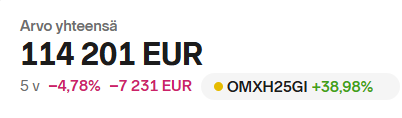
 I can’t give an exact schedule.


 A good RPG that draws you in? = Bliss.