Aker Carbon Capture - ACC-ME

Olen viime aikoina yrittänyt paneutua yhtiöön ja sitä kautta teknologiaan, joka on mielestäni liian tärkeä/tarpeellinen epäonnistumaan. Jo näin ajatteleminen on sen tason punainen lippu, että haluaisin mielelläni kuulla näkevätkö muut tilanteen samalla tavalla. On vielä asia erikseen kuuluuko kyseinen yhtiö tämän muutoksen voittajiin, mutta uskon teknologian käyttöönottoon keskipitkällä aikavälillä, koska kaikkea ei heti saa päästöttömäksi, ja Pariisin ilmastokokouksessa sovittu maali siirtyy yhä kauemmas.

Yhtiöllä on jo tämä ketju, joka on viime aikoina ehkä vähän väljähtänyt aktiivisten kirjoittajien, ja ehkä myös sijoittajien, puu(t)tuessa. Tätä selvittäessä myös tuntui, että uudella sijoittajalla on aika työ karsia kaikki tieto kasaan, joten aloituskynnys on luotaantyöntävä. Veikkaan hiljaisuuden liittyvän osaltaan myös siihen, ettei IPO:a seurannut lähtö ollut kovin vauhdikas ja alun innostus on muuttunut realismiksi, jossa odotellaan sekä lainsäädännön hyväksyntää tekniikalle että hinnan asettumista houkuttelevalle tasolle. Mielestäni tämän osalta on kuitenkin tapahtunut paljonkin.

Koska en voi tehdä yhtiölle uutta aloitusta, kokeilen tehdä uudelleenkäynnistyksen ja samalla jäsentää itsellenikin näkemystä yhtiön kokonaistilanteesta. Jos lafka tämän myötä osoittautuu uudeksi Theranosiksi, tulen pääsemään tästä vielä nollatuloksella ulos. Koska kuitenkin päädyin tekemään tämän, ei odotuksiani yhtiön potentiaalista tarvitse varmaan erikseen tuoda esiin. Siispä pidemmittä puheitta…

Tekstissä käytettyjä lyhenteitä lyhyesti avattuna:

CCS – Carbon capture and storage – Hiilensidonta (CO2) + varastointi

CCU – Carbon capture and utilization – Hiilensidonta (CO2) ja hyötykäyttö

CCUS – Kahden ylemmän yhdistelmä, joka sisältää koko mahdollisen arvoketjun

W2E - Waste to energy. Jätettä polttava voimalalaitos.

BECCS - Bioenergy with carbon capture and storage. Biomassan poltosta voimalaitoksessa syntyvän hiilidioksidin talteenotto. Keino vähentää kasvien sitoman CO2:n määrää kierrossa.

EU ETS - EU:n päästökauppajärjestelmä, jossa vuosittain kiristyvä kokonaispäästöraja sekä toimijakohtainen historiaan perustuva päästökiintiö. Päästökiintiön täytyttyä toimija joutuu ostamaan päästöoikeuksia päästökauppajärjestelmästä, jossa päästöoikeuden hinta määräytyy kysynnän ja tarjonnan mukaan.

FEED – Front-end Engineering Design -sopimus, joka sisältää alustavat suunnitelmat. Sopimuksen voittaja tuottaa tekniset määrittelyt ja vaatimukset projektille, arvioi projektin keston ja hinnan ja suunnitelmallaan pienentää projektin seuraaviin vaiheisiin liittyviä riskejä. Tämän saaminen ei vielä tarkoita koko projektin voittamista.

PDP – Process Design Package on FEED:n kanssa samaan vaiheeseen kuuluva sopimus, jossa tuotetaan prosessi- ja teknologiatietoa seuraavia vaiheita varten. Kohdistuu enemmän varsinaiseen prosessitekniikkaan, kun taas FEED sisältää myös maa- ja vesirakentamista sekä muuta projektin ympärille liittyvää. PDP onkin usein FEED:n osa.

EPC – Engineering, procurement and construction -sopimus on käytännössä projektin toteutusvaihe, johon pääseminen tarkoittaa samalla tarjouskilpailun voittamista.

FID - Final investment decision. Lopullinen investointipäätös, jonka jälkeen projektin toteutus saa vihreän valon.

ktpa = kilotonnia CO2 per annum. Vuodessa siepatun hiilidioksidin määrä tuhansissa tonneissa.

mtpa = miljoonaa tonnia per annum. Vuodessa siepatun hiilidioksidin määrä miljoonissa tonneissa.

IRA = Inflation Reduction Act. USA:ssa 2022 voimaan tullut liittovaltion laki, joka liittyy aiheeseen lähinnä uusiutuvan energian projekteihin liittyvien tukiensa kautta.

Yhtiö ja tuotteet

Kuten aloituksessakin mainittiin, Aker Carbon Capture ASA on hiilensidontaan ja varastointiin erikoistunut pure play -yhtiö, joka on saanut alkunsa Norjalaisesta Aker-konsernista irronneena spin-offina vuonna 2020. Yhtiön päätoimialueet ovat Pohjoismaat, Länsi-Eurooppa sekä USA. Työntekijöitä reilu 200.

Yhtiön oma asiantuntemus tiivistyy palamisenjälkeiseen hiilensidontaan (Post-combustion carbon capture), jossa yhtiö käyttää patentoitua amiinipohjaista liuotinteknologiaa, joka sitoo hiilidioksidin ja vapauttaa sen kuumennettaessa. Yhtiö muistaa joka välissä mainita amiiniliuottimensa HSE-ominaisuudet: liuotin on pitkäikäinen ja hiottu savukaasujen epäpuhtauksia hyvin sietäväksi, mikä vähentää ei-toivottuja sivureaktioita. Hiilidioksidi kyetään poistamaan savukaasuista noin 90-95%:sti ja erotetun hiilidioksidin puhtaus on yli 99 %, joissain lähteissä jopa 99,9 %. Teknologiaa on 2023 Q4 lopulla testattu 11 eri savukaasutyypillä yhteensä yli 60 000 tunnin ajan.
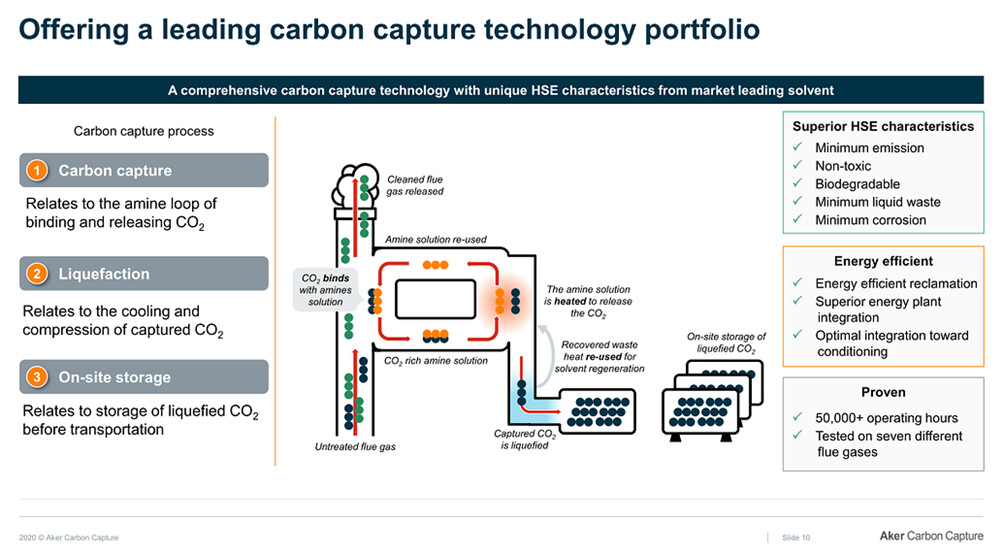
Eristetty hiilidioksidi yleensä joko varastoidaan lopullisesti, jolloin terminä on CCS (Carbon capture and storage) tai käytetään hyödyksi muualla, jolloin kyseessä on CCU (Carbon capture and utilization). Uudelleenkäyttökohteita ovat esimerkiksi hiilidioksidin käyttö yhdessä vedyn kanssa e-metanolin, e-metaanin tai e-kerosiinin valmistuksessa tai esim. suora käyttö kasvihuoneteollisuudessa kasvuaineena. Hiilensidonnan kohteena ovat lähinnä vaikeasti vihreiksi muutettavat teollisuudenalat, kuten sementtiteollisuus (8% maailman hiilidioksidipäästöistä), jätteenpolttolaitokset, terästeollisuus ja sinisen vedyn valmistus.

Yhtiö myy hiilensidontalaitoksiaan erilaisina avaimet käteen -paketteina sekä koko arvoketjun sisältävänä käyttöoikeuspalveluna (Carbon Capture as a Service), jossa asiakas maksaa kiinteän summan per sidottu tonni CO2:ta. Käyttöoikeuspalvelussa varsinainen hiilensidontalaitos ja sen ylläpito tulevat ACC:lta ja loput arvoketjusta yhteistyökumppaneilta. CCUS arvoketju sisältää hiilensidonnan, väliaikaisvarastoinnin, kuljetuksen sekä tilanteesta riippuen joko lopullisen varastoinnin tai hyötykäytön.
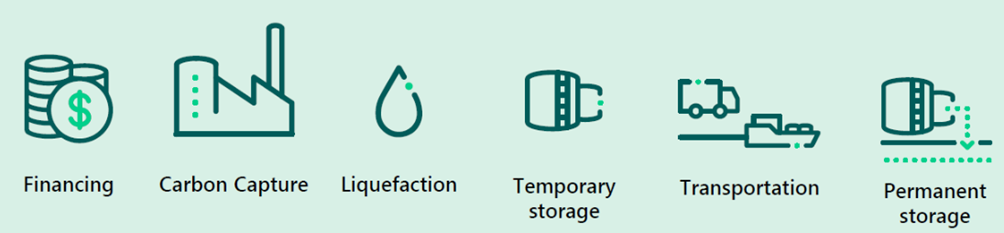
Yhtiö on päätynyt tarjoamaan myös käyttöoikeuspalvelumallia, koska CCUS on laaja kokonaisuus, eikä yhtiöllä tai useimmilla sen asiakkaista olisi yksin rahkeita koko ketjun kattamiseen. Suurimmalle osalle asiakkaista CCUS on lisäksi uusi konsepti, joka vaatii suunnittelua, suuria etukäteisinvestointeja, erillisiä sopimuksia arvoketjun eri askelmilla sekä erilaisia fyysisiä rajapintoja matkalla hiilensidonnasta lopulliseen varastointiin tai hyötykäyttöön. Tarjoamalla koko ketjun palveluna yhtiö pyrkii tekemään monivaiheisesta ketjusta helpommin lähestyttävän. Käyttöoikeuspalvelu on vaihtoehdoista kalliimpi, joten odotan tämän yleistyvän kunnolla vasta päästöoikeuksien hintojen myöhemmän nousun myötä. Myös kuljetus- ja varastointivaihtoehtojen vähäinen tarjonta rajoittaa palvelun tarjoamista. Tilanne helpottuu, kun ala kypsyy hieman lisää.

Tuoteportfolioon kuuluu yhteensä 5 eri hiilensieppauslaitosta, joista kolme ensimmäistä ovat modulaarisia ja yhdisteltävissä suuremmiksi kokonaisuuksiksi.
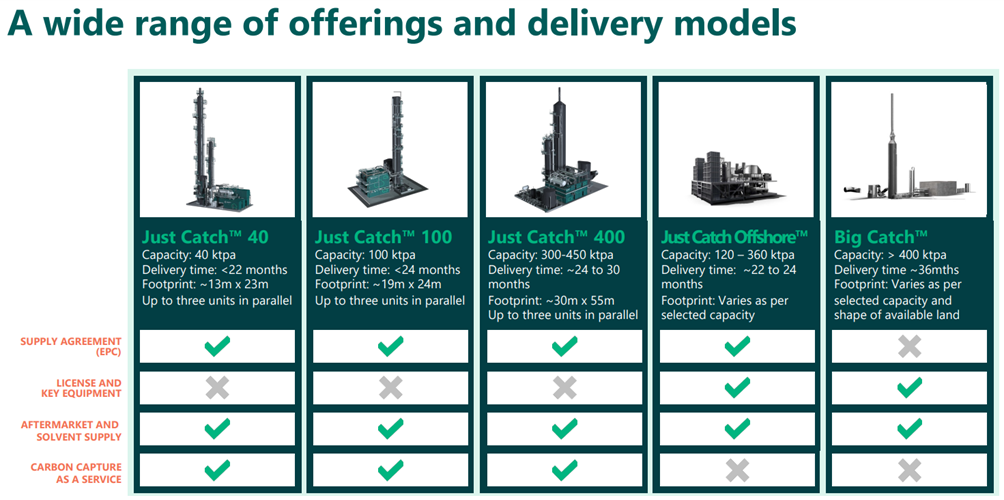
Yhtiöllä on myös testiyksikkö, mobile test unit (MTU), joka on siirreltävissä maasta toiseen, ja jonka mukana kulkee oma testitiimi. Sen avulla potentiaalinen asiakas pääsee testaamaan laitteistoa livenä omassa laitoksessaan ja operatiivinen riski pienenee. Yksikkö onkin ollut sen verran suosittu, että ACC on päättänyt rakentaa toisenkin MTU:n, joka on kohta valmis (tilanne Q4-2023). Esim. uusien savukaasutyyppien testaus onnistuu MTU:lla kätevästi.

Projektit ja tulevaisuudennäkymät

Yhtiön pörssitiedotteista piirtyy selvä ja suunnitelmalliselta vaikuttava kehityskaari. Koska yhtiö on hyvin spesifin alan toimija, se on pyrkinyt osaksi suurempia kokonaisuuksia. Ensimmäisinä vuosina yhtiö sopi paljon yhteistyökuvioita eri alojen toimittajien kanssa (ohjelmisto-, kaasuturbiini- ja voimalaitostoimittajat, sinisen vedyn valmistuslaitteistojen tuottajat, hiilen varastointiyritykset yms.), joiden tarkoituksena oli kehittää ja integroida tekniikkaa sekä mahdollistaa CCUS-pakettien tarjoaminen yhdessä muiden CCUS-arvoketjuun kuuluvien yritysten kanssa. Yhteistyökumppanihin kuuluvat esim. Microsoft, MAN Energy Solutions, Siemens Energy, Haldor Topsoe, Hitachi Zosen Inova, Carbonor, Carbfix sekä tietenkin Northern Lights JV, Norjan julkis-yksityinen hiilidioksidin varastointiprojekti.

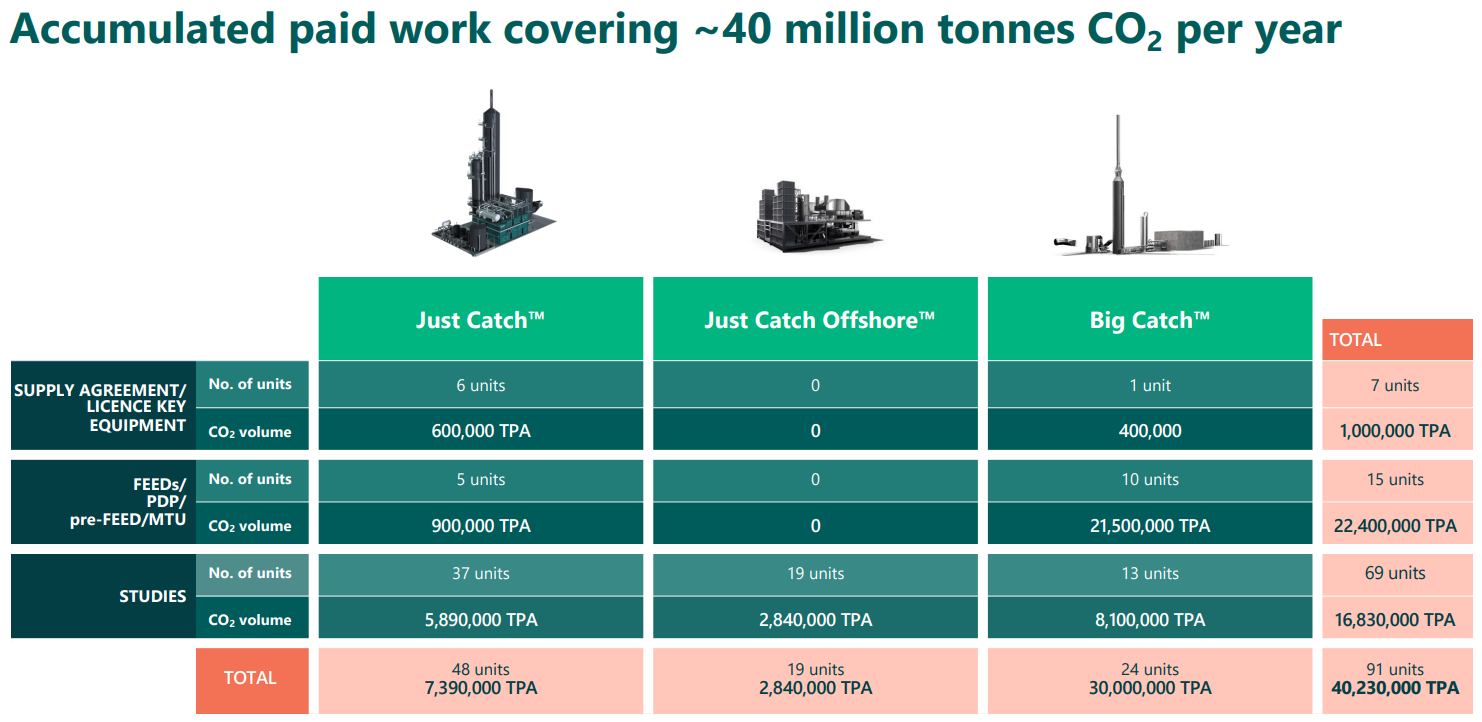
Noin viimeisen vuoden aikana eri suunnittelusopimukset ovat varastaneet uutistilan, minkä tulkitsen uuteen vaiheeseen siirtymisenä. Yhtiö on viimeisen 6 kk aikana saanut enemmän FEED- ja PDP-sopimuksia sekä feasibility studyjä kuin koko aiemman 2020 alkaneen historiansa aikana. En suostu laittamaan tätä kaikkea sattuman piikkiin, vaan uskon tämän johtuvan myös markkinan heräämisestä, mikä myös Q4 webcastissa tuotiin ilmi. Yhtiö on itsenäisenä yrityksenä olonsa aikana kerännyt kehitysputkeen suunnitteluprojekteja yli 40 mtpa:n edestä, joista yli 20 mtpa tuli vuoden 2023 aikana.
Yhtiö onkin alkavana vuonna mielestäni tähänastisen historiansa mielenkiintoisimmassa vaiheessa. Ensimmäiset oikeat laitokset, jotka toimittavat samalla referenssilaitosten virkaa, ovat valmistumassa tänä vuonna: Twencen jätteenpolttolaitoksen CCU Hollannissa on käynnistysvaiheessa ja Brevikin sementtilaitoksen CCS Norjassa on suunnitelman mukaan valmistumassa kesällä. Vaikka tekniikkaa on mobile test unitin avulla testattu useammalla eri savukaasutyypillä ja toimivaksi havaittu, antaa kokonaisten laitosten toimittaminen yhtiölle ihan uudenlaista uskottavuutta.

Käyn alla läpi yhtiön projekteja, joilla on lähitulevaisuudessa mahdollisuus saada lopullinen investointipäätös, mikä käytännössä tarkoitaa vain olemassaolevia FEED-sopimuksia.

USA

Yhtiö kiinnostui IRA-paketin 2022 myötä parantuneista toimintaedellytyksistä ja perusti toimiston Houstoniin sekä solmi yhteistyösopimuksen MAN Energy Solutionsin kanssa Yhdysvaltojen markkinapreesensin edistämiseksi. Joitain FEED-tutkimuksia menossa, mutta ei todennäköisiä FIDejä vuodelle 2024 (tieto Q4 webcastista).

UK

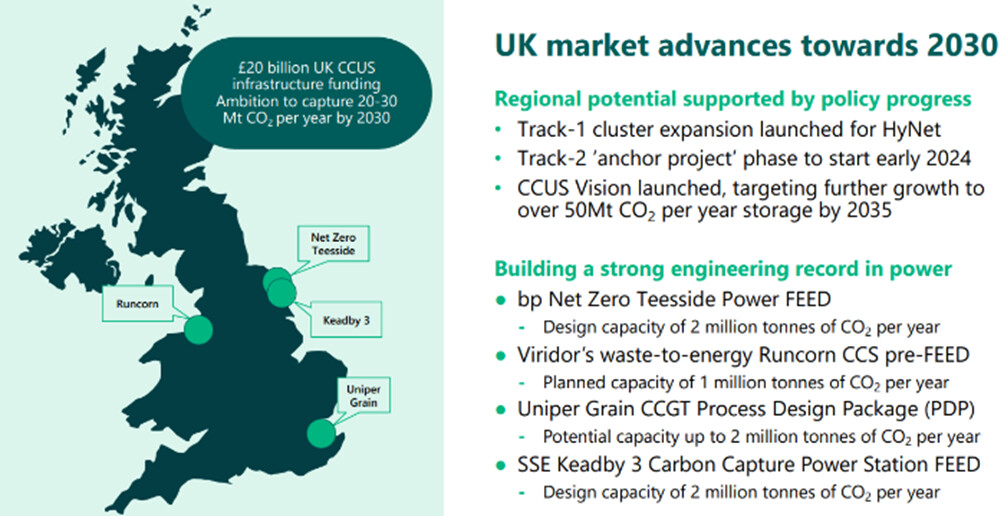
Britanniassa on meneillään hallituksen käynnistämä laaja ja taloudellisesti tuettu CCUS-projekti, johon päästäkseen yritykset lobbaavat ankarasti. Sen tarkoituksena on saattaa CCUS käyttöön minimissään kahteen teollisuusklusteriin vuoden 2025 puoliväliin mennessä (projektinimeltään Track-1) ja neljään muuhun vuoteen 2030 mennessä (Track-2). Tähän väliin on perustettu vielä Track-1 Expansion. Koko projektin suuruusluokka on 20-30 mtpa CO2 vuoteen 2030 mennessä ja sille on myönnetty 20 miljardin punnan tuki. Britannian teollisuusklustereista HyNet sekä East Coast Clusterien on vahvistettu kuuluvan Track 1:een, joka on ensimmäinen toteutettavista aalloista. Sen jälkeen tulee mahdollisesti Track 1 expansion ja ainakin Track 2. Projektin käynnistys on hieman viivästynyt, mutta Q4 webcastin mukaan ensimmäiset ACC:hen liittyvät FID:t tullaan näkemään syksyllä 2024.
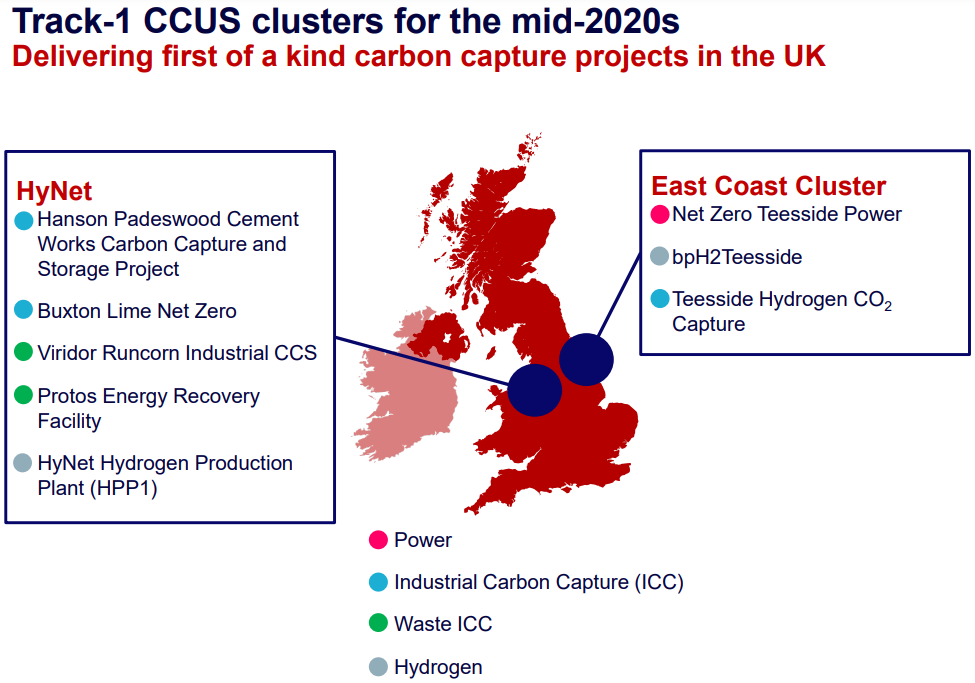
Alla vielä FID-lotto Britannian projektien osalta perustuen löytämiini tietoihin.

Projekti FID-veikkaus Peruste
bp Net Zero Teesside (G2P) Syksy 2024 Kuuluu UK Track 1 & Webcast Q4 Q&A
SSE Keadby 3 (G2P) Syksy 2024 Kuuluu UK Track 1 & Webcast Q4 Q&A
Uniper Grain (CCGT) 2025-2026 https://newsweb.oslobors.no/message/606430 & PDP menossa, jonka jälkeen vielä FEED, joka yleensä kestää noin vuoden.
Viridor Runcorn CCS (W2E) 2024-2025 Kuuluu UK Track 1, joten FID voi tulla jo syksyllä 2024, mutta nyt vasta pre-FEED käynnissä. Tarvitaanko lisäsuunnittelua?

Näistä pienimmänkin laitoksen EPC-sopimuksen voittaminen toisi kaikkien kolmen työn alla olevan CCUS-laitoksen verran uutta kapasiteettia. Yhteensä Britanniassa voitettujen suunnittelusopimusten kautta voisi olla tulossa jopa 7 mtpa:n verran uutta kapasiteettia verrattuna kolmen jo voitetun sopimuksen myötä nyt rakenteilla olevaan 1 mtpa:an.
Eurooppa

Eurooppa, etenkin Pohjois-Eurooppa, on yhtiön päämarkkina-aluetta, jossa sillä onkin jo kolme projektia työn alla. Näiden lisäksi listalta löytyy neljä FEED-vaiheessa olevaa projektia.

Projekti FID-veikkaus Peruste
Söderenergi Igelstaverket (BECCS) 2024-2025 FEED aloitettu 26.06.2023, joten FID periaatteessa mahdollinen 2024 loppupuolella.
Hafslund Oslo Celsio (W2E) 2025 FEED aloitettu 24.11.2023. Q4 raportissa mainittu, että FID tavoitteena 2024 kesällä.
Nordbex AB (BECCS) 2025 FEED aloitettu 08.02.2024, joten FID tuskin tulee vielä 2024 aikana.
Eurooppalainen toimija, CCS yhteensä 4:ään BECCS- ja W2E-laitokseen. Aikaisintaan 2025 Feed aloitettu 22.02.2024. Neljä laitosta, iso kokonaisuus. Luultavasti tehdään osissa, laitos kerrallaan, monta FID:ia.

Yhtiön menestysmahdollisuudet tullaan lähivuosina mittaamaan voitettujen projektien määrällä. Se joutuukin nyt tarjouskilpailujen myötä testaamaan teknologiansa ja hintatasonsa alan muita toimijoita vastaan. Esimerkiksi Net Zero Teesside -projektissa on kaksi kilpailevaa konsortiota:

  • Aker Solutionsin johtama konsortio, johon kuuluu Aker Solutions, Doosan Babcock sekä Siemens Energy. CC-teknologia ACC:lta.
  • Technip Energiesin johtama konsortio, johon kuuluu Technip Energies ja General Electric. CC-teknologiana Shellin CANSOLV CO2, joka myös amiiniliuottimeen perustuva.

Tekniikan TAM on ihan järkyttävän suuri, koska tulevaisuuden tavoitteena on olla hiilinegatiivinen. USA:ssa IRA:n tuomien lisätukien myötä CCUS:n kapasiteetin on arveltu voivan kasvaa 2030 mennessä vuotuiseen 200 mtpa:an. EU:n tämänhetkinen tavoite on, että vuosikymmenen loppuun mennessä sidotaan 50 mtpa:n verran ja vuoden 2040 lopulla jo 280 mtpa. Tuista tarkemmin seuraavassa kappaleessa.

Julkisuuden keskustelu vihreästä siirtymästä on värittynyttä, koska useimmilla on siihen liittyvä agenda tai ideologia: (vain hieman) karrikoiden vihreän siirtymän puristit, joiden mielestä ainut oikea vihreä siirtymä on suoraan fossiilisista täysin uusiutuviin, eikä välimuotoja hyväksytä, koska CCUS:kin on vain kakkosluokan ilmastotoimi, keino olla tekemättä välttämättömiä muutoksia. Toisella puolella öljy-yhtiöt ovat perinteisesti ja keskimäärin olleet CCUS:n puolella, koska sen käyttö vaatisi yhtiöiltä pienempiä rakennemuutoksia tulevaisuudessa ja mahdollistaisi lähes entisenlaisen toiminnan.

Olen kuitenkin viime aikoina internetin teelehdistä tulkinnut etenkin EU:n puheidensa kautta myöntäneen, että Pariisin ilmastosopimuksen tavoitteita ei saavuteta ilman hiilensidontaa, ja EU on tähän liittyen tehnytkin uusia CCUS:a puoltavia keskustelunavauksia. Tulkintani mukaan CCUS on siis tulossa yhä vahvemmin osaksi ilmastotyökalupakkia, enkä näe tässä ongelmaa, jos sitä käytetään sitomaan päästöjä vaikeasti korvattavilla teollisuudenaloilla, kuten yhtiö on tekemässä.

Elefantti olohuoneessa: hinta (ja tuet)

Teen heti selväksi, että CCUS ei tule isossa mittakaavassa realisoitumaan ilman rahallista keppiä ja/tai porkkanaa. Hinnalla on kaikista tekniikkaan liittyvistä tekijöistä varmasti merkittävin vaikutus hiilensidonnan tulevaisuuteen ja se on ollut pitkään yleistymisen esteenä yksinkertaisesti siksi, että yhden hiilidioksiditonnin sitominen on maksanut enemmän kuin sen vapauttaminen taivaalle. EU on luomallaan päästökauppajärjestelmällä luottanut enemmän keppiin kuin porkkanaan. Mekanismi, jolla päästökauppajärjestelmä on rakennettu, on viime vuodet vähentänyt vuosittain sallittujen hiilidioksiditonnien maksimimäärää 2,2 prosentilla, mikä pikkuhiljaa nostaa hiilidioksiditonnien keskimääräistä hintaa. Vuosittainen vähennys on tästä vuodesta (2024) alkaen kiristetty 4,3 %:iin. Vuonna 2018 hiilidioksiditonnin hinta oli keskimäärin 8€, kun se vuonna 2023 oli jo yli 80 €, joten nousu on vuositasolla ollut huomattavaa. Viime aikoina hinnat ovat taas hiipineet alaspäin, johtuen ainakin osittain Euroopan hiipuvasta taloudellisesta aktiviteetista. Päästökauppajärjestelmälle ei ole saatu sovittua alarajaa, joten taantumien aikaan, tuotannon hiipuessa, myös päästöoikeuksien hinnat laskevat, kun tupruttelijoilla tulee vähemmän päästökiintiöiden ylityksiä. Kaikille toimijoille on kuitenkin selvää, että keskimääräinen hinta on mekanismista johtuen pitkällä aikavälillä nouseva, mikä tekee hiilensidonnasta vuosi vuodelta houkuttelevampaa.
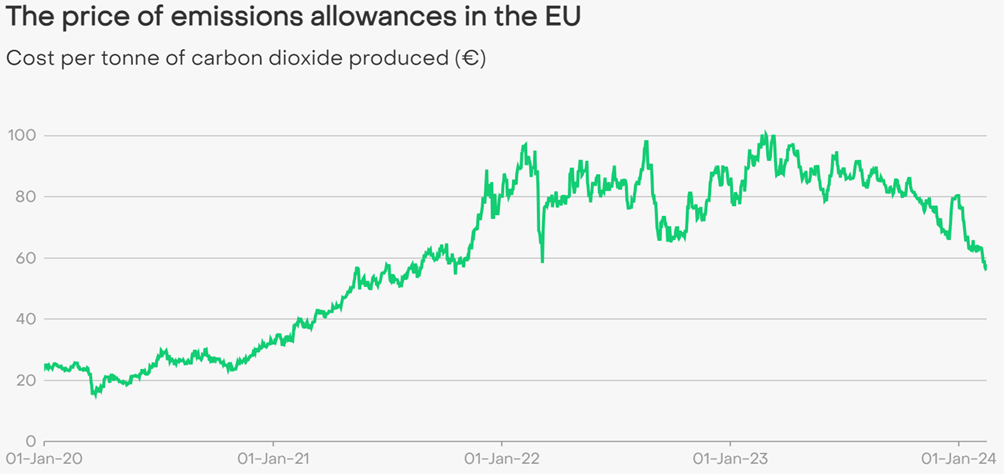
W2E-sektori ei vielä kuulu EU:n päästökauppajärjestelmään, mutta EU on jo tuonut julki aikeensa senkin integroinnista. Vuoden 2024 alusta W2E-toimijat joutuvat mittaamaan ja raportoimaan jätteenpolttolaitosten päästöt. 2026 alussa komission on määrä julkaista raportti, jossa W2E-sektori määrätään vuoden 2028 alusta mukaan päästökauppajärjestelmään jonkinlaisella kahden vuoden siirtymäajalla, eli viimeistään 2030. Toteutuessaan tämä tulisi olemaan merkittävä ajuri kohti CCUS:n käyttöönottoa Euroopassa.

EU:n porkkanaleiriä edustaa Innovation Fund, joka keskittyy suuria päästövähennyksiä tuottavien innovatiivisten teknologioiden ja lippulaivaprojektien tukemiseen. Esim. Twencen CCU-projekti on saanut rahastolta 14,3 MEUR tuen.

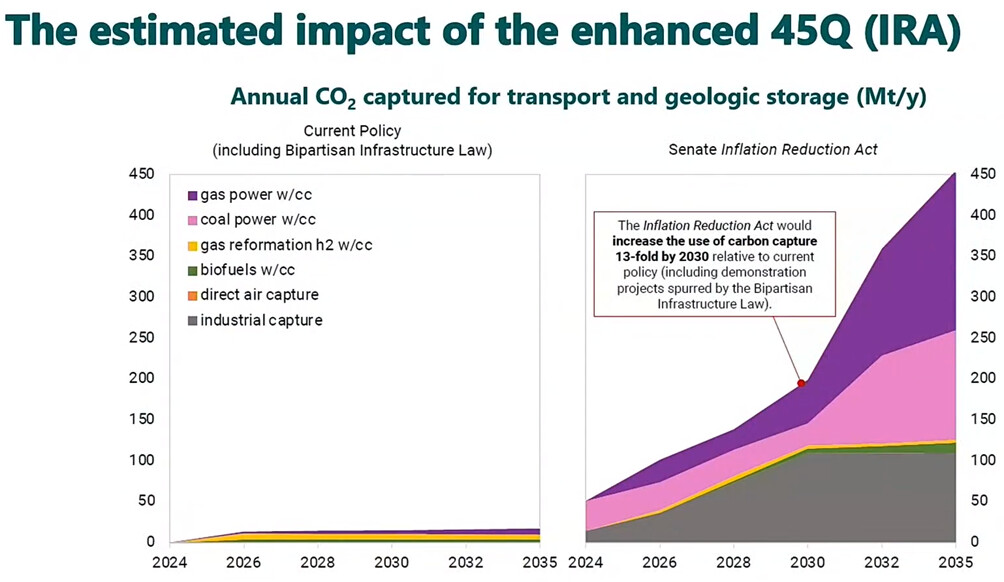
USA:ssa keppi on jätetty puuhun ja tarjolla on ainoastaan pussillinen porkkanoita. 2022 hyväksytty Inflation Reduction Act (IRA) nosti jo aiemmin voimassa olleen 45Q tax credit kannustinjärjestelmän korvauksia. Päivitetyssä 45Q:ssa CCU-projektille maksetaan 65$ per sidottu ja hyötykäytetty CO2-tonni. CCS-projekteille maksetaan 85$ per lopullisesti varastoitu CO2-tonni. Tämän lisäksi Bipartisan Infrastructure Investment and Jobs Act tarjoaa rahallista tukea CCUS-infrastruktuurin rakentamiseen. Lisäksi löytyy osavaltiokohtaisia kannustimia. Hidastavana tekijänä useimmissa osavaltioissa luvansaanti lopulliselle varastointisijainnille kestää 3 vuotta.

Alla olevassa kuvaajassa on vasemmassa ikkunassa CCUS arvioitu tilanne ennen IRA-pakettia ja oikeassa ikkunassa arvio ajasta IRA-paketin hyväksymisen jälkeen.
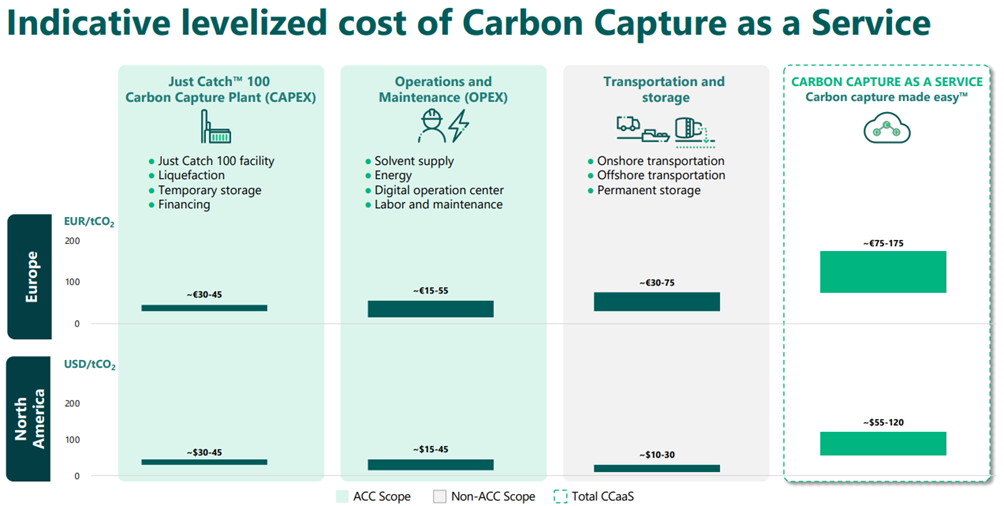
Alla ACC:n arvioimat hinnat toiminnan eri tasoille ja käyttöoikeuspalvelulle. Riippuen laitoksen integrointimahdollisuuksista ja toimitustason laajuudesta, alkaa CCUS olla etenkin USA:ssa erittäin houkutteleva vaihtoehto. Päästöoikeuksien hintojen trendi huomioiden myös Euroopassa uusien laitosten kannattaa ehdottomasti integroida CCUS jo suunnitteluvaiheessa. Hiilensidontayksikköjen toimitusaikojen ollessa lyhyimmilläänkin 2 vuotta, kannattaa vanhojenkin laitosten aloittaa suunnittelutyö jo nyt, koska päästöoikeuksien hinnat nousevat vuosi vuodelta. Alla vielä ACC:n arvioimat hintahaarukat per siepattu CO2-tonni eri toimitustasoilla.
Rahahommelit ja muita lukuja

Yhtiö hoiti rahoituksensa balanssiin järjestämällä 2021 elokuussa 840 MNOK osakeannin hinnalla 22 NOK per osake, mistä lähtien se onkin ollut nettovelaton. Annin jälkeen 2021 Q3 lopussa yhtiöllä oli käteistä noin 1,4 miljardia NOKkia, eli noin 120 MEUR. Reilu kaksi vuotta myöhemmin, 2023 Q4 lopussa yhtiöllä on noin 1,1 miljardia NOKkia (~97 MEUR). Se ei ole tehnyt vielä kertaakaan voittoa, mutta rahanpolttelu on pysynyt aika hyvin hallussa, eikä akuuttia kassakriisiä ole näköpiirissä.

Yhtiö on alempana näkyvässä kuvaajassa tällä hetkellä tukevasti kakkosvaiheessa. Olen tunnuslukujen kautta arvioinut sitä ainoastaan EV/sales -multippelin kautta, joka on viime aikoina pyörinyt edelleen noin 3,5 – 5,0 kertoimilla, vaikka osakkeen hinta onkin maltillistunut reilusti alkuinnostuksen jälkeen. Nähdäkseni hinnan voidaan edelleen olettaa pitävän sisällään odotusta tulevasta kasvusta. Toisaalta on kasvua myös tullut, koska yhtiö on onnistunut tuplaamaan liikevaihtonsa kahtena edellisenä vuotena, ja jos edes osa nykyisistä kilpailutuksista päätyy ACC:lle, en pidä liikevaihdon tuplaamista tänäkään vuonna mahdottomana tehtävänä. Tällöin EV/sales olisi nykykurssilla noin 2. Viime vuoden Q4:ään verrattuna myös order backlog on vuoden aikana tuplaantunut.
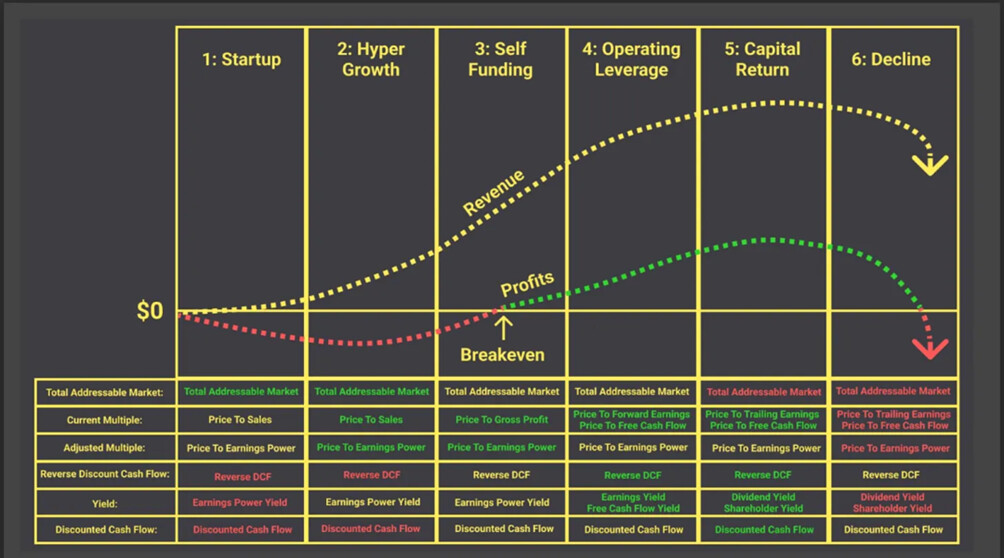
Yhtiön merkittävämmät rahavirrat syntyvät tällä hetkellä vielä aika pienestä määrästä projekteja, joten odotan voitollisuuteen pääsyn tapahtuvan hieman pomppien, tosin en vielä ainakaan tämän vuoden aikana. Yhtiön pääsyä voitolliseksi tulee luonnollisesti seurata, mutta uskon sen olevan lähinnä seuraus voitettujen projektien runsaslukuistumisesta, minkä vuoksi oma mielenkiintoni kohdistuu tällä hetkellä uusiin voitettuihin projekteihin.

Yhteenveto

Nähdäkseni sen verran moni asia tuntuu olevan yhtiön kannalta kohdallaan, tai ainakin menossa oikeaan suuntaan, että löydän yhtiölle selvästi enemmän positiivisia kuin negatiivisia ajureita. Johtuen projektien pitkistä toimitusajoista, jätän kuitenkin rakettiemojit myöhemmälle. Uskon enemmän hitaampaan ja hieman epätasaiseen kasvuun. Jos tämä kuitenkin menee odotukseni mukaan, saa yhtiö jo tänä vuonna mukavan potin uusia projekteja, minkä pitäisi katkaista kurssin pitkä pulkkamäki. Aion alkuvaiheessa seurata yksittäisten tarjouskilpailujen voittajia nähdäkseni onko ACC:lla riittävät mahdollisuudet bisneksen rakentamiseen. Osakkeen pidempiaikainen suunta on kieltämättä hieman mietityttänyt, koska on yleensä melko epätodennäköistä, että näkisin tilanteen markkinaa selvemmin. Tämän vuoksi toivoisin myös toisenlaisia näkemyksiä, mutta toisaalta tiedostan yhtiötä seuraavien silmäparien pienilukuisuuden.

Aika on ikävä kyllä ruuhkavuosina rajallista, joten tekstistä jäi puuttumaan vielä monta aihetta, joita olisin mieluusti sivunnut. Pidätänkin oikeuden päivittää tekstiä ainakin kilpailijoiden, karhuilun sekä plussat-miinukset -listan osalta, jos joskus saan uusia kappaleita aikaiseksi.
39 Likes

Uutta projektia pukkaa:

Aker Carbon Capture has been awarded a study from a European developer to assess
the feasibility of integrating carbon capture at multiple biomass and waste-to
-energy facilities. The four initial plants will be based on Aker Carbon
Capture’s modular Just Catch, which enables synergies across the projects,
faster realization and reduced overall risk.

“We are excited to be working on this leading carbon capture initiative. We
believe that our configurable Just Catch, which facilitates serial-produced
carbon capture units, will provide cost and delivery benefits. By addressing our
customer’s specific requirements, we aim to contribute to the successful
realization of their CCUS projects,” said Jon Christopher Knudsen, Chief
Commercial Officer at Aker Carbon Capture.

This award emphasizes Aker Carbon Capture’s leading European market position
with proven technology, modularized and standardized products and a major
project portfolio. The European Commission recently presented a 90% net GHG
emissions reduction proposal compared to 1990 levels as the recommended target
for 2040. To deliver a reduction of net GHG emissions of 90%, the EU’s GHG
emissions in 2040 should be less than 850 MtCO2-eq and carbon removals should
reach up to 400 MtCO2, a large part of which will have to be BECCS.

Aker Carbon Capture is currently delivering seven carbon capture plants. In the
Netherlands, Aker Carbon Capture is in the final stages of delivering a Just
Catch 100 at the Twence waste-to-energy facility. For Heidelberg Materials’
cement plant in Brevik Norway, Aker Carbon Capture is delivering a carbon
capture plant with a capacity of 400,000 tonnes per year. The company is also
delivering five Just Catch 100 units to Ørsted’s bioenergy facilities in
Denmark, with a total design capture capacity of 500,000 tonnes CO2 per year.
These flagship projects contribute to Aker Carbon Capture’s mission to serial
produce carbon capture units for the mid-scale emitter market.

https://newsweb.oslobors.no/message/611539

4 Likes

The air is being let out of the stock price properly now, and I’m trying to understand what the current drop is all about. Related to this, I’ve rewritten the section on projects and am attaching the new material here as a more easily findable update. This should also help in outlining a potential entry point.

I reviewed the company’s ongoing projects that have a chance of reaching a Final Investment Decision (FID) in the near future, which in practice only means existing FEED (Front-End Engineering Design) agreements.

USA

The company became interested in the improved operating conditions following the 2022 IRA package and established an office in Houston and signed a cooperation agreement with MAN Energy Solutions to promote its US market presence. Some FEED studies are underway, but no likely FIDs for 2024 (info from Q4 webcast).

UK

Britain has an extensive and financially supported government-led CCUS project underway, for which companies are lobbying hard. It aims to deploy CCUS in at least two industrial clusters by mid-2025 (named Track-1) and four others by 2030 (Track-2). A Track-1 Expansion has also been established in between. The scale of the entire project is 20-30 mtpa CO2 by 2030, and £20 billion in support has been allocated. Of the British industrial clusters, HyNet and East Coast Clusters have been confirmed as part of Track 1, which is the first wave to be implemented. This will potentially be followed by Track 1 expansion and at least Track 2. The project launch has been slightly delayed, but according to the Q4 webcast, the first ACC-related FIDs will be seen in autumn 2024.

image

Below is the FID lottery for the British projects based on the information I found.

Project FID prediction Basis
bp Net Zero Teesside (G2P) Autumn 2024 Part of UK Track 1 & Q4 webcast Q&A
SSE Keadby 3 (G2P) Autumn 2024 Part of UK Track 1 & Q4 webcast Q&A
Uniper Grain (CCGT) 2025-2026 https://newsweb.oslobors.no/message/606430 & PDP ongoing, followed by FEED, which usually takes about a year.
Viridor Runcorn CCS (W2E) 2024-2025 Part of UK Track 1, so FID could come as early as autumn 2024, but currently only pre-FEED is underway. Is additional design needed?

Winning an EPC (Engineering, Procurement, and Construction) contract for even the smallest of these plants would bring as much new capacity as all three CCUS plants currently under construction. In total, through the design contracts won in Britain, up to 7 mtpa of new capacity could be coming, compared to the 1 mtpa currently under construction through the three already won contracts.

image

Europe

Europe, especially Northern Europe, is the company’s main market area, where it already has three projects underway. In addition to these, there are four projects in the FEED stage on the list.

Project FID prediction Basis
Söderenergi Igelstaverket (BECCS) 2024-2025 FEED started 26.06.2023, so FID theoretically possible in late 2024.
Hafslund Oslo Celsio (W2E) 2025 FEED started 24.11.2023. Q4 report mentions summer 2024 as FID target.
Nordbex AB (BECCS) 2025 FEED started 08.02.2024, so FID is unlikely during 2024.
European operator, CCS for a total of 4 BECCS and W2E plants. 2025 at the earliest FEED started 22.02.2024. Four plants, a large package. Likely to be done in parts, one plant at a time, multiple FIDs.

Among those mentioned above, Hafslund Celsio is particularly interesting because the project’s EPC already went to Technip Energies on 4.7.2022 (link to Finansavisen news), but the price escalated during the project from 5 to 8 billion NOK. The project was halted, and a new FEED was given to Aker Solutions and ACC. If the offered price is more reasonable, the project will go to the Aker family. This is likely being pushed forward at a fast pace because the project already has funding as part of the Longship project. Since it already has funding and a previous FID, starting the project is theoretically possible as early as 2024 immediately after the completion of the FEED.

The company’s chances of success will be measured in the coming years by the number of projects won. It must now test its technology and price levels against other players in the industry through tenders. For example, in the Net Zero Teesside project, there are two competing consortia:

  • A consortium led by Aker Solutions, including Aker Solutions, Doosan Babcock, and Siemens Energy. CC technology from ACC.
  • A consortium led by Technip Energies, including Technip Energies and General Electric. CC technology is Shell’s CANSOLV CO2, which is also based on amine solvent.

The current share price decline is, in my view, a sum of many things, the main one being the fading of the hype mentioned in the previous message. Those who invested three years ago at higher prices might be starting to lose faith, as many certainly had more momentum in their initial assumptions. Another factor may be the long gap in winning new projects. I intend to investigate the competitive landscape further, but at the moment the market seems to have woken up, and I haven’t come across any alarming signs of ACC’s weak competitiveness yet. However, by the end of the year, there must be at least one new contract from projects that have received an FID; otherwise, they have gone to competitors. Even new FEED contracts no longer easily turn the share price direction, as their actual payoff is often more than a year away.

EDIT: Q4 report mentions that Hafslund is targeting an FID at the Celsio plant in summer 2024.

11 Likes

ACC has secured a new pilot project in the United States.

A previous pre-FEED has already been conducted at the site. With this pilot, the company’s technology is now being tested in the paper industry for the first time. This is a good pilot because it provides practical evidence of the solvent’s performance with a new type of flue gas.

In the US, CCUS projects have better financial incentives than in Europe, as they receive 45Q tax credits and the captured carbon dioxide tons can also be sold on voluntary carbon markets (VCM). Thus, the financial hurdles for project progression are lower.

Edit: Since this is a milestone project that has already included earlier phases (pre-FEED), I consider it likely that the path is clear all the way to a final FID, provided the milestones are achieved as planned. In other words, these wouldn’t just be independent steps. A small but interesting difference.

7 Likes

The share price is apparently falling for two reasons.

  1. The previously mentioned UK Net Zero Teesside project has gone to Technip Energies.
  2. ACC will be removed from the OBX ESG index on Monday (March 18).

Both events unfortunately coincide, causing selling pressure. Although losing the project to a competitor is not decisive in the short term—since these projects could by no means all have gone to ACC—I would have preferred to see a different name for the winning consortium. Nevertheless, this is a large 2 mtpa project with a total value of 4 billion pounds, with the returns shared among the consortium members.

There isn’t really anything positive for ACC to be seen here, so let’s digest the negatives. The size of the CCUS market certainly allows for enough work for all current players, but now the confirmation of ACC’s ability to hold its own against competitors remains somewhat unclear or even took a slight hit. Tendering is about the overall package offered by the consortium, of which ACC is a part, but based on the available information, I personally cannot yet assess what role ACC’s technology played in losing the project.

ACC delivered the FEED (Front End Engineering Design) contract for the project in question, but it apparently doesn’t have much significance when choosing the final contractor; price and the overall package are decisive. This also confirms my assumption that even a large project proceeds to the FID (Final Investment Decision) stage within about a year of starting the FEED.

It is clear that ACC needs more projects in its pipeline, so it is essential to secure one of these large UK projects, as it would also provide credibility as a potential supplier of major projects.

7 Likes

Shareholders are certainly being pampered right now, so I’ll summarize the events of the last few days here.

First, Pareto lowered its target price from 15 to 10 NOK due to a lost deal, but at least kept the buy recommendation.
Today, Clarksons Securities issued a sell rating with a target price of 4.6 NOK.

According to the latter analysis firm’s estimate, ACC would achieve 3.5 mtpa in contracts by 2025 and 23 mtpa worth of build-out by 2030. Management has set a goal of 10 mtpa by the end of 2025, which is starting to look increasingly unlikely by the day. They did mention in the Q4 webcast that the target probably won’t be reached quite by 2025, but achieving it shortly thereafter is sufficient for them. Lowering or abandoning the target could be interpreted as a profit warning.

I quickly calculated that by the end of 2025, there are at least 6 mtpa worth of projects up for grabs, likely more, but the biggest uncertainties indeed relate to how projects get funded and what share ACC manages to win. In this light, Clarksons Securities’ 3.5 mtpa by the end of 2025 is basically a very realistic scenario.

There is certainly fierce competition for CCUS construction contracts right now, as they are still only trickling in, and the bidding for the flagship project lost in the UK has undoubtedly been cut-throat. It is impossible to know whether the contract would have been financially sound, but losing it clearly resulted in reputational damage. In the background, I’m slightly bothered by that earlier Hafslund Oslo Celsio contract, which went to Technip Energies and the licensed Shell Cansolv solvent technology. I was left wondering how it’s possible that the price agreed upon with Technip Energies could rise from 5 billion NOK to 8 billion, as reported. The firm couldn’t have miscalculated the price that badly unless they are trying to win these projects with razor-thin margins. A larger firm (with a larger cash balance) naturally has better chances to compete on price to gain market share, but a 60% price increase from the original is still incomprehensible.

One big problem at the moment (besides my own entry timing :face_exhaling:) is that the share price doesn’t really have any support from fundamentals without new contracts. We’ll likely manage through this year with revenues from Ørsted Kalundborg CCS, but in terms of revenue, this year threatens to become a transitional year after two explosive years. This isn’t a problem yet, as long as the cash is made to last. Unfortunately, even signed FEED contracts are worth very little if they only materialize into full contracts in the absence of competition. My own interpretation of the situation based on current information is that this is just kicking the can a bit further down the road, as the long-term drivers remain unchanged. Risks certainly increased, making the drop in share price unfortunately justified.
3 Likes

New agreement including both FEED and pilot projects for ACC with Wacker in Norway. FID for this deal is possible in early 2025.

3 Likes

ACC has signed an MoU with CO280, mentioned in a previous stock exchange release.

CO280 is a project developer for CO2 removal projects, with whom ACC has entered into a collaboration agreement regarding carbon capture projects at pulp and paper mills in the US and Canada. As a result, the parties have agreed to act as each other’s preferred partners when developing new projects. This is a kind of expansion of the cooperation related to the previously mentioned milestone project in the US.

I’m also adding an alleged correspondence I spotted elsewhere with David Phillips, who holds the title Head of Capital Markets and New Market Strategy at ACC. There was no message from the sender, but knowing the nature of the forum, it was likely a retail investor’s cry for help, which, based on the response, didn’t seem to contain any very concrete question:

Summary

“As a shareholder I certainly share your frustration - I will also note that it is a tough time for clean tech companies globally at the moment as well (many of the headaches from 2023 continue into this year - higher interest rates, political risk on the horizon in the US and UK and so on…) As you probably know, the main trigger in the last 1-2 weeks has been the news that the “other” consortium - GE Vernova, Technip (with Shell’s technology) and Balfour Beatty - will work on the gas on a mega scale for to run the Net. The Zero Teesside project in the UK, not the consortium we work with. This was announced about 1.5 weeks ago - it’s not Saipem (that’s a wrong Bloomberg headline…they’re working on another part of this infrastructure for NEP). This is unfortunate for us, but it’s important to see it in the right context: Probably the first mainstream project we haven’t won, after being successful with ALL other projects we’ve chased that have gone forward (Orsted, Twence, Brevik , also our “victory” at Celsio in Norway), so from one angle, although it is disappointing, we cannot expect to win them all - a fact This is a project where ACC is a technology supplier to a consortium; it is important to remember that, because we are a subcontractor to a consortium that was not successful - this is NOT a comment on our technology (which performed extremely well at high capture rates), rather on the total cost of the consortium, new build gas plant, plant engineering etc - all in. Also - sometimes not as well understood, and perhaps part of the panic in the last few days - as we are a subcontractor who does not own the entire project, the financial scope for us is “medium large” even for such a large project . So for us, although this is an important project, this is not a “mega-scale” economic impact that now allows us to look at “plan B” - far from it. The UK is still a promising market for us - especially with waste to energy (smaller and larger plants) and still also with gas power - we are the “sole” technology supplier for Keadby 3 (SSE) and we are heavily involved (albeit with some competition) with Runcorn (Viridor) and Uniper etc. The US market (and Norway/Denmark) is likely to give us encouraging news in 2024, especially, as we have said before (our US news the other week – with CO280/pulp and paper – and our news today with our wider partnerships with CO280) is just the start of what should be a long line of news to come AND – probably most importantly, we’re not going to suddenly panic after not winning a project like this – we continue to have a good financial footing (as some have been worried about for the last few days - wrongly) As mentioned I am also a “fair” shareholder by the way so 100% feel the impact of the share price but we (and I) are confident that the long term picture for CCS (and our position in it) is a good one – just need to make sure we are successfully positioned for the work when it comes! And this year we have good expectations for Celsio in Oslo, more FEEDs in Europe and also the USA, and potentially some smaller awards in Europe as well, which sets up a potentially strong 2025 when it comes to new work in particular.”

There are some interesting points in the response.

  • He reminds us of things I’ve already mentioned: ACC won’t win every project. He also points out that as part of a consortium, ACC acts as a subcontractor and the total bid price is the sum of its parts; one shouldn’t draw overly far-reaching conclusions about ACC’s contribution from this.
  • In the large UK Keadby 3 project, there apparently aren’t even any other competitors involved at the moment (which, of course, doesn’t prevent the project from being tendered later).
  • Based on the wording, he seems to consider the transfer of the Hafslund Celsio project to ACC a fairly likely scenario already.

Other positive points were also mentioned, but the level of uncertainty is still such that I’ll mainly be following the related announcements with interest.

2 Likes

ACC establishes a joint venture with SLB (Schlumberger Limited).

In the arrangement, SLB acquires 80% of ACCH’s (Aker Carbon Capture Holding AS) share capital at a price of NOK 9.19, which effectively makes ACC a subsidiary of SLB.

SLB pays NOK 4.12 billion for the 80% shareholding. ACCH pays USD 50 million for SLB’s CC business. Thus, according to my interpretation, SLB’s CC business is being moved under ACC, but ACC will move to follow SLB’s strategy. ACC retains the remaining 20% stake in the joint venture.

The arrangement also includes performance-based milestones that may later become payable.

I haven’t encountered similar cases yet in my short investing career, so I’m not fully clear on all the practical matters related to the deal. However, I was left with the impression that ACC would remain on the exchange with its own ticker.

Edit: Link fixed, thanks @Fastback.

3 Likes

I don’t get it either. Hopefully someone more experienced could come and explain what this means from a shareholder’s perspective. Of course, you can already infer something from the market movements…

I’m not familiar with SLB as a company either.

2 Likes

ChatGPT can’t really say much about the company other than its oil industry operations, but based on the company’s website, it seems to have a transition towards greener technologies underway. The company rebranded itself in 2022 from being just an oil industry player to a global provider of more sustainable energy solutions. It seems to me that a larger company undergoing a strategic transition bought CC expertise here that fits their current portfolio and goals.

At best, the setup could be a shot in the arm for ACC, combining the strengths of both parties: SLB’s broader shoulders in terms of contacts, offering (e.g., carbon storage), R&D, as well as financial capabilities. CCUS involves changes and money of such a scale that big players are bound to be interested. Lately, I’ve been a bit concerned about how the small ACC will manage to compete in the long run against Shell’s Cansolv, BASF’s OASE white, or Saipem’s enzyme technology-based CC solvent. Hopefully, the uncertainty surrounding this will diminish with the arrangement.

In a worse scenario, the risks of the acquisition materialize, integration goes wrong, key personnel leave, and both companies suffer.

Edit: By the way, the Norwegian stock exchange won’t open again until Tuesday, so you can well continue digesting the press release over the weekend, perhaps even with some mämmi. However, I would expect a fairly positive share price reaction in the short term.

2 Likes

There’s nothing in the news yet, at least, regarding what all this means in practice for shareholders. Businesswire had the headline “SLB Announces Agreement to Acquire Majority Ownership in Aker Carbon Capture”, but otherwise the news article just repeats what was stated in the press release. Below is a link to the news article in question:

Also included is a comment from the company’s largest shareholder, Aker Horizons, regarding the deal:

“We are immensely proud of what ACC has accomplished and the value creation this
transaction demonstrates for shareholders. We can think of no better partner
than SLB to rapidly scale cost-effective solutions across the carbon capture
value chain,” said Aker Horizons CEO and Aker Carbon Capture Chairman Kristian
Røkke.

ACC was incubated in the Aker group and has served as a key pillar for Aker
Horizons since inception in 2020. The Company was listed the same year, and Aker
Horizons has since been ACC’s largest shareholder, with a current ownership
stake of 43.3 percent. During this period, Aker Horizons and ACC have worked
closely together to develop the nascent CCUS industry and accelerate deployment
of ACC’s carbon capture technology. The Company currently has seven carbon
capture plants under delivery in Norway, the Netherlands and Denmark, which
constitute the most mature, large-scale carbon capture projects under
construction in Europe today. In addition, ACC has been awarded a significant
number of feasibility studies, pre-FEED and FEED contracts in both the European
and North American market, giving the Company an accumulated pipeline covering
approximately 40 million tonnes of CO2 capture per year across all categories of
contracted work.

“We are very pleased to further strengthen our collaboration with SLB. This
transaction marks another important step to Aker and SLB’s existing partnerships
within subsea with Aker Solutions and digitalization with Cognite. Aker Carbon
Capture and SLB will benefit from having a highly complementary carbon capture
technology portfolio and a broader geographical presence. The transaction is
underpinned by a shared strategic vision that reflects a strong commitment to
long-term value creation and helping customers deliver on their decarbonization
targets in supporting Net Zero CO2 emissions by 2050. Furthermore, SLB shares
our commitment to innovation and deploying digital solutions,” said Øyvind
Eriksen, President and Chief Executive Officer of Aker ASA and Chairman of Aker
Horizons.

2 Likes

https://newsweb.oslobors.no/message/614802

Aker Carbon Capture has been awarded a pre-FEED for Statkraft’s Heimdal waste-to
-energy plant for capturing 220.000 tonnes of CO2 per year. By capturing and
permanently storing these emissions, it is possible to reduce up to 25% of
Trondheim municipality’s CO? emissions.

The pre-FEED covers CO2 capture, compression, purification, liquefaction, and
temporary storage of CO2 at the Heimdal waste-to-energy plant. From Heimdal, the
liquid CO2 will be transported by truck to an export terminal with subsequent
ship transport to permanent storage.

“We are excited to extend our collaboration with Statkraft. The decarbonization
of the waste-to-energy industry is crucial in achieving Norway’s ambitious
climate goal of reducing greenhouse gas emissions by 55% by 2030”, said Jon
Christopher Knudsen, Chief Commercial Officer at Aker Carbon Capture. “By
leveraging our product portfolio and ongoing projects, we maintain a robust
position within the waste-to-energy sector” Knudsen continued.

In 2023, Aker Carbon Capture was awarded a full FEED by Hafslund Oslo Celsio,
the largest supplier of district heating in Norway, to develop carbon capture at
their waste-to-energy facility at Klemetsrud in Oslo, Norway. The project will
be delivered based on Aker Carbon Capture’s modularized Just Catch 400 unit,
with a design capacity to capture up to 400,000 tonnes of CO2 per year.

Treating waste in a modern incineration plant is the most climate-efficient way
of final treatment when the waste has no other utility value. However, waste
incineration emits large volumes of CO2. District heating from Statkraft’s waste
-to-energy plant at Heimdal provides more than 30% of the Trondheim
municipality’s heating demand. District heating reduces the amount of
electricity needed, making more electricity available for other purposes.
Together with the direct carbon reduction and removal when these emissions are
captured, waste-to-energy facilities serve as an important part of Norway’s
journey towards net zero.

Project Manager Bjørn Hølaas in Statkraft finds it exciting that Aker Carbon
Capture is one of the three selected contractors who will carry out pre-FEED
studies for CO2 reduction and removal from our waste incineration plants in
Trondheim. Statkraft looks forward to continuing the good dialogue with Aker
Carbon Capture, and not least studying the report from Aker when it is completed
in the autumn.

Statkraft is also a member of ‘CCS Midt-Norge’, an industry cluster for CO2
capture and storage in central Norway, representing about 1.5 million tonnes of
annual CO2 emissions. The cluster is expected to lead to an increased
understanding, progress and potential economies of scale related to the
realization of CCS in the region.

2 Likes

https://www.dn.no/energi/aker-carbon-capture/aker/karbonfangst-og-lagring/aker-carbon-capture-sjefen-om-milliardavtalen-a-satse-globalt-er-helt-nodvendig/2-1-1618713

Attached is a quite good and informative article about the deals made with SLB.

ACC management justifies the deals with the synergy benefits of the new company, which are undoubtedly real. Expansion into the US will surely gain new momentum with SLB, and the rest of the world no longer seems so large under SLB’s umbrella. Now one can only hope that the integration is carried out smoothly.

Fortunately, SLB already has integration experience with Aker through the joint venture announced in 2022. Schlumberger (70%), Aker Solutions (20%) and Subsea 7 (10%) established a joint venture for subsea operations, which was finalized in October 2023.

One significant reason for the sale, however, has been Aker Horizons’ debt burden, which was alleviated by the sale. Aker Horizons’ ownership stake in ACC was just over 40%.

Part of the proceeds from the sale may be paid out as dividends. The total amount received from the sale as dividends would be NOK 6.82 / share.

Interest in the stock seems to have grown considerably.
Stock recommendations received today:
Sparebank 1 Markets: previous sell → neutral (10 NOK)
Clarksons: previous sell → neutral (8.82 NOK)
Fearnley: previous sell (7) → buy (10 NOK)

4 Likes

ACC, Microsoft, and CO280 have signed a Memorandum of Understanding (MoU) to develop an ecosystem for carbon removal credits in the pulp and paper industry within the voluntary carbon markets in the US and Canada.

ACC and Microsoft already had a previous MoU concerning practically the same matter, but the current agreement also includes CO280 and is more specific in its scope. Microsoft undoubtedly aims, through this cooperation, to be able to purchase carbon removal credits from projects developed by CO280 (and hopefully ACC as well), for which it has a massive need due to the emissions caused by the expanding AI boom. This should be positive for all parties: standardizing design and measurement methods will make it easier to assess project feasibility and sell the carbon removal credits produced.

2 Likes

An interesting update from Clarksons Securities AS today.
Attached is a Google Translate version of a press release that sheds light on the company’s current situation.

"
Oslo (Infront TDN Direkt): The current share price in Aker Carbon Capture is an opportunity for investors to “pick up money on the street”.

That’s what Clarksons Securities writes in an update on Monday.

After the announcement of SLB’s acquisition of 80 per cent of Aker Carbon Capture Holding (ACCH) at an indicated price of NOK 9.19 per ACC share, the market responded with an increase of 36 per cent on the first trading day to NOK 7.9 per share. However, on the following trading days, the share has fallen to around NOK 7.30 per share.

The brokerage shows in the update a fair post-transaction value of NOK 8.8 per share, excluding any performance-based payments and potential value increase on the remaining 20 percent of the shares in ACCH.

After the transaction, Aker Carbon Capture will have NOK 4,512 billion in cash and retain 20 percent ownership in the joint venture with SLB.

“With SLB fully financing the new enterprise, ACC’s liabilities are effectively reduced, essentially making it a holding company. With limited alternative uses from the proceeds, to our knowledge, and main owner Aker Horizons in need of liquidity, we expect a significant part of the cash position will be paid out as a dividend”, writes the brokerage house.

Full dividend payment indicates NOK 7.5 a share, which suggests that the shareholders can realize a premium to the current share price and in addition get the remaining 20 percent ownership in the new JV for free, according to the brokerage house.

Clarksons Securities concludes that the current share price essentially reflects a collar option strategy, with a floor on the return of 20 percent and a ceiling of around 70 percent.

“While there remain risks associated with the use of the proceeds (guided to be announced after the transaction is completed at the end of the second quarter of 2024) and the final completion of the transaction, we believe that this scenario presents the most likely outcome, barring any unforeseen happens”, writes the brokerage house.
"

4 Likes

Q1 is out.
https://akercarboncapture.com/wp-content/uploads/2024/04/ACC-Q1-2024.pdf

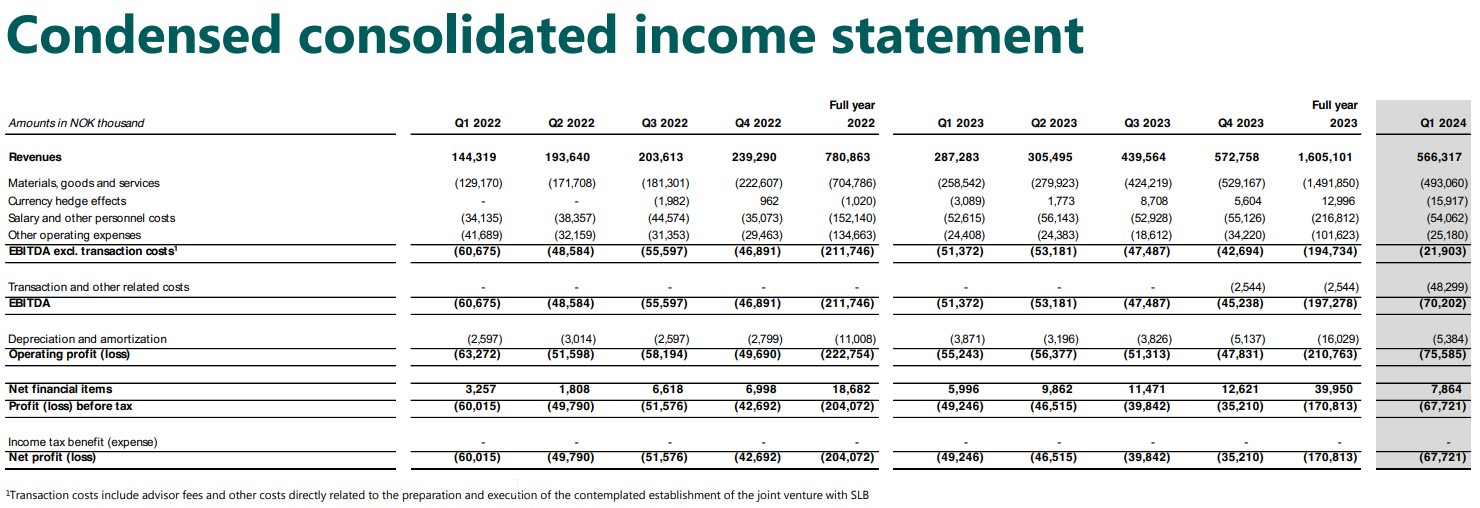
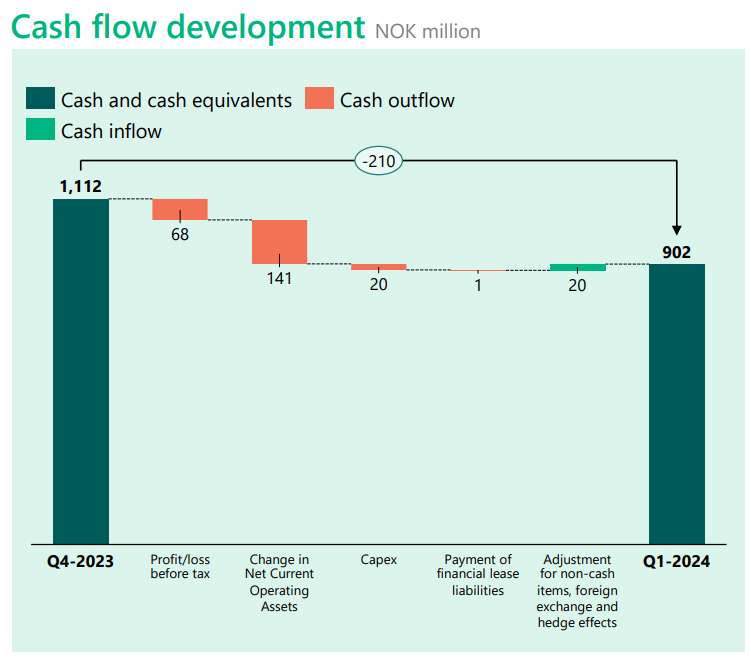
Revenue almost doubled compared to the previous Q1, but costs related to the Joint Venture weighed on the results. Without the JV costs, the earnings trend would have continued its positive trajectory. Cash fell to the level expected in the Q4 webcast, so in my view, there were no major surprises in the report.

image

image

ACC’s relatively new CFO Julie Berg is changing companies and moving to Mainstream Renewable Power, which operates under Aker Horizons ASA. I don’t find the news very surprising, as financial steering will likely shift heavily into SLB’s hands, and ACC’s CFO would probably not have been left with much more than a rubber-stamp role.

6 Likes

I waded through the Q1 webcast mainly to hear if anything interesting would come up in the Q&A section. The whole event was somewhat frustrating because the Joint Venture cast a shadow over everything and the questions revolved around it, but they couldn’t share more than what had already been published. Consequently, the entire Q&A was mostly a repeat of the same things.

In practice, it went like this: What will be done with the money received from SLB?
The general answer to this and most other questions: The management team has started work on updating the strategy, and it will be announced when it’s ready.

However, some things did become clear, and some of these have been known before, but I’ll list them here.

  • ACC remains listed and SLB will fund the joint venture during the deal’s lockup period (3 years).

  • The potential performance-based earn-out from the deal is tied to certain milestones, securing orders, and margin targets during 2025-2027, which were not elaborated upon further.

  • Brevik handover in late 2024.

  • North America is clearly becoming one of the company’s main market areas (which has been noticeable for a while, as an office has been established there, stock exchange releases have started coming from that direction, and a new mobile test unit has been built there.)

  • Unfortunately, management refused to answer whether they are bidding for current UK Track 1 projects. They ended up stating that ACC is nonetheless active in the UK. Because of this, the UK situation remained the most bothersome, as one project was already lost earlier to Technip Energies. On April 19th, Technip Energies was also selected to perform the FEED for Viridor’s Runcorn CCS project. Regarding this, the CEO admitted that they are no longer bidding for that project, so that can also be crossed off. Why isn’t ACC succeeding in the UK?

  • One good question touching on this topic related to ACC’s ability to bid for larger projects and whether a limit on cash/resources had been reached. According to the CEO, it wouldn’t be about that, as for larger projects, the bid is always made as part of a consortium where ACC is only the technology provider, and other parts of the consortium are responsible for the rest.

Something here doesn’t add up, and ACC seems to be missing something. I don’t believe the JV was voluntary, but rather a union dictated by looming necessity, which I believe was made in time, though. It could be due to several factors, but I bet the company’s size plays a central role.

Can ACC compete in solvent technology R&D with giants like BASF (Oase White) or Shell (Cansolv), or find a competitive advantage against Saipem’s new enzyme-based technology?

Could ACC alone promise quick on-site maintenance in every country or state during the bidding phase? Large plants are unlikely to accept downtime caused by carbon capture equipment. SLB has a global network through which maintenance will always be close by in the future.

Well, it seems it won’t be boring with this (either), and one apparently has to look even further ahead. Based on the answers, the JV will fortunately likely be finalized during Q2.

Edit: I’m about to send a question to IR regarding that UK situation, because the entire slide concerning the UK has disappeared from the Q1 report. It was still included in Q4. I’ll try to fish for more information, but expectations aren’t very high.

3 Likes

ACC and SLB have successfully closed their joint venture.

Following the deal, amine-based solvent technology will still come from ACC, while SLB provides complementary technology, non-aqueous solvent technology, and potentially later, sorbent-based carbon capture technology.

ACC’s current CEO, Egil Fagerland, will transition to become the CEO of the joint venture, and ACC’s former CEO, Valborg Lundegaard, will return to her previous role.

In any case, I believe that after this, it will be easier to bid on large projects when the offer doesn’t need to be limited to just carbon capture and temporary storage. SLB certainly offers support for CO2 transport and loading, as well as likely subsea injection.

Next, we await the outcome of the ongoing strategy review.

Edit: typo

8 Likes

Since this is the first joint venture (JV) I’ve encountered on my investment journey, I asked IR for a detailed breakdown regarding the roles and rights of the remaining listed company (ACC ASA). I am only providing my own translation of the response I received from David Phillips, as he has previously requested that his responses not be posted directly on forums as quotes.

  • ACC ASA: The current listed company remains as a sort of investment company that owns 20% of the new joint venture (ACCH), while SLB owns the remaining 80%. Furthermore, the funds received from the formation of the joint venture belong to ACC ASA. However, the current ACC ASA no longer has any operational activities outside of the joint venture. All tenders, projects, and development work are therefore carried out through and for the benefit of the joint venture.

  • Joint Venture (ACCH): The operational unit to which ACC ASA’s previous operational activities have been transferred essentially 1:1, and to which SLB brings its own expertise and resources. The new joint venture is better resourced in every way, focuses more on technology investments, and has a larger global footprint.

A small related nuance is the change made to the Articles of Association at the last AGM. Previously, ACC ASA’s business scope was CCUS and hydrogen. After the redefinition, ACC ASA’s business scope includes energy, climate, and environmental solutions. This allows the company to operate as an investment company if needed. Quote from David: “this is no indication of intention, but gives flexibility for the company to operate as an investment company (if needed).”

Link to the new Articles of Association below.

Previous wording from 2023: “The company’s purpose is to conduct business, invest in and / or own rights in the capture, use and storage of CO2, hydrogen, and other related activities.”

New wording from the 2024 AGM: “The company’s purpose is to, by itself or together with other parties, invest in, develop, and divest from businesses that operate within energy, climate and environmental solutions, associated technology and infrastructure, related goods and services, and capital management.”

Whether this potentially affects the size of the upcoming monster dividend is anyone’s guess, but at the very least they have increased their options for using cash for things other than just appeasing shareholders.

4 Likes