This was indeed pleasant news. There has been discussion here as well regarding how little ownership the insiders have. However, these arenât just cosmetic âŹ2,000 purchases; we are talking about sums approaching six figures per person. This total of slightly under 200k in insider shopping doesnât change the big picture as such, but itâs a nice positive signal for this year alongside the share buybacks. In previous years, I think the company has shown quite a few âred flags,â staff turnover, etc. Itâs nice to get something more positive as well.
It is also great that the CEO has a strong AI background from previous roles. One wonders if the choice of CEO happened to be a lucky match for the AI era by chance, or if it was a conscious decision during recruitment.
Indeed, and for the investor community, management buying their own shares tends to be a more significant positive signal than management selling, which is often perceived negatively and causes quite a stir on some forums. There can always be a legion of different personal reasons behind selling, whereas a buy is always a buy and an investment.
Inside Information, Profit Warning: Admicom Plc Lowers Its Guidance
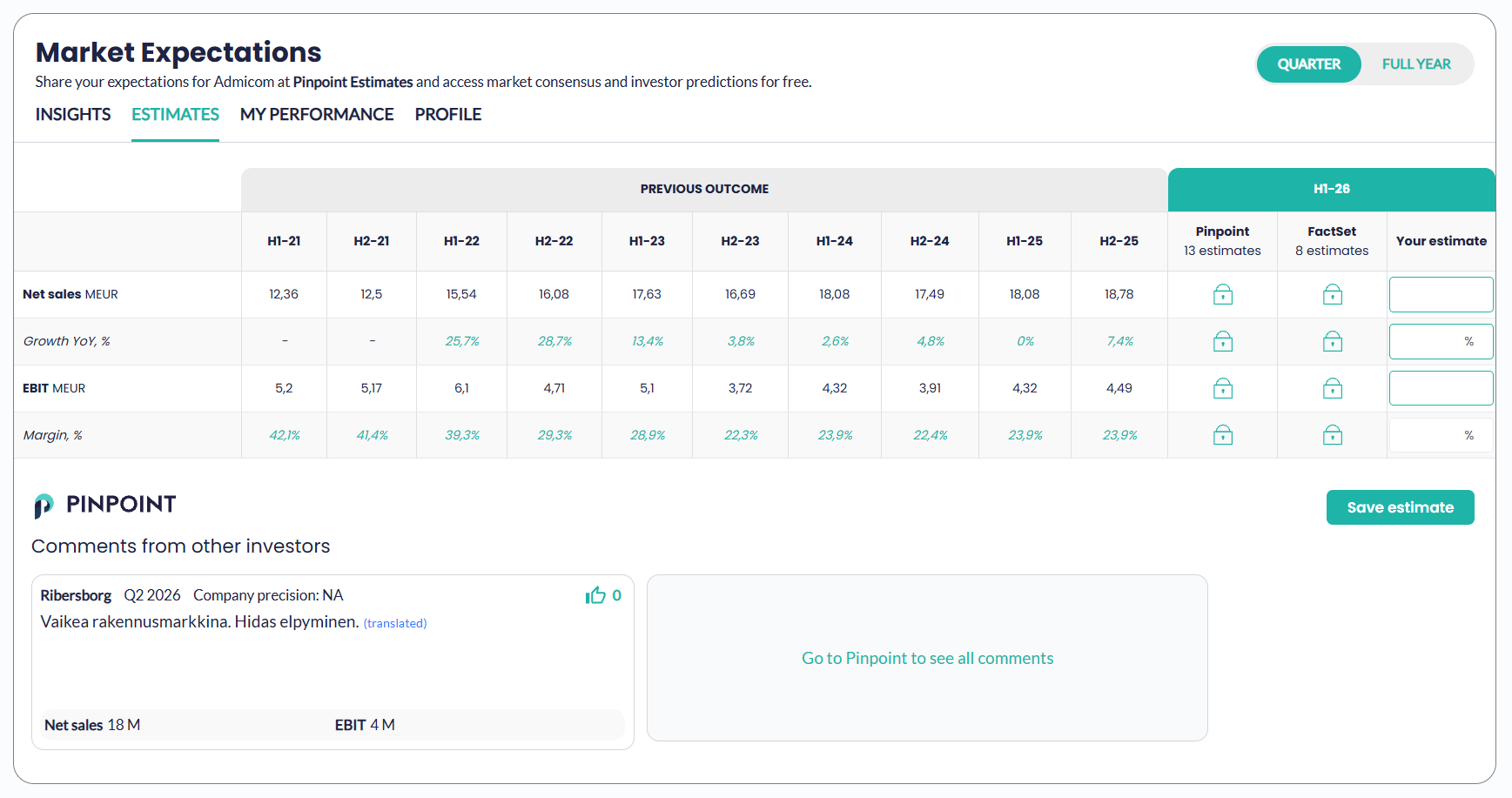
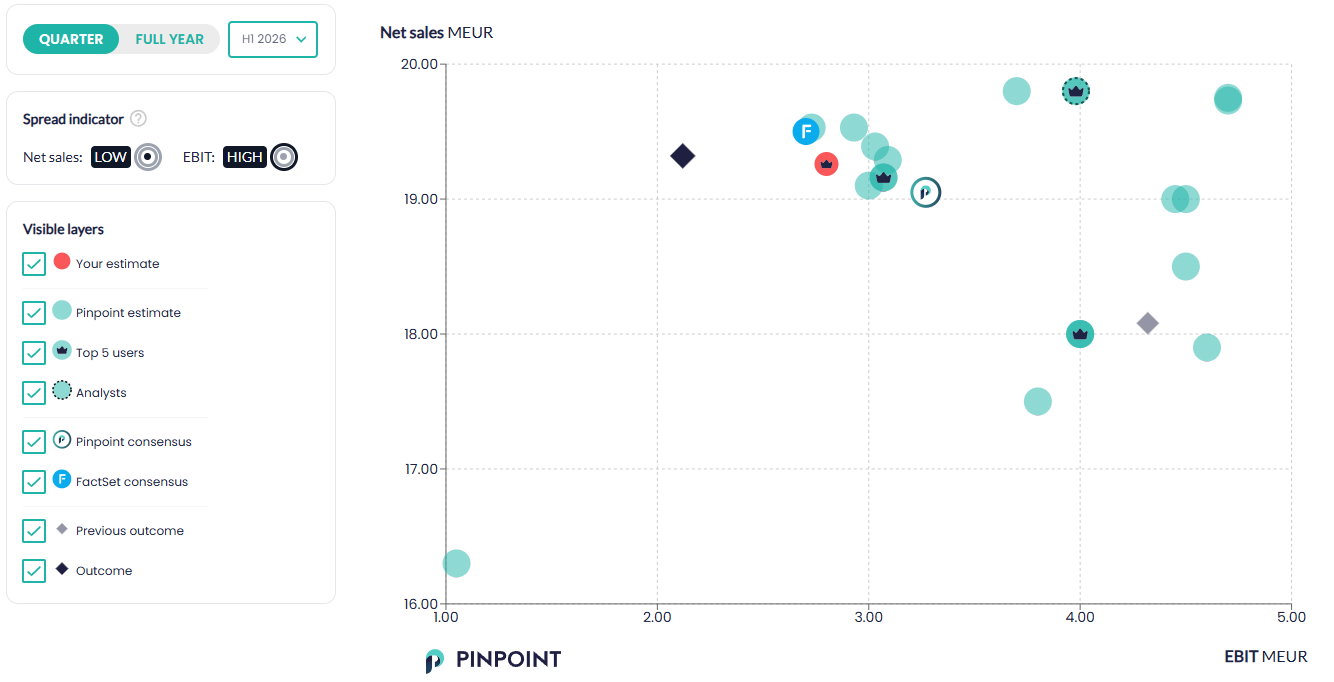
As the challenging market situation in the construction industry continues, Admicom Plc (âAdmicomâ or the âCompanyâ) is lowering its guidance for Annual Recurring Revenue (ARR) and net sales for the current year. The recovery of the construction market in Finland at the beginning of 2026 has not commenced as forecasted at the end of 2025, which has not only affected sales but has also manifested as slower-than-expected development in revenue- and user-based billing. Customer churn continues to be driven primarily by customer bankruptcies and financial difficulties, which accounted for approximately 30% of churn during the first five months of the year. Furthermore, acquisitions and mergers resulting from the consolidation of the construction market have accounted for up to 15% of customer churn.
High customer churn combined with low sales results in the first two months of the year is particularly reflected in Admicomâs net sales development. While it is possible to grow Annual Recurring Revenue (ARR) more rapidly during the second half of the year, the impact on net sales is slower. As the challenging market situation persists, uncertainties regarding growth in the second half of the year have increased.
Admicomâs original financial guidance was based on the assumption that reaching the upper end of the growth guidance would require either a faster recovery of the construction market or a small acquisition. Admicom does not rule out the possibility of an acquisition during 2026. However, the rapid development of artificial intelligence has caused uncertainty in the SaaS (Software as a Service) equity markets, which has also been reflected in Admicomâs share price. The value of the Companyâs shares has decreased significantly compared to the beginning of 2026. Valuation levels of unlisted companies have not changed to the same extent, which currently makes value creation through acquisitions more challenging. Nevertheless, Admicom is continuously developing its M&A project pipeline and aims to find ways to execute acquisitions even in this market at reasonable valuation levels.
The implementation of Admicomâs updated strategy has started well in many areas. However, in a challenging market, the benefits from projects intended to accelerate the companyâs growth have not yet materialized as planned. During the second quarter, Admicom conducted change negotiations aimed at addressing the need to shift the focus of resource allocation to better support the chosen growth strategy.
Despite the weakened growth forecasts, Admicom maintains its original guidance regarding profitability.
New Financial Guidance for 2026
The company estimates that in 2026, Annual Recurring Revenue (ARR) will grow by 3â10%. Annual Recurring Revenue in 2025 was EUR 37.8 million.
Total net sales are estimated to grow by 2â6% from 2025. Total net sales in 2025 were EUR 37.7 million.
Adjusted EBITDA is estimated to be 31â36% of net sales.
Previous Financial Guidance for 2026
The company estimated that in 2026, Annual Recurring Revenue (ARR) would grow by 6â12%. Annual Recurring Revenue in 2025 was EUR 37.8 million.
Total net sales were estimated to grow by 5â10% from 2025. Total net sales in 2025 were EUR 37.7 million.
Adjusted EBITDA was estimated to be 31â36% of net sales.
Talk about perfect timing, I just opened an Admicom position in my portfolio today ![]()
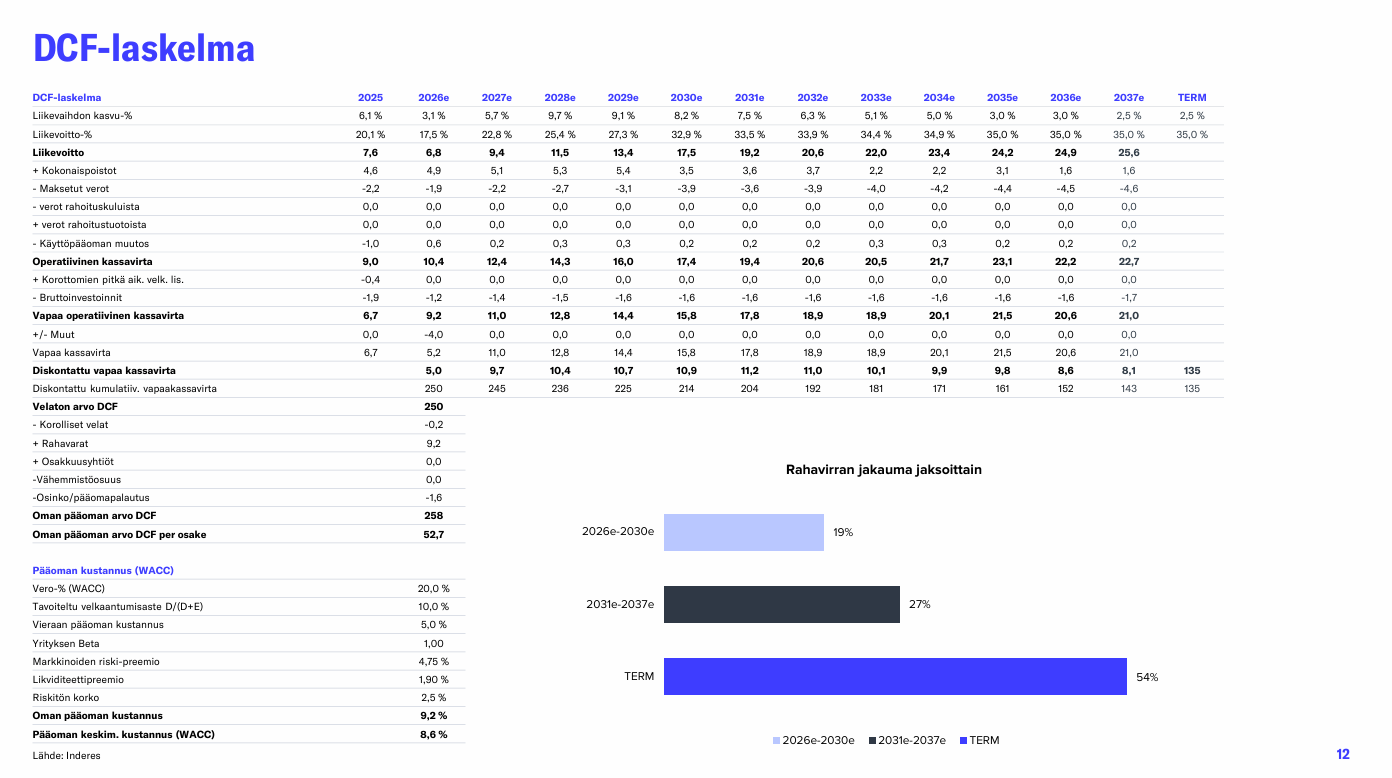
If you look at Inderesâ forecasts, for example, they were expecting 5% revenue growth for this year.
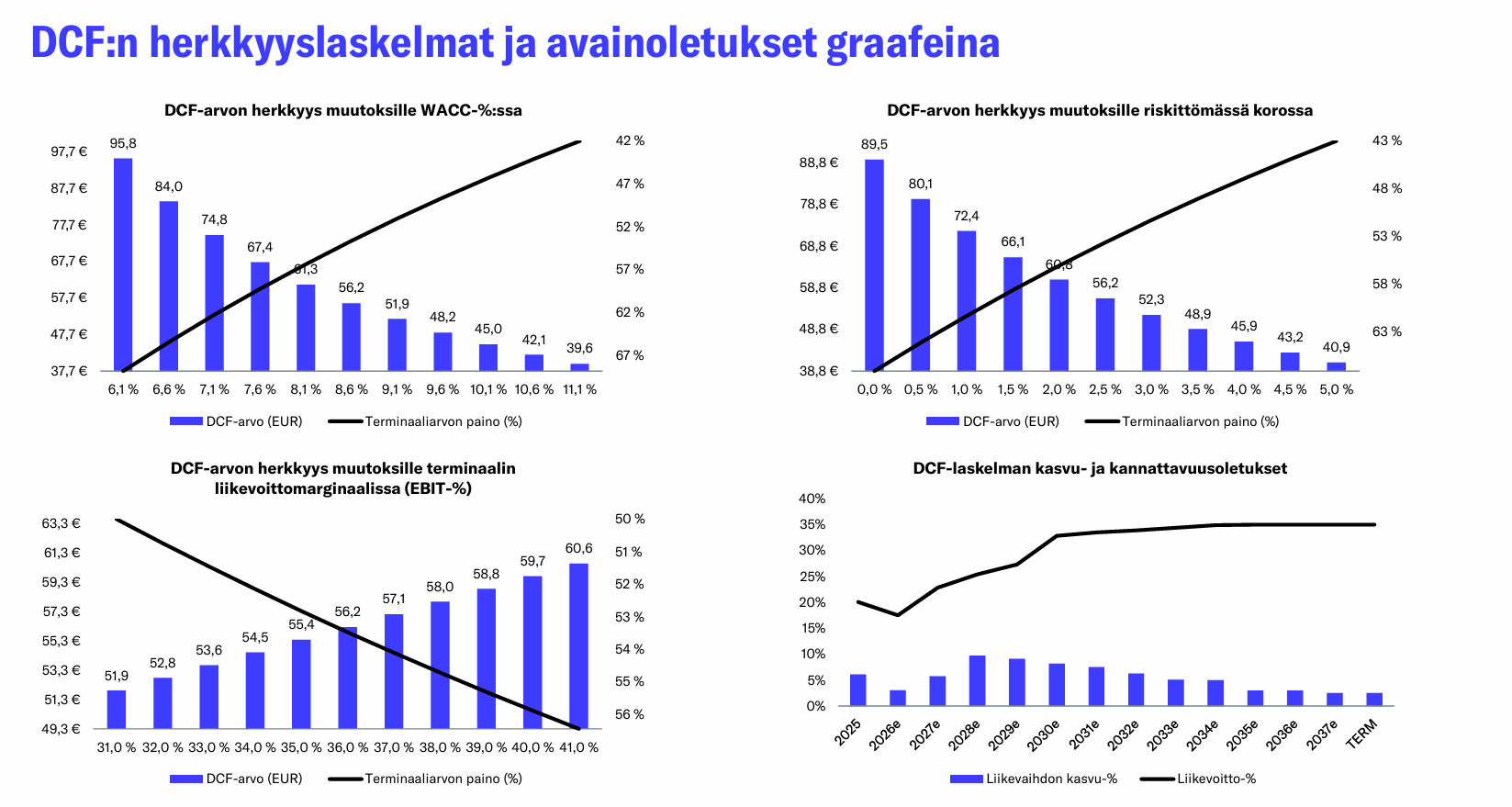
With the new guidance, that will probably drop by 1â2 percentage points, but in the big picture (DCF model, cash flows over many years) or at this stage of the cycle, is that perhaps just a drop in the ocean? This year is a write-off anyway, whether the growth is 3%, 4%, or 5% ![]()
One definitely has to wait a year or two at a minimum, but surely the cycle will turn again at some point? The stock isnât exactly expensive based on trough-of-the-cycle earnings.
I also bought Admicom for the first time last week. Iâm not deeply familiar with the company yet, but I got a pretty good overview by reading the extensive report. I decided to buy largely because the construction industry will eventually start to recover, and the companyâs valuation is very moderate. Itâs quite possible we might still head lower, but if you think long-term, we should be at quite reasonable buying prices now. Iâll eat my hat if the Finnish construction industry is âgame overâ and AI destroys this firm in the process.
Regarding the insider buys last week, I was thinking that surely they must have known a profit warning (negari) was likely coming soon, yet they still chose to buy? Or could it be that these CEO and CFO shares are some kind of option exercises etc.? They bought shares for the exact same total value, which is why this came to mind. Of course, it could just be that they chatted among themselves and decided both would buy this much, etc. ![]()
Admicom has also been beaten down so much by large fund sell-offs etc., so it will be interesting to see the reaction tomorrow. This profit warning didnât look too ugly to my eyes, so if thereâs one final âcapitulation vomitâ (oksennus) tomorrow, Iâll have to consider potentially adding to my position.
From the release:
The value of the companyâs share has decreased significantly compared to the beginning of 2026. The valuation levels of unlisted companies have not changed to a corresponding extent, which makes value creation through acquisitions more challenging at the moment.
Theory is lost here once again.
If an acquisition is made with cash or debt, the valuation level of oneâs own share relative to the valuation of unlisted companies doesnât matter at all.
An acquisition creates value if it generates a return higher than the cost of capital. As a rule of thumb, thatâs 10%.
For example, if a target is bought at a P/E of 10x and it grows by 10% per year as part of Admicomâs sales engine, Admicomâs rule-of-thumb cost of capital is exceeded immediately. In laymanâs terms, the earnings yield improves annually from 10% â 11 â 12.1%, and so on.
For instance, Constellation Software, a slightly larger software outfit, hasnât particularly complained about the drop in its own share price; instead, the companyâs acquisition pipeline is currently the largest in its history. ![]()
If the valuation of oneâs own share mattered, it would mean that when the share is expensive, the company could buy any old junk just to âcreate value.â However, we can empirically observe that firms buying just anything tend to crash. ![]()
If Admicom intends to use its shares as part of the deal, which is always regrettable dilution for owners, the calculation obviously changes. But if someone from the company is reading this, please do not dilute your share base. ![]()
I recently rambled more about value creation in acquisitions in the âVarttiâ segment.
If this was one of those investment story red herrings to soften the news.
It is also possible that the comment was intended to emphasize that potential targets are not at âbuyâ prices, even though the prices of listed companies might suggest otherwise.
Admittedly, itâs a strangely worded paragraph, so who knows.
I think the content of the paragraph is quite sensible, if the intention is to communicate that the relative prices of potential acquisition targets are too expensive and, therefore, repurchasing their own shares is the most logical way to allocate capital at the moment.
At some point, there was a lot of excitement on this forum regarding multiple arbitrage. You buy a company at, say, a P/E of 10 while your own stock is valued at a multiple of 15. Profit is then generated for the owners at the moment of purchaseâamounting to 50% of the purchase priceâas long as investors are willing to accept the new valuation.
Isnât this basically the same as management saying something along the lines of: âOn average, we arenât capable of creating value through acquisitions, so we only attempt them in cases where our own stock is clearly above fair value and we can use it to finance the acquisitionâ ![]()
If company management could actually genuinely assess the value of their own stock in all situations, this would indeed be the correct way to act opportunistically in capital allocation. Stock is expensive: fire up the printer and use it to buy companies. Stock is cheap: buy back as many shares as the market offers
A classic legend and prime example of this is, of course, Henry Singleton and Teledyne.
Anyway, for the majority of companiesâand I believe for Admicom as wellâthe more important factor is whether acquisitions can in practice systematically create value with a return exceeding the cost of capital, regardless of the approach (synergies or a decentralized operating model, etc.).
Another somewhat peculiar point in the release:
Admicomâs original financial guidance was based on the assumption that reaching the upper end of the growth guidance would require either a faster recovery in the construction market or a small acquisition. Admicom does not rule out the possibility of an acquisition during 2026.
I donât think itâs a good thing that management includes even these small acquisitions in their growth guidance. There is a risk that, at least subconsciously, they will try to rush a potential deal to completion just to avoid âfailingâ the given guidance. It would be even worse if this were tied to incentives like absolute revenue or earnings levels, but Admicom doesnât seem to have those, based on what I tried to find.
Speaking of short-term guidance, it occurred to me: do they actually serve anyone? How much of managementâs time is spent calculating what kind of guidance can be given to the market, and in Admicomâs case, even second-guessing the movements of the construction cycle? And then more time is wasted monitoring whether that guidance is being met, and in the worst case, drafting a list of excuses for why it wasnât
This time could be spent on what actually matters for long-term value creation. Of course, itâs good to communicate long-term goals and strategy to investors, but a lot of energy is wasted on this kind of short-term noise by both listed companies and investors.
Letâs start with the fact that it is actually healthy for a company considering an acquisition to state that they are evaluating the valuation levels of potential targets. This is not entirely self-evident, so letâs welcome this approach.
But back to the point: surely it isnât ruled out that the company could use its own shares as a form of financing for an acquisition, while simultaneously achieving a return on capital that exceeds a 10% cost of equity requirement? If the companyâs own shares are expensive, why wouldnât they be used at least partially for purchases, or why not organize a small share issue? If I recall correctly, the exceptional managers presented in Thorndikeâs book The Outsiders used some rather clever ways of utilizing stock to create shareholder value. We are unlikely talking about the exact same thing here, but in theory, canât value be created even through dilution if the acquisition target is high-quality and the price is attractive? Often dilution is a negative for the shareholder, but my point is that this isnât necessarily a binary issue; there are many exceptions and gray areas along the way.
E: JP beat me to it ![]()
Here are Roniâs comments regarding Admicomâs profit warning ![]()
Admicom announced on Monday evening that it is lowering its growth guidance for the current year due to the prolonged challenging situation in the Finnish construction market. However, the companyâs profitability guidance remained unchanged, which is a small relief. Although we were already at the lower end of the previous growth guidance, the comments in the release regarding sales outlooks and persistently high customer churn will likely cause slight negative forecast adjustments to our growth expectations.
I have now read through this entire thread over a couple of days. An interesting company and an amazing start to its journey on the stock exchange. But then came COVID and the construction slump. And the âentry of the Swedes,â as founder HĂ€ll puts it, likely had a major impact on the firm as well. Costs started to rise and the culture probably began to change too.
The early years also saw a broader shift in ownership. In addition to the Swedes, others joined: funds, pension companies, and foundations. The original owners cashed in on the fruits of their labor. Currently, Admicom has no âfacedâ owner (kasvollista omistajaa).
Iâm not sure what to do. To buy or not? Itâs easy to look at the past and hope for the same kind of rise as before COVID. But the company is different now, because so many executives have come and gone! There have been five CEOs since 2019. That is high turnover and speaks to a chaos in management. Another thing Iâm considering is internationalization. It has been talked about for years, and the only thing achieved was a small acquisition in Estonia. Well, maybe it was a good move? I havenât looked closely at what kind of synergy was gained from it.
A few years ago, a strategic choice was also made to focus solely on construction. Could they have chosen a specific area within the industrial sector in addition to that?
On the other hand, the firm has fared surprisingly well during this construction slump. Iâll keep following the development, even though the share price is at an all-time low.. Maybe.