Witted - Next-generation software development company

Well, as is evident from above, they have been in growth mode for a while now. Regarding profitability, Huttunen promised proof in the form of upcoming interim reports, the first of which we’ve now seen in this quarterly. While they try to remain cautious in their rhetoric, in management’s mind, profitability should also have a clear direction. Of course, there can always be temporary or even longer-term setbacks. Time will tell, but at some point, one has to dare to start trusting in a better outlook.

And even this current growth+profitability isn’t at a great level yet. However, relative to the valuation, it’s actually quite good.

2 Likes

Hello @Harri_Sieppi!

It would be nice to hear your comments on the Q1 results as well:

-What things surprised you positively?
-What are you most concerned about regarding Witted?
-In your opinion, what things should investors pay special attention to in future interim reports?

Have a great upcoming May Day :balloon:

Oh, my view =D. I’m just an “ex” after all, wouldn’t it be nice if Hude (CEO Huttunen) came to share some thoughts with us owners :slight_smile:

But of course, you can always get a view from me—it may or may not be a good one.
I think Q1 was really good. It shows the systematic good work that has been done for 2025. Q1 was mainly sold during Q4, and those profitability measures extend even further. I’m truly proud of Witted. <3

The journey continues; for Q2, it’s time to raise the bar higher.

Happy May Day to you too, Putti!

24 Likes

I promise @Harri_Sieppi to comment if I’m asked. :slight_smile:

Upcoming interim reports will show the continuity of the turnaround, as @Seinakadun_Keisari pointed out. We now have two quarters with a similar trend behind us. Some time ago, I remember Kauppalehti highlighting Elisa’s 15 consecutive quarters of earnings improvement—there’s still a long way to go, and Q3s in the service business make achieving such streaks a bit difficult, but it’s always good to have role models. And as @Karhu_Hylje commented, “even this current growth+profitability isn’t a good level yet.” We don’t think so either. It’s better than before, of course, but there’s still work to be done.

To @Putti’s questions: fortunately, Q1 didn’t surprise me. I believe I voiced my concerns (primarily general economic development, secondarily the impact of AI on our industry). Of course, I consider the impact of AI to be more of an opportunity than a risk. I won’t start advising investors in their own field, so I’ll leave the third question unanswered.

20 Likes

@markus.huttunen1, was it the case that at the core of Witted’s business model is building customer teams, specifically in a way where your people are involved in these teams in key roles?

Has the role of AI been exceptionally significant in the work of these customer teams, and can Witted’s improved success be explained by this new “team member”?

In addition to those simple yes/no answers (I hope you’ll elaborate further), I would like to hear how you, as the CEO of an IT services company, see the AI disruption affecting the operations and revenue of IT services companies both now and in the future?

6 Likes

Excellent questions! Let’s take them one by one.

”Was it so that at the core of Witted’s business model is building the customer’s teams, and specifically so that your people are involved in these teams in key roles?”

Exactly. To simplify slightly, the change management side of Nexec typically provides program management, project management, change management, etc., while the software development business provides architects, developers, scrum masters, and so on.

Has the role of AI been exceptionally significant in the work of these customer teams, and can Witted’s improved success be explained by this new ”team member”?

“Exceptionally significant” might be a bit of an overstatement, but its importance grows month by month. In some accounts, we are at a stage where no one can get by without AI expertise anymore; in others, it’s an earlier phase. In more advanced accounts, we are seeing the re-rolling of teams for the AI era, and demand is strengthening for experts capable of systemic thinking, understanding business problems, and “factory-like” software production instead of strengths purely in writing “code syntax.”

If you are interested, you can read more about this in this white paper. And if you’re interested but short on time, ask Claude/Gemini/ChatGPT to summarize the key messages. :slight_smile:

In addition to those easy yes/no answers (I hope you’ll elaborate), I’d like to hear how you, as the CEO of an IT services company, see the AI disruption affecting the operations and revenue of IT service companies now and in the future?

I already tried to say more than just yes and no above. But let’s continue.

First, briefly, the impact on us: revenue and profitability-enhancing in the medium and long term.

Then, in more detail. I’ll answer specifically from our perspective because we are a unique type of IT services company. We focus primarily on serving digitally advanced customers, where the customer’s buying behavior differs from the mainstream (more customer-led work where specialized expertise is provided; fewer project deliveries where the customer’s own activity is lower). Furthermore, our operating model is particularly suited for experienced professionals (read: we can pay senior professionals better if they are willing to share the risk of being billable in customer projects with us), and thus the market challenge regarding the future of junior developers does not affect us. Additionally, our customer base is heavily weighted toward large enterprise accounts, meaning all AI-related initiatives have a very strong change management perspective. We are not building from scratch; we are changing how hundreds or thousands of employees work in a technological environment where some building blocks might be decades old.

Our strategy is based on the assumption that gradually, every company will become a software or technology company. With AI, development becomes vastly more efficient, and the financial calculations for technology investments are recalculated. This leads to a major investment wave in automating and redesigning companies’ core functions.

A very large proportion of employees at big enterprise customers—estimates vary by industry from 20% to 50% of the workforce—perform work that is partially or entirely automatable. We have tried to estimate how many development resources are needed to automate such work, and our best educated guess is that for every 10 operational tasks being automated, 1-2 developer-type experts are needed. Those previous 10 operational tasks were not our business, but the new 1-2 developer roles are.

However, these 1-2 new developer roles are not identical in content to how software was previously developed (referring also to the white paper above). The level of abstraction rises, managing entire systems becomes more important, and enterprise-level requirements for things like security and quality bring forth entirely new key roles in the “software development factory.” At the same time, business domain experts are expanding their skills toward software development. All this means that a good IT services company must radically develop its offering and expertise. But the market is willing to pay more than before for this modern expertise.

In our business model, experts have very strong incentives to continuously develop their skills. They understand that mastery of these new methods and tools strengthens their personal demand and can positively impact earnings through the higher value provided to customers. We have an exceptionally low need to “push” people to learn new things; instead, there is a pull from the experts, as long as we can guide them in the right directions based on customer demand and broader market insight. If this weren’t the case, my hair would be turning gray much faster—the risk of “obsolete inventory” would be the single greatest danger to business profitability.

22 Likes

Observations from the fresh shareholder list:

  • The head of Nexec (previously held the CEO title) increased their holding by over 10,000 shares in April.

  • Tapio Niskanen and Mikko Näkki (VK Convest Oy), both with Nexec backgrounds, also increased their holdings.

  • Aki Pyysing increased his holding.

  • Mikko Mäkinen added a whopping 200 shares.

  • Siili’s CEO Tomi Pienimäki entered the list of largest shareholders through his company. (Welcome as a shareholder, but stay away from operational activities).

  • Medifilm lightened its holding.

  • Nexec Holding, on the other hand, disappeared entirely from the list, which likely explains why the holdings of those with Nexec backgrounds increased as the shares were distributed to the owners. This is probably also where Jatkaja’s new shares came from.

13 Likes

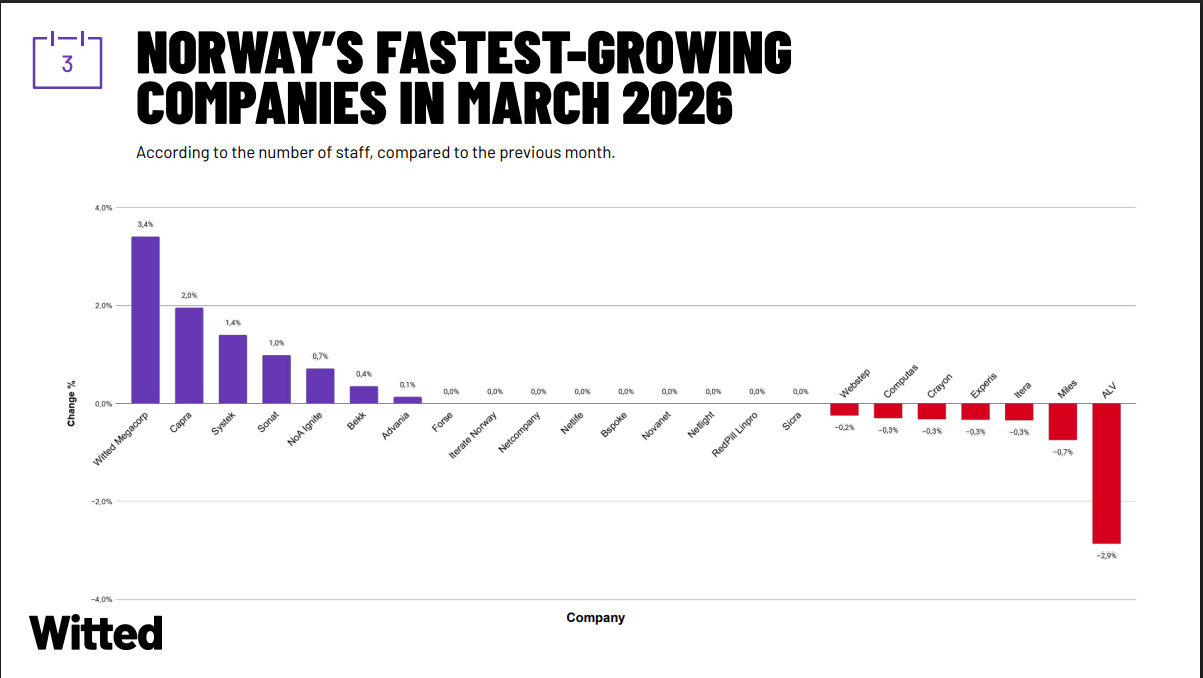
The latest Witted Insight shows Witted’s strong growth compared to its peers in Norway:

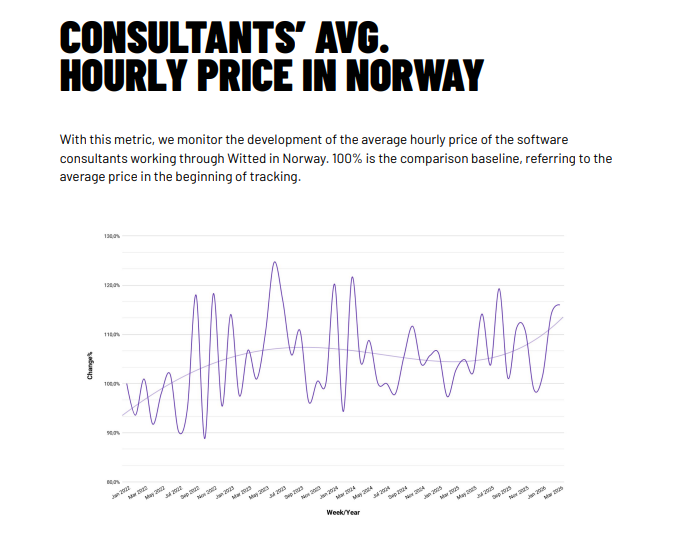
Prices are also trending upwards now:

11 Likes

Yleisradio (Finnish Broadcasting Company) has selected Witted Megacorp Plc as the primary expert partner for its Renewal and Innovation Project 2026 entity. The procurement will be implemented during 2026 and includes options to extend the assignment until the end of 2027, as well as the acquisition of up to five additional experts. The calculated total value of the contract, including all options, is 2.9 million euros excluding value-added tax.

16 Likes

Quite a nice deal, as in practice 2.9 MEUR (including options) is spread over only 1.5 years, and likely a significant portion of this will be procured during 2026 (excluding options). Of course, this doesn’t reveal what Witted’s specific share is, even though they are the main partner.

This likely relates to this previous framework agreement.

13 Likes

It was a very nice birthday present to be able to announce this on such a personal day of celebration. And you are absolutely right that it falls under the framework agreement just mentioned.

Unfortunately, commenting on the specific share/allocation falls into the category of trade secrets.

15 Likes

Share buybacks are starting again. Great news!

19 Likes

Here are Frans’s comments regarding this new share buyback program. :slight_smile:

7 Likes