Valmet - Master of Transformations

Quite a lot of bad news is already priced in. Valmet’s P/E for this year has already dropped below 9, and for next year—which analysts already expect to be difficult in their forecasts—it is hovering around 9.5. An EV/EBITDA level of ~5-6 is also quite low for a company with Valmet’s profile. So, I don’t doubt that a better buying opportunity could potentially arise. But if you calculate, for example, a -10% or a really bearish -20% margin of safety for the current year’s earnings and next year’s already weaker projected earnings, you end up with P/E multiples between 9.8–10.5 for '23 and 10.6–11.6 for '24 in that moderate bear scenario.

Valmet is significantly less cyclical than it used to be. People seem to forget Neles and the service businesses in this equation.

What kind of earnings decline are you personally expecting, since you consider the current situation such a poor time to jump on board?

29 Likes
20 Likes

Joining the discussion from the sidelines; I personally bought Valmet once in 2023, when the price seemed to reflect a lot of bad news and there was a margin of safety in the valuation. Valmet seems like a good company and the stock has a lot of potential.

However, I haven’t managed to be extremely enthusiastic about Valmet, and my Valmet holding is quite small compared to many other stocks.
Here are some of my own doubts regarding Valmet, which might spark thoughts in other Valmet shareholders, or perhaps someone can dispel my doubts:

Geopolitics: Valmet gets ~11% of its revenue directly from China. There are 2,300 / 17,500 employees in China, along with 6 production facilities and 3 R&D centers! China is a huge market and a global player probably “must” be there, but this is a big warning sign.

Valmet has many business areas, but pulp is a massive part of the business directly and certainly also in terms of maintenance. Things aren’t going well there right now, and it’s not good for Valmet if customers start tightening their purse strings (postponing/canceling investments, in-house maintenance vs. buying from Valmet, etc.).

Circular economy, green transition, etc., are big opportunities for Valmet directly and indirectly. But there are also risks; when the regulatory bureaucrats in Brussels get really excited, anything can happen…

Value chain position: the heavy industry’s preferred supplier. Valmet has a lot of expertise, and they have historically been able to monetize their products and services quite well, with apparently long-standing customer relationships. However, that position is quite precarious, as customers likely lack the ability and willingness to pay top dollar; maintenance certainly provides recurring billing, but they constantly need to sell something new with a good margin somewhere. This concern has historically been unfounded, but it’s not exactly a fantastic place to make money when customers have heavy, debt-laden balance sheets and their demand depends on consumers—and Valmet’s money then has to come from maintenance and installations for machines at UPM and the like.

Valmet’s largest owner is Solidium. One can consider the case of Fortum, for example, whether it’s an ideal situation to be a shareholder in a company driven by the Finnish state…

Insiders:

  • CEO Laine is apparently good. But he’s leaving. A new CEO is both a threat and an opportunity.
  • Chairman of the Board Mäkinen only has a small stake in the company. I don’t know much about him, but from what I’ve seen of his career at various companies, he has never impressed me.
17 Likes

Geopolitical risk is indeed a good point. But as someone from a technical background, I would disagree with the idea of shifting maintenance operations from Valmet to the customers themselves. In-house maintenance guys don’t have the expertise or the desire to start doing the kind of maintenance or overhauls that are typically outsourced. Usually, those aren’t the most pleasant jobs anyway. Furthermore, by outsourcing, the work gets done efficiently and line downtime is kept to a minimum. Stopping the line costs so much in lost production per hour that there’s no room to shift those jobs to in-house blue-collar workers on hourly wages.

I see the probability of this kind of risk as vanishingly small.

19 Likes

The forest industry has invested heavily in new capacity over recent years, and clear signs of a slowdown are now visible. Demand and price levels for end products are cyclically at a trough, making producers naturally cautious with investments; however, the biggest problem for them is the cost inflation of equipment and construction, as well as risen interest rates. With these investment costs and the cost of capital, it is very difficult to build a sensible business case, leading to decisions being postponed or canceled. This will inevitably be reflected in Valmet’s project business revenue in the coming years.

The service and maintenance business is more stable, but even there, producers’ low utilization rates provide an opportunity to postpone maintenance activities. This will turn along with the cycle, and in any case, Valmet’s service business should be fairly robust because the services purchased from them focus largely on demanding maintenance of OEM equipment, which is difficult to perform in-house.

Valmet’s strengths are technological expertise, a respected brand, and, depending on the segment, a position as either the #1 or #2 global equipment supplier, which provides pricing power to a certain extent. The state as an owner, the CEO transition (which is being carried out in a controlled manner by autumn 2024), and the very likely drop in revenue in the coming years are the key risks. If margin levels can be defended and M&A activities create value, the earnings might not take as much of a hit as the current share price implies.

At these prices, Valmet is a classic value stock where no explosive growth is expected, but on the other hand, looking across the cycle (2–3 years), the downside should also be fairly limited.

22 Likes

Clarification on investments:

The Körber Tissue acquisition is good despite the weak state of the tissue paper investment cycle. Every year, there are 100 million more middle-income consumers globally (the lower limit being 10-12 dollars of daily income, depending on the source). These consumers use their new income for things like hygiene. In 10 years, there will be a billion more consumers. This is a development completely independent of cycles.

The Siemens chromatography [acquisition] seems to mainly be about taking over the downstream part of the P2X process. This isn’t just a “nice to have” purchase either, but a strategic acquisition. In the future, P2X will inevitably be part of all heavy industrial processes as part of carbon capture. Realistically, CO2 pulled directly from the air is expensive and utopian, so industrial emissions will paradoxically become a source of income. However, those emissions must be separated, condensed, combined, separated, inspected, and stored. Valmet’s valves, software, meters, quality checks, and overall processes are involved at every stage. The finished methanol goes into a Wärtsilä engine and freights the toilet paper produced by Körber machines.

19 Likes

Valmet’s share price has been pushed extremely low.
Another good example is Stora’s earnings release this morning; the result is really poor, and the stock is trying to move upwards because it has already been priced quite low.

With Valmet, on the other hand, the earnings won’t be poor either, so it would be quite a surprise if the stock doesn’t change direction this week. Of course, future movements in short positions will also determine where the stock goes in the future.

14 Likes

Will there be a results live today as there usually is?

1 Like

Valmet Oyj: Valmet’s Interim Review January 1 – September 30, 2023: Orders received were EUR 980 million and comparable EBITA increased to EUR 150 million in the third quarter

28 Likes

Valmet has received a significant order from Liansheng Pulp & Paper (Zhangzhou) in Fujian Province, China. The order includes the delivery of multiple technologies for the customer’s Zhangpu site. Valmet will supply a coated board production line (BM 2) and related automation systems, bleached chemi-thermomechanical pulp (BCTMP) production technology, and two small-sized tissue machines (TM 5 and TM 6). Additionally, Valmet will deliver four tissue machine headboxes for the TM 7, TM 8, TM 9, and TM 10 tissue machines at the same site.

The order for the coated board production line, BCTMP technology, two tissue machines, and four tissue machine headboxes was included in Valmet’s third quarter 2023 orders. The value of the order will not be disclosed.

The start-up of the coated board machine and the BCTMP technology is scheduled for the third quarter of 2025, the start-up of the tissue machines for the fourth quarter of 2024, and the start-up of the tissue machine headboxes for the third quarter of 2024.

23 Likes

-17% in orders is a slightly better performance than Konecranes’ -19%. I think it’s a decent performance, as the forest sector has been so sluggish globally that I wouldn’t have been surprised even if the order intake had been in the -25% range. The margin improvement was also positive. One can hold this with quite a peaceful mind, as it seems that next year’s dividends are secured with this level of earnings :grin:. However, after a quick read-through of the report, I got the impression that the worst quarters for order backlog development are still ahead. I won’t move to the buy side at this stage, since I’ve already built a reasonably sized position in my portfolio at current prices, so I don’t feel like starting to overweight it yet.

27 Likes

It might also already be priced into the stock. Though it also depends on what the market sentiment will be in the coming months.

A fairly decent dividend is practically already secured for next year’s payout as well, so I intend to continue holding. The stock might struggle next year too, but the slump in new orders can’t last forever, and hasn’t the forest industry already hinted that the worst of the slump is behind us?

11 Likes

I wonder how much that large order from China saved the quarterly order intake, and how significant can individual deals actually be?

1 Like

It’s hard to estimate accurately since the order value wasn’t disclosed, but it sounds like a significant order. It is typical for engineering companies that individual orders can be large relative to quarterly sales; for example, Konecranes occasionally receives orders for a large number of port cranes at once. The inclusion or absence of these large individual orders can cause enough volatility in quarterly order intake that it’s worth keeping an eye on longer-term or historical order intake trends in similar economic conditions and “adjusting” the perceived trend accordingly.

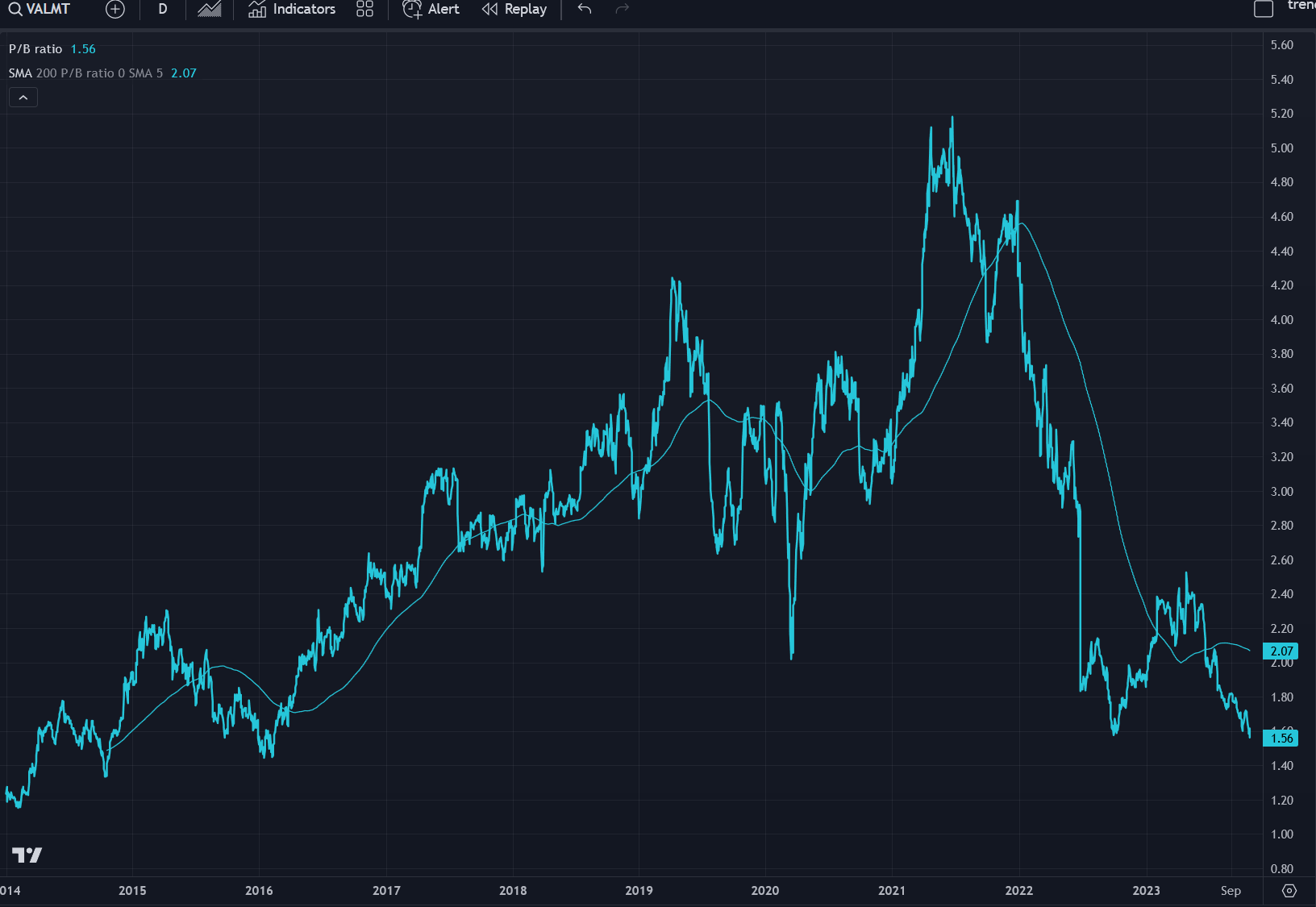
Judging by the share price reaction, the market didn’t feel that all the bad news was priced in yet. As a point of comparison, the share price of Konecranes (which has a lower return on capital) bottomed out last autumn at roughly a P/B level of 1.2, if I recall correctly. The market likely expects Valmet’s near-term profitability/return on capital to decline along with the falling order intake (project business prices must be lowered to attract customers, gross margins decrease, factories face idle time/production halts, etc.). If Valmet’s share price were also to bottom out at a P/B level of 1.2, it would mean a price of approximately €16.00–€16.50 per share. Since the market tends to overshoot in both directions, I wouldn’t consider this unlikely at all.

16 Likes

I listened to the management presentation. As the consensus above shows, I also think the company is high-quality and attractively valued.

The share price reaction is likely due to the fact that the weakness in Q3 orders hit the high-multiple and high-return-on-capital business—the one where the company’s entire value lies in the eyes of investors. If the order weakness had been in the 5% margin process equipment, the reaction would have been different.

The presentation mentioned an observed recovery in the service business in China and North America; this would partially help with the aforementioned Q3 disappointment if it materializes.

The value is obvious, but it likely requires an order turnaround in high-margin businesses before a higher valuation multiple is possible.

8 Likes

The share of so-called stable business in Valmet’s operations has grown substantially in recent years. In a weaker economic cycle, the cyclical resilience of a more stable Valmet will be seen. Analyst Antti Viljakainen comments.

Topics:
00:00 Observations from the Q3’23 report
01:03 The cycle hits with a delay
02:10 Moving forward more steadily

16 Likes

I am largely on the same page that it’s good to assess Valmet’s current pricing from the perspective of return on capital. The stock is trading at around P/B 1.5, which is in the right ballpark when talking about a company generating around a 15% return on capital with weak growth prospects (Valmet’s outlook for the next couple of years is presumably along these lines). However, if you look a bit further ahead, it’s quite justifiable to argue that Valmet’s returns on capital will approach 20% levels again. When looking at the longer term, it is also possible to forecast some growth for Valmet. For a company delivering some growth and an 18-22% return on capital, it would be quite reasonable (with a 10% required rate of return) to pay a valuation of P/B 2-2.5. In Valmet’s case, this would mean a share price of approximately 27-32 euros.

In my opinion, Valmet’s current share price offers a nice margin of safety, as the stock looks attractively priced even when mirrored against the return on capital in a weaker operating environment. In the future, as the operating environment improves, a return to earnings growth and higher return on capital will also raise the accepted valuation multiples. Waiting for this phenomenon might take a few years (analysts surely forecast this better), but during that time, the dividends paid by the company guarantee a pleasant waiting period for the shareholder. As a shareholder, there is no rush. :blush:

34 Likes


Historical P/B low of 1.15 from 2014, at current levels it’s quite nice to gradually add on the way down.

19 Likes

And Valmet is a completely different company now than it was back then. At that time, Valmet consisted mainly of what are now the process technology and services segments. Since then, it has been joined by the automation business previously acquired from Metso, as well as Neles. The latter seems to be chugging along steadily. Neles’ revenue has grown consistently since its listing. Now, revenue was already close to 200 million. At the same time, Valmet has become a less cyclical company.
One can only imagine what the performance would look like on the stock market today if they were still operating with the 2014 structure.

24 Likes

Here is Sijoittaja.fi’s analysis of Valmet, which can be read in a few minutes. :slight_smile:

15 minutes after the publication of the Q3 report, Valmet also announced that it had received a significant order from Liansheng Pulp & Paper (Zhangzhou) in Fujian Province, China. Valmet did not disclose the value of the delivery, but according to the company, the order includes the delivery of several technologies to the customer’s Zhangpu production facility.

This news likely caused investors to also re-evaluate the Q3 report and Valmet’s future outlook, which, according to the company, have remained at a good or satisfactory level. However, Valmet’s business is of very high quality and the company is also a very good dividend payer, so one could imagine investors’ eyes gradually turning towards 2024, which hopefully looks brighter in terms of Valmet’s market environment as well. Investors may, however, wait for more signs of improved demand before the stock can properly return to an uptrend. There seems to be a strong support level around 20 euros, however, below which the share price is unlikely to dive very easily.

10 Likes