CEO Patrik Anderson spoke about United Bankers as an investment.
4 Likes
Kassu’s comments on the United Bankers CEO change. 
2 Likes
Jarafi Oy, a.k.a. board member Rasmus Finnilä, continues to accumulate:
1,000 shares @ €17.78
Last month he also bought over 1,000 shares.
UB also netted good new sales in last month’s fund review:
“United Bankers had a relatively decent month, and the company collected approximately EUR 21 million in new assets into its funds. The majority of net subscriptions were directed towards a short-term bond fund with a moderate fee level, which slightly dampened the positive impact of new sales on the company’s fee income.”
3 Likes
UB FIGG acquires FiberLean Technologies
UB Forest Industry Green Growth Fund (UB FIGG) is proud to announce that it has acquired 100 percent of the shares of FiberLean Technologies Ltd (FiberLean) from the German Werhahn Group. The purchase price will not be disclosed.
FiberLean Technologies Ltd is a leading manufacturer of equipment for the production of microfibrillated cellulose (MFC). MFC is highly fibrillated cellulose that can be used to improve the properties of paper or board, such as strength characteristics. Originally established in 2016 as a joint venture between OMYA and IMERYS, two leading mineral suppliers to the paper industry, FiberLean has an extensive patent portfolio related to MFC production, both integrated and as a surface layer. With UB FIGG’s new ownership, the company will focus on selling scalable MFC machines based on its patented processes. FiberLean’s own MFC plant in Trebal, UK, produces samples for trials and larger sales volumes for customers. Customers are supported with MFC trials as well as equipment commissioning, startup, and post-commissioning services. FiberLean continues to develop its equipment, focusing on cost, efficiency, and creating value for customers through technology.
1 Like
UB published an interview with the new CEO a couple of months ago. Quite interesting thoughts about UB, although it naturally didn’t contain any big surprises: Haastattelussa United Bankersin uusi toimitusjohtaja John Ojanperä | United Bankers
4 Likes
Here are Sale’s preliminary comments as United Bankers releases its Q4 results on Thursday.
The company’s result will be good, even though the end of the year hasn’t fully hit the mark in terms of new sales. However, huge performance fees compensate for the sluggishness in sales. Regarding the outlook, we expect the company to guide for a decrease in results due to the strong comparative period figures.
1 Like
United Bankers’ new CEO John Ojanperä was interviewed by Sauli right after H2. 
Topics:
00:00 Introduction
00:10 John Ojanperä
01:00 Second half of the year
03:31 New sales
05:06 Discretionary asset management
06:50 Real estate funds
09:04 Forest funds
11:54 Guidance
12:59 Strategy
1 Like
Sauli has made a new company report on UB after the H2 report.
We revise our target price for UB to EUR 18.0 (previously EUR 19.0) and reiterate our Reduce recommendation. The H2 report did not offer major surprises, and as expected, 2025 will be an interim year for earnings growth after a strong 2024. Valuation is neutral according to our forecasts, and we do not see upward drivers for the share price before a return to the earnings growth path.
Quoted from the report:
UB’s guidance was fully in line with our forecasts, and the company expects operating profit to remain clearly below the 2024 level. This is entirely explained by performance fees, which are decreasing from the exceptional 2024 level. Otherwise, in our opinion, the outlook remains quite good. The market situation appears to be picking up, and the company’s product offering is in good shape. Key questions in the short term are the impact of media discussion on new sales of forest funds, redemption volumes of real estate funds, and the level of performance fees.
1 Like
CEO John Ojanperä’s review from last Friday’s Annual General Meeting! 
3 Likes
I interviewed UB Renewable Energy Fund managers about key projects and the outlook for the wind power market. E.g., OX2 recently announced the largest ever wind power investment in Finland.
2 Likes
Isn’t UB’s renewable development activity too small-scale to make much sense? I myself have invested in the Finnish development sector through Magnora, and the message seems to be that genuine professionals have already snatched up the best available development projects in Finland, and there’s a huge shortage of critical grid connection capacity for projects.
Instead of slow and risky, but capital-light development fumbling, one would think that fund managers should rather buy ready-packaged development projects in the Ready-To-Build phase from professionals, put the fund’s capital to work immediately, and get those projects into operational use as quickly as possible. The time and salary of fund company employees are far too valuable to be worth going to some remote fields to ask local farmers about the possibility of a lease agreement for renewables. Of course, as I understand it, greenfield development is mostly done in the areas of UB’s forest funds, but whether those are certainly the best return targets for this particular fund and its investors, that’s another matter 
5 Likes
I can ask that in the next interview.  At least for now, the returns have been reasonable for investors.
3 Likes
Yeah, or rather, the operational logic, according to my understanding, goes like this: if you start projects completely from scratch, an enormous amount of time goes into pure groundwork, and even after that, you don’t get any capital into play, because you largely have an empty plot of land that first awaits a huge number of permits from authorities and then access to the national grid.
Because of this years-long waiting phase (during which some projects fail), a huge number of projects are needed, so that it doesn’t turn into twiddling thumbs, as the company can’t necessarily do anything to advance those portfolio projects during that waiting phase. Only when we reach the ready-to-build phase after all the bureaucracy, can large capital be tied to the project, and we can start building operational production on that plot of land. Before that, costs are mainly salary expenses, and any capital possibly raised for building the projects just sits idle.
This is why small funds generally aren’t well-suited for greenfield projects; instead, the purpose of the fund’s ‘gel-haired’ managers is to quickly marry investors’ money to ready-to-build projects acquired from others.
Now, if UB (likely a company name) does greenfield development mainly on its own forest fund plots, then, on paper, a return can certainly be shown for the fund, and on the other hand, the return side of its own forest fund can be inflated, but the real return only becomes clear when the project is complete and those mills/panels/batteries generate money or are possibly sold. Before that, the profit is as theoretical as owning an empty plot of land or an unbuilt house.
It’s quite difficult for a company to report a paper profit below its self-set target, so I’m not surprised by the fund’s upward-trending return curve
P.S.
Here’s an example (outdated) summary of the main features of wind power construction permit procedures:
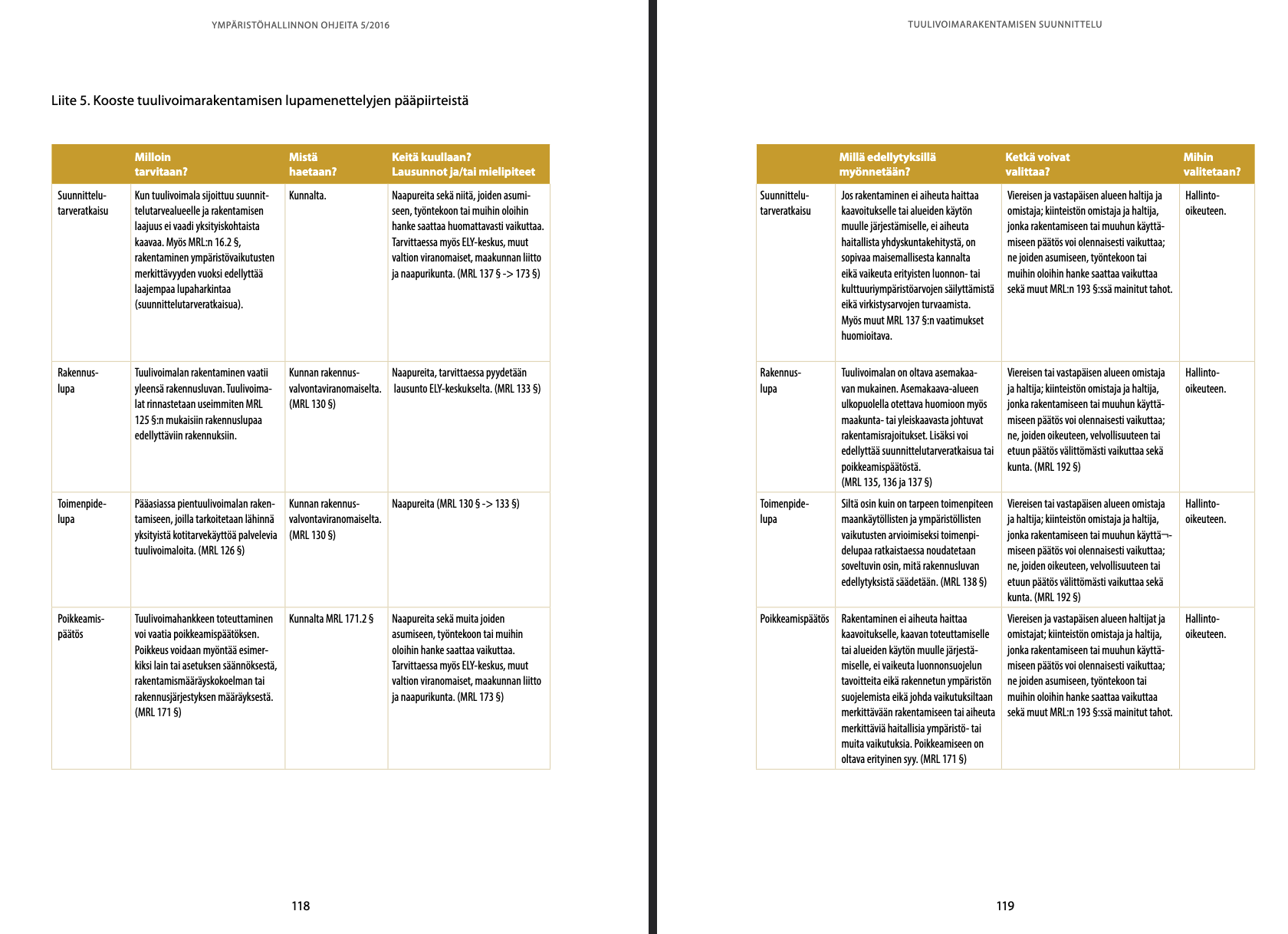
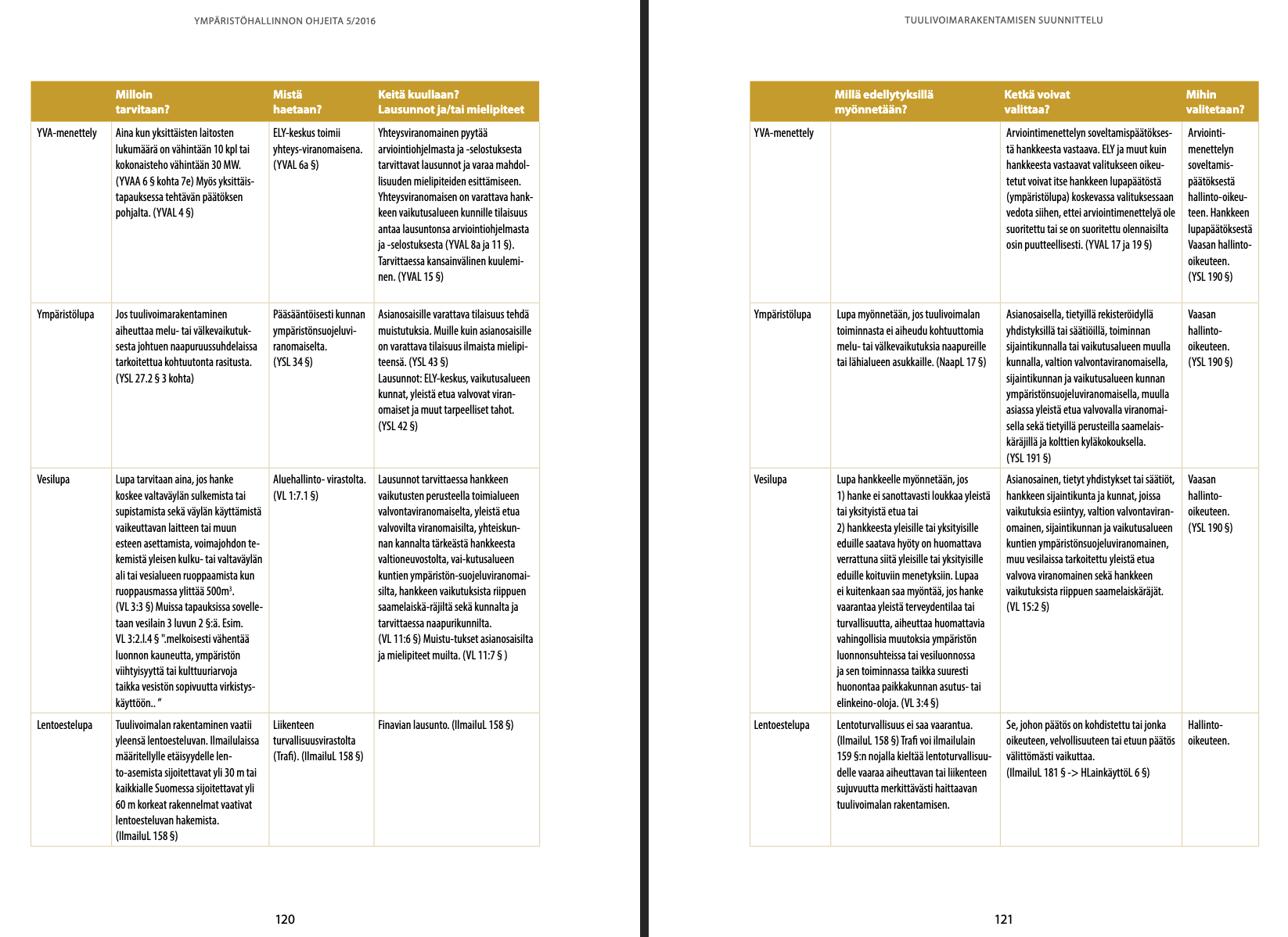
Once these are in order and all appeal rounds have been completed, the next step is to contend with Fingrid and wait for them to take care of their part 
5 Likes
UB has a very interesting article about the potential resumption of timber trade with Russia. According to some expert comments, timber trade would be one of the first possible things to happen when trade eventually normalizes. Reasons for this include the forest industry’s significant lobbying power and the ease of trade (“it’s just wood”, requires no investments, reduces pressure on logging here, etc.). This matter is significant for UB, because if a lot of raw timber flowed into Finland, it would inevitably lower the price of forest here. This, in turn, would create challenges for forest funds (returns and, through them, performance fees, as well as potential new sales), which are UB’s main pillar.
Less surprisingly, UB has a very reserved attitude towards Russian timber trade, but at least to my ear, these justifications are credible  What does @Antti_Viljakainen say, is that 5-10 year startup period realistic?
P.S., for clarity, I personally hope that trade will never normalize (or at least not before the culprits are brought to The Hague, etc.), but my opinion doesn’t carry much weight in these matters. As an analyst, one must also consider these unpleasant scenarios in deliberations.
16 Likes
I don’t know anything about forest management, except that I’ve listened to the audiobook biography of Ponsse founder Einari Vidgren (highly recommended!), but I’ve read quite a few times how “bullerovarainhoitajat” (bull market asset managers) justify that in the case of their particular raw material, the market economy ceases to function and supply bottlenecks continue, if not forever, then at least long enough that investors don’t have to worry and withdraw their money. High prices have always been said to be here to stay during boom times. In practice, however, these forecasts always go completely wrong, and the ingenuity of market economy actors surprises the raw material bulls, whether it’s oil, copper, lithium, cobalt, or even raw timber.
The end of sanctions against Russia is inevitable, because the termination of sanctions is a passive act, whereas their continuation is an active act that must be done unanimously twice a year. This is the inverse logic to sanctions against Iran, Cuba, and other similar rogue states, whose lifting requires effort and energy. It is enough for just one EU country to disagree on the continuation of sanctions, and they will automatically crumble.
After the lifting of sanctions, Russia’s enormous investment pressure will be released, and Ponsse and Kesla will gladly sell machines to Russia. No company in this sector can afford not to sell to a huge forest market the size of Russia, regardless of their political views. If necessary, sales can be handled via Belarus, Kazakhstan, or Georgia for hygiene reasons.
Russia is a backward raw material-producing economy that doesn’t really manufacture anything more complex than that. Timber harvesting is certainly not that different from oil, gas, grain, or metals, which Russia is good at exploiting. The Kremlin and its oligarch friends can easily arrange loans and investment support among themselves for their own businesses, and it doesn’t even matter if half of it is stolen along the way.
It might sound terribly serious to a gentleman in Helsinki in patent leather shoes when some certificate paper can’t be found, but if the United States and the EU together can’t even effectively sanction Russian oil transport across the world’s oceans, with the eastern neighbor inventing new tricks every week, do they really think that some ESG paper will cause any difficulties? They will be forged, some operator will be bribed, or timber loads will be mixed in some suitable way with certified goods so that the origin can be obscured. And the buyer isn’t interested in the true state of affairs in the slightest, as long as the official ‘get out of jail free’ ticket is nominally in order. That’s why certificates are acquired in the first place, so that companies can credibly virtue signal about responsibility, regardless of the actual situation.
We have a huge need to buy cheap Russian timber, in addition to the high price, simply because logging needs to be reduced to meet climate targets, and they, in turn, will have a lot of unemployed people after the war and a strong need to get more income for their states and sell us timber. One would have to be quite a wizard to logically deduce from these fundamental premises that timber trade would be halted for 5-10 years.
14 Likes
It probably depends on the scale of potential imports. If we are talking about importing birch fiber and wood chips on a pre-war or smaller scale, it would seem like a rather long time to organize it. Building a large-scale domestic wood procurement organization, on the other hand, could take a lot of time, but as UB correctly states, wood imports from the east were not unlimited before the war.
A remarkably interesting question is also what kind of additional supply would be sufficient to lower wood prices and, consequently, forest land prices in Finland (i.e., what is the price elasticity of the wood market). Sometimes in similar situations, even a surprisingly small change in the equilibrium can alleviate the worst pressure, but of course, in this context, I cannot reliably assess the matter. The market could also be loosened by a contraction in demand if industrial distress continues for too long and/or too strongly. UB’s otherwise good and credible text largely left the industry’s perspective unaddressed.
3 Likes
@Sauli_Vilen, that diligent proletarian of the Ruoholahti kolkhoz, has completed UB’s latest company report as Sunday evening work.
United Bankers’ start to the year has been slow, as market uncertainty has weighed on assets under management and hindered new sales. As a result of our lowered forecasts, we revise our target price to EUR 17.0 (previously EUR 18.0). We remain positive about the company’s long-term outlook, but in the short term, share price drivers are scarce as earnings are heading in the wrong direction and valuation is neutral. We therefore reiterate our ‘Reduce’ recommendation and await signs of a return to earnings growth.
3 Likes
Here’s a fresh interview where this question was also discussed!
4 Likes
Interesting answers. It seems that the intention is not really to participate in the best projects or to maximize the fund’s ability to put capital to work by acquiring ready-to-build phase projects from others, but at least for now, to act as a kind of feeder fund for the massive land mass of the main forest fund. Thus, with UB’s internal business logic, it clearly makes sense to get involved in hugely risky development projects, even on a smaller scale and through long, multi-year permit processes, but if I were a fund investor, I would think twice about participating in that fund.
The project development phase is extremely capital-light, as money mainly goes to salary costs, and returns for the fund only appear on paper when the company itself estimates the value of its own projects has increased as permit processes progress. Since permit processes in project development are slow, costs are fixed, and the business is highly scalable, UB should be a bit more ambitious and grow its 1,000 MW project portfolio to the 5,000 MW - 10,000 MW range, but since it seems absolutely necessary to use only their own land areas in Finland, and there simply aren’t enough suitable development projects there, what can you do
With wind power, it can easily take five to seven years from the start of a project before the first euro of revenue hits the account, and for this reason, all competing funds aim to join projects only in the final stage, when the project is ready-to-build and the capital-intensive phase begins. Industrial-scale solar power and battery projects, on the other hand, can be launched more quickly, which is why they have become more common, reaching new record levels in recent years at the expense of wind power.
Finland has (almost) the cheapest electricity in Europe, and this is by no means the optimal country for a fund to build new production capacity, because consumption does not scale up quickly enough compared to new production. It’s easy to refer to Fingrid’s strong forecasts to justify consumption growth, but this is a company with a regulatory task and a duty to prepare for the most extreme consumption scenarios. Now, if this or the next government hits data center investments hard with additional taxes and other hostile measures, and the hydrogen economy doesn’t materialize, we could easily end up in a situation where no new electricity production is profitable. Then one would nicely get to write down those paper profits from projects when no counterparties for PPA agreements can be found. Of course, one could then be involved in the data center business or on the consumption side and thereby create demand for one’s own electricity, but that turns into quite a bit of fiddling instead of seeking out places (like Germany or Italy) where the most profit can be made from renewable investments 
8 Likes
To my ears, this also sounded quite peculiar. That’s a continuous conflict of interest when lease agreements are made between two funds. There are probably different portfolio managers, but it’s still difficult to keep it objective and profitable for the investors of both funds. For an individual case, of course, it might be a good thing to achieve those “massive synergies,” but if the entire fund’s strategy largely relies on that, it doesn’t sound quite right.
Of course, they don’t say it directly, but it immediately comes to mind that if the fund’s strategy doesn’t stand on its own without such ‘good old boy’ connections, then it’s not for me.
2 Likes