Tulikivi - Fireplaces, ovens, saunas and natural stones

Revenue was slightly above Thomas’s forecast, if I saw correctly, but the result before taxes was spot on and EPS too. :slight_smile:

and from the release:

In the second quarter of the year, the company’s order intake was EUR 8.2 (11.3) million. In the first half of the previous year, demand was driven by high energy prices and uncertainties related to energy availability. The company’s order backlog normalized during the review period after the demand peak of 2023, and was EUR 3.5 (13.9) million at the end of the review period.


https://x.com/Choyoba1/status/1824386575741947908

image

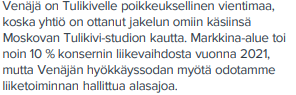
@Thomas_Westerholm, what is the situation with Tulikivi and Russian operations at the moment?

Comprehensive report 2023

image

Message from last year:

From Tulikivi’s material:

"The Group includes the parent company Tulikivi Oyj, Nordic Talc Oy, Tulikivi U.S. Inc in the USA and OOO Tulikivi in Russia. Additionally, the group companies include Tulikivi GmbH and The New Alberene Stone Company, Inc., which no longer have business operations. "

https://www.instagram.com/tulikivirussia/reels/

3 Likes

In my view, the essential thing about this year’s figures isn’t whether the company meets its given guidance—which is very ambitious in this market situation (cf. Honkarakenne or any residential builder)—or if it falls slightly short, requiring a profit warning. The current stock price assumes that the company won’t reach our forecasts, so in that sense, we can’t even fall from a very high level.

The company’s current view of revenue and operating profit in euros can’t be off by much, as there are only 5.5 months left in the current fiscal year and at most 4.5 months of sales time, since invoices are likely only issued upon delivery, and it surely takes at least 1 month from order to delivery.

Still, this is the company’s view, and the company has the best knowledge of its own business and its development.

I believe Vauhkonen said in Thomas’s latest interview that autumn/the end of the year is their best sales season, which is very understandable, especially regarding fireplaces.

The most important thing about this year’s figures is that after a very long struggle, the company is able to generate significant profit (P/E around 10), pay dividends, and reduce its debt.

Even more important than this year’s absolute euro amounts is that next year the company will have new collections in both fireplaces and electric sauna heaters, with which the company aims to increase sales alongside a growing sales network. Next year, the company should have about 25% more dealers abroad compared to the current situation, if the 50% growth target is reached by the end of 2026.

The domestic market remains important for the company, so hopefully, a recovery in domestic residential construction as early as next year would contribute additional sales across all business segments.

In a sense, it’s good that we’ve reached a level with the company where profit warning speculation focuses on whether the operating profit will be below or above 3,000,000 euros, rather than whether the company will be profitable or loss-making. Hopefully, in 2025, the same discussion will focus on whether the company reaches an operating profit target of 5,000,000 euros (my own guess), and in 2026, hopefully the topic will be reaching an operating profit target of 6,000,000 euros (based on the company’s target of €50m revenue and a 12% operating margin).

4 Likes

Correction: 4.5 months, it is already the middle of August. So about a third of the entire year.

1 Like

That is correct, meaning there are 4.5 months left in the financial year and a maximum of 3.5 months of effective sales time remaining to impact this fiscal year’s figures.

Here is a fresh company report on Tulikivi by Thomas. :slight_smile:

Tulikivi’s Q2 figures were broadly in line with our expectations, but the encouraging development of the quarter’s order flow emerged as the highlight of the report. The report slightly increased our confidence in Tulikivi’s ability to defend its cyclically high revenue level, as a result of which we slightly raised our export revenue forecasts for the coming years. We reiterate our EUR 0.4 target price and Reduce recommendation.

2 Likes

A good interview, featuring CEO Heikki Vauhkonen in an interview with Thomas Westerholm. :slight_smile:

Topics:

00:00 Intro
00:14 The start of the year through the eyes of the CEO
00:52 Providing guidance for the current year is challenging
01:26 Gross margin weaker than expected
02:08 Gross margin of sample collections
02:25 Jero collection for the US market
03:28 No broader demand visible in the US
04:27 Logistics costs
04:58 Strategic priorities, growth in Central Europe
06:56 Ramp-up of sauna operations
07:50 Seeking growth primarily from Central Europe
08:10 Distribution synergies
08:49 Suomussalmi talc project
10:02 What to keep an eye on in the project
10:36 Potential partners for the project
11:52 De-risking

2 Likes

It became quite clear from the CEO’s remarks that the project is attracting interest from potential partners. It also sounded like the preparation of the environmental permit application is well on track in the background. Once the permits are in order, this could turn into quite a big deal.

2 Likes

Vauhkonen certainly sent a strong message that the project will be realized. There are no obstacles in sight, neither in obtaining the permit nor in finding a partner.

The more economically profitable the project is, the better and more favorable the terms the company can negotiate with investors.

If the utilization of magnesium is realized—as Kurronen indicated quite clearly—ore utilization will rise to over 70%, which could have a truly significant impact on profitability.

1 Like

From a shareholder’s perspective, the situation is quite exciting in that every step of progress will also start to be reflected in the stock’s valuation. Currently, the biggest concrete step will be the environmental permit, for which there seem to be no obstacles. After this, external investors will follow.

This autumn, the ELY Centre’s reasoned conclusion on the project proponent’s assessment will be issued.

The target processing time for the environmental permit is 10 months, so at best, a permit decision could be expected this time next year, provided the permit application is submitted this autumn in October or November.

I think most Tulikivi investors (or those interested in it) are relatively well-informed. Or perhaps nothing has been said here that the market hasn’t already priced in its own way. The company is discussed quite a lot on various forums, and various investment parties are contacted regarding the company, sometimes more so in the past. Thomas has reviewed the opportunities, risks, and value drivers in his analyses.

Thomas’s materials; especially the reports are worth reading, and I thought that new interview was good. :slight_smile:

Tulikivi’s earnings-based valuation looks neutral based on forecasts for the coming years (EV/EBIT 9x), but it doesn’t offer any upside either, which leaves the expected return dependent on dividend yield. Our sum-of-the-parts calculation, which takes into account the DCF model and Nordic Talc’s NPV calculation, gives a per-share value of 0.51 euros, but for now, the drivers for its realization seem distant due to the tight financing environment, which we believe limits the investment appetite of potential financiers for the talc project.

2 Likes

I could, of course, be completely wrong and my reasoning might be flawed, but the realization of the project and the amount of financial benefit Tulikivi derives from it, one way or another, is very much dependent on the mine’s economic profitability.

It would be interesting to hear Inderes’ estimate of Nordic Talc’s profitability: a) with talc alone, or b) with both talc and magnesium.

What weight is given in the investment calculations to the fact that talc demand is projected to grow by 4% annually until the end of this decade, and that the price of talc has risen fairly steadily over the last 10–15 years?

I’m sure very few people on this forum are capable of making such calculations; I certainly don’t have the professional expertise for it.

My understanding is that at current interest rate levels, financiers/investors can be found for a good project, while a bad project will fundamentally never find them. Or am I to understand that the project’s profitability is so marginal that it is difficult to find financing at these interest rate levels?

5 Likes

According to information available today, the number of dealers in Europe has risen to 657, which is an increase of 29 distributors in 26 days. This is an increase of approximately 4.6% in the European dealer network and about 9% in export countries, assuming the growth is entirely from outside Finland.

It is excellent that the company has moved swiftly to expand the sales network announced in the spring and that things have not been left until the end of the announced timeframe.

1 Like

A job advertisement for the head of Tulikivi’s sauna business has been posted on LinkedIn.

An anticipated step following the company’s previous announcement about investing in the growth of the sauna business.

IL witnessed massive congestion at the border: even Finnish products are being exported to Russia via Estonia (iltalehti.fi)

“Leading researcher Marika Karton says that Finnish products are also being exported to Russia via Estonia. For example, Finnish soapstone fireplaces are being transported into Russia through Luhamaa.”

Could it be Tulikivi or some other Finnish soapstone manufacturer? At least according to IG, Tulikivi Russia seems to still be operating: Tulikivi Russia (@tulikivirussia) • Instagram photos and videos

1 Like

If soapstone fireplaces are not a sanctioned product, which they surely aren’t, then Russians can buy them in Finland or the Baltic countries and take them to Russia via Estonia, as the border there seems to be open.

3 Likes

@Thomas_Westerholm
So, is Tulikivi still operating in Russia?
…

1 Like

Apparently, even though they are officially trying to pull out of there. The news article would hardly mention the export of fireplaces specifically if it were just a few private individuals?

Well, trade is what pays, and I don’t think those are of much help in the conquest of Ukraine. Someone there must have money, as even in Finland, the poor don’t buy these.

Buyers can be individuals and companies. I meant Russians in general.

The number of dealers selling Tulikivi products in Finland alone is significant.

If it involves Tulikivi products, it likely means that one of Tulikivi’s dealers is selling to Russian buyers. It could also be that a dealer sells to a Finnish company, which then sells to a Russian buyer.

It is perfectly obvious that plenty of non-restricted goods are flowing from the West to Russia, even though manufacturers have ceased their own exports to the country.

Has Tulikivi stopped exporting to Russia?
…