Tencent, digital from China

I couldn’t find a thread for China’s largest digital company yet, so I’m creating one now. Tencent owns, among others, WeChat, Supercell, and other gaming companies, and owns a stake in Universal Music Group. The firm offers services ranging from payments to hailing a taxi; everything happens on the company’s WeChat platform, which in 2021 already had 1.24 billion users (mainly in China).

edit 1.
The following figures are from 2020 (EUR)
employees 51.35 k
P/E 29.81
Price to sales ratio 10.05
price to cash flow 24.87
P/B 6.43
Debt to assets ratio 0.20
Return on equity 27.28%
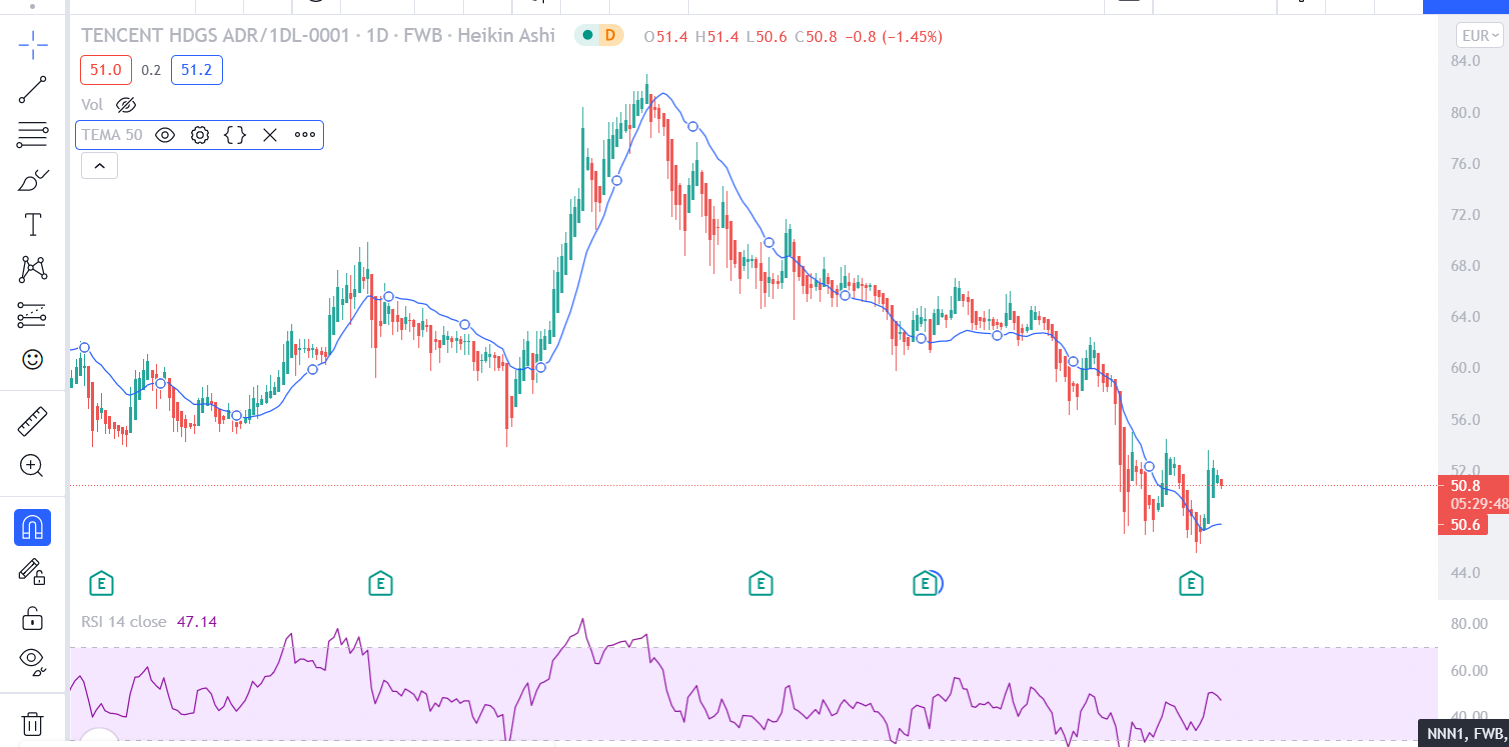
to mention a few; what makes this particularly interesting is that due to the Chinese government’s policies, the share price has fallen during this year from a peak of approx. 83 to around 50 euros.
image
@Alfons_Knautmauer’s response was so good that I’m putting it at the beginning so it’s easy to find

14 Likes

Tencent’s future moves are interesting as its market position in China seems relatively stable. The price isn’t dizzying either, due to the risks set by the Chinese government.

1 Like

Hi @moogler!

Thanks for opening a dedicated thread for Tencent. :slightly_smiling_face: Often, when a new thread is created here for a new company, some basic information about the company is provided, perhaps financial figures, charts, and a concise summary of what it does, etc. For some, Tencent might be a less familiar company, so figures and various basic facts help to get started, and after that, it’s good to begin discussing this interesting company. :slightly_smiling_face:

13 Likes

Thanks for the feedback, I’ll try to make the text more accurate and clear now for those who don’t know much about the company. If you have any more corrections to suggest, I’d be happy to hear them.

7 Likes

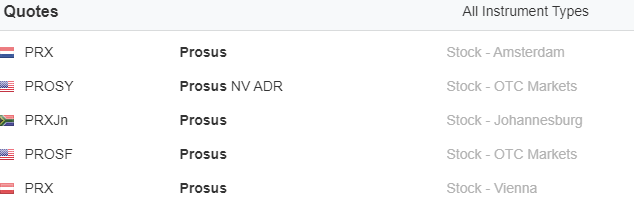
It could also be mentioned that you can invest in Tencent via the Amsterdam stock exchange through Prosus NV, whose value consists mainly of an investment in Tencent. In addition to the China regulatory discount, you also get a holding company discount.

The situation is admirably explained in the video.

11 Likes

Thanks for this interesting opening. I hadn’t even realized this myself. I’ll have to look into it.

1 Like

Has anyone found a full list of Tencent’s holdings (and their valuations)? I watched a video that had a good list made by a guy, but I can’t be bothered to manually type out the whole list into Excel myself.

https://www.reuters.com/technology/tencent-shares-fall-more-than-2-after-china-tightens-rules-young-video-gamers-2021-08-31/

China is increasing regulation for young gamers.

I’ve heard varying estimates on the impact on revenue.
They should remain relatively small.
The numbers I’ve heard have been around 3% +/-1%.
However, regulation for young people wouldn’t destroy all revenue targeting young people, but only a part of it. So, would the actual impact be smaller?

More regulation, and fear in the markets anyway. Although this didn’t come out of nowhere either, but is a repetition and part of the same crackdown.

6 Likes

Apparently, there has been child game supervision before. In my opinion, what’s interesting is how it will be monitored in practice.

I have to ask about Prosus NV; there seem to be two different priced shares, one around 70 euros and another around 14 euros. Is this an A and B share thing, or what’s going on there?

I use Nordea as a broker myself, and here I only see that Amsterdam listing, which is now a little over €70. When I checked Investing for other listings, I found some.


That €14 could be the US ADR?

3 Likes

Nordnet also has an Xetra listing with the ticker 1TY, which also has a nice 70% loan-to-value ratio.

This Prosus NV was such a good pick that @Alfons_Knautmauer’s first post, including the video, could be moved to the opening post. It greatly facilitates investing in Tencent, as there’s no need to touch US OTC stocks; even retail investors can access it through a European listing. And that 9% holding company discount doesn’t sound bad either.

Approximately 90% of Prosus NV’s valuation, when examined by market caps, consists of Tencent. Here’s a screenshot from the video, where the case is broken down in Excel, and a link to that specific part of the video.
image

6 Likes

Yes, it seems so, thank you very much. I was just wondering if there’s a difference between buying that stock at €16 or €70. Because that €16 is quite affordable.

1 Like

The cheaper one is an ADR, which corresponds to 0.2 shares. I would primarily buy from Amsterdam or, as a beginner, from Xetra, unless the US listing is clearly cheaper for you in terms of costs with your broker.

“ADRs are a form of equity security that was created specifically to simplify foreign investing for American investors. An ADR is issued by an American bank or broker. It represents one or more shares of foreign-company stock held by that bank in the home stock market of the foreign company.”

1 Like

Hey, thank you very much for the clarification.

2 Likes

Could this gaming ban, on the other hand, benefit Tencent’s own (Penguin Esports) and its partly owned (DouYu, Huya) eSports streaming platform companies? What if young people don’t go out to exercise during the gaming ban periods, as desired by the central government, but instead increase their streaming consumption?

In any case, after the streaming industry merger orchestrated by Tencent fell through, the company seems to be focusing more and more on its own platform:
https://www.bloomberg.com/news/articles/2021-08-26/tencent-beefs-up-game-streaming-arm-after-china-kills-merger

@Juha_K1, you had a strong investment in the eSports side, have you analyzed the winners and potential losers of this Tencent box game?

3 Likes

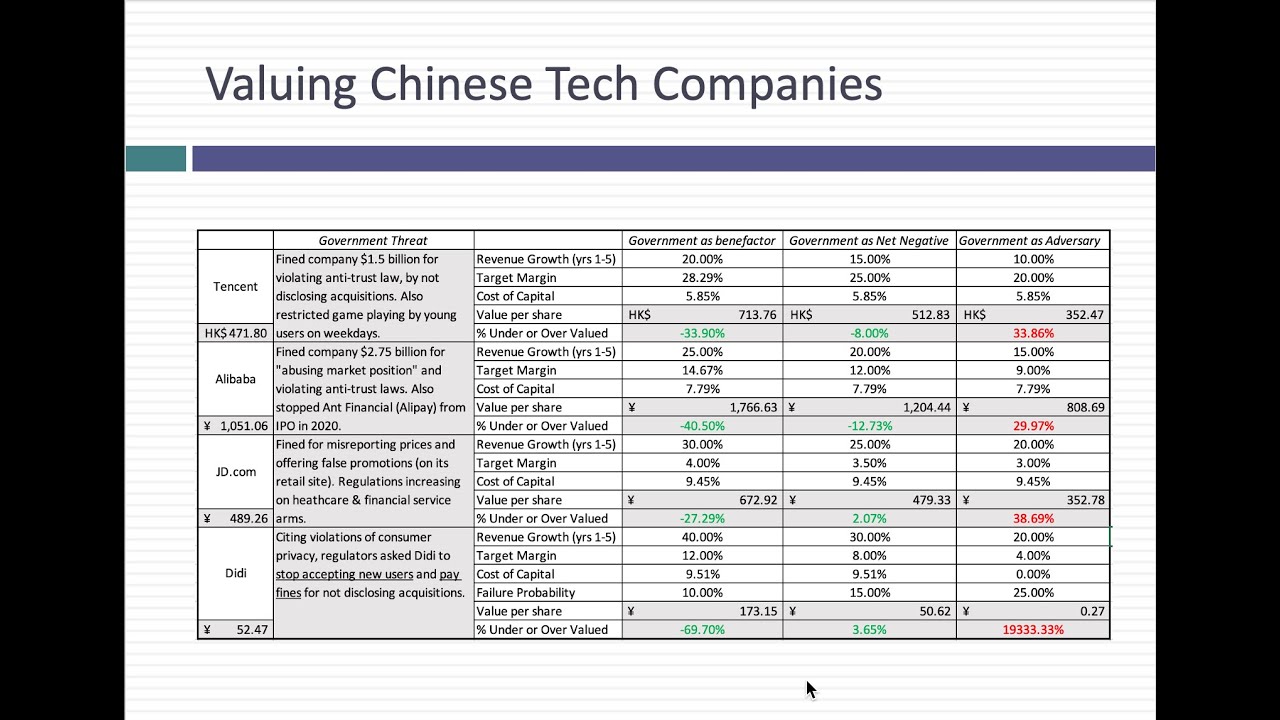
Professor Aswath Damodaran, highly respected by many, just released a video where he shares his own views on Chinese tech giants and their valuation. This might be of particular interest to those who have invested in and/or are considering investing in Tencent and/or Alibaba. JD.com and DIDI were also included.

12 Likes

I’ll post this here too; it falls into the China regulation wave sector. Feel free to move it if I’m in the wrong place.

https://www.bloomberg.com/news/articles/2021-09-03/beijing-s-city-government-seeks-to-take-didi-under-state-control

Beijing city is rumored to be buying a stake in Didi.
Honestly, I don’t know what to make of the rumor because just yesterday, they were told to improve driver treatment? → Why order improvements if the government will soon be in charge? (https://www.bloomberg.com/news/videos/2021-09-02/china-criticizes-didi-meituan-in-car-hailing-clampdown-video)

Didi also denies any such event is underway:
https://www.bloomberg.com/news/articles/2021-09-04/didi-denies-report-of-government-arranged-equity-investment

The incoming information is completely varied and unclear. This has been the case for several weeks.
It feels like someone is playing to their own advantage by instilling fear in the markets.
Who knows, maybe China’s communication is just genuinely unclear.
Misery loves company, and nothing destroys markets like fear.

If Beijing city attempts to buy its way in, the most important question is the price.
If the price doesn’t correlate at all or is significantly below market price, I would expect to see an exodus from the Chinese tech sector. If the shares were paid at a so-called fair or market price, the situation would be the opposite and reassuring.

Day after day, I find myself thinking, “the news doesn’t affect the fundamentals of the company I own.”
“I own the company, not the stock.” (Of course, in the case of an ADR, some might say I don’t own anything at all. :joy:)
Whatever the impact on fundamentals, this market turmoil is starting to get to me.

As Peter Lynch said, the most important organ in the markets is not always the brain, but the stomach. And we’ll go with that, or at least try to.
This particular case has made me reflect on my risk tolerance and what kind of risks I am willing to accept. So, if anything, I have “grown” as an investor.
The case has also highlighted that in China, IT IS COMPLETELY POSSIBLE TO LOSE ALL CAPITAL,
and I recommend that everyone investing in these companies or Chinese companies research the matter thoroughly before making their investment decision.

I still believe my investment thesis is sound, and the impact of these issues on my companies will remain reasonable in the long term (slightly slower growth, increased cost of capital, higher “tax rate”).
And for example, Tencent’s business would not be destroyed by current regulation.

I have positions in both Alibaba and Tencent. I am young and at times risk-tolerant.
My feeling right now, however, is that I want to pull my hat down for 6 months, put on some Popeda [Finnish rock band],
and come back then to see where we are.
7 Likes
5 Likes

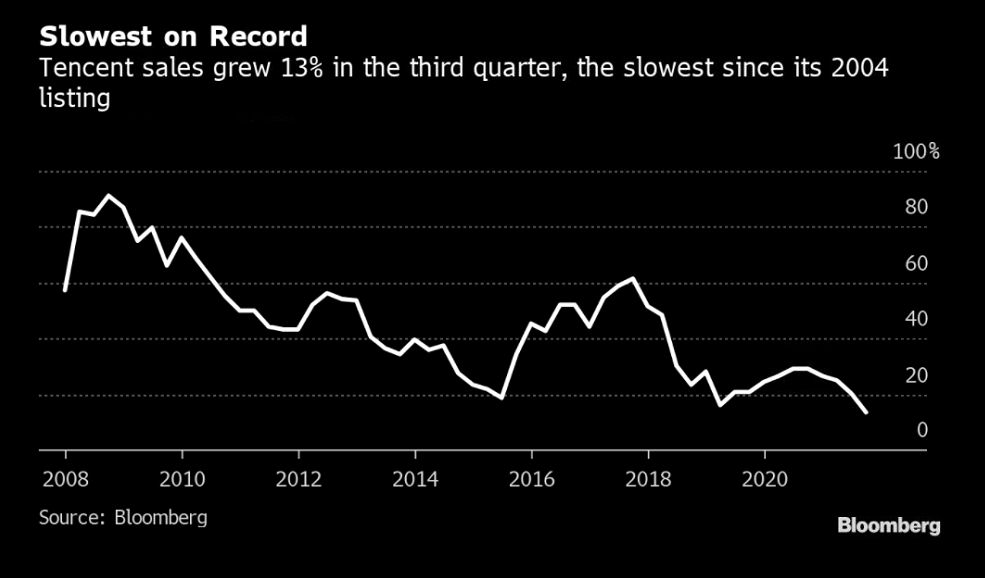
Tencent’s revenue growth slowed to 13% as tech companies were battered.

Apparently, the decline in advertising revenue in particular has slowed down the entire pump.

9 Likes