The main trigger behind Hoivatilat’s (Care Facilities) TOP3 inclusion was the 2018 guidance upgrade, which we expected to occur by the end of the year at the time of inclusion. However, the day after the inclusion, Hoivatilat announced property sales and subsequently revised its 2018 guidance. After the sales, a guidance upgrade no longer seems as likely. Another trigger we expected was strong development during the end of the year, meaning we practically anticipated a good Q3’18 result. In addition to these, we also considered the first school project as a possibility (although this was not mentioned in the TOP3 inclusion comment, nor was it the primary reason behind the inclusion). Generally, it is not easy to find TOP3 cases with a clear very short-term trigger. We often have many internal discussions within the company about where to find a new company for the TOP3 list to replace an earlier case, and finding a new company for the list can take a long time. Part of the difficulty stems from the fact that Inderes’ analyses have a 12-month recommendation horizon, while the TOP3 list aims for a clearly shorter horizon, with companies typically being on the TOP3 list for an average of 3 months.
We finally got a new track open—the first school project in Siilinjärvi has been locked in. A small project (3 million), but all the more important!
How do Lehto’s problems reflect on Hoivatilat? I understand that Lehto constructs many care facilities for them, and Lehto has recently been having profitability issues with these. I recall Karjula commenting on this earlier, saying something along the lines that it means they got them at a good price (not a direct quote by any means, but a vague and possibly incorrect recollection). If - or rather when - Lehto starts pricing projects more profitably, doesn’t this create pressure on Hoivatilat’s future construction margins? The construction industry is overbooked, and finding good competitors for projects is likely challenging.
I don’t think Lehto has been taking anything more than what’s available in the market so far. I doubt we’re talking about huge discounts here. Lehto’s problems seem to be internal rather than selling products too cheaply (though possible in some cases). The problems have apparently been caused by the desire for more individualized care facilities, so Lehto hasn’t been able to utilize its competitive advantages there. So I don’t believe they’ve even been priced purely according to mass production, so other construction companies can certainly get close to the same price.
Hoivatilat has probably also moved towards more individualized production and can thus charge tenants better. Lehto’s mass-produced cubicles have hardly been Lehto’s targets, so this is unlikely to have a significant impact on Hoivatilat.
Lehto’s double whammy of negative results, and especially the company’s latest quarterly report, clearly indicate that unprofitable projects have been taken on in the renovation and care facility segments, likely in a growth frenzy. The story doesn’t tell what proportion of these projects were done for Suomen Hoivatilat, but it’s clear that Hoivatilat, as the client, benefits from the contractor, in this case Lehto, taking on the job at a lower price. Conversely, if Lehto had priced the work correctly, the contract sums would be larger, and the margin left for Suomen Hoivatilat would be smaller. How much, I can’t say, and one would need to see the figures for individual projects.
So, is everyone assuming that Lehto would build much cheaper than others? We’re probably talking about pretty marginal differences compared to other construction companies. But it’s important to remember that Lehto has made good profits in the past, and it’s only recent projects that have messed things up. Hoivatilat has also acquired housing before, even when Lehto made good margins.
However, Hoivatilat’s strategy seems to have generally progressed more towards individually tailored properties built for the user, in accordance with the requirements of care facilities. The process was hardly designed for Lehto to mass-produce them in its factories. For Hoivatilat, this problem with Lehto isn’t of great significance.
Karjula said in the video that they don’t cooperate much with Lehto, so I don’t think it would affect Hoivatilat for that reason.
can be found from 52:20 onwards
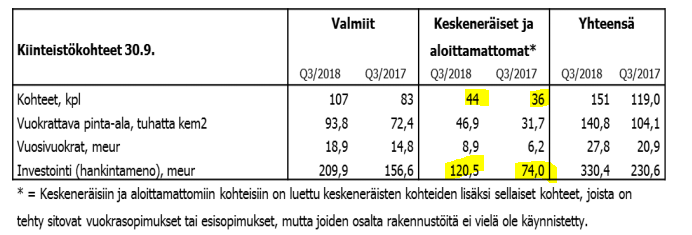
Here’s a persistent bogeyman (perhaps a remnant of the recent directed issue?) about financing. It seems that investors dread the idea of a new directed issue and ignore amazing growth and steady progress for fear of it. Is the other side of the coin (growth → need for financing) going unregistered? Of course, I don’t like the idea myself – I think they should make an issue to current owners IF it doesn’t become too expensive. Or take out debt – one would think they could get it easily and affordably. One major owner has expressed their intention to divest their ownership, perhaps they would oppose an issue directed at current shareholders if they had to invest more? Whatever the financing method that is most beneficial to current owners, hopefully, they will go with that.
Can anyone provide more detailed information on the costs of a share issue to shareholders for the company? And at what interest rate do Hoivatilat get loans? I recall that it might be possible to get even more financing from the European Investment Bank?
Hoivatilat is my investment in care funds; I’d gladly put in more – either from a dip in a directed issue or in a share issue. I’d even freeze the dividend for a while and use that money for compound interest in this hot, profitable business.
P.S.: If I read between the lines correctly, the completion of sites will be slower at the end of the year, as Karjula emphasized that Q3 is the kindergarten completion season.
Good point. The image Aston linked shows the weak development that is feared, namely that the rent divided by the acquisition cost weakens as the yield requirement for care properties decreases. One must be careful with share issues. Future cash flows must be greater than the effect of share dilution. The company states that the value of its contract portfolio (i.e., future revenue) is approximately 400 million with an average maturity of 15 years. I don’t know what happens if a contract is terminated. The needs of municipalities can change over 15 years.
I can’t really say anything about the company’s goal of “at least 30% revenue growth annually.” Is this real estate market really such that the winner is the one who builds the house first, when everyone has huge revenue growth targets?
I agree, the offering is only seen as a bogeyman and the positive aspects are not taken into account. The stock market is precisely for growth companies like Hoivatilat, which need capital and are able to invest this capital profitably, thus offering investors high returns. In 2017, Hoivatilat’s return on equity was 25%. If the company were to issue shares and use this capital just as profitably, the offering would increase shareholder value, even if it were done at a small discount to the current share price. In addition, the company’s fixed costs would likely scale with growth, which would further increase profits and thus shareholder value. In my opinion, the offering would primarily be a positive thing for Hoivatilat’s investors, assuming, of course, that it is done at a reasonable price.
The costs of Hoivatilat’s directed share issue of EUR 31.5 million in March 2017 were, according to our estimate, approximately EUR 0.9 million, or about 2.9% of the gross funds raised. Typically, the costs of a rights issue (which I assume you meant in your question?) are, to my understanding, higher than this. At the end of last year, Hoivatilat’s average interest rate on interest-bearing loans was very low at 1.51%. In our forecast, however, the average interest rate on loans for Hoivatilat in 2019 is 1.9%. The company has not disclosed the interest rate for EIB (European Investment Bank) loans, but our understanding is that the interest rates for these loans typically range from about 2-3%. The EIB loan was EUR 50 million, and it was stated that EUR 30 million had been drawn in April 2018, meaning EUR 20 million should still be available. However, the balance sheet was not opened in the Q3 business review, so it is not possible to say for certain how much is undrawn.
Thanks for the answer, Jesse, that’s exactly what I meant by the right to subscribe.
There’s such a peculiar negative spiral here: as investors wait with their purchasing decisions for a possible Partnera spin-off dip or a directed issue dip, the strong growth doesn’t become visible in the share price. This, in turn, means that Hoivatilat (i.e., investors) get less value per share in the issue. The main thing, of course, is that funding is secured and growth & value creation can continue. Hoivatilat is one of the few portfolio companies where there has never been a chill wind coming in with an earnings report; instead, the company steadily chugs uphill. Even surprises have only been positive.
The EIB loan and a small property sale were good moves, the latter enabling the “same money” to be recycled as value-growing fuel again. It also showed good judgment from the management not to proceed with an issue at a low share valuation. At the latest, these sales should also have shown the markets that the Orava disease is not a spreading kind, i.e., Hoivatilat’s balance sheet has not been inflated with balloons (even if there were reasons to celebrate ;)).
Debt financing would sound like the most affordable option. I trust the management; they will certainly implement the most reasonable financing option from the owners’ perspective.
For Suomen Hoivatilat, growth is essential. Growth has also been very profitable, even if it requires financing to materialize. They could also sell completed properties to care funds and finance future ones with that, but it’s even better for the completed properties to continue generating returns, as financing costs are still lower than those returns. Not that it would be bad to sometimes realize some finished properties if a good price is available.
Hoivatilat makes a strong profit from every property they build, so it would be crazy to leave those raisins for others to pick. It’s also noteworthy that there is currently a boom in outsourcing kindergarten and other facilities, as well as in transitioning to the private sector with service vouchers. If they didn’t strike now, the moment would pass. Someone else would certainly offer the market what the market wants, and the profit would be left unmade. Jesse’s mention of a 25% return on equity speaks for itself – when such numbers are on offer, it would be madness not to pick them, whether with borrowed money or equity, as long as they are picked as long as the return is clearly positive.
In the company’s income statement, the profit for both 2017 and 2016 is equal to the line “fair value valuation of properties.” Fair value, in turn, is an estimate by an external appraiser of the property’s future net cash flows, and the discount factor is the required rate of return. In other words, we have been reliant on excel profits. The growth in the value of holdings is certainly a good thing, but don’t construction companies get their share of this in future projects? A key risk is that required rates of return will start to rise, which would cause significant losses in the income statement and weaken the company’s key figures.
Return on equity is thus misleading in this case, because equity is changing due to share issues, and “profits” are recorded as projects are completed. I would rather look at future cash flows. I would compare their sufficiency to the risks of growth projects and the dilutive effect of share issues. A typical mistake during a boom is to take on a lot of debt when the market looks good. The situation turns into over-indebtedness when market values fall.
In our forecast, cash flow-based operational EPS will grow by 27% this year and an average of 26% annually in 2019-2021, and this growth can be achieved without share issues. So we are not relying solely on “Excel profits.” If a share issue were made, this could increase, depending, of course, on the dilutive effect. The risk associated with current projects is, in my opinion, relatively small because the projects have already been leased at 100% occupancy with long lease agreements. The company also does not agree to projects unless profitability criteria are met. I agree that an increase in yield requirements is a risk, and this applies to all real estate companies. However, the impact of this depends on why the yield requirements increase. If yield requirements increase because the economic environment improves, there is inflation, and the central bank raises interest rates, the impact will likely remain largely small, as real estate companies, and especially Hoivatilat, have leases tied to an index. In this case, an increase in rental income can fully compensate for the impact of increased interest expenses and yield requirements. If, on the other hand, yield requirements increase because market risk premiums grow, the impact is negative.
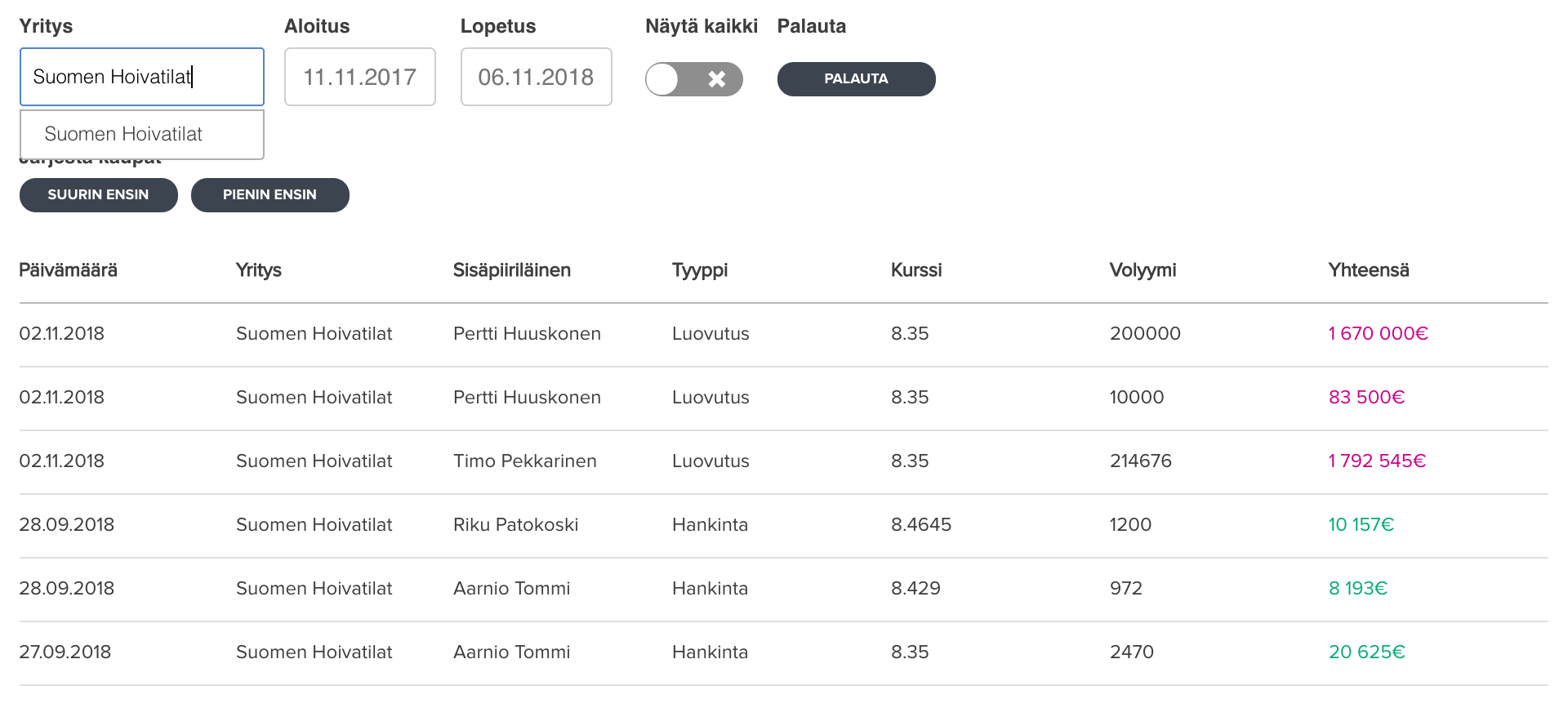
Big insider sales at Hoiva:
In the spring, there was talk that the main owner, Partnera, was also looking for “alternatives” for its ownership:
In Pikamatikka, Timo Pekkarinen sold about 19% (Tirinom Oy shares) and Pertti Huuskonen about 57% of their holdings (Lunacon Oy).
I’m not really sure what to think yet. Both are fairly significant owners.
It’s peculiar that those happened at the same time. There doesn’t seem to be anything good about those sales, if one wants to draw any investment conclusions from them. However, the stock price didn’t react significantly to them.
According to Hoivatilat’s press release, the reason for the sales was portfolio rebalancing after a significant rise.
Do you find this explanation credible? Could there be disagreements within the insider group, for example, regarding expansion into Sweden at this stage?
Referring to my message above, I might grudgingly accept Pekkarinen’s explanation. I don’t buy Huuskonen’s explanation.
My own thoughts are that these owners have some kind of distrust towards the company, considering the size of the sales. It’s different if it’s a gaming company whose stock jumps 40% from a trailer, but this is a fairly defensive and by no means overvalued company.
Let’s wait and see, but I’ve definitely been thinking about lightening up my position this morning.
PS. I didn’t mean to open anyone’s wounds with the gaming company comment 