Heads up! Coverage starting tomorrow. Opening the discussion 
https://twitter.com/mikaelrautanen/status/1104748841956503552?s=21
Heads up! Coverage starting tomorrow. Opening the discussion
https://twitter.com/mikaelrautanen/status/1104748841956503552?s=21
Tomorrow, SSH will be on the rise. Inderes is known for not initiating coverage on companies unless they share a similar view on valuation with the company itself. So, companies don’t blindly buy coverage; they first negotiate whether the company will get value for their money at the target price. Offhand, I recall perhaps one case where there was even a “reduce” recommendation right from the start (there might be others, but I wouldn’t guarantee even this one).
Are there any proofs to support this point of view? Something in black and white? Could you post it in the “Developing the Inderes Operations” thread? Thanks
Aktia started with at least a Reduce recommendation
I couldn’t find those messages right away. I’ve mentioned this before, and Sauli admitted that the issue is a bit problematic. It was about an IPO-related report, and the discussion was about why Inderes only reports on offerings where it has a positive view. It then became clear that before a mandate, Inderes’s perceived value for the company is roughly reviewed. If Inderes’s view is clearly below the company’s view, no deals are made, and Inderes does not produce an analysis. This was justified by saying that reports on poor investment targets would not add value to investors (I was a bit of a different opinion on this as well :D).
Regarding listings, companies probably have a greater interest in getting a positive analysis, so that’s where a bigger problem arises. I really don’t know to what extent this is a problem for companies already listed, as the analysis doesn’t have the same significance for them. However, I would assume that the process is somewhat similar, at least.
Thanks for the clarification. Based on your first message (“inderes does not cover…”), I somehow got the impression that it would be “Inderes’s choice” to cover or not cover a company. This could lead to wrong conclusions…
However, the company being covered pays the bills, so they decide. It’s understandable that they wouldn’t be enthusiastic if opinions differ. The most important point of the whole thing, in my opinion, is that Inderes’s analysis is independent, and that should be upheld.
Basically, if I were a company about to be followed by Inderes, I might see that my company isn’t being properly valued, in which case information through Inderes could have a positive impact?
On the other hand, there’s always the risk of “trust case” targets. However, this seems to be a company that has been on the stock exchange for a long time.
That’s how it is, of course. The buyer decides. So there’s no problem as such, but it’s good to be aware that Inderes probably has a positive view when the monitoring starts.
SSH always feels like an eternal promise, and it constantly feels like we’re about to see a take-off. We’ll certainly see a situation again where great expectations are placed on future earnings and the valuation is based on them. The business is scalable, of course, but there is no real evidence that sales would increase significantly.
The company has wasted large amounts of cash on lawsuits, so what is the probability that they will continue to generate returns without massive litigation of their own rights?
The sector is still in bubble prices, so such a small company can easily be valued up under that premise as well. It’s still mostly technology-based products, so the scalability opportunities are very good.
The biggest question for the company is why significant growth would happen now or in the future.
and the report probably answers that :)… and hopefully it’s correct and the analysts actually believe it. The risks should at least be properly flagged.
What kind of investment profile do these technology companies have? Many have been unprofitable for years and destroy shareholder value, meaning they need to generate enormous returns in the future for ownership to be worthwhile. On the other hand, these companies are already valued many times their equity. SSH last made a profit (327,597 euros) in 2014. Can technology companies even be valued based on fundamentals? It’s probably possible that the market buys into the company’s story and the share price multiplies until some entity buys the company off the stock exchange. In that case, investing would be gambling.
I have F-Secure and Nixu.
At the end of the latest Yle stock market day broadcast, cybersecurity companies were briefly discussed. F-Secure’s future once again seemed very positive. It’s also at the top of OP’s dividend recommendations in terms of expected returns. An interesting case, whose stock price currently seems very affordable and trading volume high…
To correct the claims above: indeed, in IPOs we try to participate only when we see value for investors in the company and its pricing, @Sauli_Vilen can elaborate.
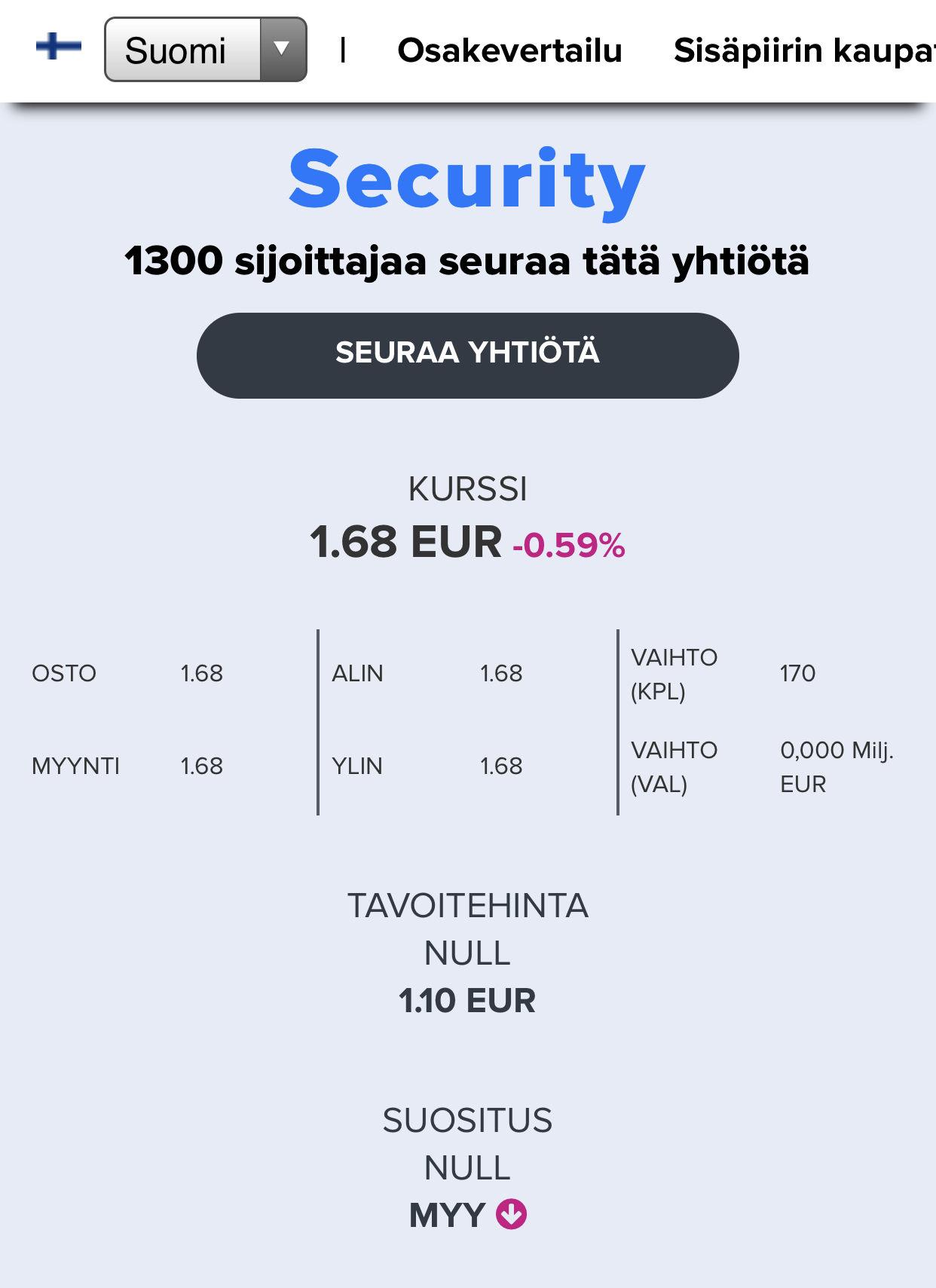
However, when initiating coverage on a company that is already listed, there are no such considerations, at least on our part; on the other hand, the company serves its investors by coming under coverage, and the target price and recommendation should not matter for that service (analysis and commentary on companies and informing investors). For example, Sievi was initiated with a target price 50% lower than the share price and a sell recommendation. SSH seems to belong to this group as the recommendation and target price are already visible:
Addition: a comprehensive report has been published Jälleenrakennustyö hyvässä vauhdissa - Inderes
There’s a clear factual error here, so I have to correct it. We start coverage on all interested companies. In company coverage, the recommendation can be equally positive or negative. The company has no ability to intervene or influence the outcome of our analysis, and we certainly do not go through our future recommendation with the companies before starting coverage. Throughout our history, we have started coverage on approximately 90 clients, with about 55 positive and about 35 negative recommendations. It’s quite natural that the emphasis is slightly more on the positive side, as companies usually come into coverage when they are doing well.
In IPOs, we only participate in cases that we consider good and where we see a good return expectation for investors. In IPOs, we also conduct our analysis completely independently, but we present our view on the fair value for the company, and based on this, the company itself decides whether to set its valuation at this level.

It is really important that there are analysis service companies like Inderes in Finland. It is then every investor’s/trader’s own business to create their own perspective on both the analysis service company and the companies under surveillance. That is why I myself have joined this forum, based on long-term monitoring.
If you work in the US markets, you have some insight into how many different analysis service companies there are. In the same way that everyone familiarizes themselves with an investment target, it is good to familiarize oneself with analysis service companies and their operations. The price recommendations of a reliable analysis service company have a completely different impact than those of slightly weaker ones. There is a lot of benefit to be gained from these.
Well, a negative rise is still a rise.
This company was an interesting analysis process. If one looks at the company’s development curve, it’s a fairly traditional case where new management comes in to fix a company that has almost drifted into crisis. Now, a few years later, the crisis has been averted, the results are starting to look quite good, and the direction is right. What surprised us was the stock’s pricing. Normally, the market behaves in such a way that the valuation of a stock in such a case would have been driven really low after the crisis year (2016). For some reason, in the case of SSH, the stock’s valuation has remained really high by all measures. One of our theories is that the stock had a patent-related premium loaded into it (many considered a jackpot possible, which justified the high pricing) that has not yet fully melted away.
This company could be a really interesting long-term turnaround story, as long as the valuation was at the level that a company in this stage of development should have. The current EV/S of 3.7x is a really high valuation when reflecting it against the combination of growth and profitability, and taking into account that the majority of current revenue still comes from fairly mature products.
https://www.inderes.fi/fi/tiedotteet/tulosvaroitus-ssh-communications-security-oyj-alentaa-arviotaan-vuoden-2019
Negative from SSH on Tuesday evening.
Well, tomorrow it’ll be cheaper… or rather, it’ll cost less.