Yeah, I have a pretty steady income stream anyway, so I haven’t needed to, but I do have various loans that I haven’t wanted to pay back because the portfolio can be bigger, but I could definitely dabble with leverage. Maybe it would be a bit more worthwhile with such low exchange rates.
I’ve been following various discussions here for a long time and finally dared to create an account.
Do users here have experience using Nordnet’s Superloan for purposes other than investing? I have a somewhat larger expense coming up in the spring, and I’ve been considering taking out a Superloan as an alternative to selling my holdings. It wouldn’t be an absurd amount in relation to my portfolio, though. Just enough so that even if prices fall, I wouldn’t have to pay more interest than the minimum 0.99%. Is it possible to simply transfer money from the Nordnet account to one’s own checking account after a positive (Super)loan decision?
Any opinions on this?
1 Like
Exactly. Just as a regular withdrawal. If there isn’t enough cash in your Nordnet account, the rest will come from Superlånet if you have it enabled.
I’ve done this myself and invested the money elsewhere.
For those who mentioned a mortgage, it’s worth noting the poor interest deduction on mortgages. It’s better to apply for an investment loan and pay off the mortgage. I have an investment loan from the bank against my apartment, which is a bullet loan for 3 or 5 years with no amortization and an interest rate of 0.9%. It’s a sensible way to leverage a portfolio, especially if you have a suitable dividend yield, as I do, around 6-7%. The loan’s share of the invested capital is 25%, and slightly under 20% of the market value.
4 Likes
Today serves as a good example of how investing with leverage can be dangerous. Nokia is down almost -25%, and there are significant cuts to Nordea and Sampo dividends. A novice investor should absolutely not try their luck with credit unless they are completely sure that there is a unique opportunity to get a stock very cheaply (who raises their hand?).
Stocks may look affordable right now, but they are by no means cheap yet. Of course, a skilled stock picker can always find returns. However, if you are considering leverage, make calculations about what the situation in your portfolio will be after a 30-40% drop and how leverage relates to that.
Leverage works in an uptrend and when buying from the very bottom, but in this market situation, I find it difficult to find a basis for it.
Objections are welcome 
6 Likes
However, if you are considering leverage, calculate what the situation in your portfolio will be after a 30-40% drop and how leverage relates to it.
If the loan is secured by something other than the portfolio, then even steep declines will only cause your temples to throb. That is, no forced sales or anything like that. Of course, it’s everyone’s own business when it’s a good time to put your chips on the table 
1 Like
This was a good point. It hadn’t occurred to me before. The interest rate probably doesn’t differ much when the same apartment is used as collateral for both. I’ll have to keep that in mind if I ever apply for an investment loan.
So far, I’ve only occasionally operated with a very light super loan if I didn’t happen to have cash. However, when calculated with the apartment, the self-sufficiency rate is not yet dizzying, so there’s no rush to get more loans. 
2 Likes
Here’s one possible company suitable for using debt leverage, Outokumpu.
It’s nice to buy net assets worth 6.38 euros for under 3.00 euros (now 2.70). That’s less than half price. Outokumpu’s low is around 2 euros and its high is somewhere around 12-15 euros. Of course, it requires patience.
3 Likes
I agree that if you have solid collateral, e.g. an apartment in the Helsinki metropolitan area or even a forest, then leverage can and almost should be used. It would be interesting to discuss what kind of portfolio one would build with debt? Perhaps not FANG stocks? REIT funds? 5-10% gold? Berkshire? Inderes model portfolio? Nordea’s CapMan fund or FIM’s housing fund? Broad diversification with a reasonable risk/return level, perhaps a few rocket stocks like PYN Elite etc. as a spice in the portfolio. Opinions on what an ideal debt portfolio would be like?
Outokumpu is now very affordably priced. The downside here is a significant political risk at the EU level, specifically in the form of protective tariffs. Without protective tariffs, practically all European steel companies would go bankrupt, so tariffs are crucial for the steel industry. If the EU doesn’t raise tariffs, it’s very likely that we might have to wait a very long time for them to increase.
1 Like
I did my yard renovation with a super loan 
1 Like
I casually asked my personal banker at OP about their stance on investment loans for stocks. It’s quite a small branch. Apparently, they are very positive about it, but these are primarily short-term consumer loans, meaning a maximum loan period of 5 years. They said that other options might be considered on a case-by-case basis, but I got the impression that it’s not very common. Immediately after, I also sent an inquiry to S-Pankki. I can report back after the negotiations to let you know what they say.
My plan would be to take out, for example, 20-50,000 euros in an investment loan and diversify it, similar to monthly saving, into the same stocks I already buy monthly with my salary savings. Time diversification, depending on the amount, would be 1-3 years. After that, roughly one-third of my portfolio would consist of investments bought with debt.
For the repayment period, I would hope for a long time, 15-25 years, with monthly installments, as my own investment horizon is effectively eternal. I could also take a payment holiday for the first year to build up a slightly larger buffer than usual to minimize risks. A long horizon and loan period also because the longer the period, the more likely I believe the stock market will yield more than the loan interest takes.
If I were to take out an investment loan, I wouldn’t actually change my investment plan at all. I would invest in the same companies I already invest in (e.g., Talenom, Revenio, Qt, Incap, Capman, Bittium, Hoivatilat, Remedy in my portfolio, and considering Neste, Nixu, Terveystalo, for example). I might dabble a bit in indexes if there were a significant market downturn.
Any thoughts?
4 Likes
One would think that, especially in some big cities these days, there would already be some experience with these kinds of things. It’s surprisingly difficult, though, according to what a few people have asked.
It’s not as hopeless as when I inquired about a small loan to buy a forest plot at the beginning of the decade 
Thinking about Superluotto, can I see my portfolio’s current loan value from somewhere in Nordnet?
@Skorppar1
At least for me, it shows as one column in the old Nordnet portfolio overview. In the new Nordnet, it’s also here: Kirjaudu | Nordnet. Does anything show up for you there?
Another way is to look at the lending value of each security and calculate them one by one. For example, if you own €1000 of Elisa, their lending value is 85%, meaning you can borrow a maximum of €850 against them.
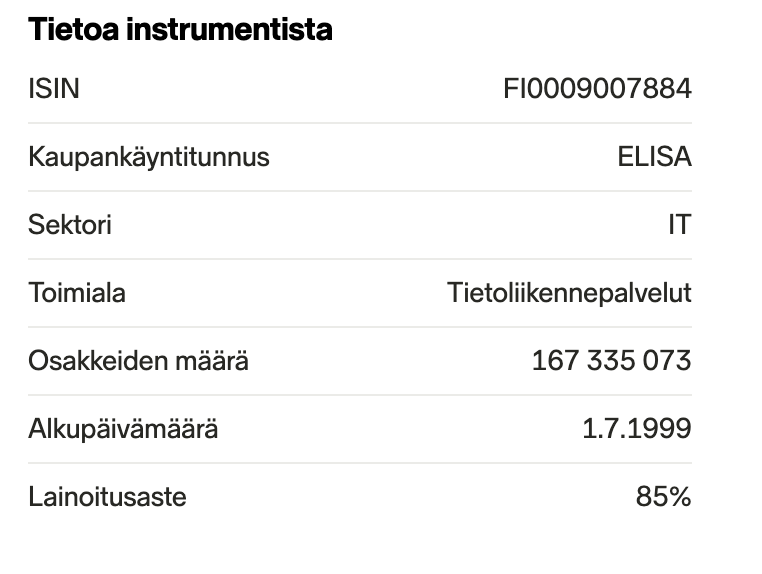
…of course, if you invest on credit, the papers bought on credit are also counted, meaning the maximum amount you can buy of Elisa against a thousand euros of capital is 1000/(1-0.85)=€6666.66.
3 Likes
I’ve had a 1-month Euribor on my mortgage for 10 years, and the margin is outrageously low. OP has started to get annoyed with this deal and has been very difficult if I’ve asked about an investment loan or any other banking matter, immediately demanding that I update my current mortgage to a more favorable form for them. Customer service has been really poor and inappropriate, so I will never do business with them again.
2 Likes
3.5% interest rate does sound really cheap for an unsecured loan. Compared to a secured loan, the interest rate is, of course, really high. I should ask the bank what interest rate I could get for an investment loan, for example, against a property. From what I’ve seen online, unsecured loans start from about 4%.
On OP’s website, I found that loan interest rates are in the range of 1-3%
https://www.op.fi/henkiloasiakkaat/lainat-ja-asunnot/sijoituslaina
Whereas an unsecured loan would be available starting from 4.5% interest: https://lainoittaja.fi/
What does “starting from” mean then? And what is the actual interest rate?
How does the taxation of an investment loan work otherwise? Can interest expenses be directly deducted in taxation as expenses for acquiring income?
Yes, they can be deducted from capital income.
I shared my own experience in the coffee room, which should not be repeated as is.
I asked about that myself within the last month or so, and at least to me it became clear that such a product doesn’t even exist. At least not at a level where the bank would have a reason to publicly advertise it to us ordinary stock savers.